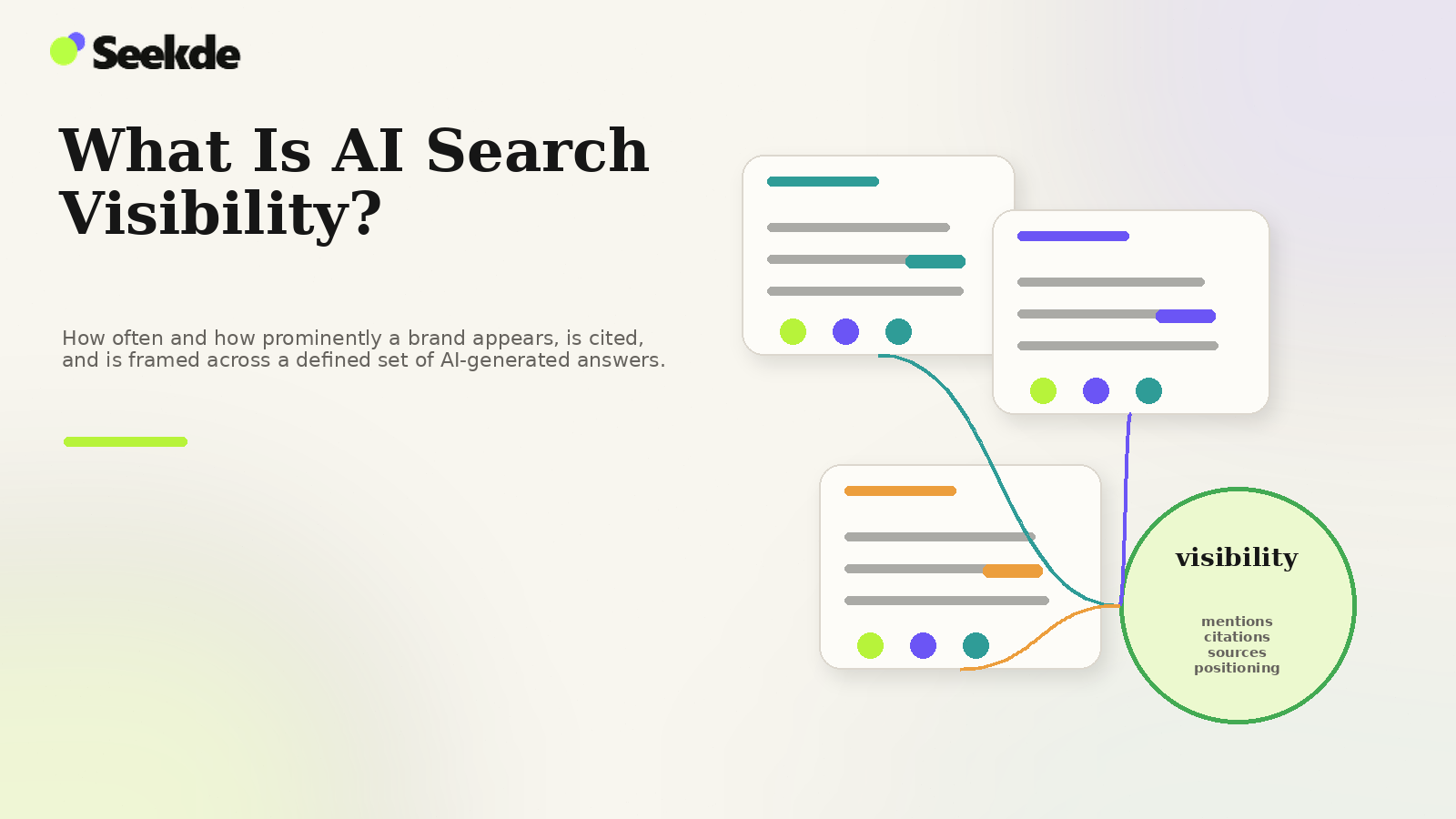
AI search visibility is the observable presence of a brand, website, product, or source across AI-generated answers. It can be measured through signals such as brand mentions, linked citations, recurring source inclusion, and contextual positioning across a defined prompt set and repeated runs. Unlike traditional search visibility, it should not be treated as one stable ranking position.
Unlike conventional search engine optimization—where visibility is quantified by keyword rankings on a static page of ten blue links—AI search visibility evaluates how often, in what context, and through which evidence pathways an entity is synthesized into real-time generative responses. It encompasses both explicit textual mentions within generated answers and hyperlinked source citations provided by platforms such as Google AI Overviews, Google AI Mode, ChatGPT Search, Perplexity, Microsoft Copilot, and Gemini.
Understanding AI search visibility involves moving past single-keyword rank tracking. Generative engines do not maintain fixed result slots; they dynamically retrieve, evaluate, rerank, and synthesize web documents into natural language summaries. Measuring this visibility demands new diagnostic metrics, clear distinctions between what can and cannot be observed, and a rigorous empirical approach to tracking probabilistic systems.
How AI Search Visibility Differs From Traditional Search Visibility
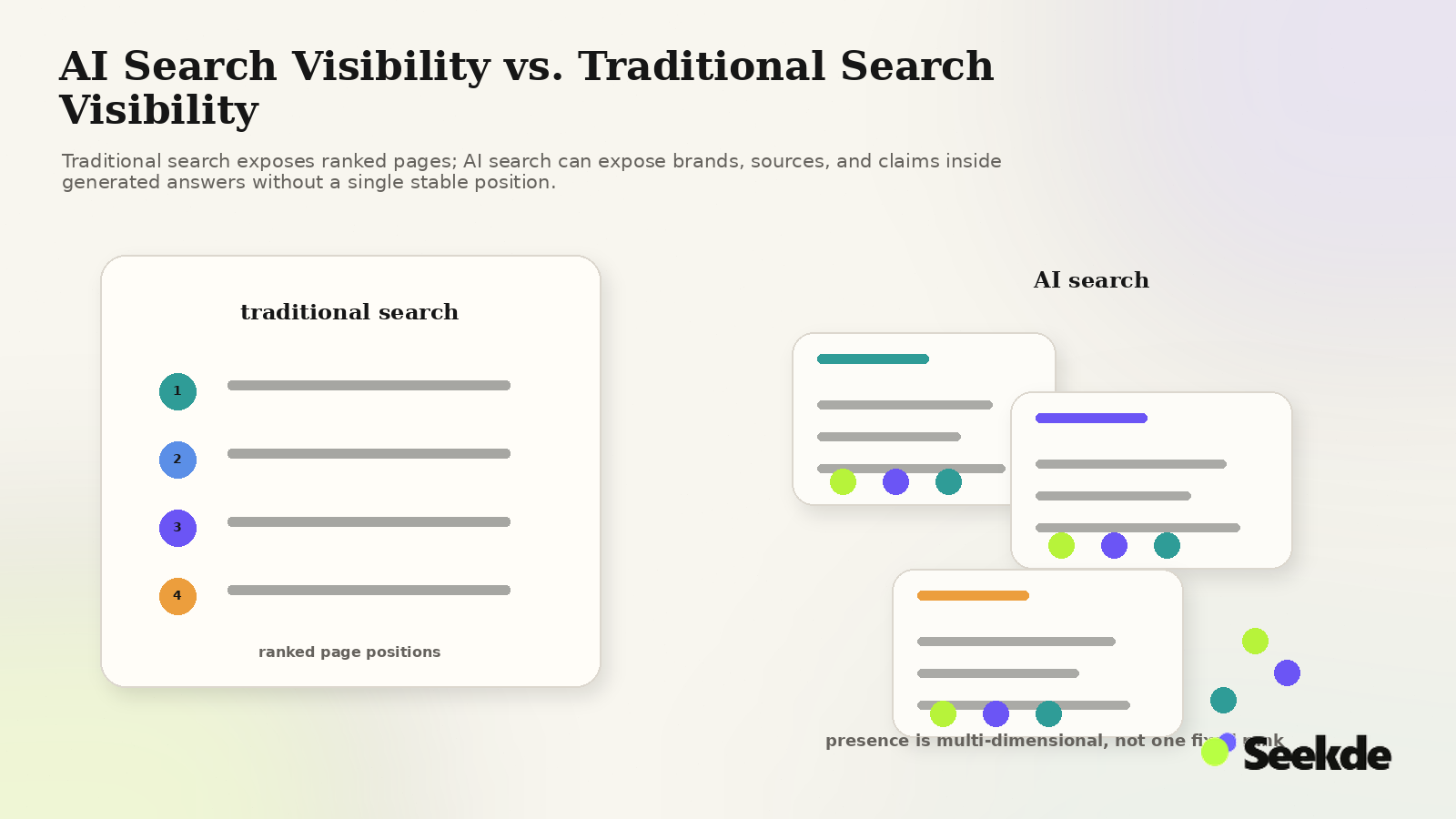
In traditional search engines, organic visibility is deterministic and position-based. A website targets a specific keyword, Google crawls and indexes the page, and the page is assigned a numerical rank (e.g., Position 1, Position 4) on the Search Engine Results Page (SERP). Impressions, click-through rates, and average positions can be tracked directly through tools like Google Search Console.
Generative answer engines break this linear paradigm. Instead of presenting a uniform list of sorted links, an AI engine interprets user intent, decomposes complex queries into multiple retrieval sub-queries, extracts relevant passages from across the web, and generates an original synthesized response.
| Dimension | Traditional Organic Search (SEO) | Generative AI Search (GEO / AEO) |
|---|---|---|
| Primary Metric | Numerical SERP position (Rank 1–10), CTR, Impressions | Mention Rate, Citation Rate, Share of Model (SoM) |
| Retrieval Architecture | Inverted keyword index with static link scoring | Retrieval-Augmented Generation (RAG) with vector search & neural rerankers |
| Output Presentation | Ranked list of page titles, snippets, and URLs | Synthesized natural language prose, inline citation badges, source carousels |
| Result Stability | Relatively stable between queries; changes via index updates | Stochastic and non-deterministic; can vary across identical prompts |
| Attribution Pathway | Direct user click on ranked snippet | Dual pathway: unlinked brand endorsement vs hyperlinked source citation |
| Optimization Focus | Page-level metadata, keyword placement, link equity | Passage-level information density, entity salience, verifiable claims |
Because an AI engine synthesizes information from dozens of disparate sources into a single narrative, a brand can achieve high visibility in several distinct ways. A company may be named as the leading solution in an industry roundup without having its website linked, or its research study may be cited as authoritative proof without the brand being recommended as a vendor. Traditional rank-tracking software completely misses these nuances.
The Four Observable Dimensions of AI Visibility
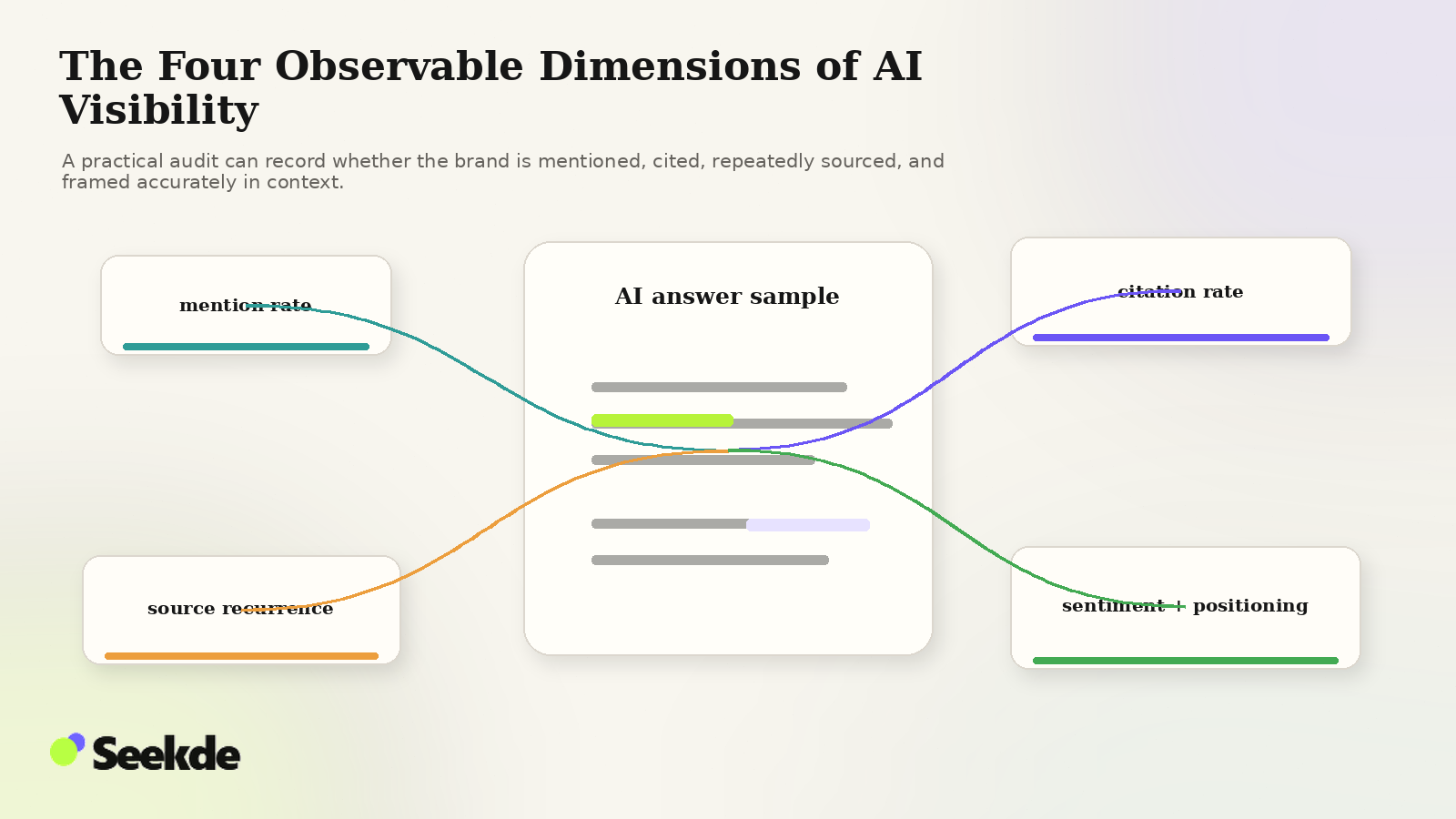
Evaluating an entity’s presence in generative search involves decomposing visibility into four distinct, observable signals:
% of prompt runs naming the entity in text
% of prompt runs hyperlinking domain URLs
Frequency of domain in reference carousels
Alignment with authoritative brand facts
1. Brand Mention Rate
The Brand Mention Rate measures the proportion of relevant prompt queries where an entity, product, or spokesperson is explicitly named within the generated prose.
For example, when a user asks, "What are the top enterprise project management platforms for distributed engineering teams?", does the AI include your platform in its recommended list?
A brand mention represents semantic recognition: the model’s underlying weights or retrieved context identify your organization as an authoritative entity within that topical domain. However, a mention does not guarantee that the engine will link to your website or that the description will be complete.
2. Hyperlinked Citation Rate
The Citation Rate measures how frequently an engine embeds an active, clickable hyperlink to your specific domain to support its generated statements.
In platforms like Perplexity or ChatGPT Search, citations appear as numbered brackets, inline badges, or source pills. Earning a citation is substantially more valuable than an unlinked mention:
- It drives qualified referral traffic directly to your web properties.
- It provides transparent factual attribution that users can verify.
- It indicates that the retrieval engine’s neural rerankers identified your specific URL as high-quality ground truth.
3. Source Inclusion Recurrence
Source inclusion recurrence tracks how often your domain appears in peripheral source lists, such as Google AI Overviews’ source carousel or Copilot’s reference drawer, regardless of whether your brand is directly recommended in the primary text.
Frequently, an AI engine will extract a statistic, definition, or technical specification from an authoritative guide to construct its answer while recommending third-party commercial tools. Monitoring source recurrence identifies whether your informational content is serving as foundational training or grounding data for the engine.
4. Contextual Sentiment and Positioning Accuracy
Visibility is counterproductive if an AI search engine presents outdated, inaccurate, or negative information about your brand. Generative engines are prone to synthetic hallucinations and outdated training associations.
Tracking contextual sentiment evaluates:
- Are product capabilities, pricing models, and technical specifications accurate?
- Is the brand associated with its current core value proposition or deprecated legacy offerings?
- Does the engine frame the brand as an industry leader, a budget alternative, or a niche specialist?
What Can Be Measured vs. What Cannot Be Observed
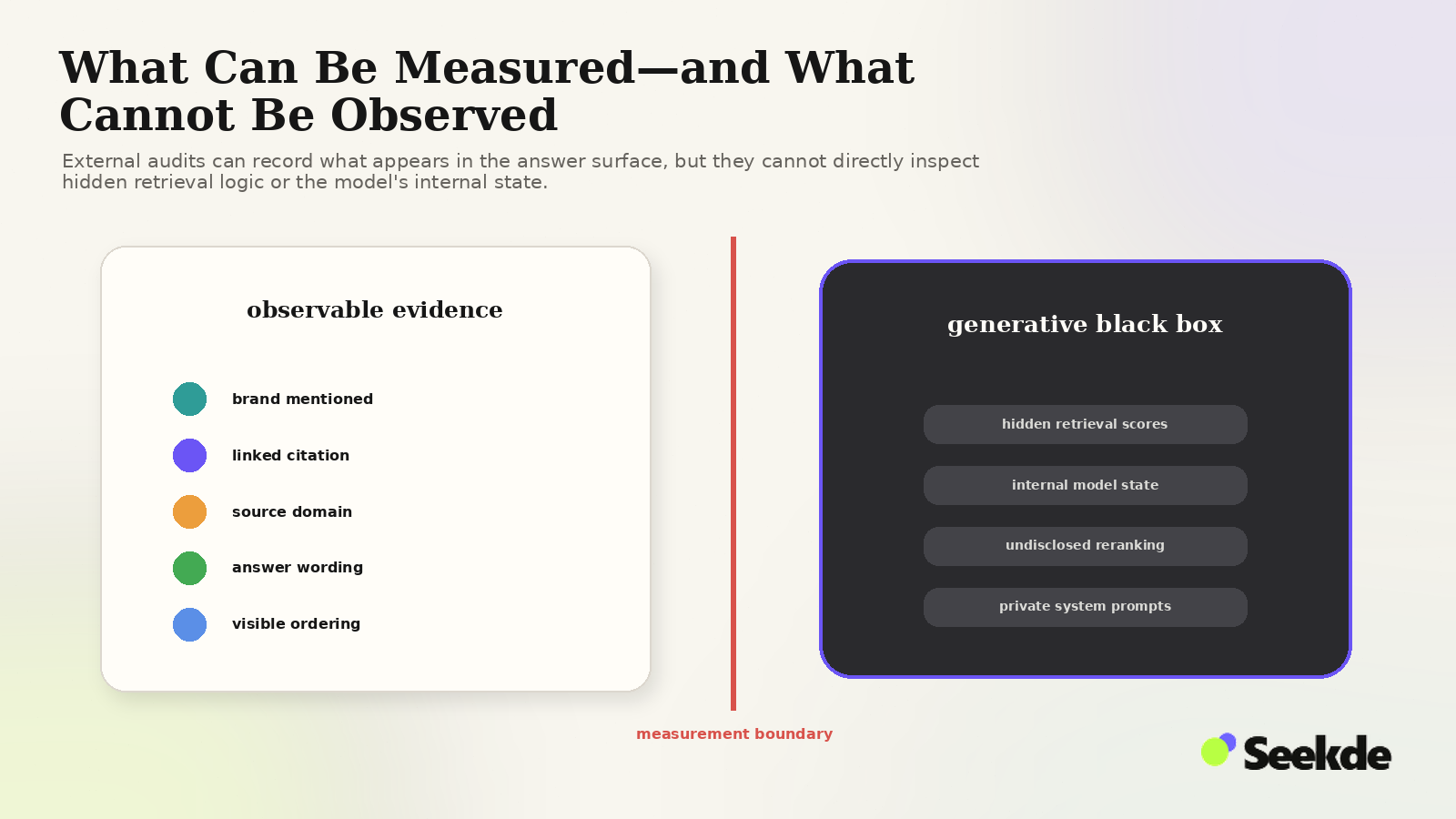
A foundational principle of Seekde’s research methodology is separating observable empirical evidence from internal algorithmic speculation. Because commercial AI engines are proprietary, closed systems, search practitioners must understand the boundaries of observability.
What Can Be Directly Measured (Observable Evidence)
- Rendered Output Text: The exact textual response returned by the model for a specific prompt at a specific timestamp.
- Rendered Citation Links: The exact URLs, root domains, and anchor text embedded in the response interface or reference drawer.
- Citation Placement and Layout: Whether a link appears as an inline reference, a top-level carousel card, or an expandable footnote.
- Outbound Referral Parameters: Tracking parameters appended to source links, such as OpenAI’s
utm_source=chatgpt.comparameter in ChatGPT Search. - On-Site Referral Analytics: Sessions, user journeys, and conversions originating from identifiable AI referrers recorded in web analytics platforms like Google Analytics 4.
- First-Party Search Telemetry: Verified generative impressions recorded in Search Console’s dedicated Generative AI performance report, alongside broader Search Performance clicks, total impressions, and position telemetry.
- Longitudinal Variance: How frequently answers, mentions, and source citations shift across repeated prompt executions over time.
What Cannot Be Observed Directly (The Generative "Black Box")
- Internal Model Weights and Token Probabilities: Publishers cannot inspect the raw logit scores or probabilistic distributions that determined why one token was chosen over another.
- Proprietary Reranking Weights: External observers cannot view the exact algorithmic weighting applied by proprietary cross-encoders during retrieval.
- Hidden Chain-of-Thought Reasoning: While some models display summarized reasoning steps, the complete internal inference trajectory remains inaccessible.
- Global Prompt Query Volumes: Unlike Google’s Keyword Planner, AI search platforms do not publish precise monthly search volumes for natural language conversational prompts.
- Unclicked Answer Views: Unless a user clicks an outbound citation link or scrolls a citation into the viewport, site owners cannot detect when their content was read inside an AI interface without specialized monitoring panels.
Recognizing these boundaries prevents organizations from investing in pseudo-scientific tracking tools that claim to reverse-engineer hidden algorithmic weights.
The Fallacy of a Single "Rank" in AI Search
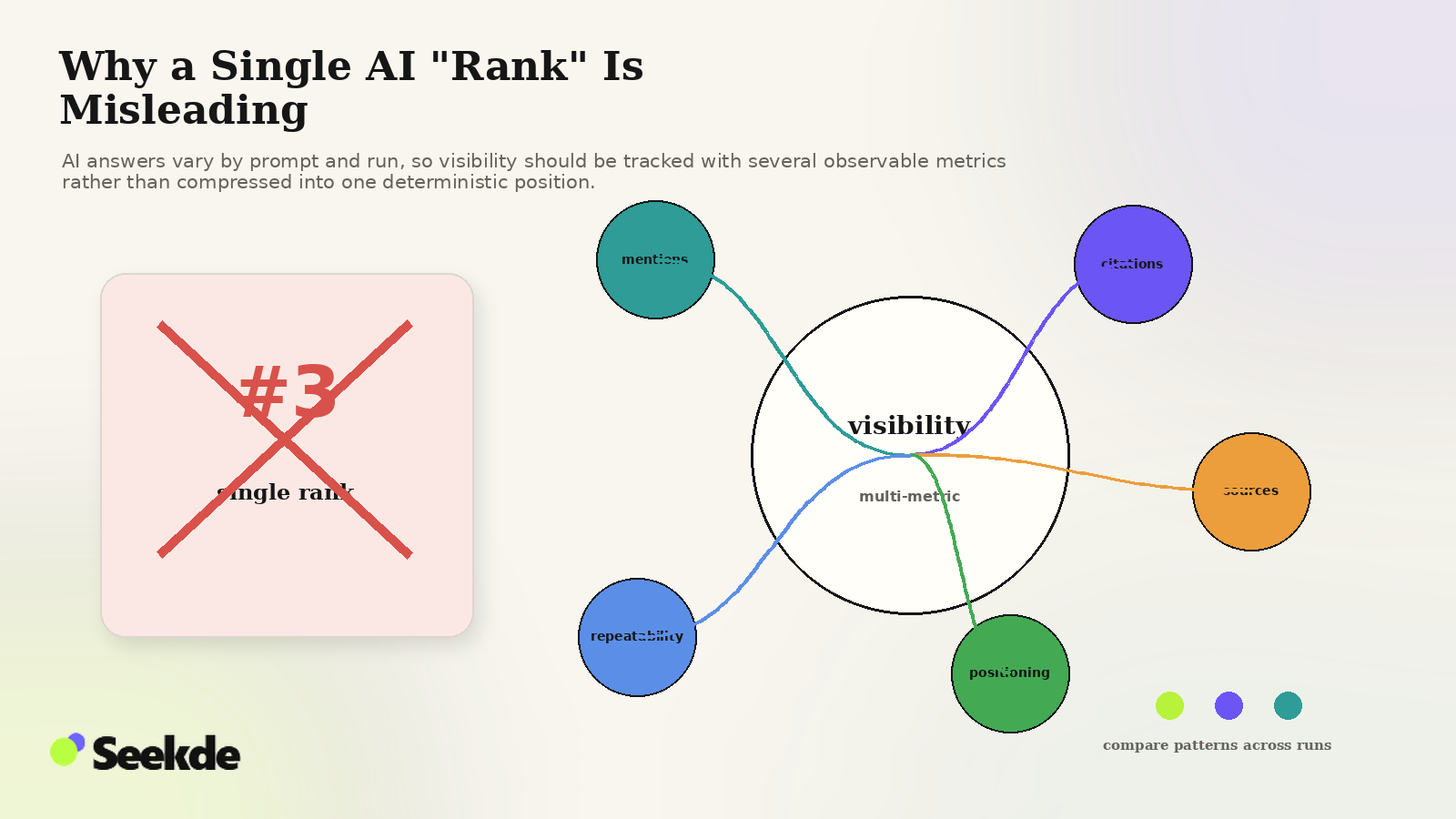
In legacy search engine tracking, rank-tracking tools query a keyword, record whether a URL sits at position 3 or 7, and compute an "Average Rank" metric. Applying this methodology to AI search creates misleading conclusions.
Generative engines do not operate on fixed slot mechanics:
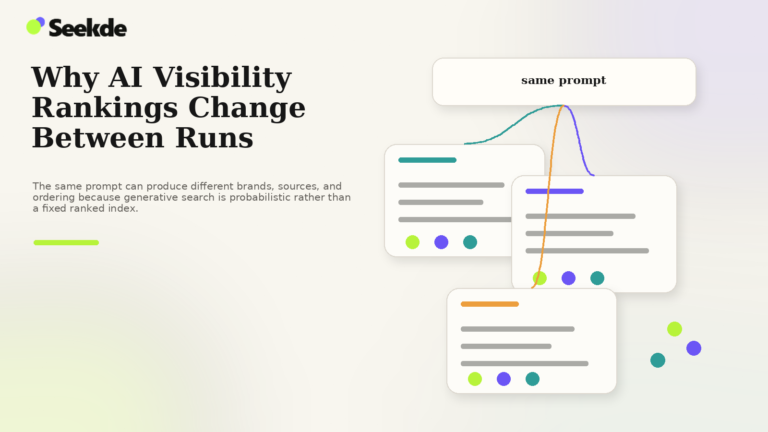
- Response Stochasticity: Because language models sample tokens probabilistically based on decoding parameters like temperature and top-$p$, two identical prompts executed seconds apart can return different syntheses. An engine may cite your URL on the first run, cite a competitor on the second run, and synthesize an answer without citations on the third run.
- Prompt Phrasing Sensitivity: Small syntactic variations in user input—such as "best CRM for marketing agencies" versus "which CRM do marketing agencies recommend?"—can trigger divergent query fan-out sub-queries, retrieving entirely different source sets.
- Conversational Multi-Turn Context: In conversational environments like Google AI Mode or ChatGPT, the engine’s answer is conditioned on previous conversational turns, user geographic location, and conversational memory, eliminating the concept of a single universal SERP.
Rather than pursuing a single static position in AI answers, visibility must be evaluated as an aggregate probability distribution across a structured corpus of representative prompts over time.
Seekde’s Measurement Framework: Diagnostic Multi-Metric Tracking
To provide reproducible, actionable intelligence, Seekde rejects opaque "composite visibility scores" that blend unrelated metrics into an arbitrary index. Instead, we advocate an unweighted, multi-metric diagnostic framework:
Unweighted Brand Mention Rate (%) =
  (Total Runs with Brand Mention / Total Valid Observed Prompt Runs) × 100

Unweighted Domain Citation Rate (%) =
  (Total Runs with Domain Citation / Total Valid Observed Prompt Runs) × 100

First-Party Citation Ratio (%) =
  (Runs with First-Party Citations / Total Runs with Any Brand Mention) × 100
By decoupling these metrics, marketing and technical teams can diagnose their exact operational bottlenecks:
| Observed Pattern | Diagnostic Meaning | Recommended Action |
|---|---|---|
| High Mentions, Low Citations | The engine recognizes the brand as an established entity, but relies on third-party reviews (e.g., G2, Reddit, media) for factual grounding. | Optimize first-party technical documentation, structured data, and extractable statistical claims to earn direct citations. |
| High Citations, Low Mentions | The engine cites your informational research or data, but does not recommend your commercial product as a solution. | Bridge informational authority to commercial solutions by connecting research reports to product use cases. |
| Low Mentions, Low Citations | The entity suffers from topical absence; crawlers may be blocked or the brand lacks topical salience in the retrieval corpus. | Audit technical crawler access (Robots.txt, Crawlability) and establish basic entity citations across trusted industry publications. |
| High Mentions, High Citations | Optimal generative search presence; the brand is endorsed and directly verified through first-party URLs. | Defend visibility by monitoring ranking volatility and tracking competitor displacement across rolling prompt sets. |
Operationalizing AI Search Visibility
Building an operational AI search visibility workflow calls for continuous coordination between technical SEO, content engineering, and analytics teams:
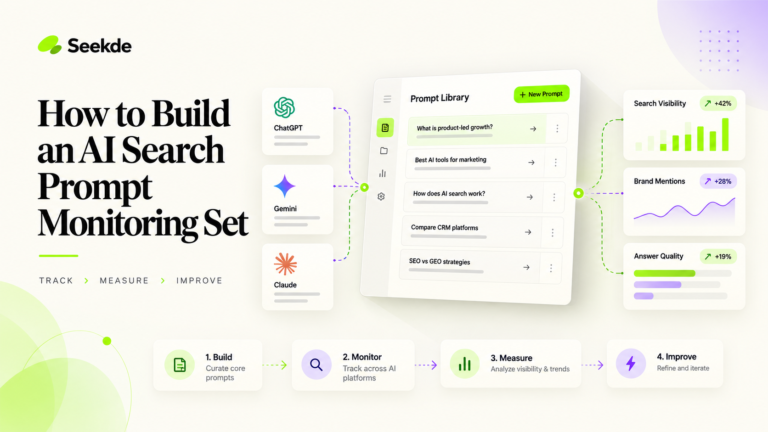
- Establish a Representative Prompt Monitoring Set: Develop an objective, multi-intent prompt library covering informational, commercial, comparative, and navigational queries as outlined in our guide on Building an AI Search Prompt Monitoring Set.
- Execute Longitudinal Observation Audits: Run repeated, unauthenticated prompt sampling across major generative platforms (Google AI Overviews, ChatGPT Search, Perplexity) to smooth out stochastic variance, as detailed in How to Measure Brand Visibility in AI Search.
- Benchmark Against Direct Competitors: Track competitive share using explicit denominators and transparent segmentation, following the principles in What Is AI Share of Voice?.
- Differentiate Mentions from Citations: Maintain strict reporting separation between unlinked brand awareness and clickable traffic pathways, as examined in AI Citations vs Brand Mentions.
- Monitor Ranking Volatility and Algorithmic Updates: Track how model updates, index refreshes, and temperature settings impact presence over time, as explained in Why AI Visibility Rankings Change Between Runs.
- Connect Search Presence to Web Analytics: Verify that generative visibility translates into actual referral traffic and business conversions by configuring GA4 ChatGPT Tracking and analyzing Search Console’s dedicated Generative AI Performance Report.