Perplexity finds and cites web sources through a mix of routine crawling and user-triggered retrieval, then surfaces selected sources inside grounded answers. For publishers, the practical SEO work is to keep important pages accessible, factually strong, clearly structured, semantically organized, and current enough to support a specific answer. Crawl access can improve eligibility, but it does not guarantee retrieval, ranking, or citation for any query.
For digital publishers, understanding Perplexity visibility requires separating technical crawler accessibility from editorial source selection, and keeping consumer search interfaces distinct from developer API infrastructure.
According to official Perplexity documentation on crawlers, the platform utilizes two distinct automated user-agents to interact with websites: an indexing search crawler and an on-demand, user-initiated retrieval agent. Configuring server infrastructure to recognize and handle these distinct bots is the foundation of Perplexity visibility.
The Dual-Agent Crawling Architecture
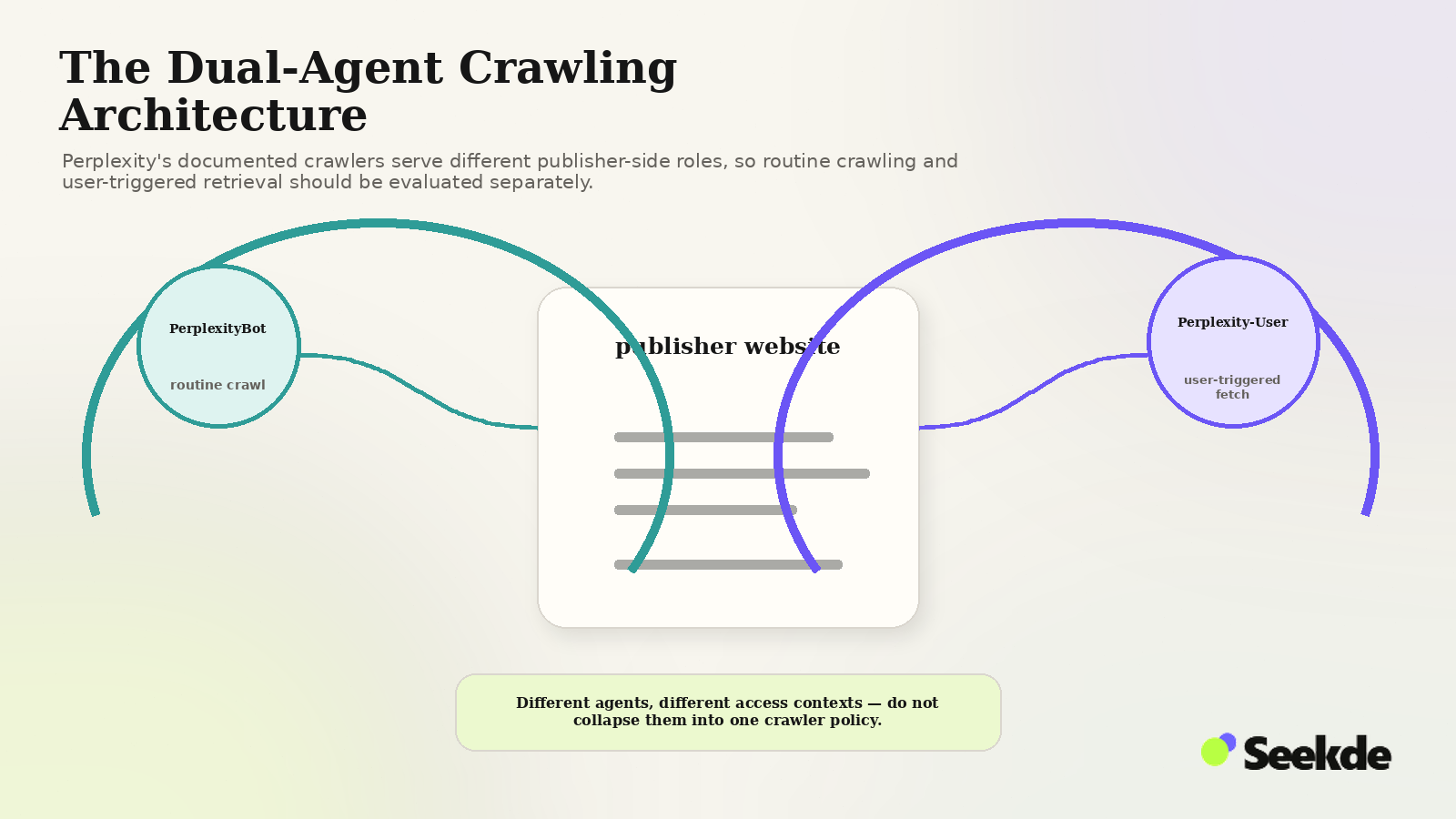
Publishers evaluating server logs must distinguish between Perplexity’s two automated access mechanisms:
| Dimension | PerplexityBot (Search Indexer) | Perplexity-User (Interactive Fetcher) |
|---|---|---|
| Operational Role | Automated search crawler used to discover, crawl, and index content for search results | On-demand fetcher activated when a user submits a prompt requiring live web data or URLs |
| Robots.txt Adherence | Perplexity documents PerplexityBot as its automated search crawler and recommends managing/allowing it through robots.txt |
Generally ignores robots.txt because the fetch is directly initiated by a user request |
| Execution Trigger | Automated crawling to build and refresh search index content | Immediate, on-demand fetch initiated by an interactive user prompt requiring web access |
| Training Use | PerplexityBot is designed to surface/link websites in search results and is not used to crawl content for AI foundation models | Perplexity-User supports user actions, is not a general web crawler, and is not used to collect content for AI foundation-model training |
| User-Agent String | PerplexityBot |
Perplexity-User |
To ensure Perplexity can index your public content for search, verify your root robots.txt configuration:
User-agent: PerplexityBot
Allow: /
Additionally, Perplexity publishes verified CIDR IP ranges for both bots. Infrastructure and security teams should configure Web Application Firewalls (WAFs) and anti-bot mitigation tools to allowlist these IP blocks, preventing automated challenges (such as Cloudflare Managed Challenges or CAPTCHAs) from blocking legitimate crawler access.
Surface Demarcation: Consumer Search vs. Developer API
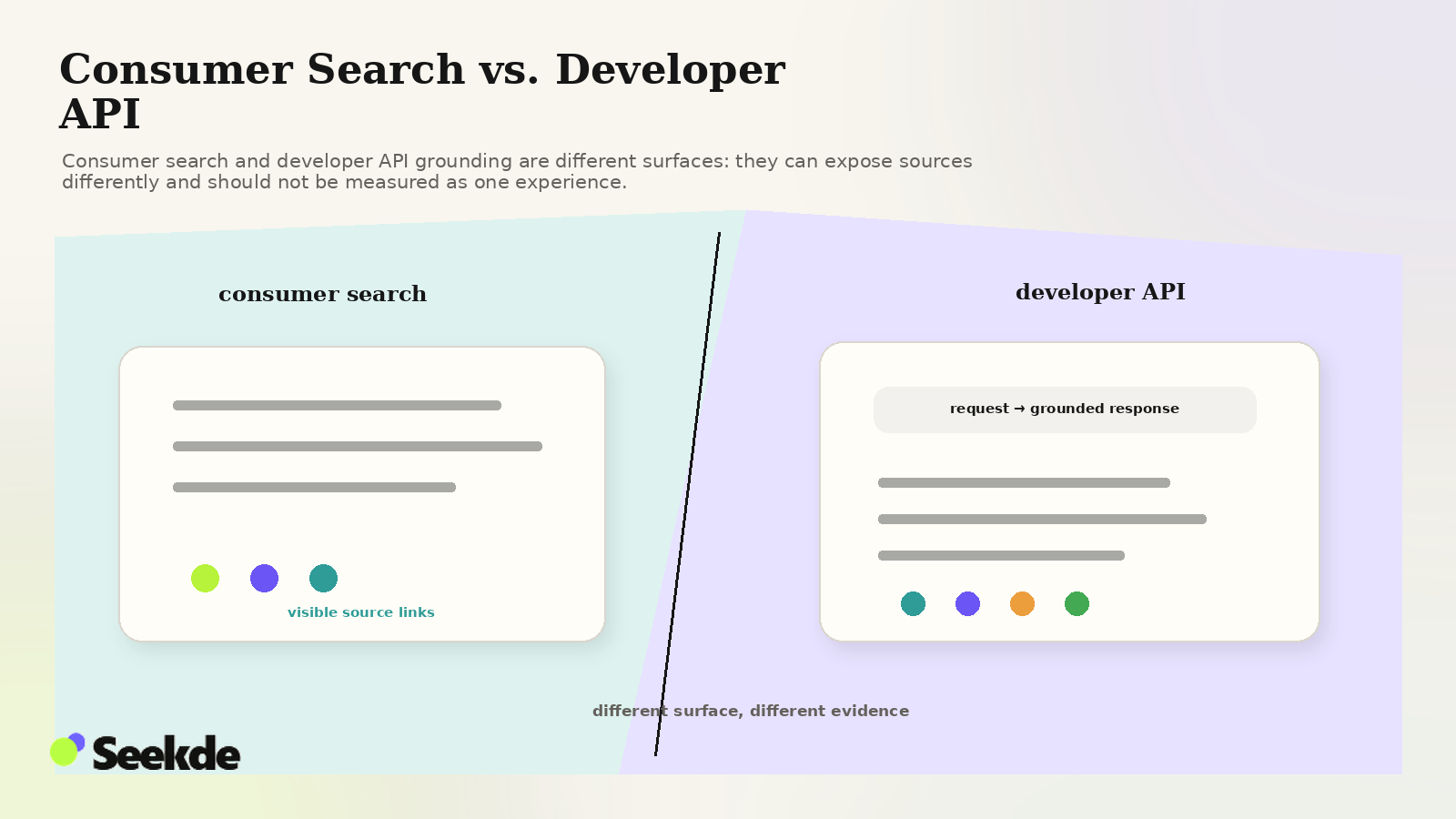
A critical governance requirement for publishers is keeping consumer Perplexity search separate from developer API architecture:
- Consumer Search Surface: The web and mobile interfaces at
perplexity.airepresent the consumer search product. Here, queries execute multi-source retrieval across the public internet, synthesizing answers with numbered inline citations and displaying a top source drawer. - Developer Agent API (Time-Sensitive): Perplexity provides an API ecosystem for enterprise developers. According to official Perplexity product documentation on the Agent API, legacy Sonar chat completion endpoints are scheduled for retirement on September 27, 2026, with programmatic workloads transitioning to the unified Agent API (subject to specific enterprise migration terms and contractual schedules).
While the Agent API handles programmatic multi-step agent workflows and model selection, it represents a distinct developer product. Marketers and SEO teams must not confuse backend API changelogs with consumer search engine ranking algorithms.
Seekde Editorial Recommendations for Perplexity Retrieval Readiness
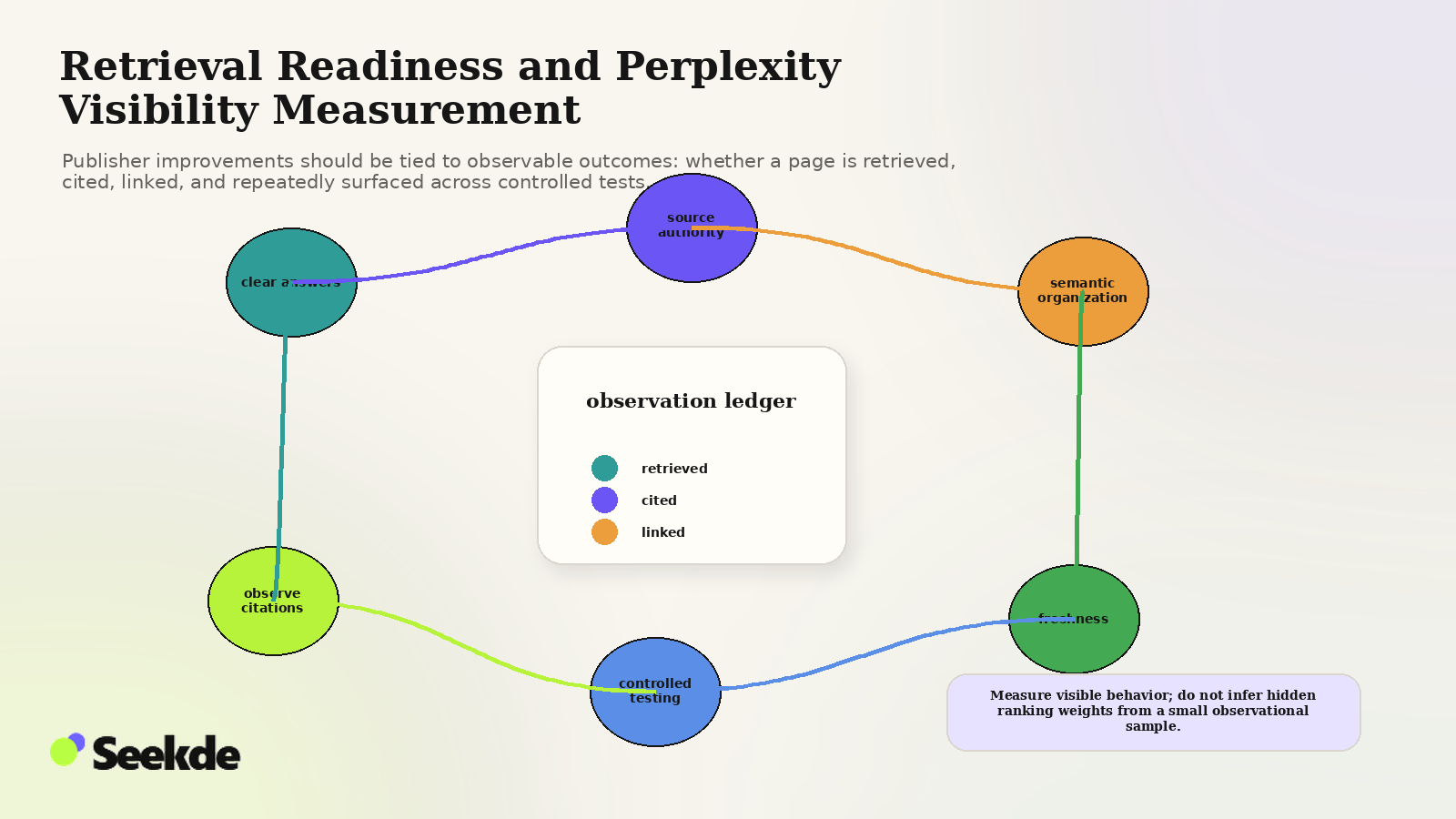
(SEEKDE EDITORIAL HEURISTICS — NOT PUBLISHED PERPLEXITY RANKING FACTORS)
Perplexity does not publish an algorithmic ranking formula for source inclusion. Based on answer engine synthesis mechanics, Seekde recommends the following content practices to maximize clarity and retrieval utility:
1. High Factual Density and Direct Answers
Structure passages to answer the core question directly and concisely upfront. Placing clear factual definitions at the start of sections aids both reader comprehension and automated passage extraction.
2. Primary Source Authority
When discussing technical specifications, benchmark data, or industry standards, cite and link primary evidence. Providing verifiable provenance strengthens factual reliability.
3. Clear Semantic Organization
Use explicit heading hierarchies (<h2>, <h3>), semantic data tables, and structured lists. Well-structured HTML allows retrieval systems to cleanly parse relevant context. To explore how answer engines parse web documents, see how AI search engines find and cite content.
4. Freshness for Fast-Moving Topics
For topics subject to frequent updates (such as software releases, API migrations, and pricing schedules), maintain clearly dated technical documentation and current changelogs to ensure readers and automated systems can verify temporal relevance.
Controlled Observational Evidence: Perplexity Search Testing
To observe Perplexity’s citation behavior across diverse subjects, Seekde conducted a controlled observational test suite across eight distinct queries (two informational, two technical, two commercial, and two time-sensitive) plus repeated verification runs.
| Query Category | Prompt Text | Referenced Sources Count | Inline Citations Rendered | Primary Observed Sourced Domains |
|---|---|---|---|---|
| Informational | “what is retrieval augmented generation in search” | 15 sources referenced | Numbered badges [1]-[5] | indexly.ai, andrew.cmu.edu, seohales.com, xseek.io |
| Informational | “how do search engines use large language models for answering questions” | 10 sources referenced | Numbered badges [1]-[2] | nature.com, perplexity.com |
| Technical | “how to block ai crawlers using robots txt” | 10 sources referenced | Numbered badges [1]-[4] | perplexity.com (compiled syntax guide) |
| Technical | “llms txt standard specification for ai agents” | 10 sources referenced | Numbered badges [1]-[3] | perplexity.com (standard specification summary) |
| Commercial / Comparison | “best enterprise search engines comparing elasticsearch and algolia” | 10 sources referenced | Numbered badges [1]-[4] | meilisearch.com, perplexity.com |
| Commercial / Comparison | “cloudflare vs fastly cdn edge caching performance and pricing” | 10 sources referenced | Numbered badges [1]-[4] | blog.blazingcdn.com, perplexity.com |
| Time-Sensitive | “latest news on google search console generative ai reporting” | 10 sources referenced | Numbered badges [1]-[3] | developers.google.com, perplexity.com |
| Time-Sensitive | “latest perplexity sonar model updates and agent api migration” | 10 sources referenced | Numbered badges [1]-[4] | community.perplexity.ai, perplexity.ai |
Observational Findings & Methodology Limitations
(Seekde Controlled Observational Sample — September 2026)
- Observed Sourcing Breadth: In Seekde’s controlled sample, Perplexity surfaced and referenced approximately 10–15 sources on the observed queries. The interface synthesized unified multi-paragraph summaries featuring numbered bracket citations (
[1],[2]) that linked directly to source drawers displaying destination page titles, snippets, and favicons. - Observed Source-Type Distribution: Across the test queries, cited sources spanned a diverse cross-section of publication types:
- Official vendor documentation (
docs.perplexity.ai,developers.google.com). - Peer-reviewed academic publications (
nature.com,andrew.cmu.edu). - Specialized technical software blogs and comparative benchmarks (
meilisearch.com,blog.blazingcdn.com). - Industry news publications and agency analyses.
- Official vendor documentation (
- Mandatory Sample Qualification: This distribution represents a SEEKDE CONTROLLED OBSERVATIONAL SAMPLE and does NOT establish a PLATFORM-WIDE SOURCE PREFERENCE. Seekde does not infer that Perplexity algorithmically prefers technical sites, prioritizes documentation over editorial media, or assigns higher ranking weight to any specific publishing category.
- Methodological Note on Guest Sessions: During repeated testing in unauthenticated guest sessions, Perplexity presented a rate-limit modal ("Sign up and repeat your request") after approximately eight consecutive queries. This observation is noted purely as technical methodology context regarding guest session parameters; it is not an algorithmic ranking factor.
For full query logs, timestamps, and capture paths, consult our research methodology archive.
Measuring and Monitoring Perplexity Visibility
To build an empirical measurement practice for Perplexity:
- Track Non-Branded Category Prompts: Measure brand presence across informational, comparison, and alternative prompts to gauge topical authority.
- Monitor Sourced Competitors: For queries where your brand is absent, audit the domains Perplexity cites. Analyze whether competitors provide deeper technical data, more transparent pricing, or superior primary evidence.
- Inspect Referral Traffic: Segment incoming traffic from
perplexity.aiin web analytics to measure user engagement and conversion performance. - Avoid Low-Value Tactics: Do not publish hundreds of thin prompt-variant pages or attempt to manipulate citation cards with unverified claims. Robust visibility aligns with Generative Engine Optimization (GEO) and Answer Engine Optimization (AEO) principles.
Internal References & Reading
- What Is Generative Engine Optimization (GEO)?
- What Is Answer Engine Optimization (AEO)?
- GEO vs SEO vs AEO: Architectural Comparison
- How AI Search Engines Find and Cite Content
- ChatGPT Search SEO: How to Improve Website Visibility
- Google AI Overviews SEO: Complete Guide
- Seekde Research Methodology & Evidence Standards