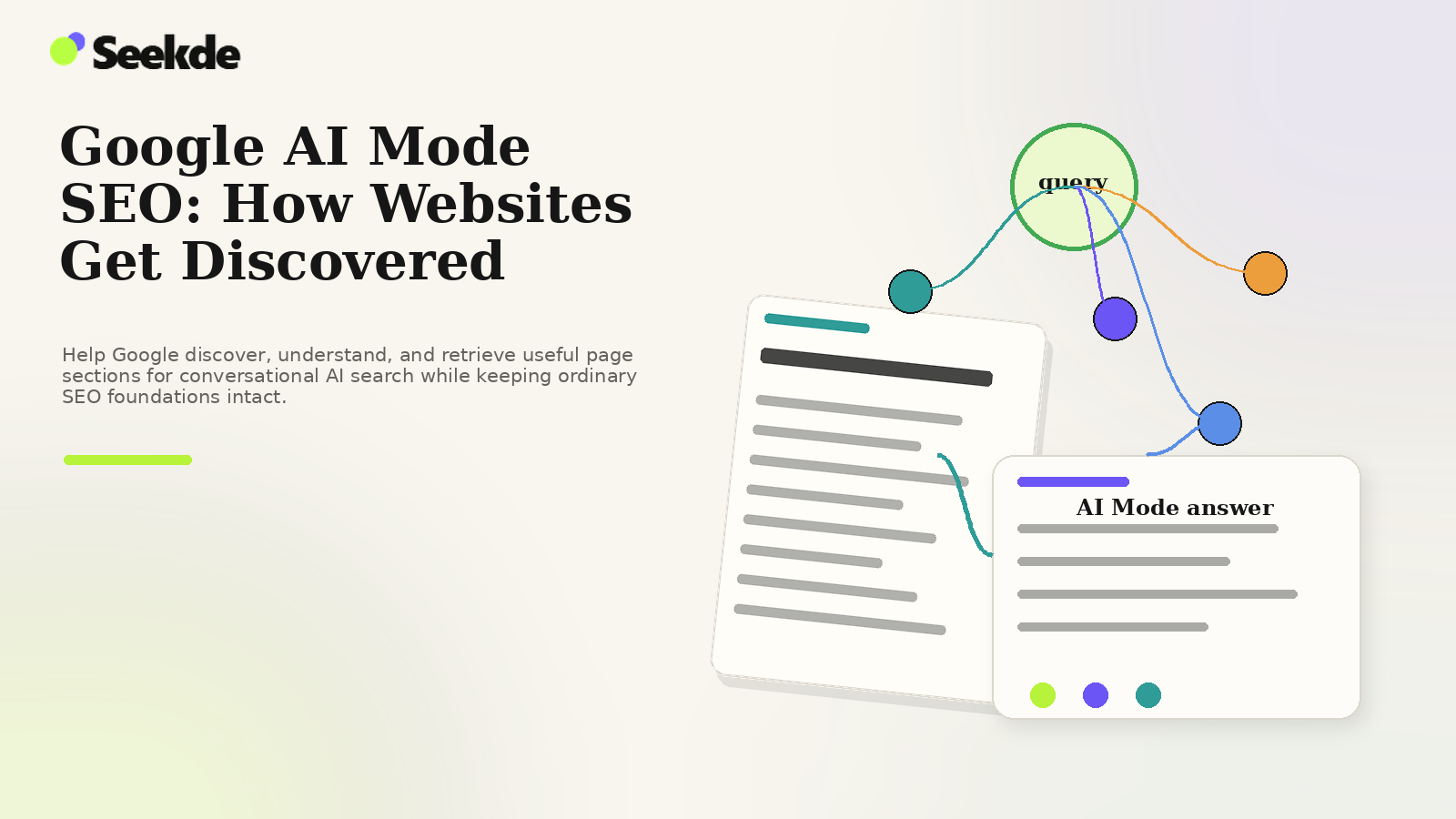
Google AI Mode discovers websites through Google’s ordinary crawling and indexing systems, then uses conversational query expansion and web retrieval to assemble AI-generated answers from useful sources. To improve discovery, keep important pages crawlable and indexable, make facts easy to extract, publish distinct first-hand or primary information where possible, and structure related sections so they can support follow-up questions without duplicating or contradicting one another.
While Google AI Overviews summarize search results above standard organic links for isolated queries, AI Mode provides a dedicated conversational environment accessible via the search navigation bar. Despite this conversational interface, Google’s technical requirements remain rooted in web standards: pages must be crawled and indexed by Googlebot, return valid responses, and meet ordinary snippet eligibility criteria.
To evaluate visibility in AI Mode, content teams must recognize how conversational search journeys unfold. Users do not simply enter an isolated keyword; they ask broad preliminary questions, apply progressive technical or commercial constraints, request side-by-side comparisons, and explore related subtopics. To succeed, websites must structure their content to remain relevant across an evolving multi-turn dialogue.
Architectural Boundary: AI Overviews vs. AI Mode
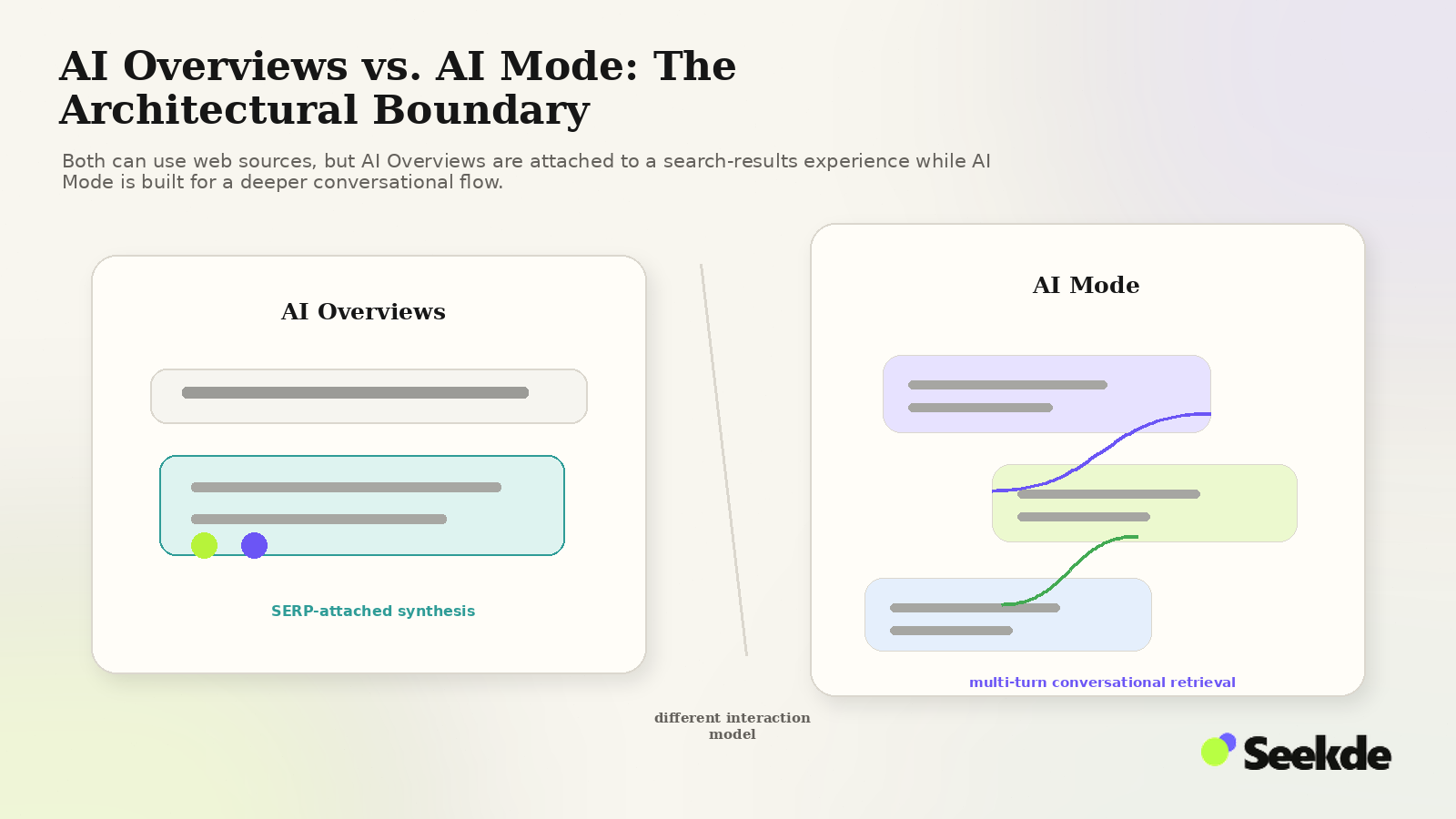
A common point of confusion is treating all generative Google features as an identical technical surface. The user journey, retrieval requirements, and interface behavior differ fundamentally between standard SERP overviews and dedicated AI Mode sessions.
| Dimension | Google AI Overviews (Map 17) | Google AI Mode (Map 18) |
|---|---|---|
| Primary Surface | Embedded atop the standard Google SERP alongside traditional organic results | Dedicated conversational interface accessible via the “AI Mode” tab in Google Search |
| Interaction Model | Generated response embedded in Search results; may use query fan-out depending on the query | Multi-turn conversational dialogue with progressive constraint refinement |
| Context Persistence | Standard AI Overview is not presented as a dedicated multi-turn chat; on supported surfaces users can transition into AI Mode and continue with the original search context | Session-aware; retains dialogue context and entities across sequential turns |
| Supporting Sources | Inline citation badges paired with a static right-rail card carousel | Dynamic right-rail source cards and in-text citation pills that update per turn |
| Technical Prerequisite | Googlebot indexing and snippet eligibility (no custom markup required) | Standard Googlebot indexing and snippet eligibility (shared Search index) |
As documented in official Google Help and product announcements, AI Mode builds on Google’s core Search indexing infrastructure. There is no proprietary "AI Mode feed" or custom schema required to become discoverable.
How Conversational Sourcing Operates: Mechanisms vs. Observations
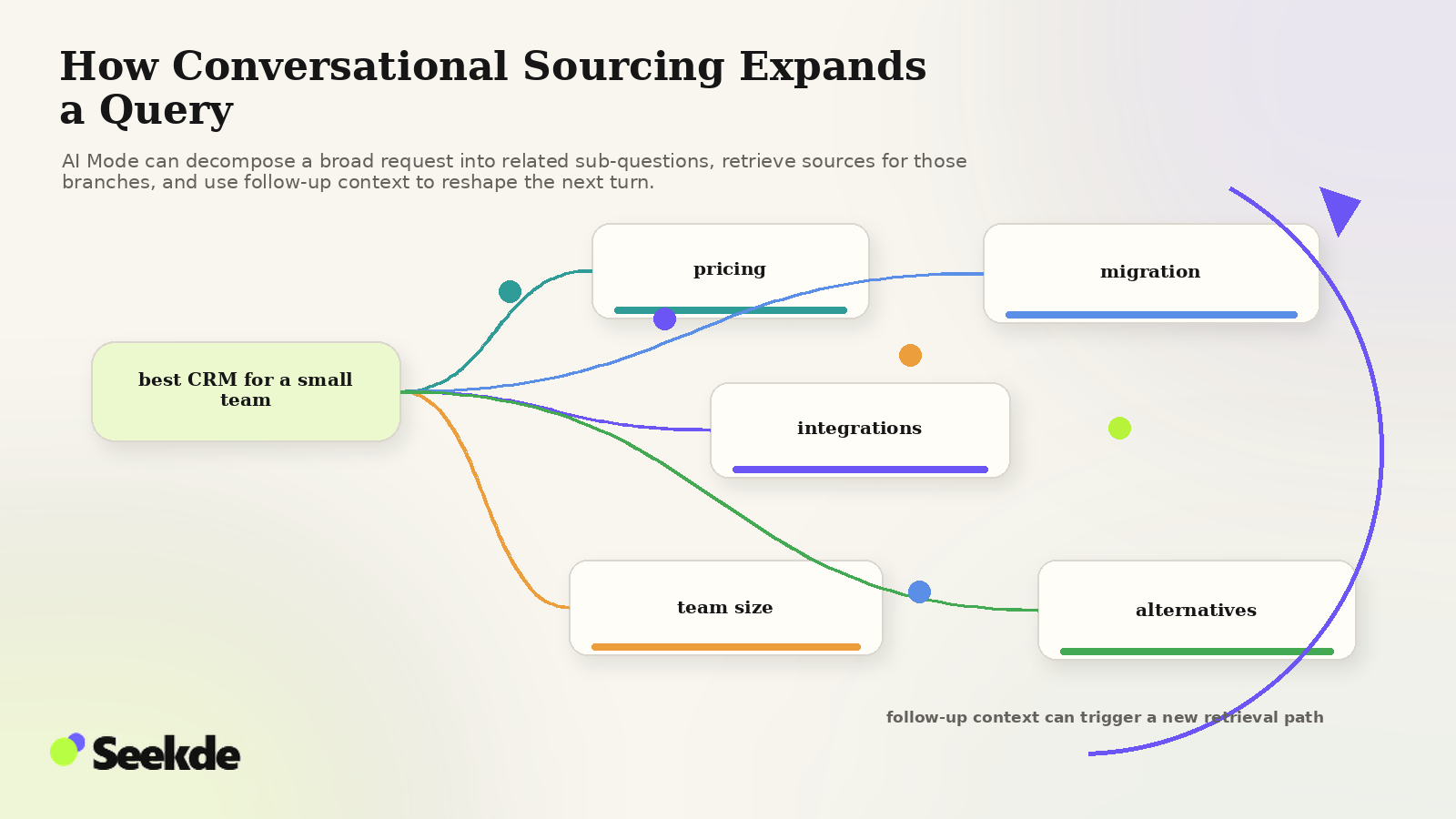
When analyzing how websites get discovered in AI Mode, it is essential to distinguish between documented platform mechanisms (published by Google) and observed user-surface behaviors (recorded in testing).
Documented Mechanism: Conversational Query Fan-Out
In its documentation, Google describes generative search features as utilizing query fan-out. When a user engages with AI Mode, the underlying system can divide complex multi-part prompts into simultaneous sub-queries directed at specialized indexes, technical datasets, and web documents. Users can ask follow-up questions that explore related subtopics.
Observed User-Surface Behavior
In controlled testing, this mechanism manifests as dynamic source updates:
- Turn 1: A broad introductory prompt surfaces general high-authority domain hubs and definitional articles.
- Turn 2: Adding a specific technical constraint (such as crawler directives or code syntax) shifts visible source cards toward specialized developer documentation.
- Turn 3: Introducing comparative criteria (such as pricing or competing platforms) causes the interface to synthesize comparative tables citing independent review blogs and technical benchmarks.
In testing, visible source adaptation was consistent with the newly introduced constraints and Google’s documented query-fan-out behavior; the observations do not establish the proprietary internal ranking path.
Technical Foundations for Conversational Discovery
Because AI Mode draws from Google’s standard Search index, technical health is the non-negotiable gateway to discovery:
- Unimpeded Googlebot Crawling: Pages must be accessible to Googlebot. Disallowing crawlers in
robots.txtor blocking traffic via security firewalls prevents inclusion entirely. - Accessible Renderable Content: Important content must be accessible to Google and available in a form Google can render and process. Server-side rendering can simplify accessibility but is not an AI Mode eligibility requirement.
- Consistent Entity Information (Seekde Editorial Hygiene Recommendation): Maintaining factual consistency across your domain—such as synchronized dates, product names, and pricing tiers—prevents contradictory facts from degrading user utility. Maintaining a single canonical page for key specifications is a sound editorial hygiene practice, though Google does not publish a rule that conflicting pages trigger domain omission.
- Crawlable Internal Link Hierarchy: Maintain descriptive, crawlable internal links between broad topic hubs and granular technical spokes. When AI Mode fans out into sub-queries, structured internal links help search systems traverse related resources. For a complete look at this architecture, see our guide on how AI search engines find and cite content.
Controlled Observational Evidence: Multi-Turn Testing
To evaluate how Google AI Mode handles multi-turn sessions in practice, Seekde executed four controlled conversational sequences (three progressive turns each, totaling 12 observed turns) across diverse query categories.
| Sequence & Category | Turn Progression & Prompts | Observed Answer Behavior | Visible Sourced Domains |
|---|---|---|---|
| Seq 1: Informational |
T1: “what is generative engine optimization” T2: “focus specifically on technical crawlability and robots.txt” T3: “compare how this differs between Google and ChatGPT Search” |
Turn 2 retained Turn 1 context, narrowing the general GEO definition to crawl parameters. Turn 3 synthesized a structured comparative table evaluating bot handling between platforms. |
T1: coursera.org, wikipedia.org, seerinteractive.com T2: salesforce.com, vendasta.com, coursera.org T3: seerinteractive.com, salesforce.com |
| Seq 2: Technical |
T1: “how do ai search engines handle robots.txt and crawler user agents” T2: “explain the difference between search index bots and model training bots” T3: “provide exact robots.txt syntax examples for openai perplexity and google extended” |
Turn 2 expanded upon the crawler taxonomy introduced in Turn 1. Turn 3 synthesized valid syntax code blocks directly addressing the requested bot tokens. |
T1: openai.com, glasp.co, youtube.com T2: openai.com, youtube.com T3: openai.com, perplexity.ai, developers.google.com |
| Seq 3: Commercial |
T1: “best tools to track brand citations in ai search engines” T2: “focus on platforms that track perplexity and chatgpt search” T3: “compare pricing and enterprise api support between them” |
Turn 2 successfully filtered the broad toolset from Turn 1 to specific platforms. Turn 3 generated a comparative pricing breakdown and API capability matrix. |
T1: coursera.org, seerinteractive.com, frase.io T2: seerinteractive.com, frase.io, salesforce.com T3: seerinteractive.com, salesforce.com |
| Seq 4: Time-Sensitive |
T1: “google search console generative ai performance report features” T2: “how to filter impressions by ai overviews vs ai mode” T3: “what export options and api metrics are available in 2026” |
Turn 2 provided operational guidance on Search Console search appearance filters. Turn 3 detailed BigQuery bulk exports and Search Analytics API dimensions. |
T1: support.google.com, searchenginejournal.com T2: support.google.com, developers.google.com T3: developers.google.com, support.google.com |
Observational Findings & Methodology Limitations
(Seekde Controlled Observational Sample — September 2026)
- Context Retention Verified by Content: In all four sequences, semantic context was retained across turns. The system did not treat follow-up prompts as disconnected questions; instead, generated answers explicitly built upon prior conversational context (for example, applying the "robots.txt" constraint in Sequence 1 to the previously defined GEO framework). While specific technical session parameters (such as
&atvm=2) have been observed in exploratory testing, context retention was proven by the coherent substantive continuity of the generated responses. - Dynamic Source Adaptation: Visible citations and right-rail cards adapted dynamically as conversational constraints were introduced. Across the sequences, general educational and trade publications were cited for high-level concepts, while specific technical constraints triggered documentation links from official developer domains (
developers.google.com,openai.com,perplexity.ai). - Surface Distinctions: AI Mode consistently formatted complex follow-ups using structured comparison lists and syntax callouts, distinct from the shorter summary cards typical of standard AI Overviews.
Detailed logs and query traces are maintained in our research methodology repository.
The Multi-Turn Content Strategy
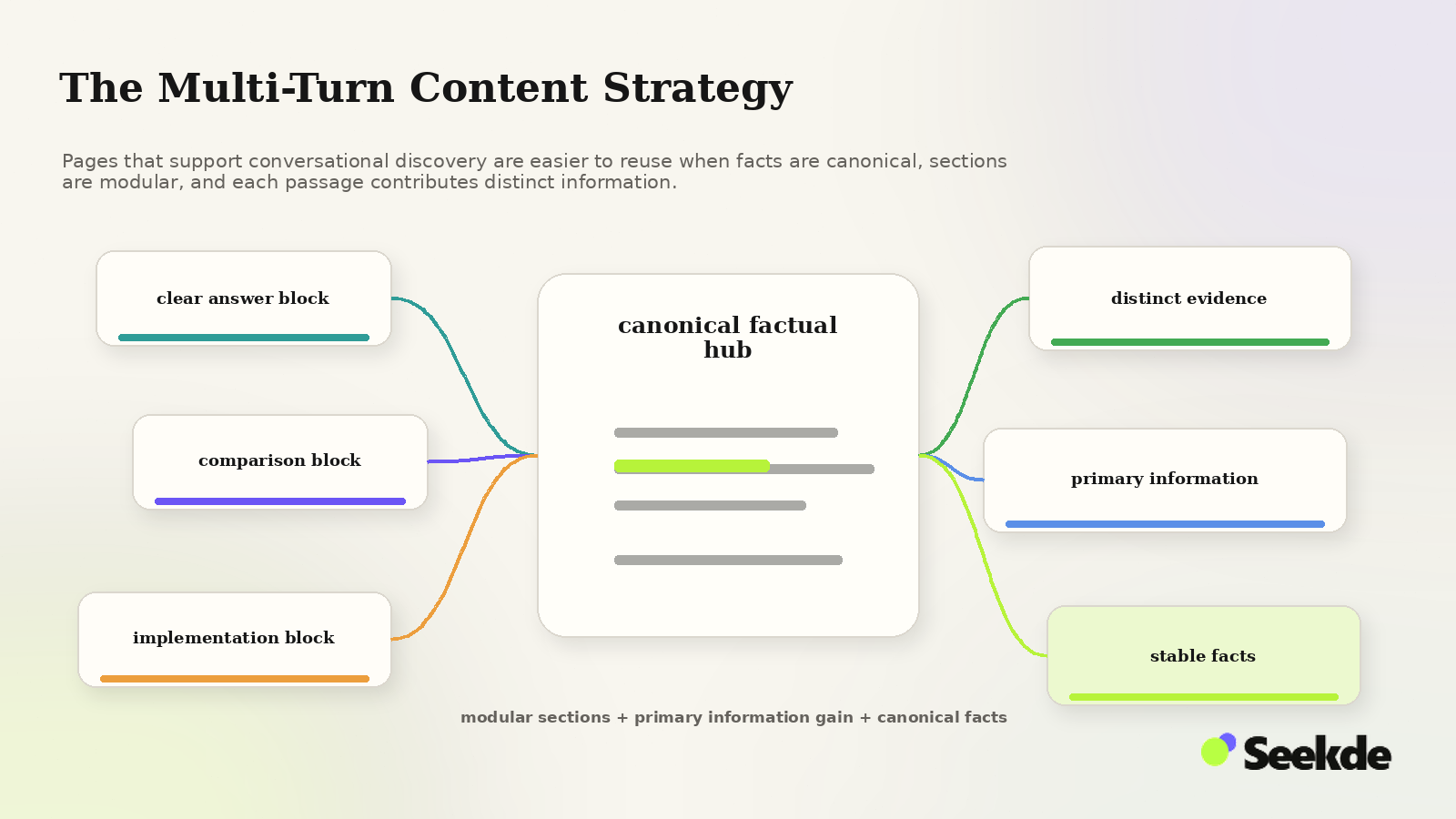
Optimizing for conversational discovery involves moving beyond single-article keyword targeting:
1. Build Modular Content Architecture
Because conversational searches touch multiple facets of a subject, develop content as an interconnected hub:
- Foundational Guide: Clear explanations of core definitions and frameworks (e.g., What is Answer Engine Optimization?).
- Tactical Implementation: Detailed setup instructions, code snippets, and configuration rules.
- Comparative Analysis: Honest evaluations of competing approaches, tools, or products with objective criteria.
2. Emphasize Primary Information Gain
Original research, firsthand evidence, current specifications, benchmarks, and other non-commodity content can provide users with distinctive value and align with Google’s people-first and non-commodity content guidance. Publishing unique data does not provide a citation guarantee, but it ensures your content contributes genuine information gain rather than repeating generic definitions.
3. Maintain Canonical Factual Hubs
Contradictory facts on your own website create ambiguity for users and automated evaluation systems. While Google does not publish a mechanism stating that factual variations cause brand omission, establishing a single authoritative page for specifications and regularly auditing legacy claims is sound editorial hygiene.
Internal References & Reading
- Google AI Overviews SEO: Complete Guide
- What Is Generative Engine Optimization (GEO)?
- What Is Answer Engine Optimization (AEO)?
- GEO vs SEO vs AEO: Architectural Comparison
- Understanding Query Fan-Out in AI Search
- Search Links to Generated Answers: The Traffic Shift
- Seekde Research Methodology & Evidence Standards