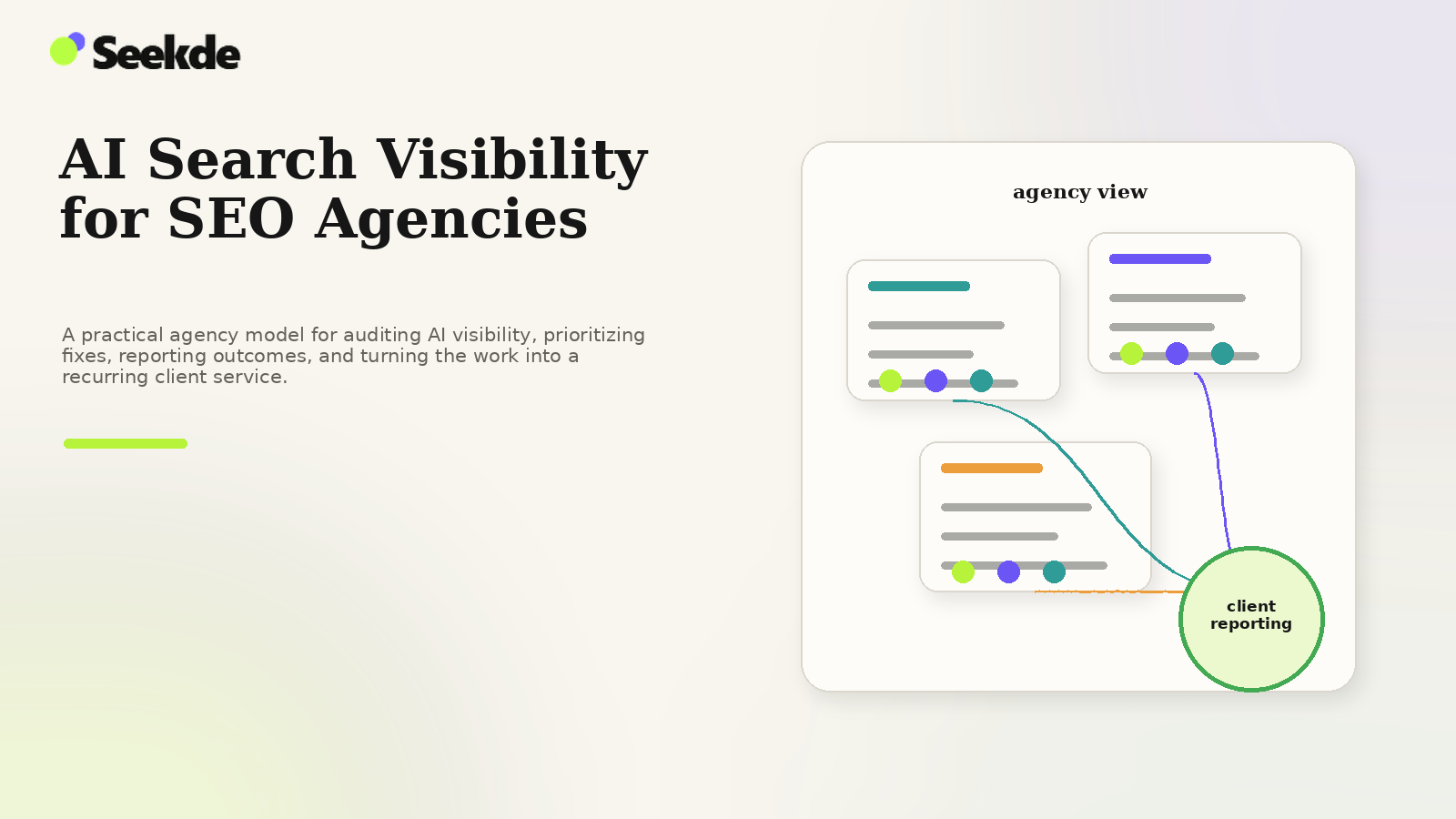
AI search visibility for SEO agencies is the commercial practice of packaging, pricing, executing, and reporting generative engine optimization (GEO) services to enterprise and mid-market clients without making unscientific ranking guarantees. As brand stakeholders observe consumer traffic fragmenting across Google AI Overviews, ChatGPT Search, Perplexity, and Microsoft Copilot, agency executives face growing client demand for generative visibility solutions.
However, agencies that attempt to sell AI optimization using legacy search ranking models—promising "guaranteed #1 ChatGPT rankings" or charging monthly retainers for undifferentiated keyword stuffing—frequently suffer high client churn, eroded operating margins, and reputational friction when probabilistic engines inevitably vary their outputs.
Sustainable agency profitability in AI search calls for a mature operating model built upon empirical measurement, systematic gap diagnosis, hypothesis-driven remediation, and transparent probabilistic reporting. This playbook provides agency founders, practice leads, and account directors with an end-to-end framework for establishing a scalable AI search visibility practice.
The Agency Operating Model: The 4-Phase Client Lifecycle
Successful agencies structure generative visibility engagements into a recurring, iterative lifecycle that separates ongoing data monitoring from strategic editorial and technical execution:
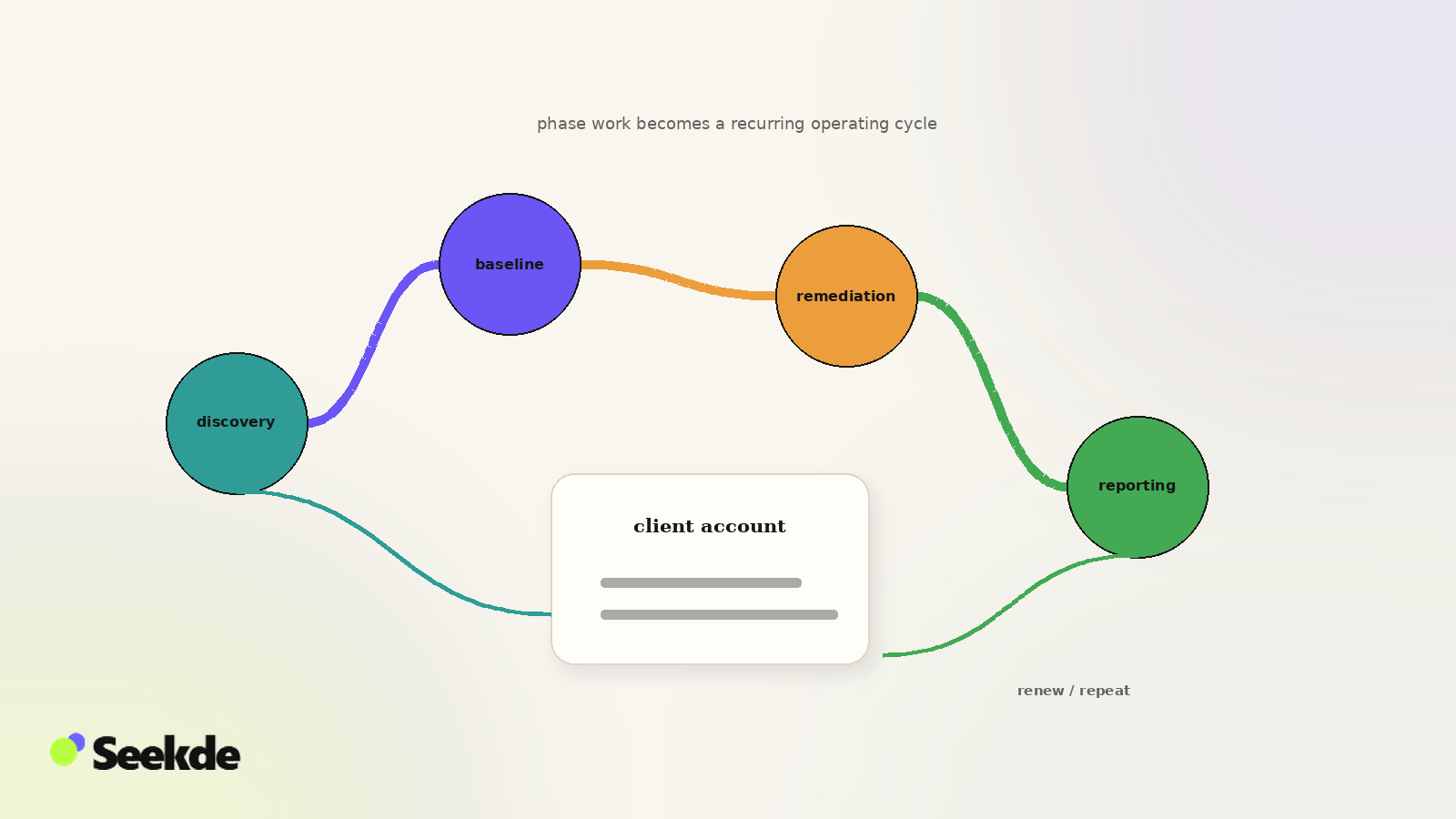
Stratified prompt set mapping, competitor set definition, and entity modeling.
Technical retrieval blockers, entity gaps, third-party review audits, and noise filtering.
Hypothesis-driven experiments across semantic HTML tables, schema, and digital PR.
Brand Mention Rate (BMR), Source Citation Rate (SCR), and assisted conversions.
Phase 1: Discovery, Entity Onboarding, and Prompt Set Architecture
The onboarding phase establishes the empirical baseline against which all agency progress is measured. Rushing directly into content rewrites without establishing a documented baseline prevents the agency from demonstrating downstream commercial value.
1. Entity and Competitive Universe Mapping
- Client Entity Definition: Document canonical corporate names, parent brands, product sub-brands, executive spokespersons, and official web properties. Verify how knowledge graphs (Wikidata, Google Knowledge Graph) currently represent the client.
- Competitor Set Definition: Establish a standardized list of 3 to 5 direct commercial competitors and 2 to 3 editorial/aggregator domains that dominate target category queries.
2. Stratified Prompt-Set Design
Do not allow clients to evaluate visibility based on arbitrary, ad-hoc conversational queries entered by their executive team. Build a structured, version-controlled prompt set containing 25 to 100 queries across five distinct commercial intents:
| Prompt Intent Category | Purpose & Buyer Mindset | Example Client Prompt Pattern | Target Platform |
|---|---|---|---|
| 1. Direct Branded Queries | Brand reputation, pricing clarity, and executive leadership inquiries. | "What is [Client Brand] pricing and how does its enterprise tier work?" | ChatGPT Search, Perplexity |
| 2. Category Discovery | Top-of-funnel non-branded software/service evaluation. | "What are the top enterprise workflow automation platforms for healthcare?" | Google AIO, Copilot |
| 3. Attribute-Constrained | High-intent qualification based on technical or compliance requirements. | "Best SOC-2 compliant CRM tools with bi-directional Snowflake connectors" | ChatGPT Search, Perplexity |
| 4. Direct Head-to-Head | Consideration-phase buyer trade-off analysis. | "[Client Brand] vs [Competitor Brand]: Which platform has better customer support?" | Google AIO, Perplexity |
| 5. Objection & Risk Inquiries | Pre-purchase risk assessment and consumer sentiment queries. | "What are the most common complaints regarding [Client Brand] onboarding?" | ChatGPT Search, Claude |
Phase 2: Diagnostic Gap Analysis
Once the baseline prompt set is executed across target platforms, the agency diagnoses why the client is omitted, downweighted, or misrepresented. Classify every discovered gap into one of four operational buckets:
- Technical Retrieval Blockers: Inspect server logs and
robots.txtfiles. Are client web pages blockingOAI-SearchBotorPerplexityBot? Does aggressive JavaScript rendering obscure critical pricing or product specifications from non-rendering scrapers? - Propositional Entity Gaps: Does the client’s website lack machine-readable HTML tables and JSON-LD structured data? If competitor specifications are structured in semantic HTML while the client uses promotional marketing prose, language models naturally cite the structured competitor.
- Third-Party Reputation Deficits: If conversational models consistently cite G2, Capterra, Reddit, or industry publication reviews when answering category queries, the client’s gap is not on-page SEO—it is off-page digital PR and review volume.
- Algorithmic Variance (False Gaps): If an omission occurs in Run 1 but disappears in Runs 2, 3, and 4, the gap is stochastic noise rather than a structural penalty. Educate account managers not to trigger emergency content rewrites based on isolated queries.
Phase 3: The Hypothesis-Driven Remediation Backlog
Transforming diagnostic findings into client billable work calls for an engineering-style experiment backlog. Never bill clients for generic "monthly GEO hours" without defining specific deliverables:
EXP-042]
FinTech Enterprise Client
Migrating API latency benchmarks from a downloadable PDF into a semantic HTML <table> on /developers/ will earn citations in ChatGPT Search for "fastest payment gateway APIs".
– 1x HTML table with verified millisecond latency benchmarks – 1x TechArticle JSON-LD schema deployment – 1x Internal link update from /pricing/
21 days post-crawl
Client inclusion in 3 of 5 repeated runs for target prompt family.
Phase 4: Executive Reporting and Metric Governance
Traditional SEO rank-tracking reports showing weekly keyword position changes (+1, -2) do not translate to generative search. AI platforms generate probabilistic syntheses where exact ranks do not exist.
Agencies must standardize client deliverables around three core pillars of generative measurement:
Brand Mention Rate (BMR)
- (% of runs where the
- brand name appears)
Source Citation Rate (SCR)
- (% of runs where client
- URL is linked as source)
Competitive Share of Voice (SOV)
- (Ratio of client brand mentions
- vs total competitor mentions)
The Monthly Client Executive Deliverable Structure
A high-retention monthly agency report should contain six concise sections:
- Executive Scorecard: Summary of BMR, SCR, and Share of Voice deltas across target platforms, highlighting the three largest business-relevant shifts.
- Prompt Family Performance Matrix: Heatmap showing visibility across Branded, Category, Attribute, and Head-to-Head query sets.
- Source Ecosystem Analysis: Breakdown of domains cited by AI models when answering category queries (e.g., 42% third-party reviews, 31% competitor blogs, 18% primary client docs, 9% community forums).
- Remediation Experiment Log: Status update on active on-page and off-page optimization hypotheses with verified crawl confirmation.
- Downstream Business Impact: Referral sessions, conversion rates, and assisted pipeline tracked via GA4 UTM parameters and dedicated referral segmenting.
- Next-Sprint Strategic Priorities: Prioritized list of technical and editorial remediation tasks scheduled for the following 30 days.
Tool-Stack Strategy: Manual Logging vs. Dedicated Commercial Software
Agency profitability depends on balancing software licensing overhead against billable analyst hours. Choosing the right tool stack depends on agency maturity and client account tier:
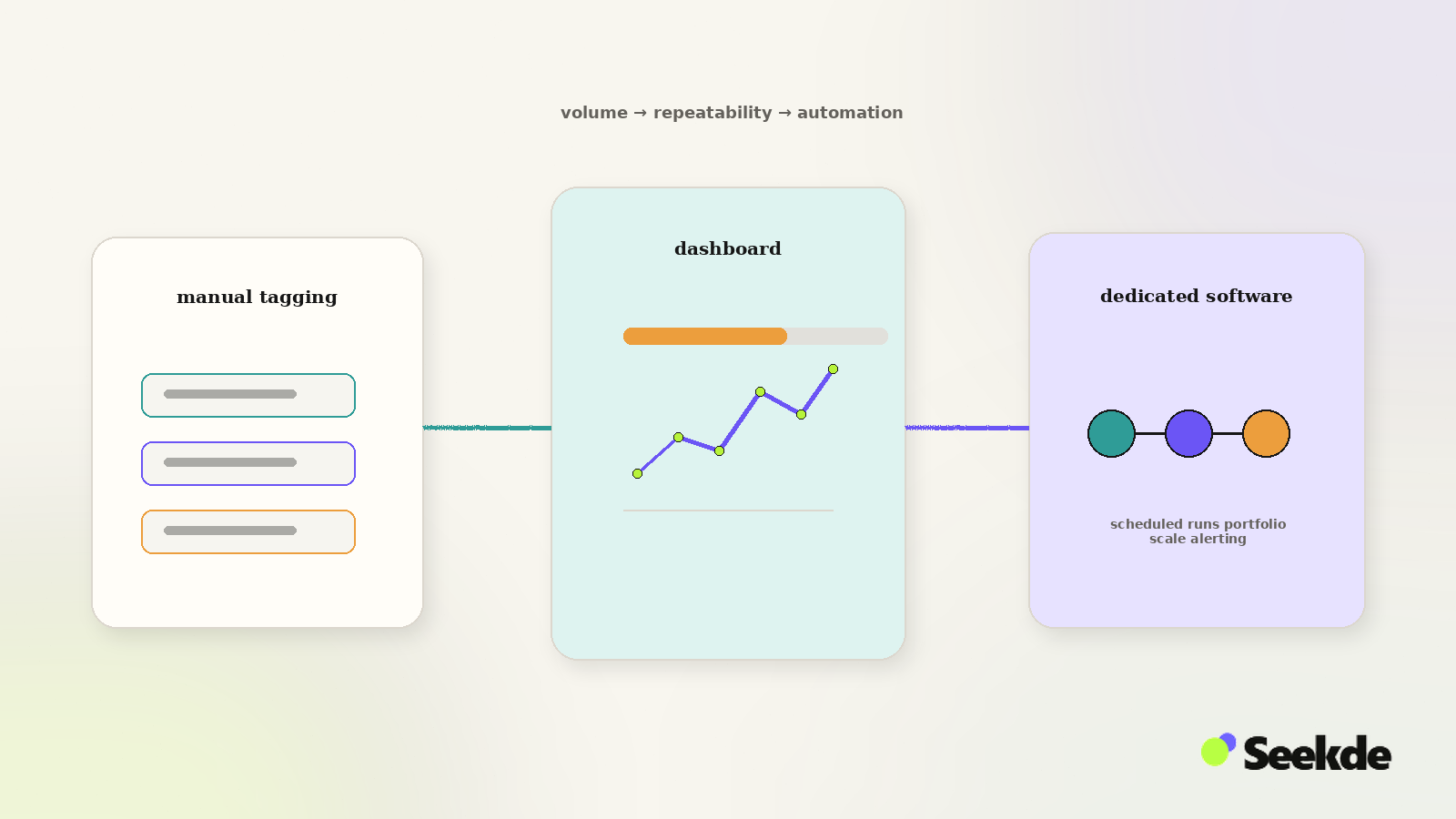
| Operational Dimension | Zero-Cost / Manual Workflow | Agile Commercial Trackers | Enterprise Agency Workspaces |
|---|---|---|---|
| Typical Tooling | Google Sheets + Python + GSC Generative AI Reports + GA4 | Otterly AI, Peec AI | Profound, Enterprise Semrush |
| Monthly Software Overhead | $0 software licensing | $49 to $299 / month | $1,000 to $3,500+ / month |
| Prompt Capacity | 25 to 50 prompts per client | 50 to 200 prompts per client | 500 to 2,000+ enterprise prompts |
| Multi-Client Isolation | Manual tab separation | Basic workspace toggles | Strict RBAC and dedicated client workspaces |
| Reporting Output | Looker Studio dashboards | Native exports + screenshots | Automated white-label client PDF reports |
| Best Suited For | Boutique agencies, initial pilot programs, low-budget clients | Mid-market SEO agencies managing 5 to 20 accounts | Large global network agencies with enterprise retainers |
Strategic Agency Guidance: Agencies launching an AI search practice should begin with controlled, manual or agile tool setups for initial client cohorts before committing to multi-thousand-dollar enterprise platform annual contracts.
Packaging, Service Scoping, and Retainer Pricing
To protect agency gross margins (targeting 60%+ on recurring retainers), pricing must factor in both software query execution costs (API credits) and senior consulting time:
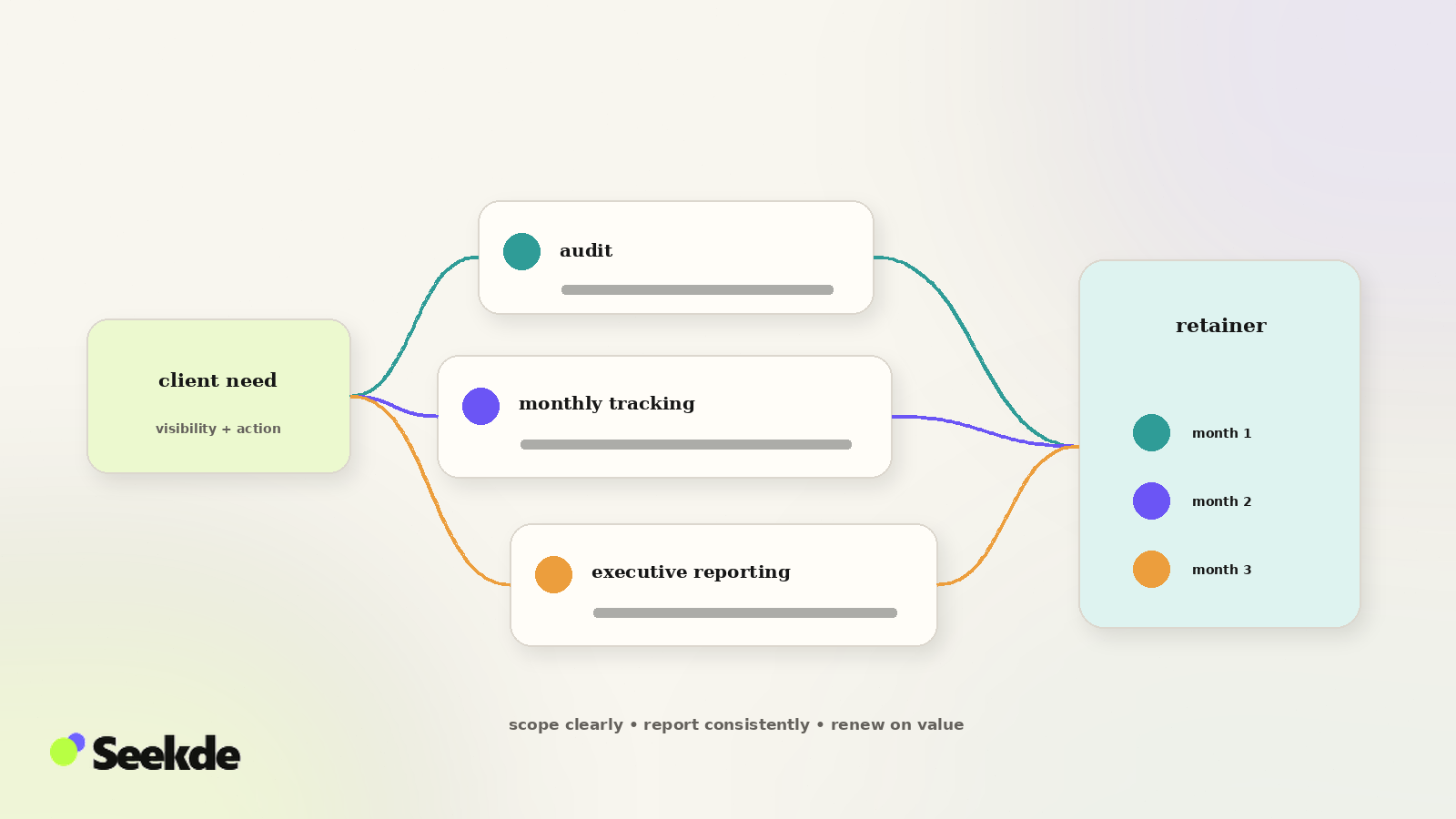
(Note: The retainer figures below represent an illustrative Seekde pricing and effort estimation framework modeled on typical agency staffing hours, tool API consumption rates, and a 60% gross margin target. They do not constitute an empirical survey benchmark of current market rates across all global agencies.)
Tier 1: Foundation
- 25 curated prompts
- 2 platforms (Google, ChatGPT
- Monthly reporting cadence
- Technical crawl audit
- Quarterly strategy review
Tier 2: Growth
- 75 stratified prompt
- ) – 4 platforms (incl. Perplex
- Bi-weekly monitoring
- 2x content experiments/mo
- Digital PR alignment
Tier 3: Enterprise
- s – 200+ global prompts
- ity)- Daily observation cadence
- Multi-region & multi-language
- Dedicated engineering sync
- Custom Looker Studio portal
Modeling Cost-to-Serve
Before quoting a retainer, agency directors must calculate the operational cost per account:
- Software Credit Cost: (Tracked Prompts) × (Platforms) × (Cadence) × (Provider API Rate).
- Analyst Execution Hours: 6 to 12 hours per month for prompt maintenance, anomaly filtering, experiment documentation, and client reporting presentation.
- Strategist / Senior Hours: 2 to 4 hours per month for client executive calls, hypothesis design, and cross-channel integration.
Client Communication and Expectation Management
The greatest threat to agency retention in AI visibility engagements is misaligned client expectations. If a client expects deterministic ranking outcomes similar to legacy keyword rank tracking, any algorithmic variation will be perceived as agency failure.
Three Contractual and Communication Principles
- Never Promise Deterministic Placements: Formalize in service master service agreements (MSAs) that generative AI models are probabilistic neural networks whose outputs vary based on context, temperature, and continuous model weight updates.
- Focus on Directional Share of Voice Over Point-in-Time Queries: Train clients to evaluate performance using 30-day moving averages of mention and citation rates across prompt families, rather than obsessing over a single query run on an executive’s laptop.
- Emphasize the Multi-Channel Value of Primary Evidence: Remind clients that restructuring content for AI search—publishing machine-readable tables, clarifying entity definitions, improving review profiles, and eliminating technical crawl blocks—measurably improves conventional SEO rankings, conversion rates, and buyer trust simultaneously.
Agency Account Director Audit Checklist
Use this 10-point checklist before delivering an AI visibility proposal or onboarding a new client:
- [ ] 1. Multi-Intent Prompt Taxonomy: Does the proposed prompt set include branded, category, attribute-constrained, and head-to-head queries?
- [ ] 2. Documented Empirical Baseline: Has the agency executed an initial 5-run baseline before executing any on-page changes?
- [ ] 3. Strict Competitor Set Defined: Are 3 direct commercial competitors and 2 editorial reference domains locked for share-of-voice tracking?
- [ ] 4. Dedicated Client Workspace: Is client data strictly partitioned within agency monitoring tools to prevent cross-account leakage?
- [ ] 5. Contractual Expectation Disclaimers: Does the client agreement explicitly articulate the probabilistic nature of generative search?
- [ ] 6. Server-Side Crawler Permissions: Have client server configurations and
robots.txtfiles been audited for AI crawler accessibility? - [ ] 7. Measurable Experiment Hypotheses: Are all planned optimizations documented with clear hypotheses, test windows, and metric goals?
- [ ] 8. Business Impact Integration: Are GA4 UTM parameters and custom channel groupings configured to isolate conversational search referral traffic?
- [ ] 9. Margin & Software Cost Modeling: Does the monthly retainer price yield at least a 60% gross margin after factoring tool credits and labor hours?
- [ ] 10. Executive Deck Standardization: Does the monthly reporting template prioritize strategic insights and action items over raw data dumps?
Summary: Building a Defensible GEO Agency Practice
Generative Engine Optimization is not a fleeting tactic or a collection of prompt-engineering tricks; it represents the structural evolution of search marketing. Agencies that master the discipline of empirical measurement, transparent probabilistic reporting, and systematic content engineering will position themselves as indispensable strategic partners to enterprise brands.
By establishing disciplined operating workflows, educating clients on probabilistic discovery, and packaging services around high-margin diagnostic and experimental deliverables, SEO agencies can build durable, highly profitable AI visibility service practices.
Related Playbooks and Technical Guides
- Best AI Visibility Tools for Agencies (forthcoming comparative roundup)
- Best GEO Tools for SEO Teams (forthcoming in-house workflow guide)
- Free Ways to Monitor AI Search Visibility: The Zero-Cost Manual Stack
- How to Measure Brand Visibility in AI Search
- AI Search Prompt Monitoring Set: Complete Design Framework
- Entity SEO for AI Search: A Practical Guide
- GEO for SaaS Companies: Vertical Playbook
- AI Search Optimization for Publishers