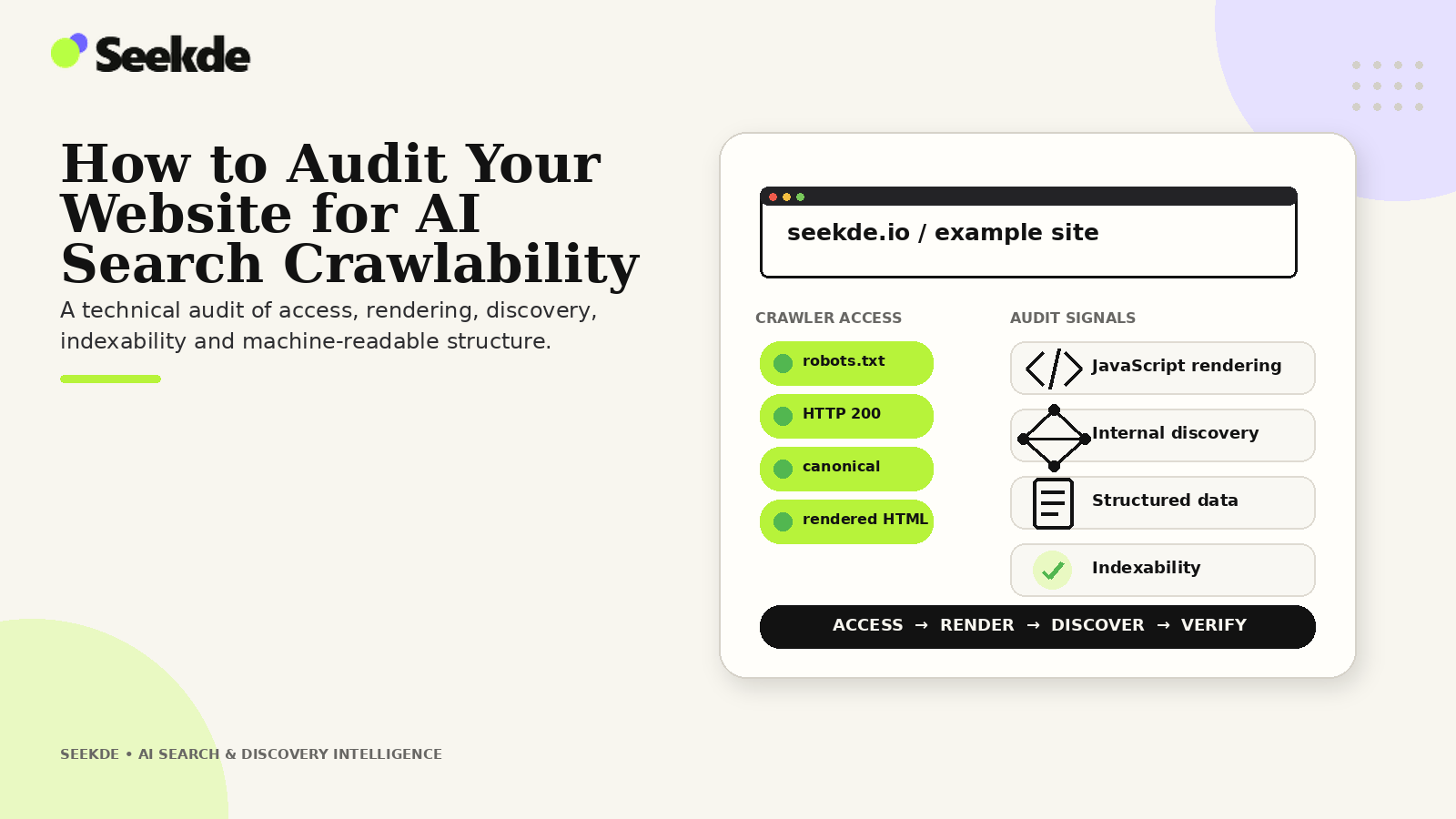
An AI search crawlability audit is an end-to-end technical inspection that verifies whether automated search discovery crawlers can access, parse, render, and index your website without encountering edge firewalls, robots misconfigurations, or client-side rendering bottlenecks. In generative search engines like Google AI Overviews, ChatGPT Search, Microsoft Copilot, and Perplexity, technical accessibility is the foundational eligibility layer. If a crawler cannot retrieve and parse your content with sub-second latency, that content is permanently excluded from real-time Retrieval-Augmented Generation (RAG) candidate pools.
However, technical teams must maintain rigorous expectations regarding what a crawlability audit accomplishes: passing an audit does not guarantee top AI search rankings or frequent citations. Technical crawlability is an eligibility prerequisite, not an algorithmic citation guarantee. Once technical access is secured, citation selection depends on topical authority, factual density, query relevance, and content structure. This guide provides a comprehensive 10-phase audit protocol and an actionable checklist designed specifically for technical teams and webmasters optimizing for generative search engines.
The AI Crawlability Audit Architecture
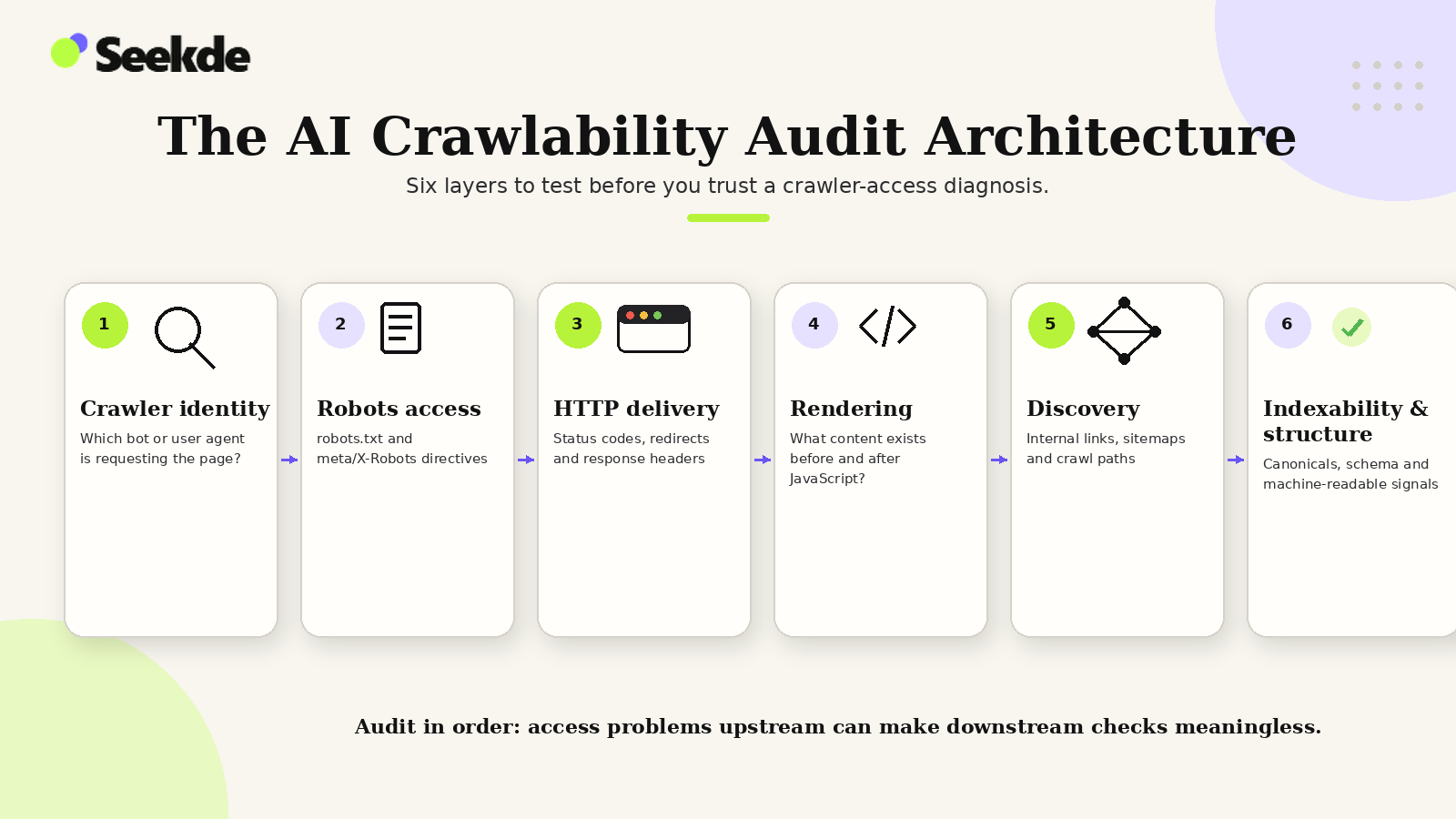
A thorough audit evaluates your technical stack from the external network boundary down to internal semantic data structures:
[Infrastructure & Edge]
- 1. DNS & Host Latency
- 2. WAF & Bot Protection
[Crawler Directives]
- 3. Robots.txt Complia
- 4. HTTP Codes & Redirects
[Content & Semantics]
- nce 5. Raw HTML vs. JS
- 6. Meta Robots & Canonicals
- 7. XML Sitemaps
- 8. Internal Link Graph
- 9. Schema.org Markup
- 10. Server Access Logs
The 10-Phase AI Search Crawlability Audit Protocol
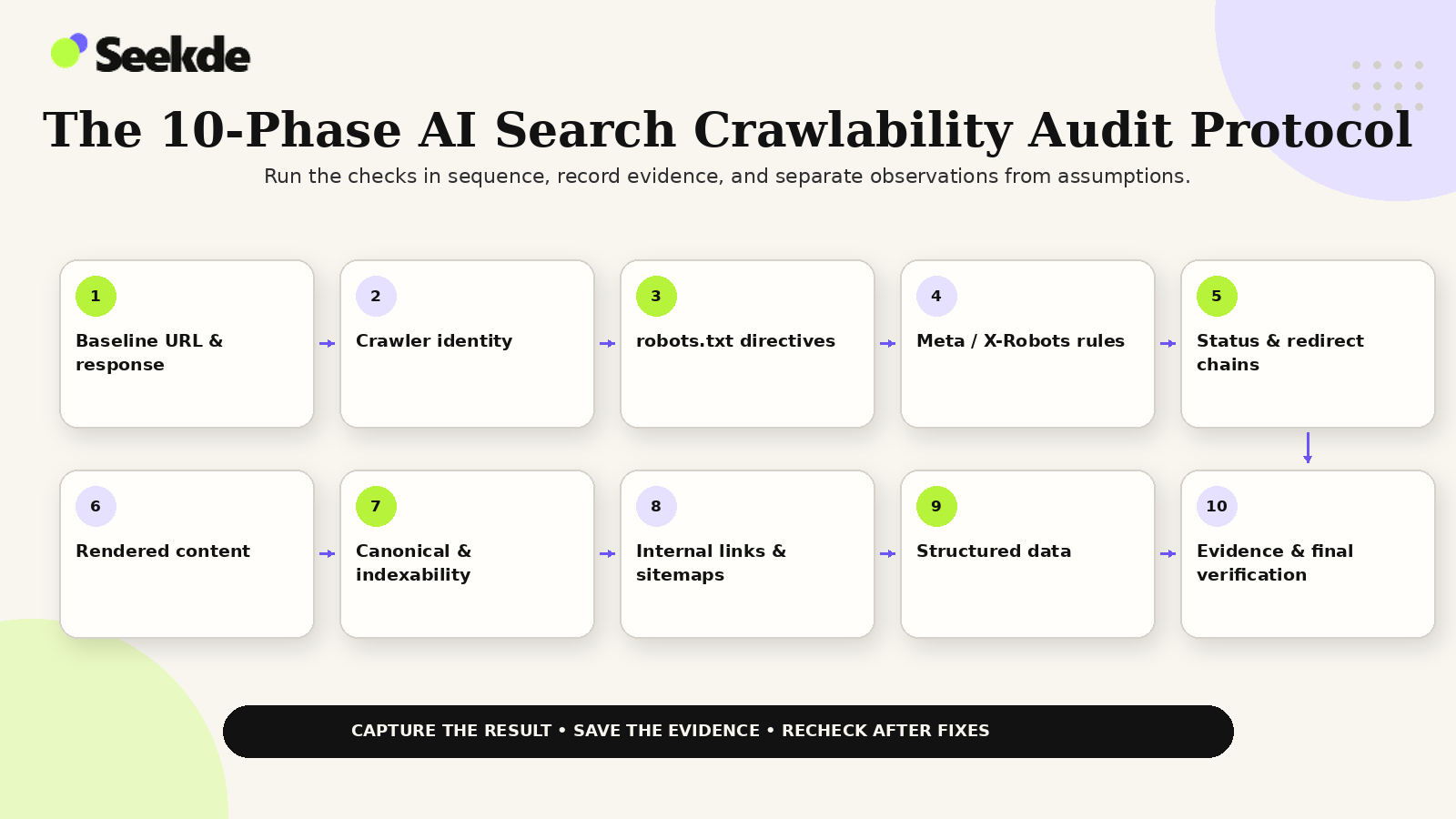
Phase 1: Edge & Host Infrastructure Latency
AI search retrieval operates under aggressive real-time query timeouts. When a user submits a prompt in ChatGPT Search or Perplexity, the engine’s retrieval orchestrator queries external websites with latency budgets often restricted to 2–4 seconds total. If your web host or edge server takes 1.5 seconds just to deliver the first byte (TTFB), your page risks timing out before its content can be evaluated.
Diagnostic Checks:
- Time to First Byte (TTFB): Must remain under 500ms globally for cached HTML resources, and under 800ms for dynamic routes.
- HTTP/2 and HTTP/3 Protocol Support: Confirm that edge web servers negotiate modern multiplexed protocols to accelerate concurrent crawler resource fetching.
- TLS/SSL Handshake Overhead: Ensure modern TLS 1.3 ciphers are active, with valid, trusted certificates and zero certificate chain errors.
Terminal Diagnostic Command:
# Measure DNS lookup, connect time, TTFB, and total transfer time
curl.exe -o /dev/null -s -w "DNS: %{time_namelookup}s | Connect: %{time_connect}s | TTFB: %{time_starttransfer}s | Total: %{time_total}sn" https://seekde.io/ai-crawlers-explained/
Phase 2: Web Application Firewall (WAF) and Bot Protection
The single most frequent cause of total AI search invisibility is edge firewall misconfiguration. Security tools—such as Cloudflare Bot Management, AWS WAF, Akamai, or Datadome—are designed to challenge automated bot traffic. Because search crawlers do not execute interactive JavaScript challenges (e.g., CAPTCHAs or Cloudflare Managed Challenges), edge firewalls that treat search bots as malicious scrapers terminate crawler connections with HTTP 403 Forbidden. Major AI search operators—including OpenAI’s published bot IP feeds and crawler guidance—require infrastructure operators to explicitly allow verified bot IPs or pass verified search bots without challenge.
Diagnostic Checks:
- WAF Bypass Rules: Ensure custom WAF rules explicitly allow verified search bots (
Googlebot,Bingbot,OAI-SearchBot,PerplexityBot) based on reverse DNS or official IP CIDR lists. - Rate Limiting Policies: Confirm that crawler IP addresses are exempt from aggressive rate-limiting thresholds that trigger HTTP 429 Too Many Requests.
- Data Center ASN Blocking: Verify that edge firewalls do not issue blanket blocks against Microsoft Azure, AWS, or Google Cloud ASNs, which AI search engines utilize for crawling infrastructure.
Learn more about separating search bots from scrapers in our directory of AI Crawlers Explained.
Phase 3: Robots.txt RFC 9309 Compliance
Your robots.txt file must enforce precise directives that distinguish search discovery engines from foundation model training scrapers without violating RFC 9309 rule evaluation mechanics, which governs crawler parsing across search and AI operators as detailed in Google’s Robots.txt Specification.
Diagnostic Checks:
- Group Isolation: Verify that specific crawler blocks (such as
User-agent: OAI-SearchBot) replicate all sensitive path disallows, as specific groups ignoreUser-agent: *. - Search Bot Clearance: Confirm that
Googlebot,Bingbot,OAI-SearchBot, andPerplexityBotare grantedAllow: /across all indexable routes. - Training Scraper Discipline: Ensure that opt-outs for
GPTBot,ClaudeBot,Google-Extended, andApplebot-Extendedreflect corporate policy without accidentally blocking search discovery bots. - Sitemap Declaration: Ensure the absolute canonical URL of your primary XML sitemap index is declared at the base of the file.
Terminal Diagnostic Command:
# Inspect live robots.txt response headers and status
curl.exe -sI https://seekde.io/robots.txt | grep -E "(HTTP/|Content-Type)"
For complete, tested templates, consult How to Configure Robots.txt for AI Search Crawlers.
Phase 4: HTTP Status Codes & Redirect Chains
Search engines prioritize direct, reliable URLs. Redirect hops, redirect loops, and soft 404s waste crawler bandwidth and dilute algorithmic confidence.
Diagnostic Checks:
- Direct HTTP 200 OK: All internal navigation links and sitemap entries must return a clean HTTP 200 directly without redirecting.
- Single-Hop Redirects: If a page has moved, it must redirect via a single HTTP 301 Permanent Redirect directly to the final destination URL. Never permit chains of two or more redirect hops (e.g.,
http://→https://→https://www.→ final URL). - Zero Soft 404s: Ensure that non-existent URLs return a genuine HTTP 404 or 410 status code rather than returning HTTP 200 with an empty page.
Terminal Diagnostic Command:
# Audit full redirect chain for an endpoint
curl.exe -sIL https://seekde.io/ai-crawlers-explained/ | grep -E "(HTTP/|Location:)"
Phase 5: Raw HTML Delivery vs. Client-Side JavaScript Dependency
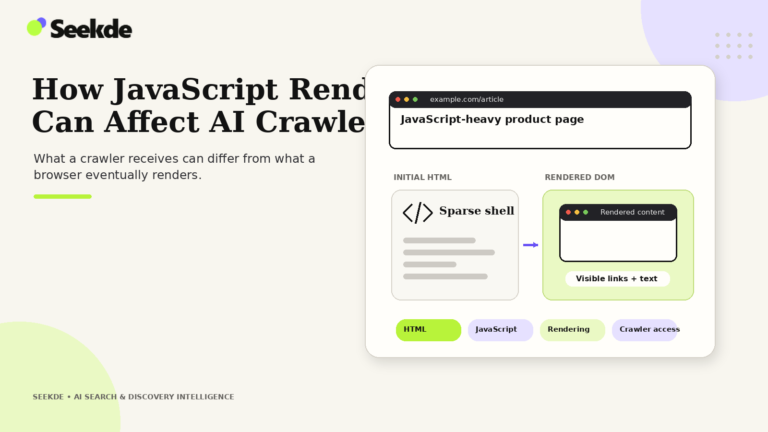
As documented in our technical guide on How JavaScript Rendering Can Affect AI Crawlers and Google’s JavaScript SEO Basics, high-throughput AI search bots and training scrapers prioritize raw HTML and lightweight DOM structures over heavy client-side JavaScript execution.
Diagnostic Checks:
- Server-Rendered Content Parity: Verify that primary article copy, headings (H1–H3), comparison tables, and author details exist in the initial raw server HTML response.
- Zero Empty App Shells: Confirm that the server does not deliver an empty
<div id="root"></div>container that requires bundle execution to display text. - DevTools No-JS Verification: Disable JavaScript in Chrome DevTools to ensure the webpage remains fully legible and functional without client script execution.
Terminal Diagnostic Command:
# Confirm raw HTML contains target article text
curl.exe -sL https://seekde.io/ai-crawlers-explained/ | grep -c "OAI-SearchBot"
Phase 6: Meta Robots and Canonical Tag Integrity
Meta robots directives and canonical tags instruct search engines how to handle page indexing and duplicate URL resolution.
Diagnostic Checks:
- Robots Meta Tag: Ensure the
<head>contains<meta name="robots" content="index, follow, max-image-preview:large, max-snippet:-1">. Ensure no accidentalnoindexornonedirectives exist on public articles. - Canonical URL Match: The
<link rel="canonical" href="...">tag must point strictly to the exact, preferred HTTPS URL with matching trailing slash syntax. - HTTP Header Consistency: Verify that server responses do not emit conflicting
X-Robots-Tag: noindexheaders in HTTP response headers.
Phase 7: XML Sitemaps and Discovery Paths
XML sitemaps provide automated crawlers with an authoritative inventory of all canonical URLs intended for search indexing.
Diagnostic Checks:
- Sitemap Accessibility: Confirm that primary sitemaps (e.g.,
/wp-sitemap.xmlor/sitemap_index.xml) return HTTP 200 withContent-Type: text/xmlorapplication/xml. - Canonical Only: Ensure sitemaps contain zero redirected (301), non-canonical, parameterized, or noindexed URLs.
- Freshness Timestamps: Verify that
<lastmod>timestamps reflect genuine editorial updates in ISO 8601 format.
Phase 8: Internal Link Graph and Click Depth
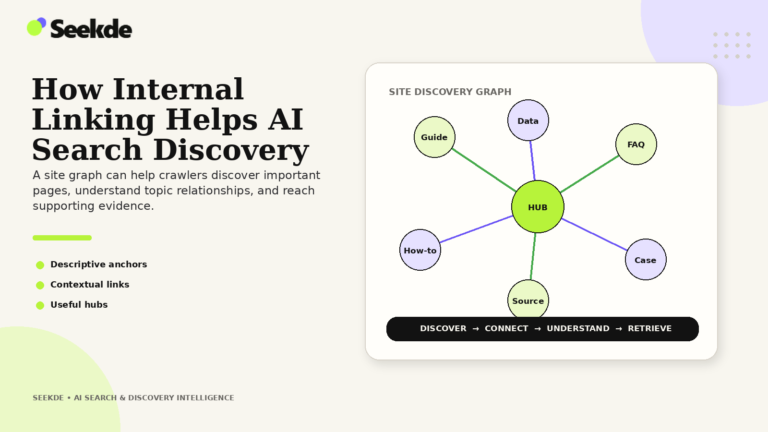
An intentional internal linking topology ensures fast crawler traversal and passes topical context to RAG embedding systems.
Diagnostic Checks:
- Click Depth < 3: Confirm that all high-priority technical guides can be reached within 2 to 3 clicks from the homepage.
- Zero Orphan Pages: Ensure every published article receives at least two inbound internal links from established, indexable pages.
- Standard HTML Anchors: Confirm that all internal links use standard
<a href="/slug/">syntax rather than synthetic JavaScriptonClickhandlers. - Semantic Anchor Text: Verify that internal links utilize descriptive, topic-specific anchor text rather than generic phrases like "click here."
For first-party architectural examples, see How Internal Linking Helps AI Search Discovery.
Phase 9: Semantic Schema Markup (JSON-LD)
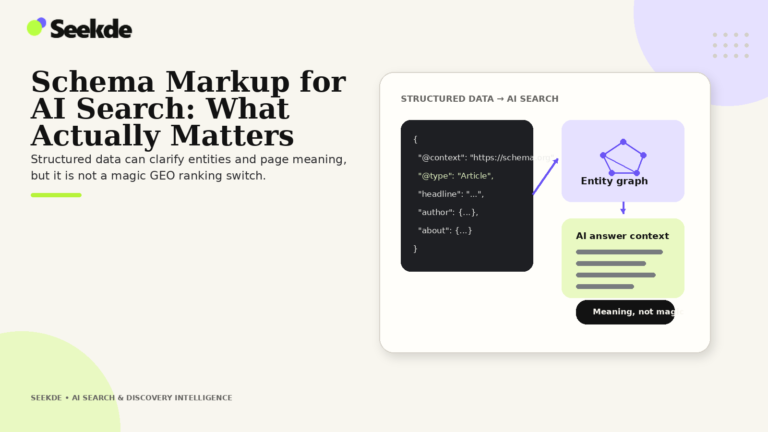
Structured data provides deterministic entity disambiguation that helps AI retrieval engines resolve brand identity and content relationships in accordance with Google’s Structured Data General Policies.
Diagnostic Checks:
- Core Schema Types: Implement valid
OrganizationandWebSitemarkup on the homepage, andArticle/BlogPostingcombined withBreadcrumbListon all editorial content. - Visible Copy Parity: Ensure that headline, author name, publication dates, and descriptions in JSON-LD precisely match visible page copy.
- Entity Graph Linking: Use
@idURI identifiers to connect articles to verified author (Person) and publisher (Organization) objects. - Deprecate Outdated Types: Avoid obsolete
FAQPagerich result markup or fabricated review ratings.
Validate markup using the Schema Markup Validator as detailed in Schema Markup for AI Search.
Phase 10: Server Access Log Analysis & Bot Verification
Server access logs provide the final empirical proof of crawler behavior, revealing whether automated agents are actively crawling your site or encountering errors.
Diagnostic Checks:
- Crawl Frequency: Measure request volume across verified search crawlers (
Googlebot,OAI-SearchBot,Bingbot,PerplexityBot, andClaude-SearchBot). - HTTP Status Codes by Bot: Confirm that verified search bots receive HTTP 200 responses, with zero unexplained 403 Forbidden or 429 Too Many Requests spikes.
- Reverse DNS and Source-IP Validation: Authenticate legitimate crawlers against spoofed requests using vendor-appropriate verification methods. For crawlers supporting reverse DNS lookup (such as
Googlebot,Bingbot, andApplebot), perform two-way DNS verification in accordance with Google’s Bot Verification Guide. For vendors that publish official source-IP lists (such as OpenAI’s published bot IP feeds and Anthropic’s published source-IP list), verify that incoming requests originate from documented IP addresses. Note Anthropic’s important caveat that IP blocking is not its recommended persistent opt-out mechanism; robots.txt directives remain the primary documented standard for site owners to manage access.
Terminal Diagnostic Command:
# Aggregate daily HTTP status codes served to AI search crawlers
grep -E "(Googlebot|OAI-SearchBot|Bingbot|PerplexityBot|Claude-SearchBot)" /var/log/nginx/access.log | awk '{print $9}' | sort | uniq -c
The Seekde AI Search Crawlability Audit Checklist
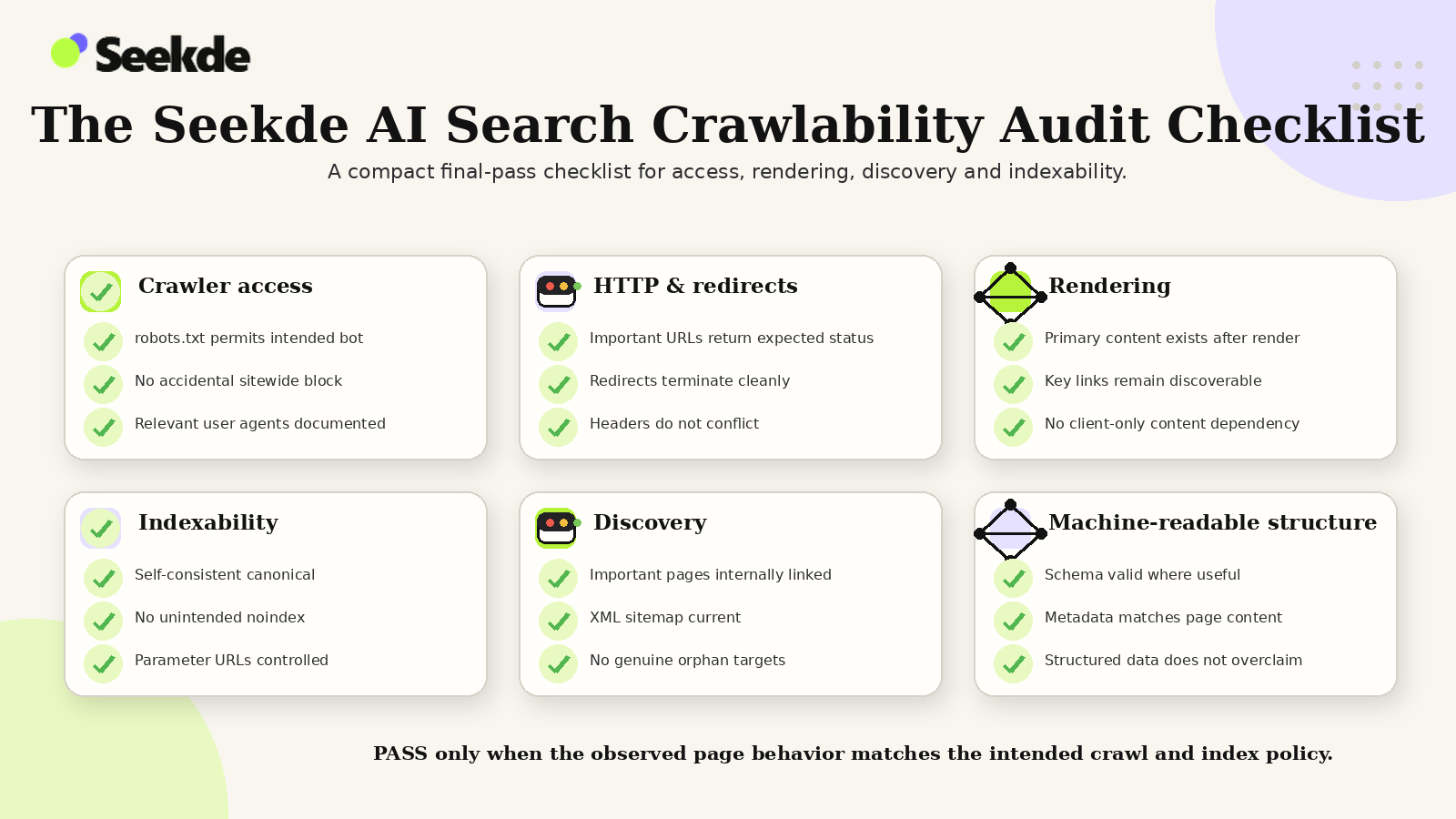
Use this structured checklist to execute systematic audits across your web properties:
| Audit Phase | Inspection Item | Technical Standard | Primary Tool | Pass Criteria |
|---|---|---|---|---|
| 1. Edge & Host | Time to First Byte (TTFB) | < 500ms for cached pages; < 800ms for dynamic | curl / WebPageTest |
Returns fast initial byte globally |
| 1. Edge & Host | Protocol & TLS | HTTP/2 or HTTP/3; TLS 1.3 | SSL Labs / Browser DevTools | Zero certificate or handshake warnings |
| 2. WAF & Bot | Search Bot Bypass | Legitimate search bots bypass WAF challenges | Edge WAF Console (Cloudflare/AWS) | Zero 403 blocks for verified search bots |
| 2. WAF & Bot | IP / Egress Whitelist | Published vendor CIDR blocks allowed | WAF IP Rules | Known crawler IP ranges not challenged |
| 3. Robots.txt | RFC 9309 Precedence | Specific bot groups replicate global rules | curl / Google robots tester |
No accidental exposure of admin routes |
| 3. Robots.txt | Crawler Policies | OAI-SearchBot allowed; GPTBot policy set |
Text Editor / Search Console | Directives match corporate strategy |
| 4. Status Codes | Canonical Response | Direct HTTP 200 OK | curl -sIL |
0 redirect hops on canonical links |
| 4. Status Codes | Redirect Protocol | 301 Permanent; maximum 1 hop | curl -sIL |
Zero redirect chains or loops |
| 5. Rendering | Raw HTML Delivery | Core copy, tables, H1–H3 present in raw HTML | curl -sL |
Complete text extracted without JS |
| 5. Rendering | DevTools No-JS | Content readable with JavaScript disabled | Chrome DevTools (Disable JS) | Zero blank screens or missing sections |
| 6. Canonicals | Robots Meta Tag | index, follow, max-image-preview:large |
View Page Source | No conflicting noindex headers |
| 6. Canonicals | Canonical Match | Self-referencing HTTPS canonical URL | View Page Source | Exact match with requested URI |
| 7. Sitemaps | XML Sitemap Status | Returns HTTP 200; declared in robots.txt | XML Parser / Browser | Valid XML syntax; < 50,000 URLs per map |
| 7. Sitemaps | URL Hygiene | 100% canonical, indexable URLs only | Sitemap Validator | Zero 301, 404, or noindexed URLs listed |
| 8. Linking | Click Depth | Maximum 3 clicks from homepage to any article | Site Crawler (Screaming Frog / Custom) | 100% of priority articles at depth ≤ 3 |
| 8. Linking | Orphan Elimination | At least 2 inbound internal links per article | Internal Link Graph Script | Zero orphan URLs across indexable corpus |
| 9. Schema | Entity Linking | Organization, Article, BreadcrumbList |
Schema Markup Validator | Valid JSON-LD syntax; 0 critical errors |
| 9. Schema | Visible Parity | JSON-LD metadata matches visible text | Manual / DOM Inspector | Exact parity between schema and page text |
| 10. Server Logs | Bot Response Codes | 200 OK served to verified search bots | Bash / Grep / Log Analyzer | Zero unexplained 403, 429, or 500 errors |
| 10. Server Logs | Bot Verification | Two-way rDNS or published source-IP matches vendor | host / IP lookup |
Authenticates legitimate crawlers (use robots.txt for governance) |
Python Diagnostic Tool: Automated AI Crawlability Probe
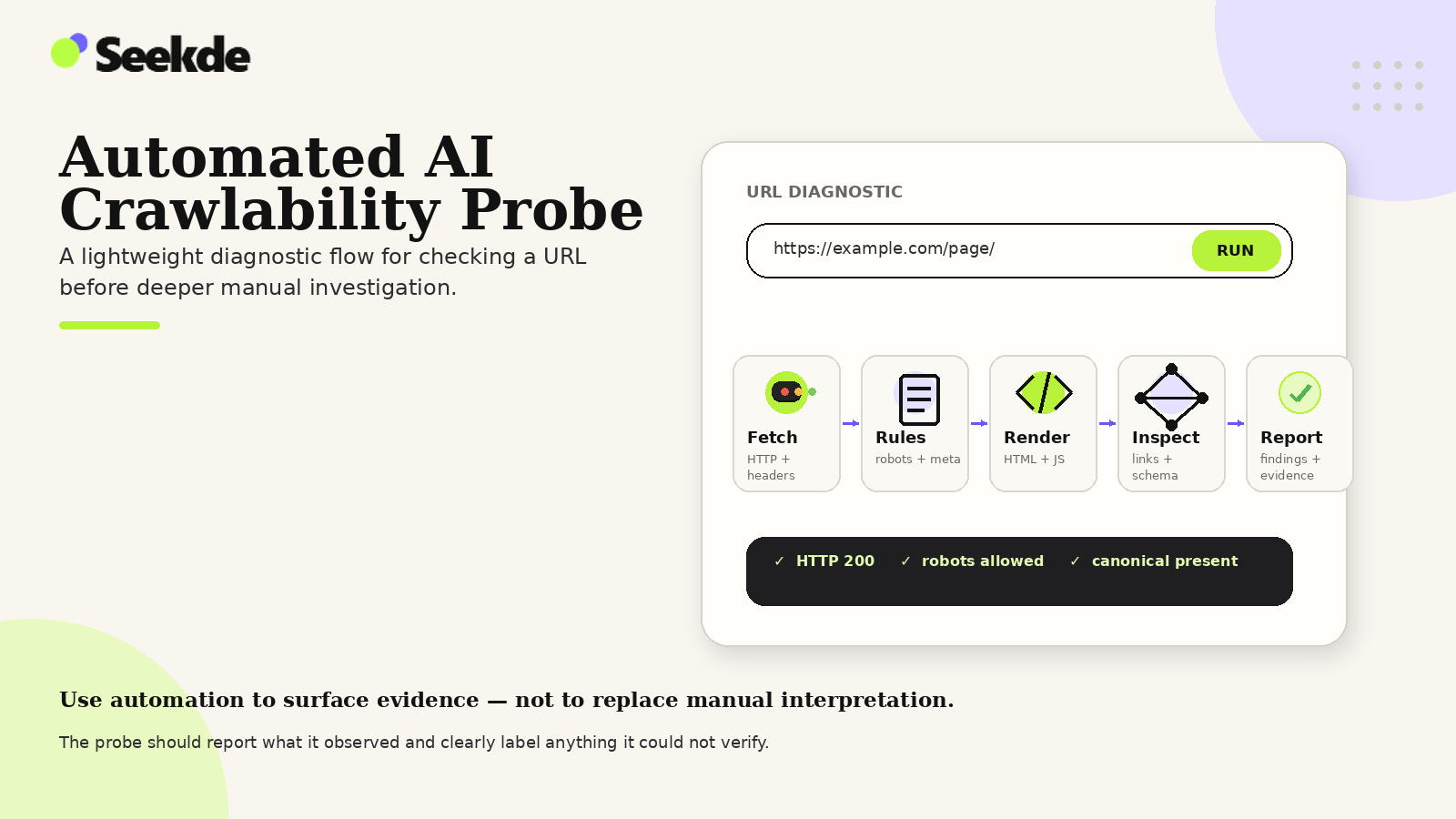
To automate verification, technical teams can deploy this lightweight Python script to test edge status codes, TTFB, raw text density, and robots directives across key URLs:
import urllib.request
import urllib.robotparser
import time
import re
import sys

def audit_url(target_url, base_domain):
    print(f"==================================================")
    print(f"AUDITING: {target_url}")
    print(f"==================================================")

    # 1. Robots.txt Inspection
    rp = urllib.robotparser.RobotFileParser()
    rp.set_url(f"{base_domain}/robots.txt")
    try:
        rp.read()
        searchbot_allowed = rp.can_fetch("OAI-SearchBot", target_url)
        gptbot_allowed = rp.can_fetch("GPTBot", target_url)
        print(f"[ROBOTS.TXT] OAI-SearchBot Access: {'ALLOWED' if searchbot_allowed else 'DISALLOWED'}")
        print(f"[ROBOTS.TXT] GPTBot Access:        {'ALLOWED' if gptbot_allowed else 'DISALLOWED'}")
    except Exception as e:
        print(f"[ROBOTS.TXT] Error reading robots.txt: {e}")

    # 2. HTTP Status and TTFB Probe
    req = urllib.request.Request(
        target_url,
        headers={'User-Agent': 'Mozilla/5.0 (compatible; OAI-SearchBot/1.0; +https://openai.com/searchbot)'}
    )

    start_time = time.time()
    try:
        with urllib.request.urlopen(req, timeout=10) as response:
            ttfb = time.time() - start_time
            status_code = response.getcode()
            content = response.read().decode('utf-8', errors='ignore')

            print(f"[HTTP] Status Code: {status_code} (Expected: 200)")
            print(f"[PERFORMANCE] TTFB: {ttfb:.3f}s {'[PASS]' if ttfb < 0.8 else '[WARNING: SLOW]'}")

            # 3. Raw HTML Content Extraction
            clean_text = re.sub(r'<[^>]+>', ' ', content)
            word_count = len(clean_text.split())
            print(f"[CONTENT] Raw HTML Word Count: {word_count} words")
            if word_count < 300:
                print("[WARNING] Low raw HTML word count! Page may depend on client-side JS.")
            else:
                print("[PASS] Substantial server-rendered copy detected.")

            # 4. Canonical & Robots Meta Check
            has_canonical = bool(re.search(r'<link[^>]+rel=["']canonical["']', content, re.IGNORECASE))
            has_noindex = bool(re.search(r'<meta[^>]+content=["'][^"']*noindex[^"']*["']', content, re.IGNORECASE))
            print(f"[TAGS] Canonical Tag Present: {'YES [PASS]' if has_canonical else 'NO [FAIL]'}")
            print(f"[TAGS] Noindex Directive Found: {'YES [WARNING]' if has_noindex else 'NO [PASS]'}")

    except Exception as e:
        print(f"[CRITICAL ERROR] Failed to fetch target URL: {e}")

if __name__ == "__main__":
    audit_url("https://seekde.io/ai-crawlers-explained/", "https://seekde.io")
Running this script as part of continuous integration (CI/CD) pipelines ensures that new frontend releases do not introduce regressions into your crawlability baseline.
Summary: Key Takeaways for Webmasters
- Eligibility vs. Ranking: Crawlability guarantees technical eligibility; it does not guarantee generative search citations.
- Prioritize Edge WAF Integrity: Verify that CDN security tools and bot management products never issue JavaScript challenges to verified search bots.
- Honor RFC 9309 Rules: Remember that specific user-agent blocks in robots.txt do not inherit rules from
User-agent: *. - Enforce Server-Side HTML Delivery: Deliver primary article prose, headings, and comparison tables directly in the initial server response.
- Maintain Shallow Link Architectures: Keep all indexable articles within 3 clicks of the homepage, and eliminate orphan pages.
- Audit Regularly with Server Logs: Combine synthetic terminal probes with empirical server access log audits to verify that search bots are actively fetching your content without errors.
Related Technical Resources
- AI Crawlers Explained: Googlebot, OAI-SearchBot, GPTBot and More
- OAI-SearchBot vs GPTBot: What’s the Difference?
- How to Configure Robots.txt for AI Search Crawlers
- Does llms.txt Help AI Search Rankings?
- Schema Markup for AI Search: What Actually Matters
- How Internal Linking Helps AI Search Discovery
- How JavaScript Rendering Can Affect AI Crawlers
- How AI Search Engines Find and Cite Content
- What Is AI Search Optimization?