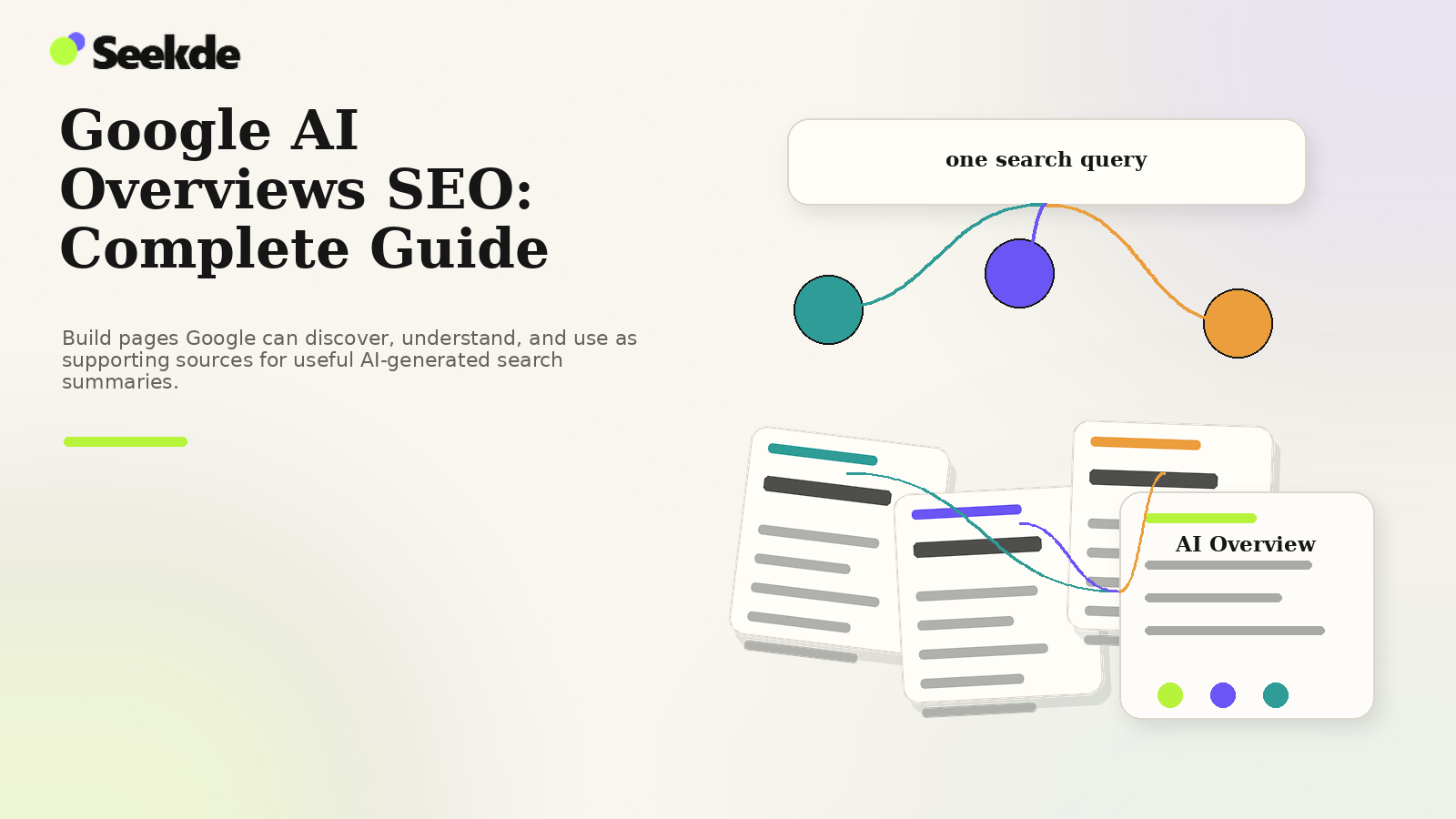
Google AI Overviews SEO is the practice of making pages technically accessible, easy for Google to understand, and useful enough to support AI-generated search summaries. The practical work starts with normal crawlability and indexability, then adds clear answer-focused content, strong evidence, semantic structure, and publisher controls that do not block important retrieval or snippets. No individual tactic guarantees inclusion in an AI Overview.
According to official Google Search Central documentation on AI features, the foundational web standards that make content crawlable, indexable, and useful for traditional Search govern eligibility for generative Search features. Google does not require special structured data, custom schema markup, or files such as llms.txt to appear in AI Overviews.
However, the user presentation and retrieval mechanics differ significantly from a traditional list of blue links. AI Overviews synthesize multi-source answers directly at the top of the search engine results page (SERP), deploy query fan-out across diverse subtopics, and present supporting links through inline citation badges and right-rail source cards. Succeeding in this environment calls for understanding how normal Search indexability interacts with generative eligibility, citation behavior, and Search Console measurement.
The Technical Hierarchy: Indexability vs. AI Overview Eligibility
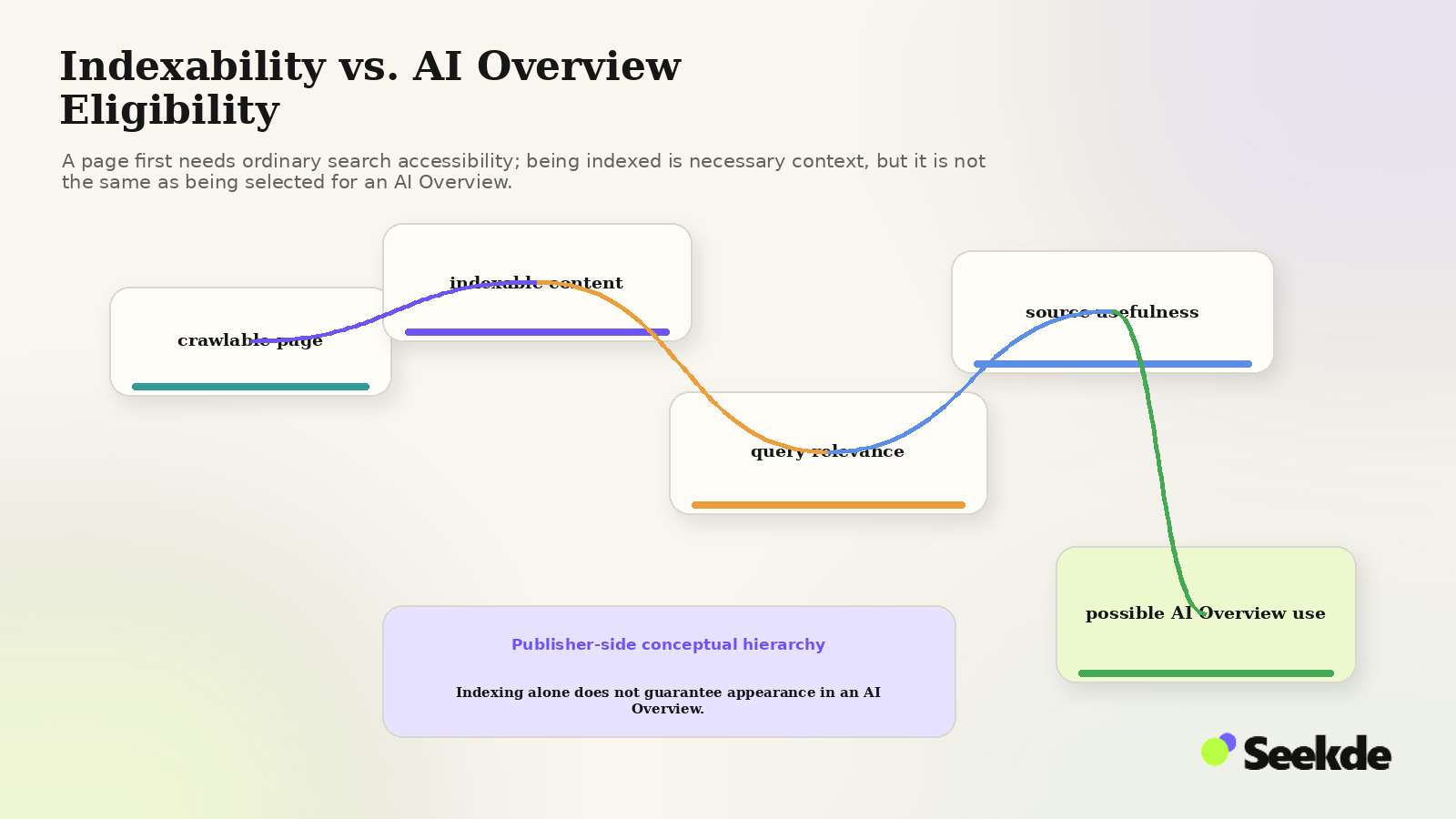
To understand how content enters Google AI Overviews, publishers must separate technical infrastructure from algorithmic citation selection.
1. Search Indexability (The Prerequisite)
- Googlebot Crawling: The URL must be accessible to Googlebot without WAF or
robots.txtdisallow rules. - HTTP Status: The page must return a clean
200 OKresponse. - Rendered HTML: Primary content and factual claims must be present in rendered DOM, not trapped in inaccessible client-side scripts.
- Canonical Signals: Consistent internal linking, sitemaps, and canonical tags provide standard Search hygiene signals (canonicalization is a standard Search signal, not an independent AI Overview requirement).
2. AI Overview Eligibility (The Surface Rules)
- Snippet Eligibility: The page must be eligible to appear with a text snippet in Google Search.
- Robots Meta Controls: Directives like
nosnippet,max-snippet, ornoindexdirectly govern whether Google can display snippets in AI Overviews. - No Special Markup: Google officially confirms that no custom “AI schema” exists or is recognized for generative features.
- Unified Crawler: Blocking Googlebot in robots.txt prevents Googlebot from crawling page content. A robots.txt block is not a guaranteed deindexing mechanism for an already-known URL. To prevent a page from being indexed, Google documents the noindex rule; the page must remain crawlable for Googlebot to discover that directive.
As Google Search Central explains in its guidance on optimizing for generative AI, a page must be indexed, eligible to appear with a Google Search snippet, and meet the applicable Search generative AI eligibility controls. However, meeting technical requirements does not guarantee crawling, indexing, serving, citation, or inclusion. No secondary submission, feed, or inclusion request exists.
Do You Need Special Schema for AI Overviews?
No. Google explicitly confirms that there are no additional technical requirements, special schema.org types, or "AI files" required to appear in AI Overviews or Google AI Mode.
Standard structured data remains valuable when it accurately represents visible page elements—such as Article, Organization, Product, BreadcrumbList, and Author. These standard types help search engines parse entities and site hierarchy. However, adding invented schema properties or attempting to "train" generative models via hidden microdata provides no documented advantage.
Publishers seeking to understand how AI search engines interpret structured information should review the structural foundations of Generative Engine Optimization (GEO) and the differences outlined in GEO vs SEO vs AEO.
How Query Fan-Out Shapes Content Sourcing
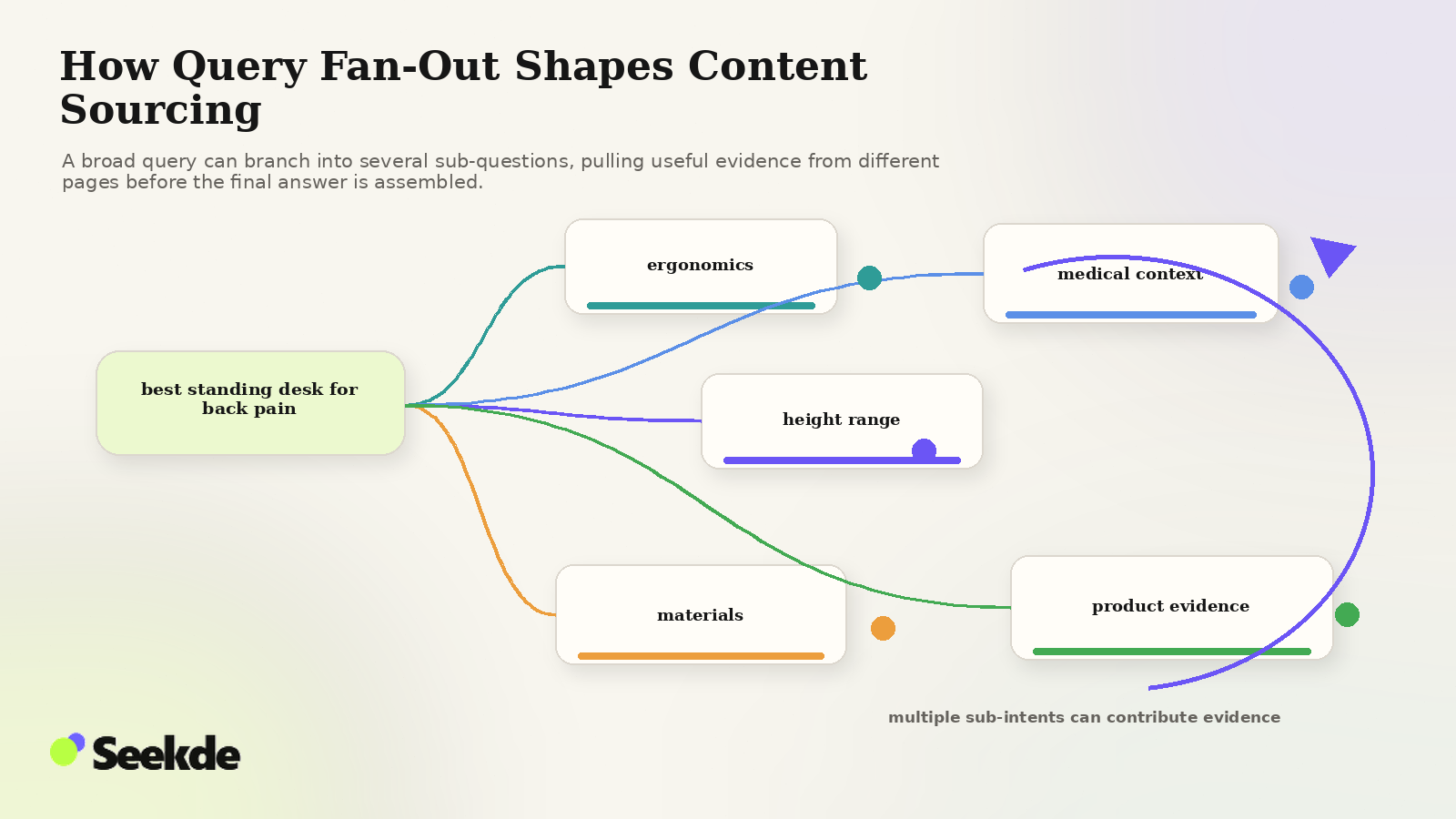
In its architectural descriptions of generative Search capabilities, Google describes a query fan-out technique. Rather than matching a user’s prompt to a single search query, the system decomposes complex, multi-faceted questions into multiple related searches across subtopics and data sources.
For content teams, query fan-out reinforces a disciplined topic-cluster architecture:
- Comprehensive Pillar Hubs: An authoritative resource covering core concepts, terminology, and foundational workflows.
- Specialized Modular Spokes: Sub-pages answering genuinely distinct sub-intents—such as technical implementation guides, pricing benchmarks, edge cases, and comparative evaluations.
- Structured Contextual Linking: Contextual internal links between related sub-pages that clarify entity relationships for web crawlers.
Query fan-out decomposes complex questions into multiple related searches across subtopics and data sources.
Seekde Editorial Recommendation: While Google does not publish a ranking rule that modular content is inherently "rewarded," organizing content into modular, information-dense resources may make distinct subtopics clearer and more useful for complex retrieval journeys. This architectural approach serves as editorial hygiene; it provides no ranking or citation guarantee. Detailed architectural analysis of this retrieval mechanism is available in our guide on query fan-out in AI search.
Content Practices That Build Useful, Non-Commodity Pages
Because generative systems assemble answers from multiple sources, publishing useful, unique, non-commodity content aligns with Google’s people-first content guidance. Seekde recommends that content teams publish verifiable, primary evidence that provides distinctive value beyond generic web summaries. This is an editorial recommendation to improve information quality and utility, not a probabilistic guarantee of earning citation links.
1. Deliver Verifiable, Primary Information
Generic summaries can be generated by large language models without accessing an external document. To provide genuinely distinct value, pages should contain primary facts that cannot be easily substituted:
- Original industry benchmarks and proprietary survey data.
- Firsthand testing observations and code implementations.
- Concrete pricing models, tier breakdowns, and discount policies.
- Step-by-step troubleshooting procedures documenting real error codes.
2. Ensure Entity and Factual Consistency
Generative synthesis compares multiple candidate documents to establish factual consensus. Contradictory statements within a single domain—such as divergent release dates or mismatched product specifications—introduce ambiguity that can degrade content utility. Maintain a single canonical page for product facts, specifications, and editorial standards.
3. Maintain Direct Task Alignment
Titles, H1 tags, and opening paragraphs should immediately address the user’s primary intent. A page targeting technical configuration should present the relevant syntax and prerequisites upfront rather than forcing readers—and evaluation models—to navigate introductory marketing prose.
4. Provide Accessible Semantic HTML
Do not encapsulate primary informational value inside unindexed image text, client-side canvases, or gated interface elements. Automated retrieval pipelines depend on accessible text and semantic markup (<h2>, <h3>, <table>, <code>) to parse, chunk, and evaluate relevant passages. For a broader explanation of citation extraction pipelines, see how AI search engines find and cite content.
Publisher Controls: Snippets, Robots, and Crawlers
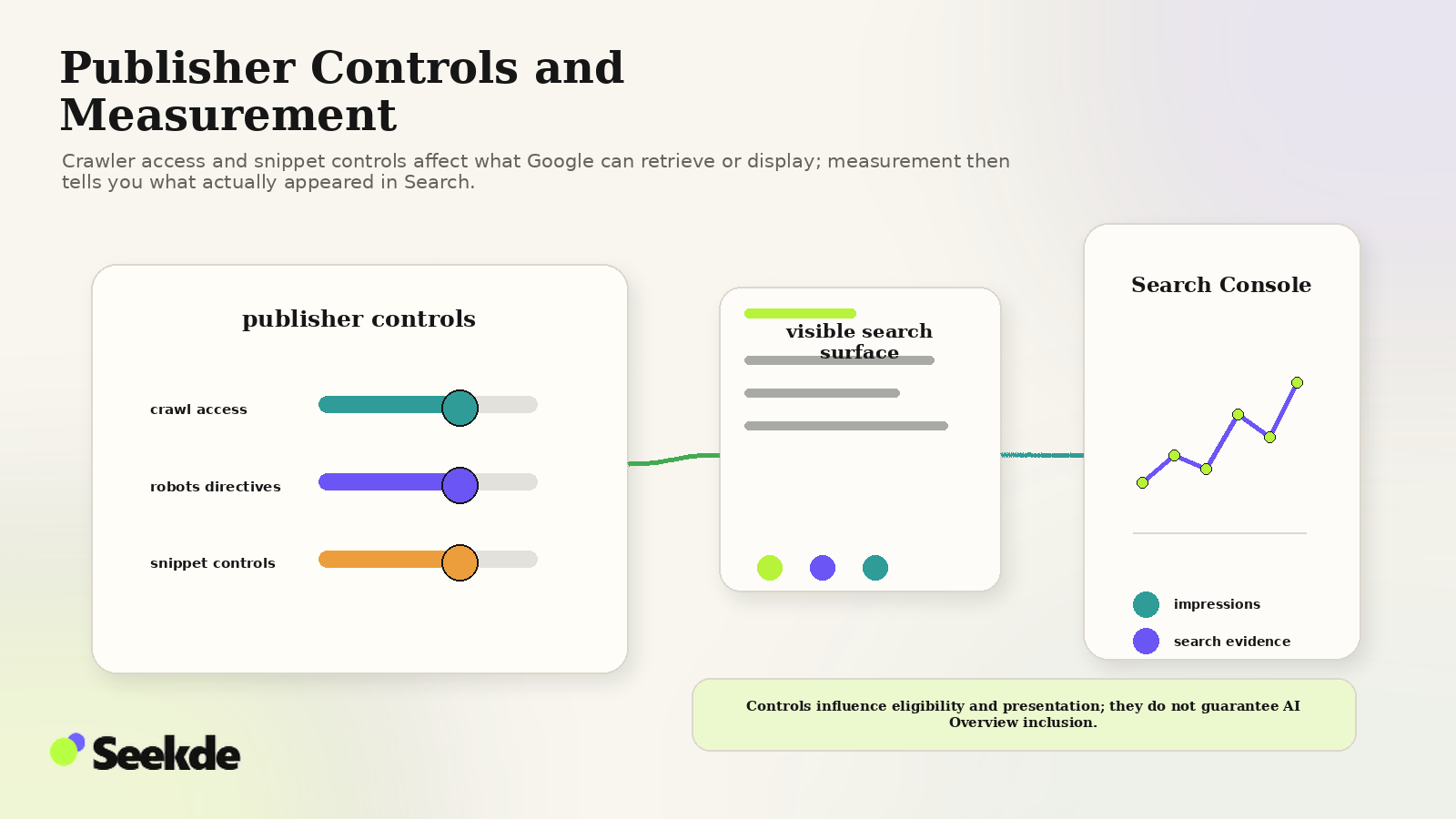
Publishers evaluating how their content appears in AI Overviews have specific, documented mechanisms at their disposal:
- Robots Meta Directives: Standard snippet controls function as documented across Google Search. Utilizing
nosnippetprevents Google from displaying a text snippet from the page in traditional results and prevents textual snippets from being extracted into AI Overviews. Themax-snippet:[number]directive limits snippet length. - Search Generative AI Control (Search Console): As documented in official Google Search Console Help, Google introduced a dedicated Search generative AI control with worldwide rollout announced on August 31, 2026. By default, site links and content participate in supported Search generative AI features. Publishers may explicitly choose to exclude their site’s content and links, which prevents them from appearing in or grounding responses for those supported features. Google documents that this control is not a ranking or inclusion signal for other parts of Google Search, nor does it control AI model training (which is governed separately by the
Google-Extendedproduct token for documented non-Search systems). - Crawler Specificity: Google uses its unified search crawler,
Googlebot, to index content for both standard Search results and AI Overviews. Blocking Googlebot in robots.txt prevents Googlebot from crawling page content. A robots.txt block is not a guaranteed deindexing mechanism for an already-known URL. To prevent a page from being indexed, Google documents thenoindexrule; the page must remain crawlable for Googlebot to discover that directive. - Google-Extended Separation: The
Google-Extendeduser-agent token is documented by Google as a control for foundation model training and Vertex AI grounding; it does not control Google Search indexing or appearance in Search AI features.
Publishers should evaluate these controls carefully. Applying sitewide nosnippet directives removes visibility in traditional Search result previews alongside AI Overviews.
Measuring Visibility in Google Search Console
Measurement approaches for AI Overviews have evolved significantly. Previous industry analyses described generative performance tracking as experimental or limited to closed pilot groups.
Official Search Console Reporting (August 31, 2026 Worldwide Rollout): As documented in official Google Search Console Help, Google has rolled out a dedicated Search Generative AI performance report worldwide. This dedicated report tracks impressions originating from AI Overviews and AI Mode in Google Search across pages, countries, dates, and devices. Google maintains a distinct, separate Generative AI performance report for Google Discover. The dedicated Search Generative AI report focuses specifically on impressions rather than dedicated clicks or CTR metrics.
To evaluate generative visibility accurately, organizations should combine:
- Search Console Generative AI Reports: Monitor impressions in the dedicated Search Generative AI report across pages, devices, and countries to track whether generative features surfaced your site.
- Standard Performance Reports: Inspect traditional Search Console queries and landing pages alongside overall traffic trends to evaluate user engagement.
- Targeted Prompt Sets: Monitor representative informational and commercial queries on a regular schedule to evaluate how brand references and source cards appear live in Search.
Controlled Observational Evidence
To observe how Google AI Overviews behave in practice, Seekde executed a controlled observational test suite across technical, informational, commercial, and time-sensitive queries.
| Query Category | Sample Query | AI Overview Generated | Primary Sourced Domains | Observed Organic Overlap |
|---|---|---|---|---|
| Informational | “what is retrieval augmented generation in search” | Yes | cloud.google.com, aws.amazon.com, youtube.com | Cited domains present in top 5 organic results |
| Technical | “oai-searchbot user agent string and robots.txt directives” | Yes | developers.openai.com, crawlercheck.com | Direct vendor documentation cited; organic #1 match |
| Commercial / Comparison | “best enterprise vector database solutions comparison” | Yes | firecrawl.dev, atlan.com, redis.io | Cited specialized comparison articles outside top 3 organic |
| Time-Sensitive | “google search console generative ai performance reporting updates 2026” | Yes | support.google.com, searchenginejournal.com | Cited Google Help and industry reporting on global rollout |
Observational Findings & Methodology Limitations
(Seekde Controlled Observational Sample — September 2026)
- Query Appearance Rate: In Seekde’s deliberately selected 12-query base test set, an AI Overview appeared for all 12 queries. This 100% appearance rate is a property of this specific, highly informational test query set and must not be interpreted as an assertion that Google displays AI Overviews for 100% of all global search queries.
- Repeat Sourcing Variance: When a representative subset of four queries (informational, technical, commercial, and time-sensitive) was repeated under identical conditions, repeated observations showed source variation in 3 of 4 repeated queries. While core reference domains frequently persisted, secondary citation badges and right-rail cards alternated between competing publications.
- Observed Organic Overlap (Not a Statistical Correlation): Within this controlled September 2026 sample, queries with canonical developer documentation mirrored top-ranking organic URLs, while commercial and comparison queries surfaced specialized comparison blogs and tutorials that ranked outside the top 3 visible organic positions. These observations describe retrieval diversity within our defined test sample; they do not establish that ranking lower causes or enables citation, nor do they represent a statistical correlation analysis.
For details on test protocols and query selection, review our published research methodology.
What to Avoid
When preparing content for Google Search and AI Overviews, avoid common speculative tactics that lack empirical support:
- Do not invent "AI Schema": No search engine recognizes custom microdata purporting to designate content as "optimized for AI."
- Do not artificially rewrite paragraphs to arbitrary word counts: Rigidly capping sections at 40 or 50 words does not guarantee citation and often compromises readability.
- Do not publish thin prompt-variant pages: Producing dozens of nearly identical pages targeting minor conversational phrasing variants contributes to index clutter and low-value scaled content.
- Do not neglect traditional snippet optimization: Snippet eligibility governs Google Search generative supporting-link and snippet eligibility. Disabling snippets sitewide through directives such as
nosnippetprevents textual extracts and supporting links from appearing in AI Overviews.
Sustainable visibility in Google AI Overviews is built by maintaining rigorous technical crawlability, publishing primary data that resolves complex user tasks, and structuring pages so that automated retrieval systems can easily verify and cite your claims.