To improve visibility in ChatGPT Search, make important pages accessible to search-oriented crawling, ensure firewalls and CDNs do not block legitimate access, and publish clear, current, well-sourced content that can support a specific answer. OAI-SearchBot is associated with search discovery while GPTBot serves model-training purposes, and neither crawler access nor any content tactic guarantees that ChatGPT will retrieve, rank, or cite a page for a given query.
According to official OpenAI documentation for publishers and developers, public websites can be eligible to appear in ChatGPT Search when accessible to its dedicated search crawler, OAI-SearchBot. However, inclusion and placement are not guaranteed.
Succeeding on ChatGPT Search calls on publishers to establish a clear distinction between crawling controls, understand when and how the platform invokes web search, maintain accessible technical infrastructure, and track inbound traffic using documented referral parameters.
The Crawler Boundary: OAI-SearchBot vs. GPTBot
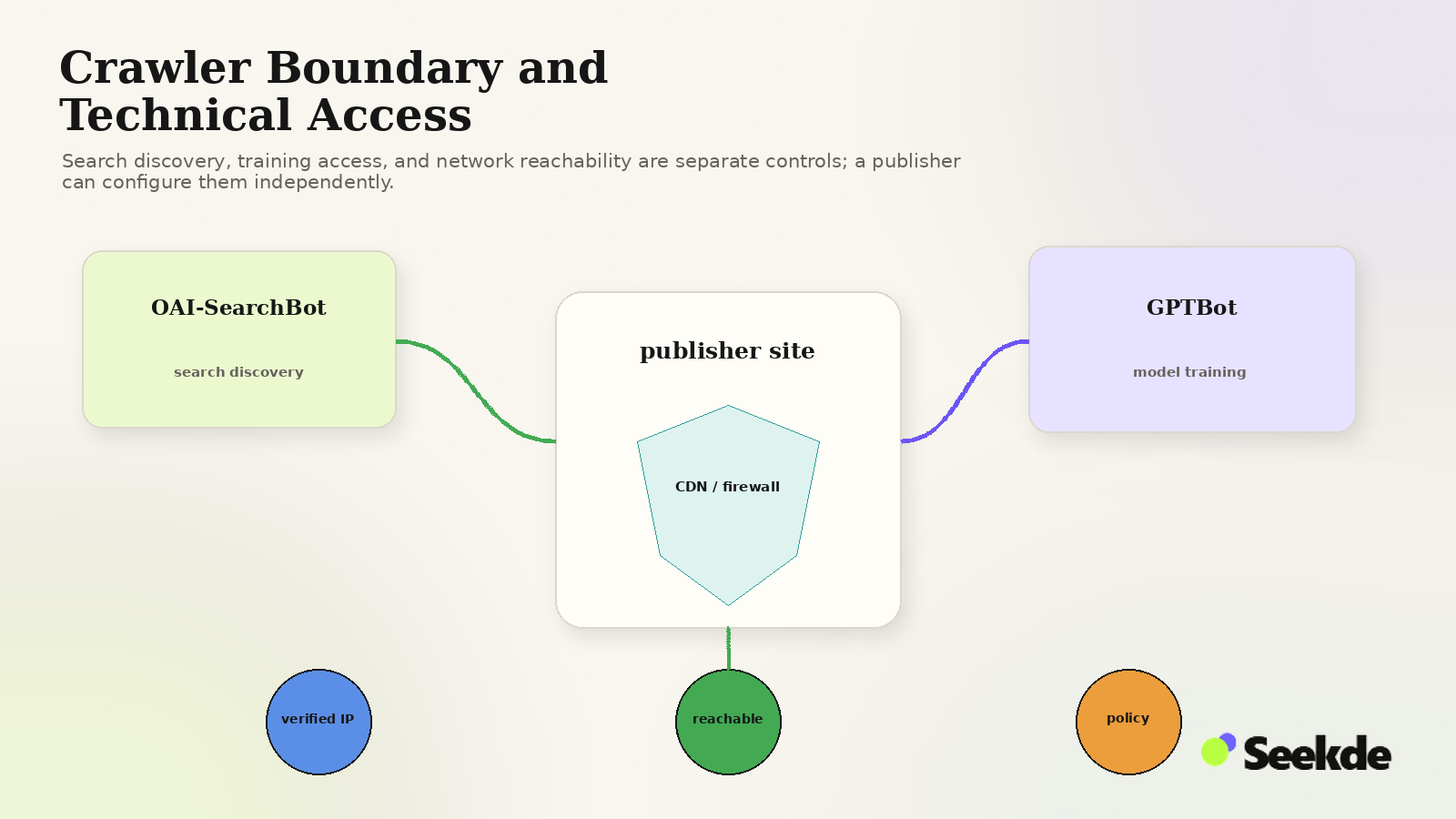
The foundation of a sound ChatGPT Search strategy is understanding OpenAI’s crawler separation. Many organizations inadvertently block search visibility because they conflate search indexing with foundation model training.
OAI-SearchBot (Search Discovery)
- Purpose: Used specifically to crawl, index, and surface web content in ChatGPT Search summaries, snippets, and citation cards.
- Impact of Blocking: Disallowing
OAI-SearchBotinrobots.txtremoves your site from eligibility for ChatGPT Search results. - Training Use: Does not crawl content to train OpenAI’s generative foundation models.
- User-Agent:
OAI-SearchBot
GPTBot (Foundation Model Training)
- Purpose: Used by OpenAI to scrape public web content to train and improve future AI models.
- Impact of Blocking: Disallowing
GPTBotprevents content from being used in model pre-training, but does not prevent the site from appearing in ChatGPT Search ifOAI-SearchBotis allowed. - Search Discovery: Blocking GPTBot does not remove your site from search results.
- User-Agent:
GPTBot
As documented in OpenAI’s crawler overview, webmasters can control these functions independently in robots.txt:
# Allow search indexing and citations in ChatGPT Search
User-agent: OAI-SearchBot
Allow: /

# Prevent content from being scraped for AI model training
User-agent: GPTBot
Disallow: /
This structural separation allows publishers to protect intellectual property from bulk training scraping while preserving discoverability in live search queries.
Technical Access: Firewalls, CDNs, and Verified IPs
Allowing a crawler in robots.txt is ineffective if network-level security layers intercept the bot before it reaches your server. Automated security tools, Web Application Firewalls (WAFs), and Content Delivery Networks (CDNs) frequently flag new crawler user-agents as suspicious scrapers.
To ensure uninterrupted discovery:
- Allowlist Verified IP Ranges: OpenAI publishes machine-readable IP ranges in JSON format (
searchbot.json). Network administrators should configure WAF rules (such as Cloudflare, AWS WAF, or Fastly) to allow traffic from these verified CIDR blocks. - Ensure Clean HTTP Responses: URLs should return standard
200 OKstatus codes. Avoid complex redirect chains that delay retrieval. - Expose Content in Accessible HTML: Primary claims, structured pricing, and product specifications should reside in accessible, rendered HTML. Ensuring content is directly parseable simplifies crawling and automated verification.
For a broader evaluation of how automated retrieval agents interact with website architecture, review our analysis of how AI search engines find and cite content.
When Does ChatGPT Search Invoke the Web?
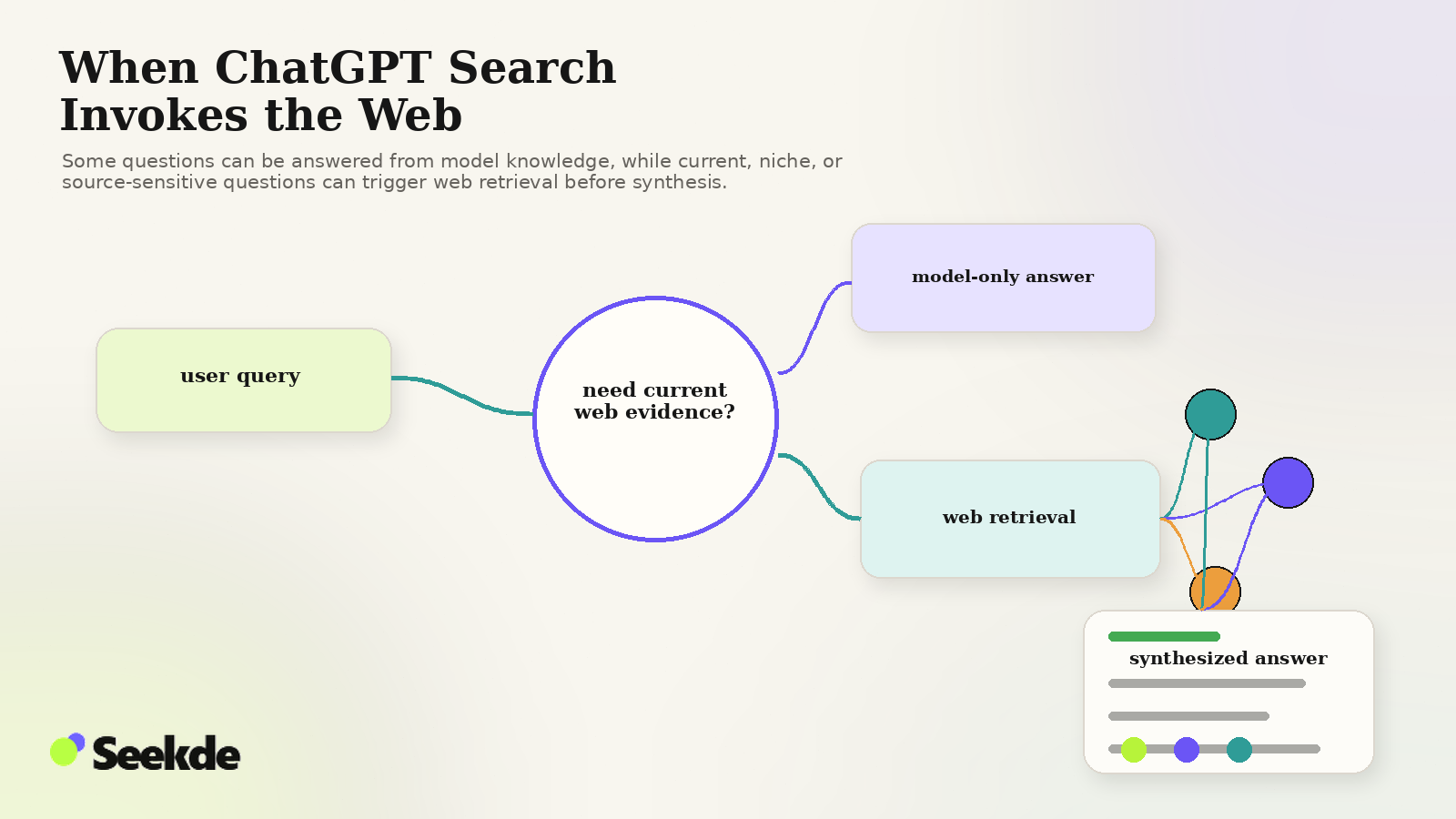
Unlike traditional search engines that query an index for every submission, ChatGPT operates as a hybrid conversational system:
- Automatic and Manual Search Invocation: According to official OpenAI user documentation on searching the web with ChatGPT, ChatGPT may search automatically depending on the prompt (such as prompts asking about current events, local businesses, or fast-moving technical developments), or users can manually initiate a search using the search icon.
- Search-Query Rewriting: The system may rewrite user prompts into one or more targeted search queries sent to search partners, and additional specific searches may occur to gather relevant context.
- Synthesized Answers with Citations: When web search is invoked, retrieved sources are synthesized into the response with clickable inline source pills and a sidebar drawer displaying destination titles, favicons, and URLs. Public websites accessible to
OAI-SearchBotcan be eligible to appear, though inclusion and placement are not guaranteed.
Tracking Traffic: The utm_source=chatgpt.com Parameter
A major operational benefit of ChatGPT Search for digital marketers is built-in referral tracking. OpenAI officially documents that links clicked from ChatGPT Search results automatically append the following query parameter:
utm_source=chatgpt.comIn Google Analytics 4 (GA4) and other analytics platforms, webmasters should create custom channel groupings or filter traffic reports by Source = chatgpt.com to measure:
- Organic referral sessions originating from ChatGPT answers.
- Landing page performance and engagement metrics for AI-referred visitors.
- Downstream conversion events, sign-ups, and purchases.
Because referral parameters can be stripped by aggressive redirect rules or canonical redirects, verify that your server configuration preserves incoming query parameters across all site routes.
Controlled Observational Evidence: ChatGPT Search Testing
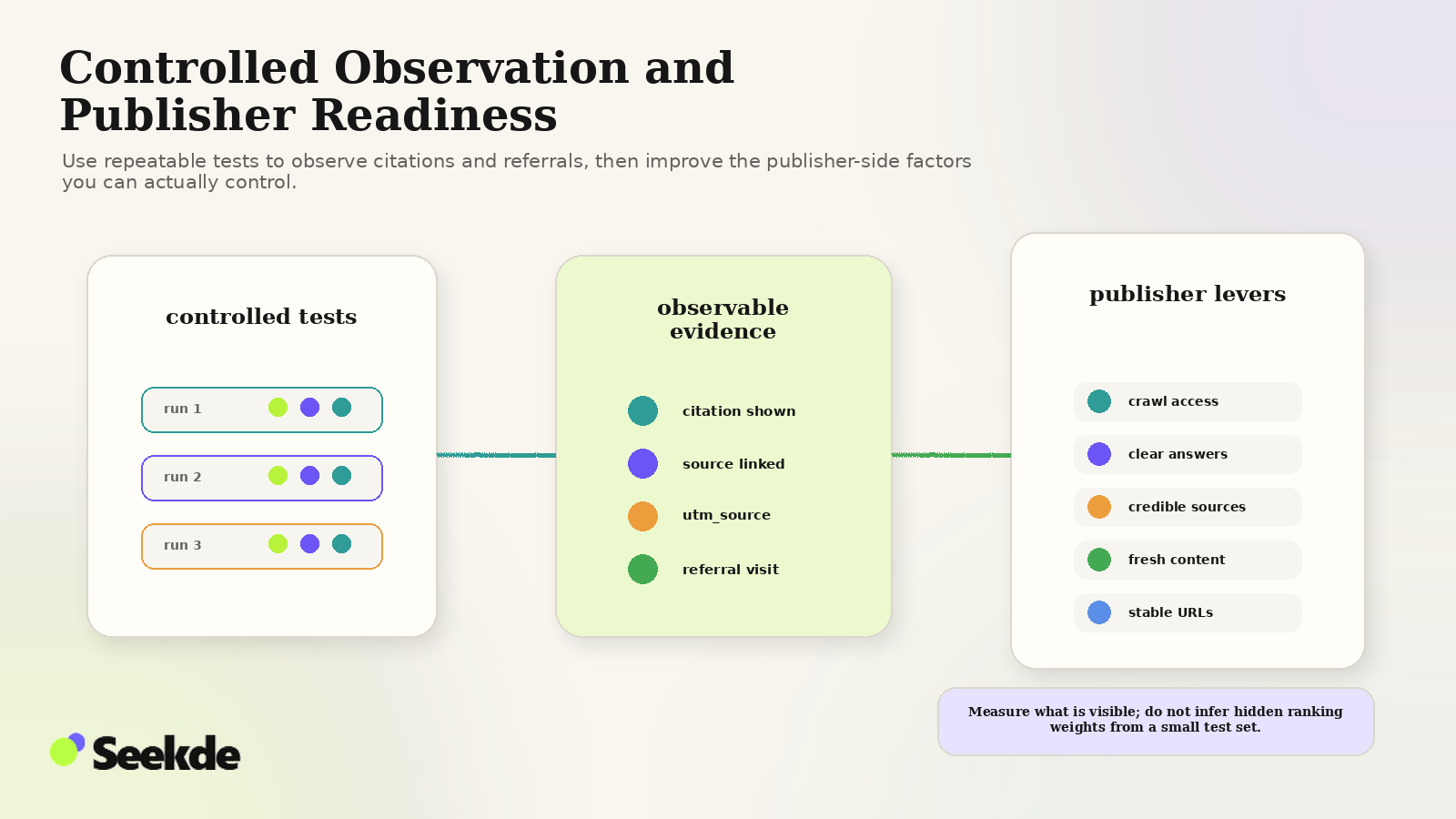
To observe how ChatGPT Search surfaces web sources under real-world conditions, Seekde conducted a controlled observation suite across eight distinct queries (two informational, two technical, two commercial, and two time-sensitive) plus repeated verification runs.
| Query Category | Prompt Text | Visible Search Invocation | Inline Citations Rendered | Primary Sourced Domains |
|---|---|---|---|---|
| Informational | “what is retrieval augmented generation in search” | No visible web-search invocation was observed | None visible | No cited source path visible; underlying knowledge route not observable from UI |
| Informational | “how do search engines use large language models for answering questions” | No visible web-search invocation was observed | None visible | No cited source path visible; underlying knowledge route not observable from UI |
| Technical | “how to block ai crawlers using robots txt” | No visible web-search invocation was observed | None visible (syntax code block generated) | No cited source path visible; underlying knowledge route not observable from UI |
| Technical | “llms txt standard specification for ai agents” | Yes (web search invoked) | Clickable source pill: “llms-txt +1” | llmstxt.org |
| Commercial / Comparison | “best enterprise search engines comparing elasticsearch and algolia” | No visible web-search invocation was observed | None visible (comparison table generated) | No cited source path visible; underlying knowledge route not observable from UI |
| Commercial / Comparison | “cloudflare vs fastly cdn edge caching performance and pricing” | No visible web-search invocation was observed | None visible (matrix table generated) | No cited source path visible; underlying knowledge route not observable from UI |
| Time-Sensitive | “latest news on google search console generative ai reporting” | Yes (web search invoked) | Clickable source pill: “Google for Developers +1” | developers.google.com |
| Time-Sensitive | “latest perplexity sonar model updates and agent api migration” | Yes (web search invoked) | Clickable source pill: “Perplexity +1” | perplexity.ai |
Observational Findings & Methodology Limitations
(Seekde Controlled Observational Sample — September 2026)
- Selective Search Invocation: On general conceptual, architectural, and comparative prompts (Q01, Q02, Q03, Q05, Q06), no visible web-search invocation was observed. The system answered directly without rendering search indicator badges or source citation pills. Conversely, prompts involving recently updated specifications (Q04
llms.txtv2) and time-sensitive platform announcements (Q07 Google Search Console generative AI report rollout, Q08 Perplexity Sonar API retirement) automatically invoked live web search. - Citation Presentation: When search was triggered, responses incorporated clickable inline pill badges (such as
Google for Developers +1andllms-txt +1) linked directly to external publisher URLs. - Repeated-Run Sourcing Variance: When time-sensitive query Q07 was repeated under identical conditions, web search was invoked again, but the primary citation pill shifted from
Google for Developers (+1)in Run 1 toGoogle Support (+1)in Run 2. This observation confirms that repeated executions of the same prompt can yield source variation across authoritative domains covering the same topic. - Sample Boundary: These observations reflect behavior within Seekde’s defined 10-run test sample on unauthenticated consumer surfaces. They describe observed UI state and must not be interpreted as permanent platform-wide retrieval rules or proof of specific ranking criteria.
Full experimental data and capture paths are documented in our research methodology archive.
Publisher Readiness Strategy
Building visibility in ChatGPT Search calls for an editorial approach that emphasizes verifiable facts and original substance:
- Answer High-Intent Questions Directly: Position core factual definitions, pricing tables, and implementation parameters near the top of the document to ensure immediate clarity and utility for readers.
- Prioritize Primary Documentation: When reporting on industry developments or technical standards, cite and link primary sources. Authoritative pages that provide verifiable provenance ensure sound factual grounding.
- Differentiate from Tactical "Citation Hacks": Avoid manipulative tactics such as artificially stuffing brand mentions or generating superficial prompt-variant pages. Sustainable presence in answer engines is earned through structural authority and genuine information gain. For an overview of generative search optimization principles, see What Is Generative Engine Optimization (GEO)?.