AI Share of Voice (SOV) is the percentage of observable AI-answer visibility your brand captures relative to a defined competitor set across a fixed group of prompts and runs. It is only meaningful when the query set, platforms, sampling method, and denominator stay consistent, and it should not be treated as traffic, ranking position, or market share.
It provides a comparative benchmark of competitive prominence across generative answer engines such as Google AI Overviews, ChatGPT Search, Perplexity, and Microsoft Copilot. However, AI share of voice is useful only when the denominator is explicitly defined and transparently disclosed.
Unlike absolute visibility metrics—such as Brand Mention Rate or Citation Rate—Share of Voice is inherently zero-sum. Increasing your share can occur because your brand was cited more often, or simply because a tracked competitor was cited less often. Without disciplined prompt selection, competitor qualification, and intent segmentation, AI SOV easily degenerates into misleading vanity reporting.
The Fundamental Mathematical Formulas
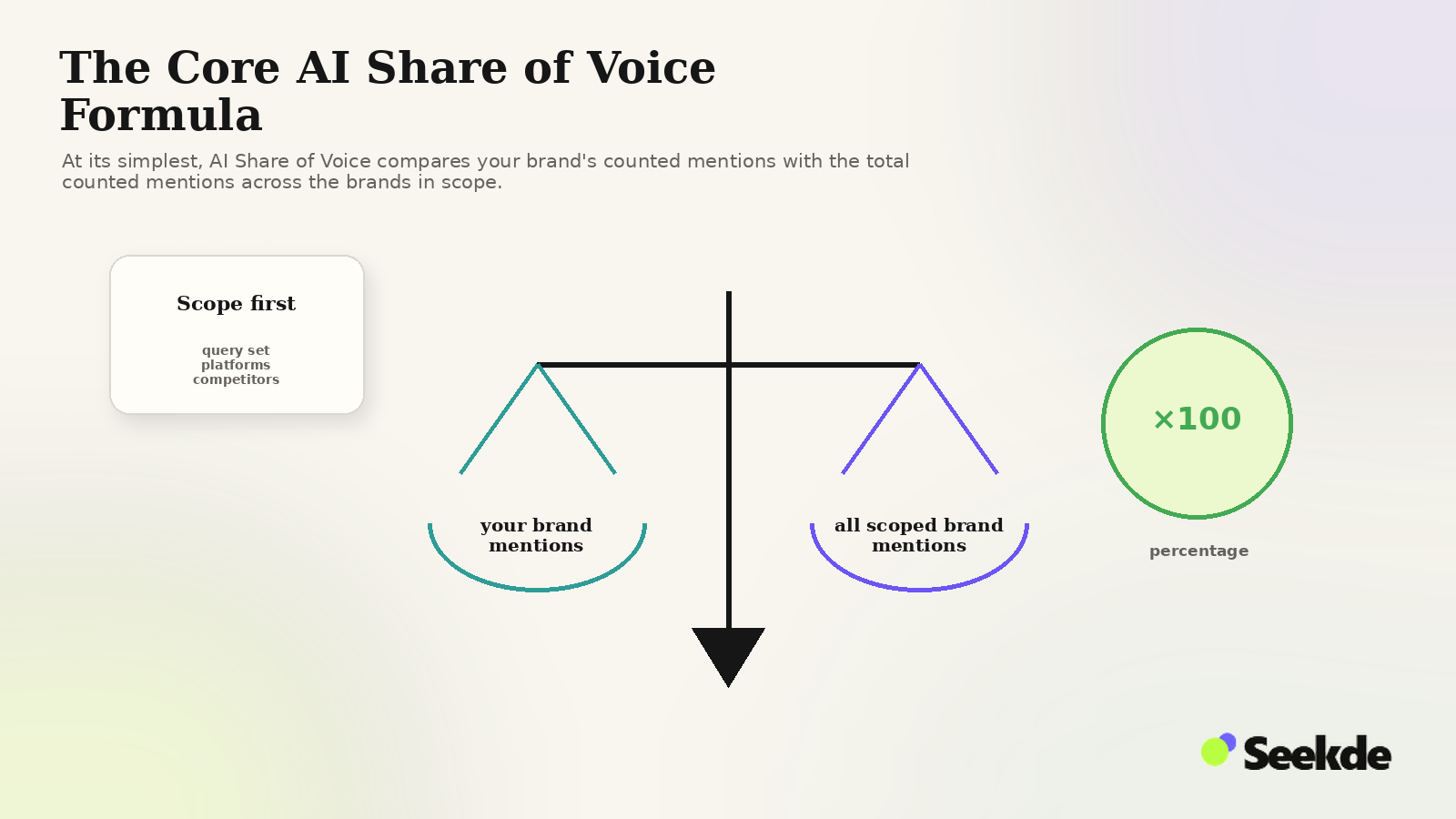
At its core, unweighted mention-based AI share of voice divides the volume of observed brand occurrences by the total occurrences across a designated competitor cohort.
1. Unweighted Mention Share of Voice
The standard mention-based formulation is:
$$text{Mention AI SOV (%)} = left( frac{M{text{brand}}}{sum{i=1}^{n} M_{i}} right) times 100$$
Where $M{text{brand}}$ is the total number of valid responses where your brand was named, and $sum M{i}$ is the total sum of brand mentions across all $n$ tracked brands (including your own) across the tested prompt set.
Worked Example:
Across 500 observed query executions of commercial B2B prompts, five project management platforms are monitored. Across all responses, the tracked brands receive 400 total mentions:
- Brand A (Your Brand): 120 mentions
- Competitor 1: 140 mentions
- Competitor 2: 80 mentions
- Competitor 3: 40 mentions
- Competitor 4: 20 mentions
$$text{Brand A Mention SOV} = left( frac{120}{400} right) times 100 = 30%$$
Crucial Interpretation: This result means Brand A captured 30% of brand mentions within that specific 500-run dataset. It does not mean Brand A owns 30% of "all AI search."
2. Citation Share of Voice
Because mentions and citations represent fundamentally different search events (as detailed in AI Citations vs Brand Mentions), search teams must compute an independent Citation SOV:
$$text{Citation AI SOV (%)} = left( frac{C{text{domain}}}{sum{i=1}^{n} C_{i}} right) times 100$$
Where $C{text{domain}}$ is the number of times your official web pages are hyperlinked as sources, and $sum C{i}$ is the total citations earned by competitor domains.
Comparing Mention SOV against Citation SOV reveals critical competitive dynamics. A legacy competitor may capture 45% of mention share due to strong brand memorization in base model weights, but capture only 10% of citation share because modern neural retrieval models favor your updated, data-dense technical documentation.
The Denominator Problem in AI Search
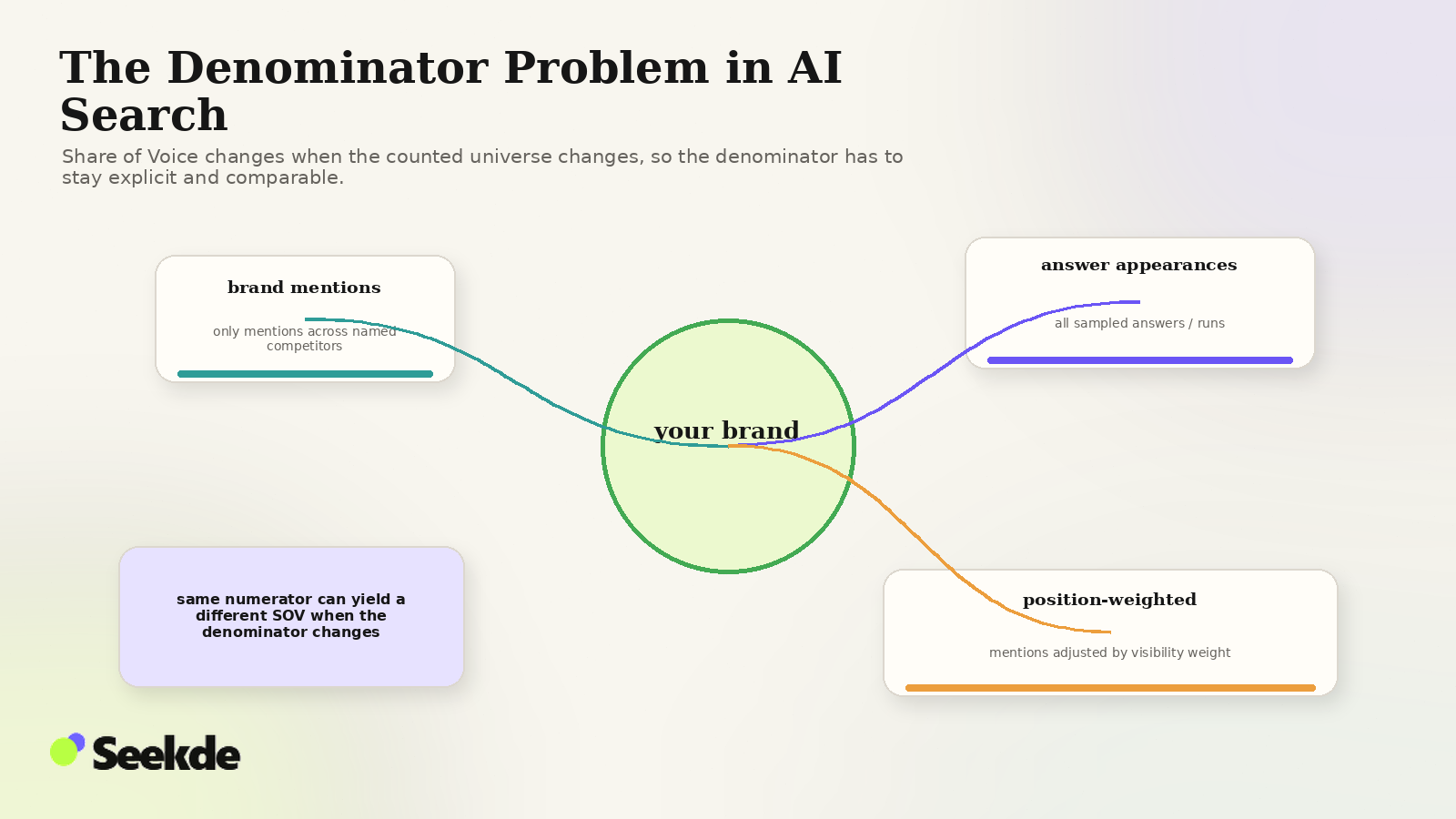
The most significant risk in calculating AI share of voice is the "denominator problem." In traditional search, market share is often estimated against total estimated search volume for a keyword list. In generative search, there is no public ledger of search volume, and answers are synthesized dynamically.
Every AI SOV calculation depends entirely on human choices:
- Which prompts are included: A prompt set heavy on enterprise features will yield completely different shares than one focused on budget pricing.
- Which competitors count: Selectively omitting a dominant market leader will artificially inflate your brand’s reported share.
- Which platforms are measured: ChatGPT Search, Google AI Overviews, and Perplexity use different retrieval indices and rarely yield identical shares.
- Handling multi-brand answers: Whether an answer that names four competitors counts once for each brand or weights repetitive token mentions.
- Observation frequency & time window: Whether data reflects a single point-in-time test or a multi-run longitudinal average.
- Geographic and localization settings: Queries executed from London will surface different local vendor ecosystems than queries executed from New York.
Two independent research teams can audit the same company on the same day and report 15% and 42% AI Share of Voice respectively—and both figures can be mathematically accurate relative to their divergent datasets.
Share of Voice (SOV) vs. Share of Model (SOM)
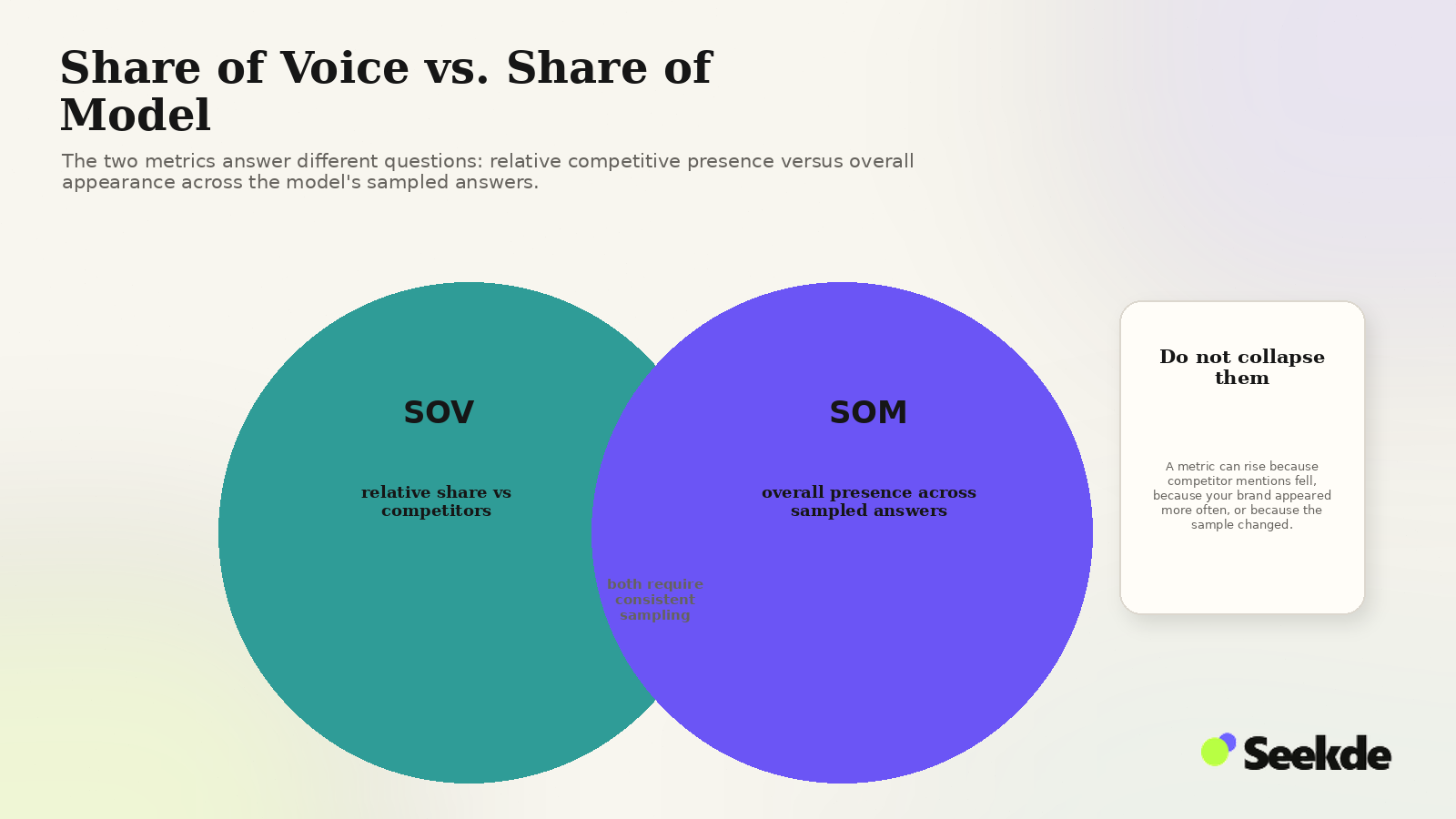
In emerging industry discussions, the terms "Share of Voice" and "Share of Model" are often used interchangeably, but technical practitioners should distinguish them:
| Attribute | AI Share of Voice (SOV) | Share of Model (SOM) |
|---|---|---|
| Operational Definition | Real-time presence in live synthesized search outputs, including real-time web retrieval (RAG). | Latent presence inside the frozen parametric memory (weights) of a base language model without web search. |
| Retrieval Dependency | Highly dependent on real-time web search, crawler indexation, and citation retrieval. | Dependent on base pre-training data, Common Crawl representations, and alignment fine-tuning. |
| Volatile vs Durable | Volatile; can shift daily as web content updates and retrieval algorithms change. | Durable; remains static until the model provider releases a new checkpoint or fine-tune. |
| Actionable Lever | Real-time content optimization, structured data, entity PR, and passage engineering. | Long-term digital PR, widespread Wikipedia/Wikidata entity inclusion, and corpus-scale brand recognition. |
Measuring real-time generative search platforms like Perplexity, ChatGPT Search, or Google AI Overviews evaluates AI Share of Voice. Measuring raw foundation models queried without web access evaluates Share of Model.
Should Position in Generative Answers Be Weighted?
In traditional SEO, rank weighting is straightforward: Position 1 receives a ~30% CTR, while Position 10 receives ~1%. In generative answers, the value of position is nuanced:
- In a bulleted list of "Top 5 Software Solutions," the first-listed brand generally enjoys primacy of attention.
- In a comparative summary table, all brands in the table are evaluated simultaneously.
- In a narrative paragraph ("While Platform X is best for enterprise compliance, Platform Y is preferred for rapid deployment"), position is dictated by syntactic contrast rather than hierarchical superiority.
The Risk of Premature Weighting
Attempting to create an arbitrary "Weighted SOV" (e.g., assigning 5 points for position 1, 3 points for position 2) introduces subjective bias unless backed by eye-tracking or clickstream data.
Seekde’s Methodological Standard:
- Maintain and report the unweighted mention share as a primary benchmark.
- If position weighting is applied for executive reporting, explicitly declare the weighting formula (e.g., linear rank decay) and present the unweighted figure alongside it for transparency.
How to Make AI Share of Voice Actionable
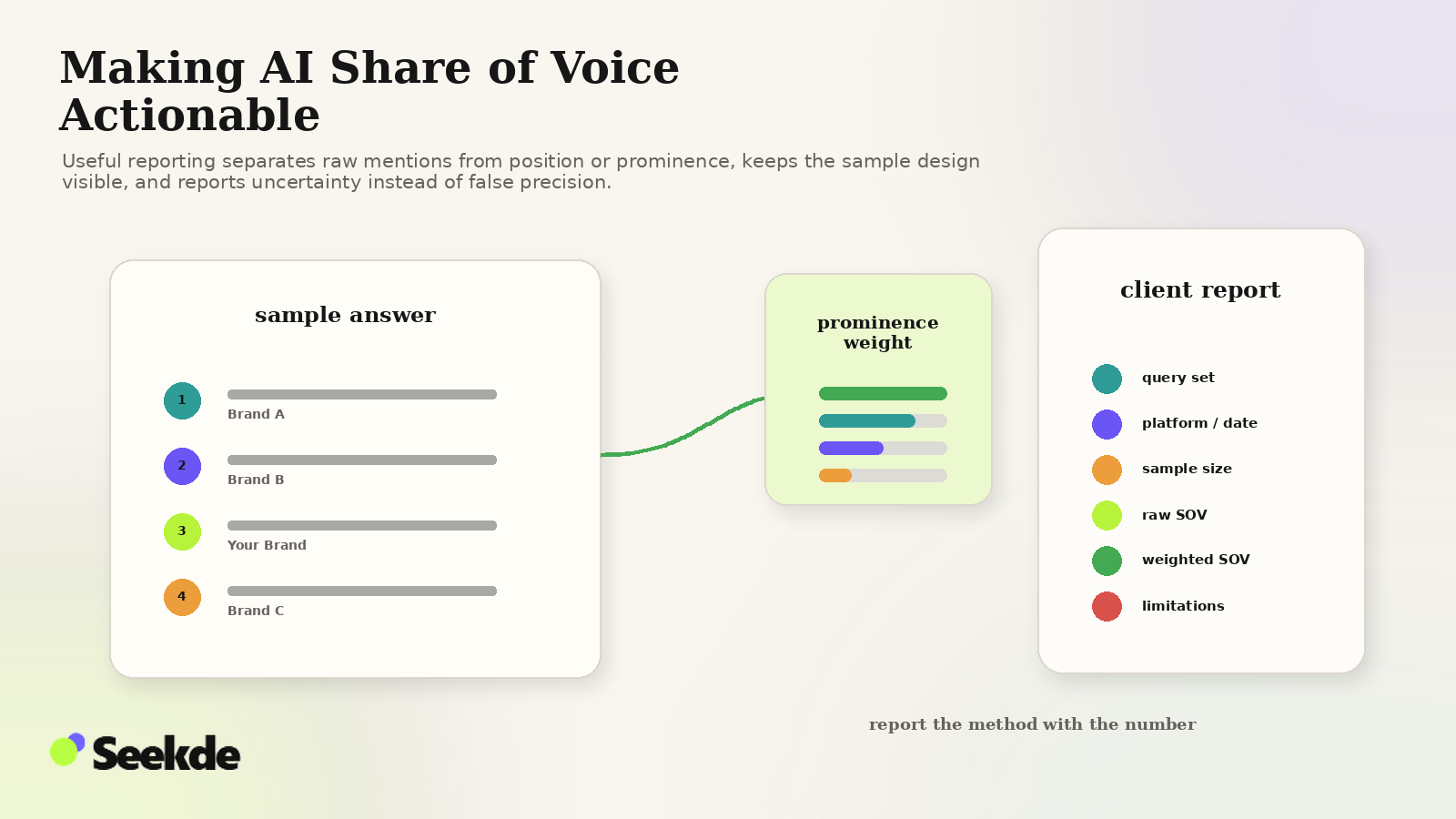
Aggregate, company-wide Share of Voice figures hide the exact insights search teams need to make decisions. To make AI SOV actionable, decompose your data across three structural axes:
Informational vs Commercial vs Comparative
Google AIO vs ChatGPT vs Perplexity
Direct Competitors vs Aggregate Reviewers
1. Segment by Search Intent
An aggregate 30% Share of Voice can conceal severe strategic vulnerabilities.
Case Study: The Danger of Blended SOV
A cybersecurity firm evaluates its presence across 150 prompt runs and calculates an overall 32% Share of Voice. When broken down by intent tier:
- Technical & Informational Prompts ("How does zero-trust network access work?"): 68% SOV. The firm’s educational guides dominate source citations.
- Commercial & Evaluative Prompts ("Best enterprise ZTNA vendors"): 8% SOV. Generative engines consistently recommend three legacy competitors and omit the firm.
The blended 32% figure gives executives a false sense of security. In reality, the company is winning top-of-funnel educational research while being shut out of active buying evaluations.
2. Segment by Search Platform
Never aggregate performance across platforms into a single "AI Share" number. Retrieval mechanisms differ fundamentally:
- If your ChatGPT SOV is 45% but your Google AI Overview SOV is 10%, your site may have strong authority in OpenAI’s retrieval index while suffering from traditional organic ranking deficits on Google’s primary index.
- Platform segmentation isolates whether visibility issues are engine-specific or universal.
3. Account for Sample Size and Non-Determinism
Because generative answers vary stochastically between runs (as explained in Why AI Visibility Rankings Change Between Runs), a Share of Voice metric based on a single pass of 20 prompts carries massive statistical uncertainty.
- A 40% SOV based on 10 prompt queries can swing by 20 percentage points on a re-run simply due to model temperature.
- Reliable SOV tracking relies on repeated observations (a minimum of three to five runs per prompt) across at least 75–100 distinct prompt variants.
- Report rolling 14-day or 30-day averages rather than day-over-day point fluctuations.
What AI Share of Voice Cannot Tell You
While AI SOV is an essential comparative metric, search practitioners must recognize its analytical boundaries:
- Does Not Indicate User Clicks or Traffic: A 40% Share of Voice does not mean your site captured 40% of referral clicks. A brand mentioned without a hyperlink earns zero direct web traffic.
- Does Not Reflect Business Conversions: Presence in a list of options does not reveal whether users converted into paying customers.
- Does Not Reveal Algorithmic Motivation: SOV shows what the model outputted, not why the underlying neural network selected that entity over another.
- Does Not Guarantee Brand Advocacy: An AI engine may mention your brand neutrally or even negatively (e.g., "Platform X has powerful features but frequent complaints regarding implementation complexity"). High mention volume with poor sentiment can be damaging.
The Client & Executive Reporting Standard
When presenting AI Share of Voice to executive leadership or consulting clients, reporting must follow strict disclosure hygiene. A standalone statement like "Our AI Share of Voice is 34%" is unscientific and unreproducible.
A comprehensive AI SOV report should provide the following seven metadata parameters:
| Parameter | Required Disclosure | Example Value |
|---|---|---|
| 1. Target Metric | Unweighted Mention SOV vs Citation SOV | Unweighted Mention Share of Voice |
| 2. Prompt Corpus Size | Number of unique natural language prompts tested | 120 standardized prompts |
| 3. Observation Volume | Total valid model responses executed | 600 total observations (5 runs per prompt) |
| 4. Platform Scope | Specific engine and interface evaluated | ChatGPT Search (Desktop Web) |
| 5. Time Window | Date and time range of test execution | 2026-09-01 to 2026-09-05 (Rolling 5-Day) |
| 6. Tracked Cohort | Full roster of tracked competitor brands | Brand A (Client), Competitor B, Competitor C, Competitor D |
| 7. Multi-Brand Counting Rule | Response-level presence vs token recurrence | Response-level (max 1 mention recorded per brand per response) |
Without these explicit parameters, Share of Voice metrics cannot be compared longitudinally and cannot be verified by third parties.