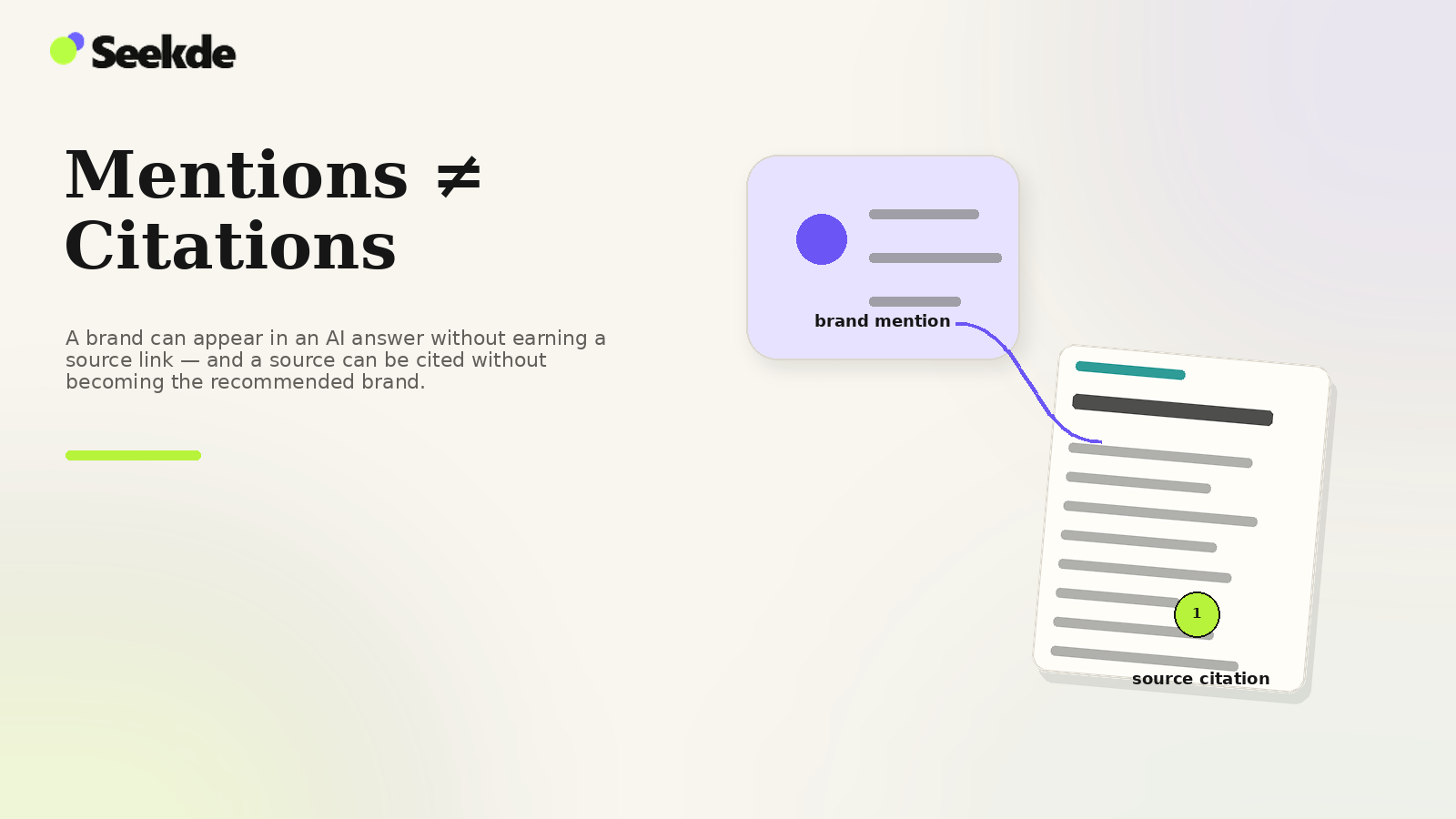
An AI brand mention occurs when a generative answer explicitly names an entity in its text; an AI citation occurs when the interface embeds a clickable link or identifies a specific webpage as a supporting source.
While mentions and citations frequently co-occur, treating them as identical metrics distorts search visibility audits. A brand can be repeatedly recommended by an AI search engine without a single link pointing back to its website. Conversely, a brand’s technical documentation or research study can be cited as ground truth without the engine ever recommending the company’s products.
Understanding the difference between mentions and citations—and mastering the mechanisms that convert unlinked brand presence into clickable, traffic-driving citations—is one of the most critical skills in Generative Engine Optimization (GEO).
Terminology Breakdown: The Spectrum of AI Visibility
In generative search environments, presence exists along a spectrum from latent entity recognition to direct referral pathways:
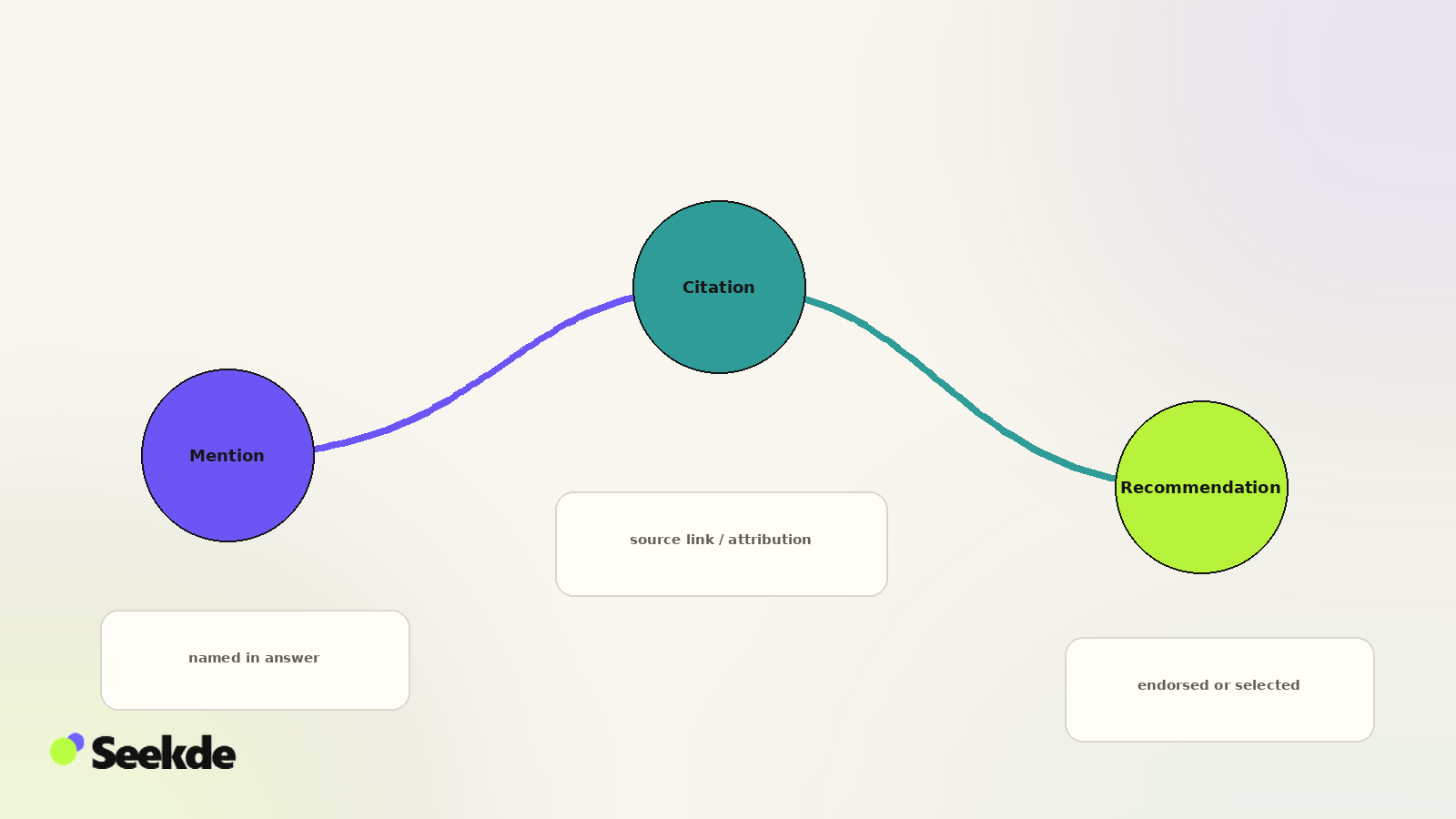
Model recognizes brand as a topical concept
Brand is named in text; no link provided
Brand is framed as a solution or vendor
Brand is mentioned, but reviewer is linked
Official brand domain is hyperlinked
- Entity Presence: The base language model’s latent awareness of an entity within its pre-trained weights. The model "knows" what the company does, its industry category, and its primary products based on training corpora.
- Unlinked Brand Mention: The engine names the company, product, or executive within the synthesized natural language response, but provides no clickable hyperlink to the brand’s digital properties.
- Commercial Recommendation: The engine explicitly recommends the brand as a suitable solution to a user’s commercial inquiry ("For enterprise inventory tracking, Platform X is widely recommended").
- Source Inclusion / Footnote Citation: A webpage URL or domain is displayed in a peripheral source carousel, reference drawer, or numbered footnote. The link supports a factual claim, but the text may not mention the domain owner by name.
- Linked First-Party Citation: An active, clickable hyperlink that points directly to a page on your official domain, embedded inline or directly beside an explicit recommendation of your brand.
The Four Operational Quadrants of Generative Discovery
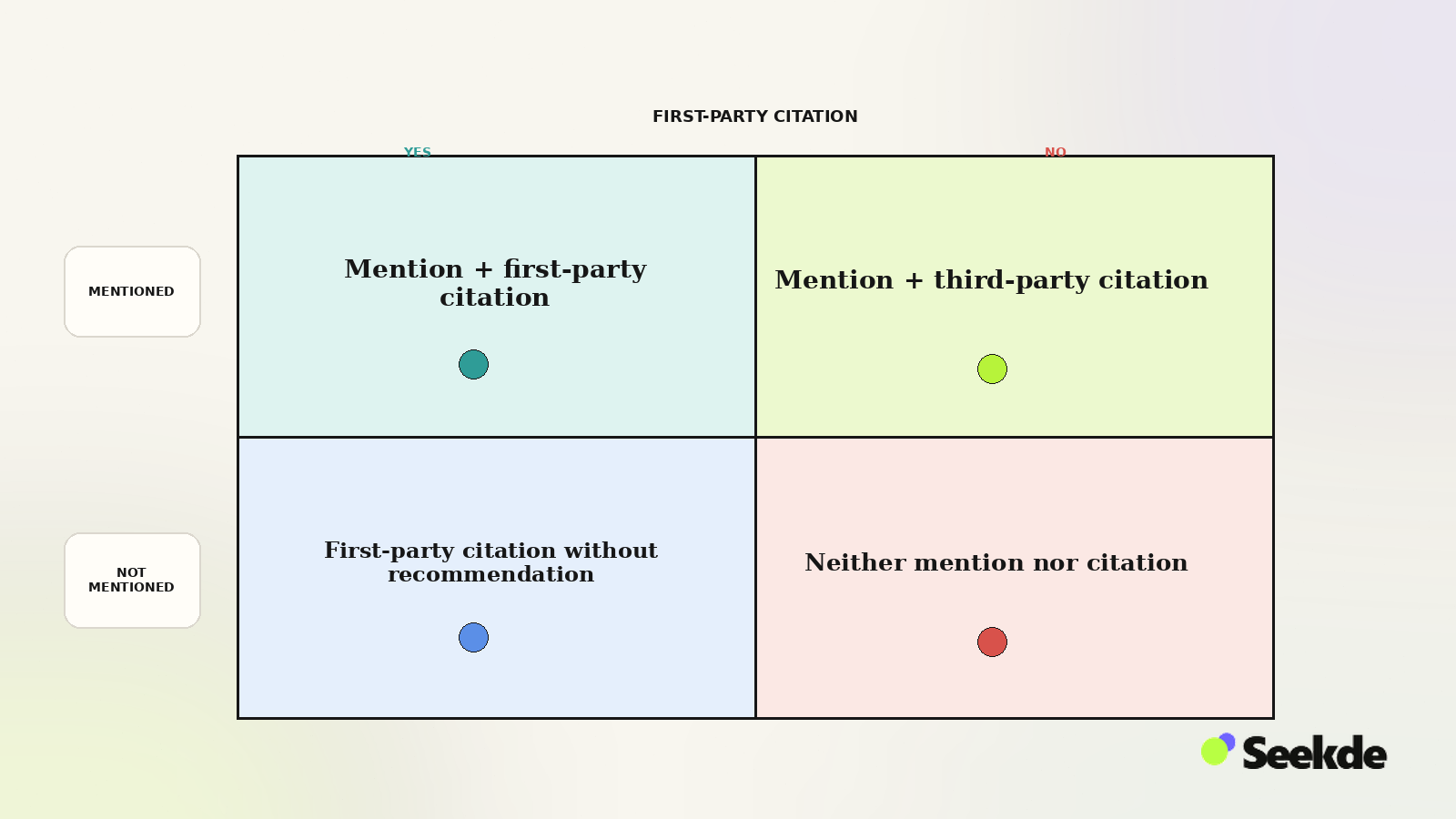
When auditing search results across Google AI Overviews, ChatGPT Search, Perplexity, and Microsoft Copilot, every prompt outcome falls into one of four distinct operational quadrants:
| Operational Quadrant | Mention Status | Citation Status | Strategic Meaning |
|---|---|---|---|
| Quadrant 1: Optimal Grounding | Present | First-Party Citation | Maximum search authority; brand is recommended and directly supported by its own URLs. |
| Quadrant 2: Surrogate Authority | Present | Third-Party Citation Only | High brand awareness, but traffic is intercepted by aggregators, review sites, or media. |
| Quadrant 3: Uncredited Reference | Absent | First-Party Citation | Site has informational authority as a research source, but lacks commercial recommendation. |
| Quadrant 4: Discovery Absence | Absent | Absent | Entity is missing from the generative response; retrieval pipelines bypass the brand entirely. |
Quadrant 1: Mention + First-Party Citation (Optimal Grounding)
- What Occurs: The AI engine synthesizes an answer recommending your product and explicitly embeds a link to your official product or pricing page as the supporting citation.
- Example: "For SOC 2 compliance automation, Vanta is widely used because it integrates directly with cloud providers [1]." (Where
[1]links directly tovanta.com). - Strategic Impact: Optimal business outcome. The user receives an authoritative brand endorsement and a direct, frictionless path to click through to your website.
Quadrant 2: Mention with Third-Party Citation (Surrogate Authority)
- What Occurs: The engine recommends your product, but cites an independent review site (such as G2, Capterra, or Trustpilot), a community forum (such as Reddit), or a digital trade magazine.
- Example: "For mid-market CRM automation, Platform X is known for customizable pipelines [G2 Review]."
- Strategic Impact: The brand captures brand awareness and consideration, but loses the direct referral click. The user must either navigate through an intermediary review platform—where they are exposed to competing ads—or manually open a new browser tab to search for your brand.
Quadrant 3: First-Party Citation without Recommendation (Uncredited Reference)
- What Occurs: An AI engine extracts a statistic, framework, or technical definition from your research report, blog post, or documentation, linking to your domain in the source list. However, your product is not included in the synthesized recommendations.
- Example: An engine answers "What is the average cost of customer acquisition in B2B SaaS?", citing your annual benchmark report, but when the user asks "Which marketing software should I buy?", your platform is not mentioned.
- Strategic Impact: Your domain possesses high topical authority and technical crawlability, but your commercial entities are disconnected from your informational assets.
Quadrant 4: Neither Mention nor Citation (Discovery Absence)
- What Occurs: Neither your brand name nor your domain appears in the generated response across multiple prompt executions.
- Strategic Impact: The entity suffers from a complete discovery deficit for that prompt cluster. The cause may be technical (crawler blocks), structural (lack of clear entity definitions), or authoritative (lack of independent digital PR).
The Attribution Leakage Problem: Why AI Cites Third Parties
The most common frustration for enterprise brands is Attribution Leakage: why does an AI search engine recommend our platform while citing a third-party review site rather than our official homepage?
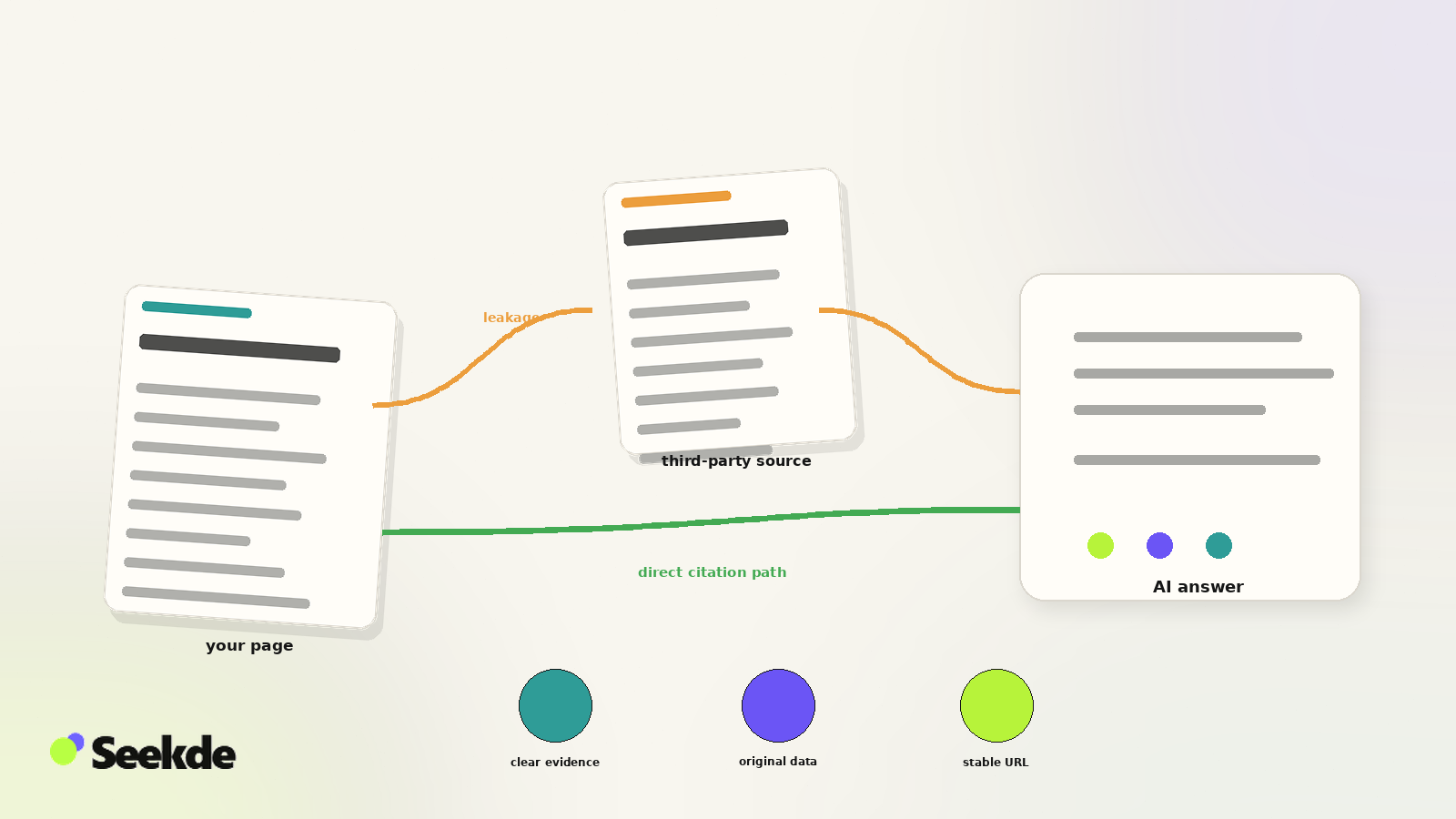
Generative answer engines use neural rerankers trained to prioritize objective, unbiased, and comprehensive ground truth. When an AI crawler evaluates an official brand page alongside a third-party aggregator review:
- Commercial Bias Detection: Official product pages are perceived as marketing copy. Neural models favor comparative directories (e.g., G2, Capterra, Software Advice) because they aggregate verified customer feedback, pros and cons, and standardized feature matrices.
- Entity Density: Aggregator pages mention multiple competing entities in structured HTML tables. A single scrape of an aggregator provides the retrieval engine with comparative context across four or five brands simultaneously.
- Structured Claim Quotability: Media outlets and software directories format product summaries using concise, declarative sentences that are easier for RAG pipelines to extract than stylized brand slogans.
How to Reclaim First-Party Citations
To convert Quadrant 2 mentions into Quadrant 1 first-party citations:
- Publish Objective Feature & Pricing Data: Replace vague marketing copy ("Seamless, best-in-class workflows") with precise, factual specifications ("Supports SAML 2.0, SCIM provisioning, and REST API webhooks with 99.99% uptime").
- Structure Comparative Content Transparently: Provide comprehensive comparison matrices on your own domain that acknowledge trade-offs rather than presenting one-sided claims.
- Implement Structured Entity Schema: Use JSON-LD
SoftwareApplication,Product, andOrganizationmarkup with unambiguoussameAsreferences to your Wikidata and LinkedIn entities.
Clickable Links vs. Source Inclusion Across Major Platforms
Different AI search engines handle citation presentation and link mechanics through divergent user interfaces:
Numbered inline brackets [1] + domain source pills
Inline text link cards + right-hand source panel
Top-right source carousel + expandable site badges
Numbered superscripts linked to Bing search cards
- Perplexity: Highly visible citation UI. Every factual claim features an inline numbered bracket (e.g.,
[1],[2]), accompanied by a top-level source card carousel displaying domain favicons and article headlines. - ChatGPT Search: Displays interactive link cards directly beneath synthesized answers, as well as a right-hand "Sources" sidebar. Clickable citation links append
utm_source=chatgpt.comparameters for web analytics tracking. - Google AI Overviews: Houses citations in a top-right expandable carousel and within inline expandable drop-down pills directly following synthesized paragraphs.
- Microsoft Copilot: Utilizes numbered superscript tags that trigger hover cards displaying article titles, snippets, and Bing-grounded destination URLs.
Actionable Optimization Strategies by Quadrant
To systematically improve generative discovery, align your optimization tactics with your current diagnostic quadrant:
Strategy for Quadrant 2 (Mentions without First-Party Citations)
- Audit Information Gaps: Inspect the third-party pages the AI is currently citing. What specific data (pricing, feature limitations, system requirements) are they providing that your site omits?
- Create Self-Contained Answer Passages: Format key technical documentation with clear H2/H3 subheadings and concise 40–60 word answer paragraphs that neural extractors can lift cleanly.
- Verify Technical Bot Access: Ensure OAI-SearchBot, Googlebot, and PerplexityBot are not blocked in your Robots.txt file.
Strategy for Quadrant 3 (First-Party Citations without Recommendations)
- Bridge Informational Authority to Products: In high-performing research guides and industry whitepapers, embed natural contextual bridges explaining how your commercial product applies the research.
- Strengthen Internal Semantic Links: Link research articles directly to relevant product solution pages using descriptive, entity-rich anchor text, following principles in How Internal Linking Helps AI Search Discovery.
- Clarify Brand Identity: Ensure informational guides explicitly state your brand’s role as a vendor in that domain, reinforcing your entity relationship in schema markup.
Strategy for Quadrant 4 (Complete Absence)
- Establish Foundation Entity Citations: Seed the retrieval pool by building co-occurrence across respected industry trade publications, guest analyses, and podcast transcripts.
- Target Uncontested Long-Tail Prompts: Build content targeting specific, multi-word technical problems before attempting to win broad head-term commercial roundups.
Executive Reporting: Separating Mentions from Citations
When reporting AI search performance to marketing executives or clients, maintain strict separation between brand awareness metrics and acquisition metrics:
| Metric | Business Function | Primary KPI |
|---|---|---|
| Brand Mention Rate | Brand Awareness & Consideration | % of category prompt runs naming brand |
| First-Party Citation Rate | Technical GEO Authority & Traffic Pipeline | % of prompt runs hyperlinking official domain |
| Third-Party Citation Ratio | Attribution Leakage Indicator | % of mentions supported solely by intermediaries |
| Referral Sessions & Conversions | Commercial ROI & Pipeline Attribution | Downstream conversions tracked in GA4 |
Separating these signals transforms an AI visibility audit from a passive score into a clear operational roadmap.