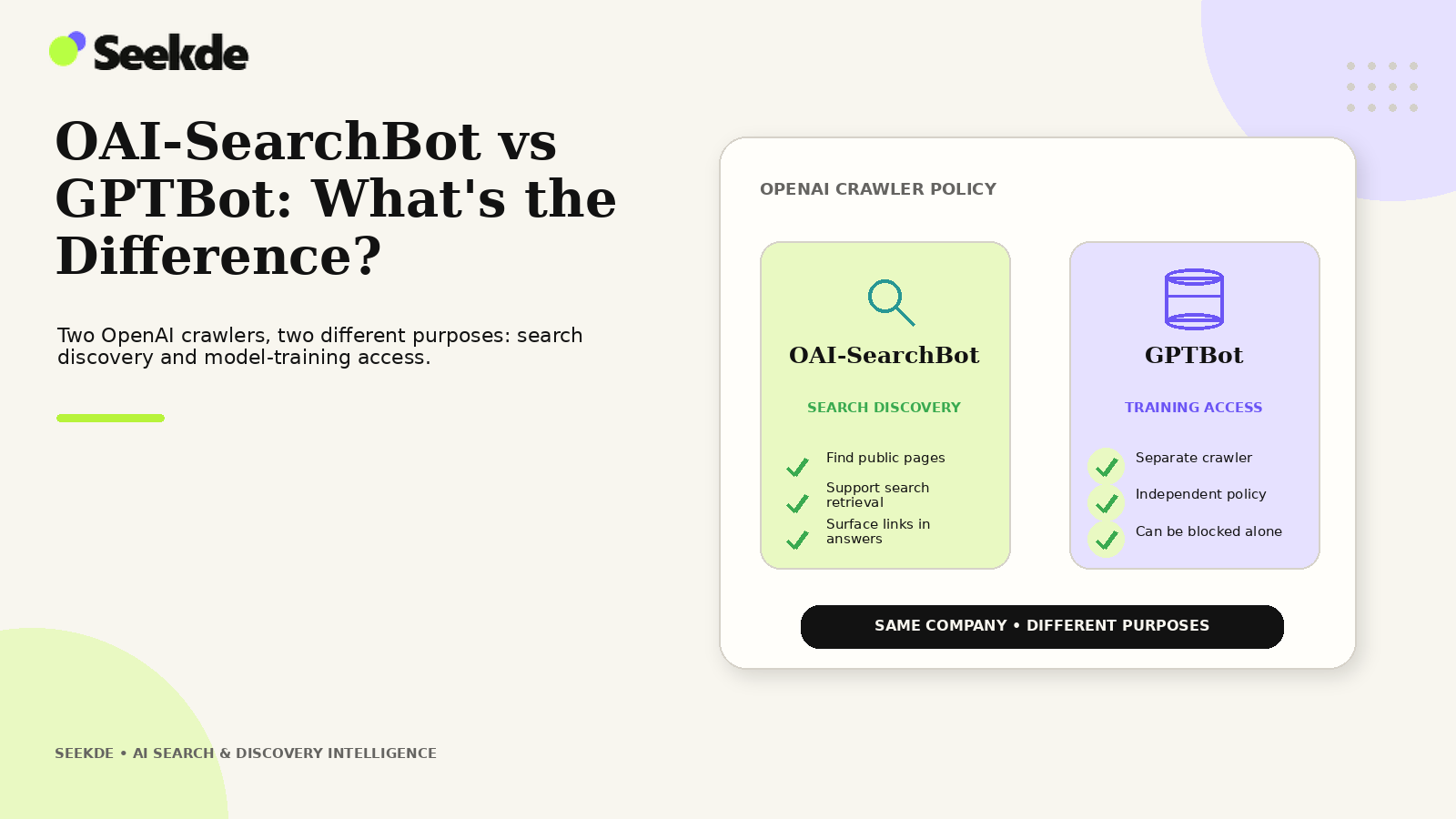
OAI-SearchBot and GPTBot are two distinct web crawlers operated by OpenAI that serve completely different technical purposes. OAI-SearchBot is OpenAI’s dedicated search crawler used to discover, crawl, and index web content specifically for ChatGPT Search, enabling websites to surface as cited sources in answer summaries. GPTBot, by contrast, is an asynchronous web scraper used exclusively to collect training data to build and refine OpenAI’s foundation models.
A persistent and costly misconception among digital publishers is assuming that blocking GPTBot removes a website from ChatGPT Search, or that allowing GPTBot is necessary to receive search referral traffic. In reality, OpenAI decoupled these systems. A publisher can block GPTBot in robots.txt to prevent content ingestion into foundation training datasets while simultaneously permitting OAI-SearchBot to maximize organic search visibility, citations, and click-through referral traffic from ChatGPT Search.
Architectural Comparison: OAI-SearchBot vs. GPTBot
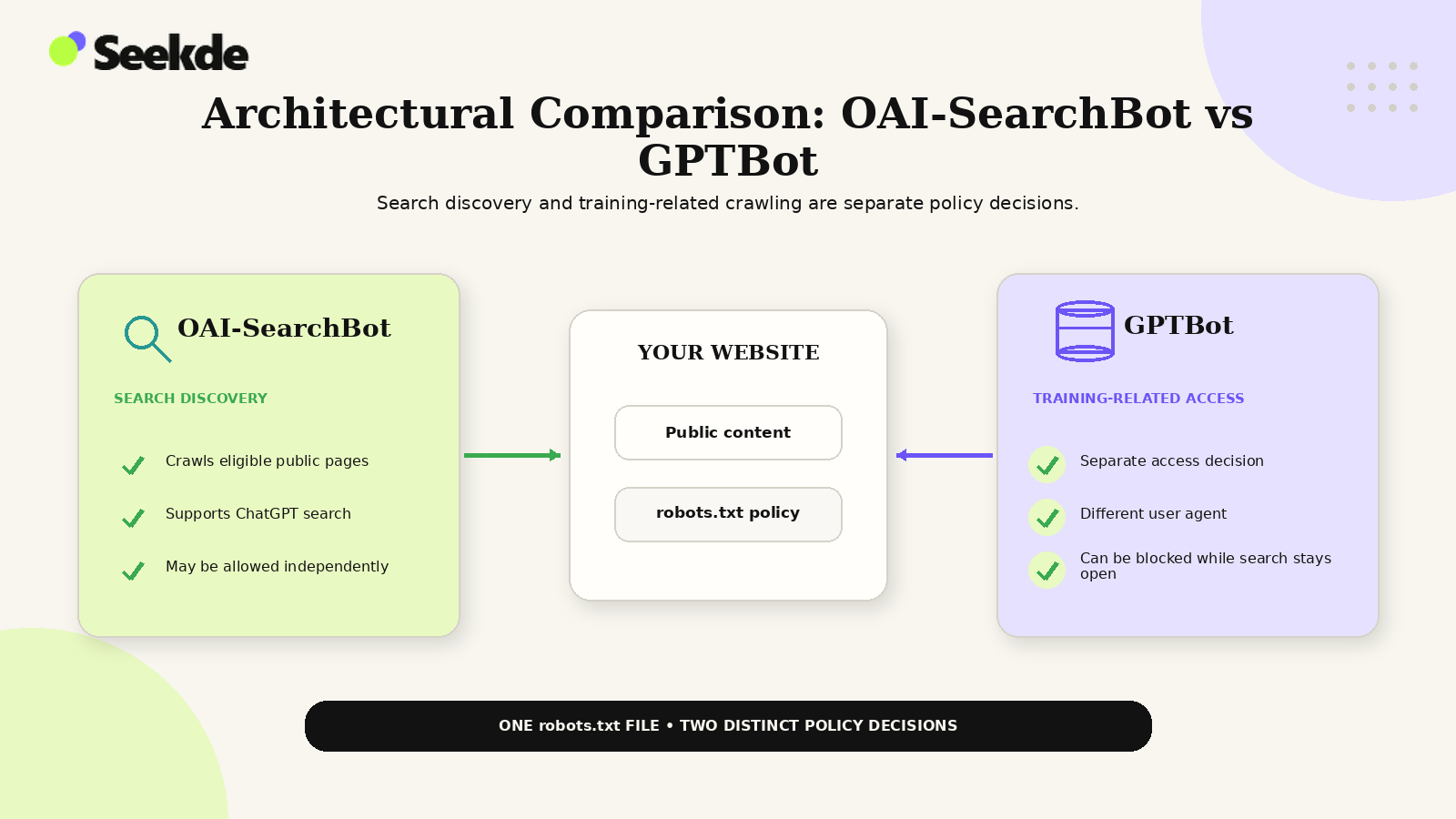
Understanding how these bots operate within OpenAI’s infrastructure clarifies why independent robots.txt directives are necessary:
OAI-SearchBot
- Role: Search Discovery & Indexing
- Product: ChatGPT Search
- Data Lifecycle: Search Index & RAG
- Referral Mechanism: Direct Citations & Links
- Robots Token: User-agent: OAI-SearchBot
- Reverse DNS: *.search.openai.com
GPTBot
- Role: Model Training Scraper
- Product: GPT-4, GPT-5, etc.
- Data Lifecycle: Offline Pre-training Corpora
- Referral Mechanism: None (Parametric Memory)
- Robots Token: User-agent: GPTBot
- Reverse DNS: *.openai.com
Side-by-Side Technical Specification
| Feature / Attribute | OAI-SearchBot | GPTBot | ChatGPT-User (Reference) |
|---|---|---|---|
| Primary Function | Indexing and retrieving content for ChatGPT Search | Scrapes public web data for training generative foundation models | On-demand fetching triggered by an individual user prompt |
| User-Agent String Token | OAI-SearchBot |
GPTBot |
ChatGPT-User |
| Full User-Agent Header | Mozilla/5.0 AppleWebKit/537.36 (KHTML, like Gecko; compatible; OAI-SearchBot/1.0; +https://openai.com/searchbot) |
Mozilla/5.0 AppleWebKit/537.36 (KHTML, like Gecko; compatible; GPTBot/1.0; +https://openai.com/gptbot) |
Mozilla/5.0 AppleWebKit/537.36 (KHTML, like Gecko; compatible; ChatGPT-User/1.0; +https://openai.com/bot) |
| Direct Referral Traffic? | Yes (Generates inbound referral clicks via citation links) | No (No direct citations or live user sessions) | Conditional (Only if the specific user clicks the link they asked about) |
| Robots.txt Standard | Honors RFC 9309 | Honors RFC 9309 | Honors RFC 9309 |
| Reverse DNS Domain | search.openai.com |
openai.com |
No standard rDNS (Egress proxy pool) |
| Published IP Feed | https://openai.com/searchbot.json |
https://openai.com/gptbot.json |
https://openai.com/chatgpt-user.json |
| Impact of Blocking | Excludes pages from ChatGPT Search index and real-time citation | Prevents content from being used to train future OpenAI foundation models | Prevents ChatGPT from fetching links pasted directly into user prompts |
For a broader overview of how OpenAI’s agents fit into the global landscape of search engines and scraping bots, see our master guide to AI Crawlers Explained.
Detailed Role: What OAI-SearchBot Actually Does
OpenAI launched OAI-SearchBot to power its conversational search capabilities within ChatGPT. As documented in the OpenAI Publisher FAQ, OAI-SearchBot is used to index web content for ChatGPT Search, enabling websites to surface in search results and citation snippets. Unlike general training scrapers that process content offline over months-long development cycles, OAI-SearchBot operates continuously to discover new documents, re-crawl updated pages, and populate OpenAI’s search retrieval index.
When a user submits a search query in ChatGPT (such as "best enterprise data governance platforms 2026"), the system evaluates the prompt using Retrieval-Augmented Generation (RAG). To produce an accurate, grounded answer with transparent citations, the retrieval engine queries its index of documents crawled by OAI-SearchBot or dispatches search queries across trusted index partners.
Key characteristics of OAI-SearchBot:
- Search Discovery: It crawls links, parses metadata, extracts clean HTML copy, and maps site structure.
- Attribution & Citations: Content indexed by
OAI-SearchBotprovides the text snippets that ChatGPT evaluates to generate in-line footnote citations and source cards. - No Model Training: OpenAI explicitly documents that crawling activity performed under the
OAI-SearchBotuser-agent is not used to train or fine-tune foundation models such as GPT-4 or successor architectures.
Blocking OAI-SearchBot tells OpenAI: "Do not index our site for ChatGPT Search." Consequently, your domain will rarely or never appear as a linked source card in ChatGPT Search answers. To learn more about optimizing for this retrieval engine, review our guide to ChatGPT Search SEO.
Detailed Role: What GPTBot Actually Does
GPTBot is OpenAI’s foundation model training crawler, officially documented in OpenAI’s Bot Documentation. Its operational mandate is broad-scale data ingestion across the open web. The raw text gathered by GPTBot is sanitized, tokenized, and processed into pre-training corpora that teach neural networks language structure, factual relationships, coding syntax, and world knowledge.
Key characteristics of GPTBot:
- Offline Training Corpora: Data crawled by
GPTBotenters OpenAI’s deep learning pipeline. It affects parametric memory—the internal weight associations stored inside neural models. - No Real-Time Citations: A visit from
GPTBotdoes not create an index record for real-time search queries. It does not provide direct links back to your website for current user queries. - Intellectual Property & Licensing: Decisions to allow or block
GPTBotare typically driven by copyright strategy, commercial content licensing, and data sovereignty considerations rather than SEO.
Blocking GPTBot tells OpenAI: "Do not use our website to train your foundation models." As confirmed in OpenAI’s publisher guidance, blocking GPTBot does not prevent a website from appearing in ChatGPT Search, provided OAI-SearchBot is allowed.
The Third Agent: Understanding ChatGPT-User
In addition to OAI-SearchBot and GPTBot, OpenAI deploys a third user agent: ChatGPT-User. Technical administrators frequently confuse ChatGPT-User with autonomous crawlers, leading to misconfigured firewalls.
As defined in OpenAI’s documentation, ChatGPT-User is not an autonomous crawler. It is an on-demand HTTP client that acts strictly on behalf of an active ChatGPT user. If an enterprise user pastes an internal documentation URL into ChatGPT and prompts, "Summarize this deployment runbook," ChatGPT dispatches a request using the ChatGPT-User header to retrieve the page content.
Operational implications:
- If you disallow
ChatGPT-Userin robots.txt under RFC 9309, ChatGPT will display an error message to the user stating that it cannot access the specified URL due to robots.txt restrictions. ChatGPT-Userrequests originate from OpenAI’s cloud egress proxies rather than search crawler infrastructure.- Blocking
ChatGPT-Userdoes not prevent autonomous search crawling or model training; it only stops manual URL analysis by end-users.
Publisher Decision Matrix: Choosing the Right Policy
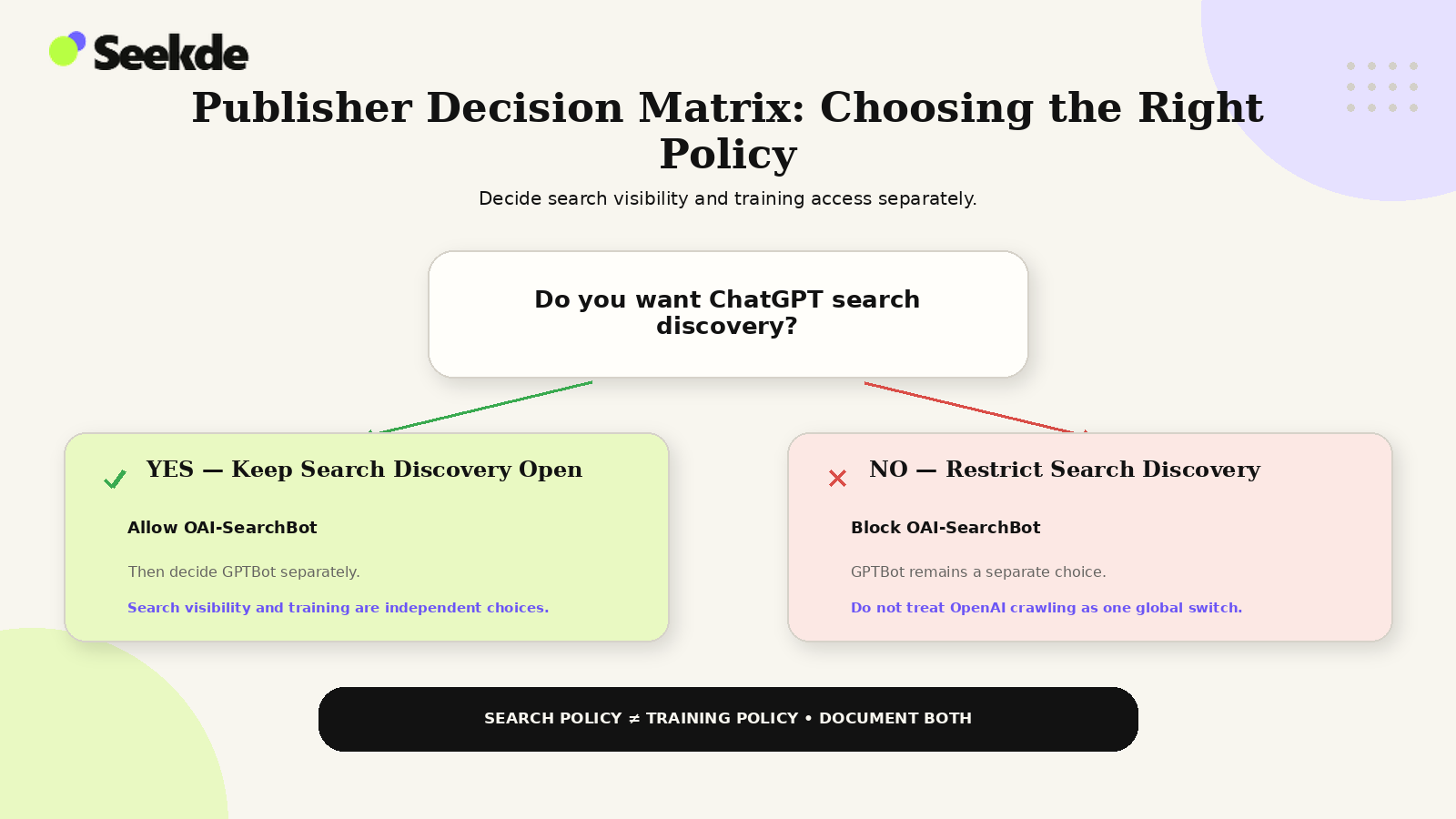
Organizations should not adopt robots.txt rules copied from third-party blogs without evaluating their strategic objectives. The table below outlines four standard publisher postures and their corresponding robots.txt rules:
Want Search Referral Traffic? Want Search Referral Traffic? YES NO Want AI Model Want AI Model Want AI Model Want AI Model Training? Training? Training? Training? YES NO YES NO
[Posture 2: [Posture 3: [Posture 4: Full Open] Search-Only] Training Only] Complete Block]
Posture 1: Maximum Search Visibility with Model Training Opt-Out (Recommended for Most Publishers)
This posture is ideal for digital publications, media outlets, SaaS providers, and corporate blogs. It allows ChatGPT Search to index content, generate citations, and send referral traffic, while preventing OpenAI from ingesting content to train foundation models:
# Allow ChatGPT Search discovery and attribution
User-agent: OAI-SearchBot
Allow: /

# Block foundation model training scraping
User-agent: GPTBot
Disallow: /
Posture 2: Full Open Web Participation
Ideal for open-source projects, academic institutions, and organizations that actively want their documentation represented both in search retrieval and within foundation model parametric weights:
# Allow both search discovery and model training
User-agent: OAI-SearchBot
Allow: /

User-agent: GPTBot
Allow: /
Posture 3: Complete OpenAI Exclusion
Ideal for private subscription services, protected database providers, or organizations with strict legal directives prohibiting any interaction with OpenAI systems:
# Block both search discovery and model training
User-agent: OAI-SearchBot
Disallow: /

User-agent: GPTBot
Disallow: /
Posture 4: Selective Directory Protection
A hybrid configuration allowing search indexing across public articles while preventing both search and training crawlers from touching proprietary research or member areas:
# Allow search indexing for public articles, protect private directories
User-agent: OAI-SearchBot
Disallow: /private-research/
Disallow: /member-resources/
Allow: /

# Block training scraping entirely
User-agent: GPTBot
Disallow: /
For full syntax validation and rule precedence instructions, refer to our comprehensive guide on How to Configure Robots.txt for AI Search Crawlers.
RFC 9309 Robots.txt Precedence Traps
When implementing separate rules for OAI-SearchBot and GPTBot, understanding the Robots Exclusion Protocol standard (RFC 9309) is essential to avoid accidental misconfigurations.
The Group Isolation Rule
Under RFC 9309, a crawler evaluates only the single user-agent group that most specifically matches its name. Crawlers do not merge rules from a specific group with rules defined under the generic User-agent: * block.
Consider this flawed configuration:
# Flawed Configuration
User-agent: *
Disallow: /admin/
Disallow: /staging/

User-agent: OAI-SearchBot
Allow: /
In this example, because a dedicated User-agent: OAI-SearchBot block exists, OAI-SearchBot ignores the User-agent: * block entirely. Consequently, /admin/ and /staging/ are left completely open to OAI-SearchBot!
To prevent security leaks, replicate path restrictions within the specific crawler group:
# Correct RFC 9309 Configuration
User-agent: *
Disallow: /admin/
Disallow: /staging/

User-agent: OAI-SearchBot
Disallow: /admin/
Disallow: /staging/
Allow: /

User-agent: GPTBot
Disallow: /
How to Verify Authentic OpenAI Crawler Requests
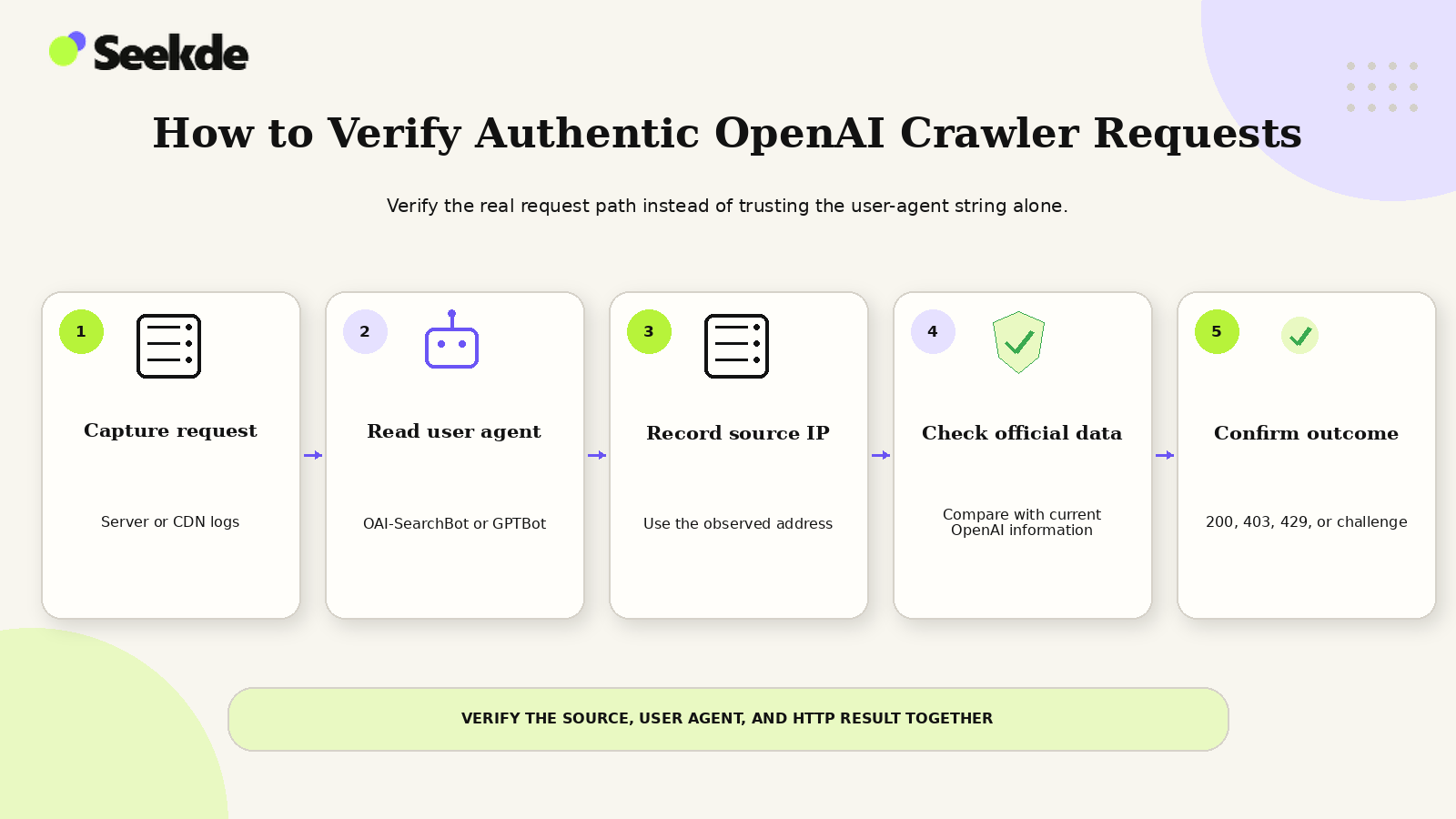
Because malicious bots frequently forge user-agent strings, web servers must verify incoming requests claiming to be OAI-SearchBot or GPTBot.
Step 1: Two-Way Reverse DNS (rDNS) Verification
OpenAI crawlers support forward-confirmed reverse DNS. The originating IP address must resolve to a valid OpenAI domain, and that domain must resolve back to the same IP.
Verifying OAI-SearchBot
-
Perform a reverse DNS lookup on the client IP address:
host 20.171.206.123 # Output should point to a hostname under search.openai.com # Example: 123.206.171.20.in-addr.arpa domain name pointer search-20-171-206-123.search.openai.com. -
Confirm the returned domain ends strictly in
.search.openai.com. -
Perform a forward DNS query on the returned hostname:
host search-20-171-206-123.search.openai.com
# Must match the original IP: 20.171.206.123
Verifying GPTBot
For GPTBot, the authoritative reverse DNS hostnames resolve under .openai.com (for example, crawl-xxx.openai.com).
Step 2: Automated Validation via Published IP Feeds
If your infrastructure sits behind a cloud firewall (such as Cloudflare or AWS WAF) that does not support per-request rDNS lookups, ingest OpenAI’s published JSON feeds to maintain dynamic IP allowlists:
- OAI-SearchBot IP Feed:
https://openai.com/searchbot.json - GPTBot IP Feed:
https://openai.com/gptbot.json
Common Edge Failure: Robots.txt Allows, but WAF Blocks
A frequent diagnostic finding during site audits is that while OAI-SearchBot is explicitly allowed in robots.txt, the domain receives zero citations in ChatGPT Search. Upon inspecting raw web server logs, the issue is revealed: the edge security layer (WAF) is terminating crawler connections with HTTP 403 Forbidden.
Modern web application firewalls employ behavioral bot-mitigation engines that flag automated HTTP requests as threats. Because AI crawlers originate from cloud data centers (e.g., Microsoft Azure, AWS) and do not solve interactive browser challenges, default WAF security policies often block them silently.
Diagnostic Protocol
- Search Access Logs for HTTP 403s:
grep -i "OAI-SearchBot" /var/log/nginx/access.log | awk '{print $1, $9, $7}' | grep "403" - Review Firewall Security Events: In your CDN dashboard (Cloudflare, Fastly, CloudFront), filter security events for User-Agent matching
OAI-SearchBot. - Implement Managed Bypass Rules: Configure a custom WAF rule that permits traffic matching verified OpenAI ASN/IP ranges or verified bot signatures to bypass Web Application Firewall challenges.
For an end-to-end testing workflow covering status codes, headers, and rendering, see our comprehensive AI Search Crawlability Audit.
What Robots.txt Controls Cannot Do
While configuring robots.txt for OAI-SearchBot and GPTBot is critical, site owners must maintain realistic expectations regarding the boundaries of the protocol:
- No Retroactive Model Erasure: Disallowing
GPTBottoday does not delete knowledge, weights, or associations that foundation models acquired from your site during previous training runs. Robots.txt is a forward-looking crawl instruction, not a data deletion mechanism. - No Guarantee of Search Citations: Allowing
OAI-SearchBotgrants crawl access; it does not guarantee that ChatGPT Search will cite your content. Selection depends on retrieval relevance, content depth, factual accuracy, and query intent. Review How to Get Cited by ChatGPT for actionable citation optimization strategies. - No Protection Against Third-Party Scrapers: Disallowing
GPTBotdoes not stop unverified third-party scrapers that harvest web content and sell datasets to AI companies. Total proprietary data protection calls for server-side authentication and bot-detection infrastructure.
Summary: Key Takeaways for Technical Teams
- Decoupled Roles:
OAI-SearchBotgoverns ChatGPT Search discovery;GPTBotgoverns foundation model training. - Independent Policy: You can allow search citations while blocking model training by setting
Allow: /forOAI-SearchBotandDisallow: /forGPTBot. - Separate User Agent:
ChatGPT-Userhandles direct user link navigation and should not be confused with search or training bots. - RFC 9309 Isolation: Define all required path rules inside each crawler’s specific block to avoid exposing sensitive endpoints.
- Verify at the Network Layer: Use reverse DNS (
search.openai.com/openai.com) or published IP feeds to distinguish authentic crawlers from spoofed requests. - Check WAF Settings: Ensure edge firewalls do not block verified
OAI-SearchBotrequests with automated JavaScript challenges.