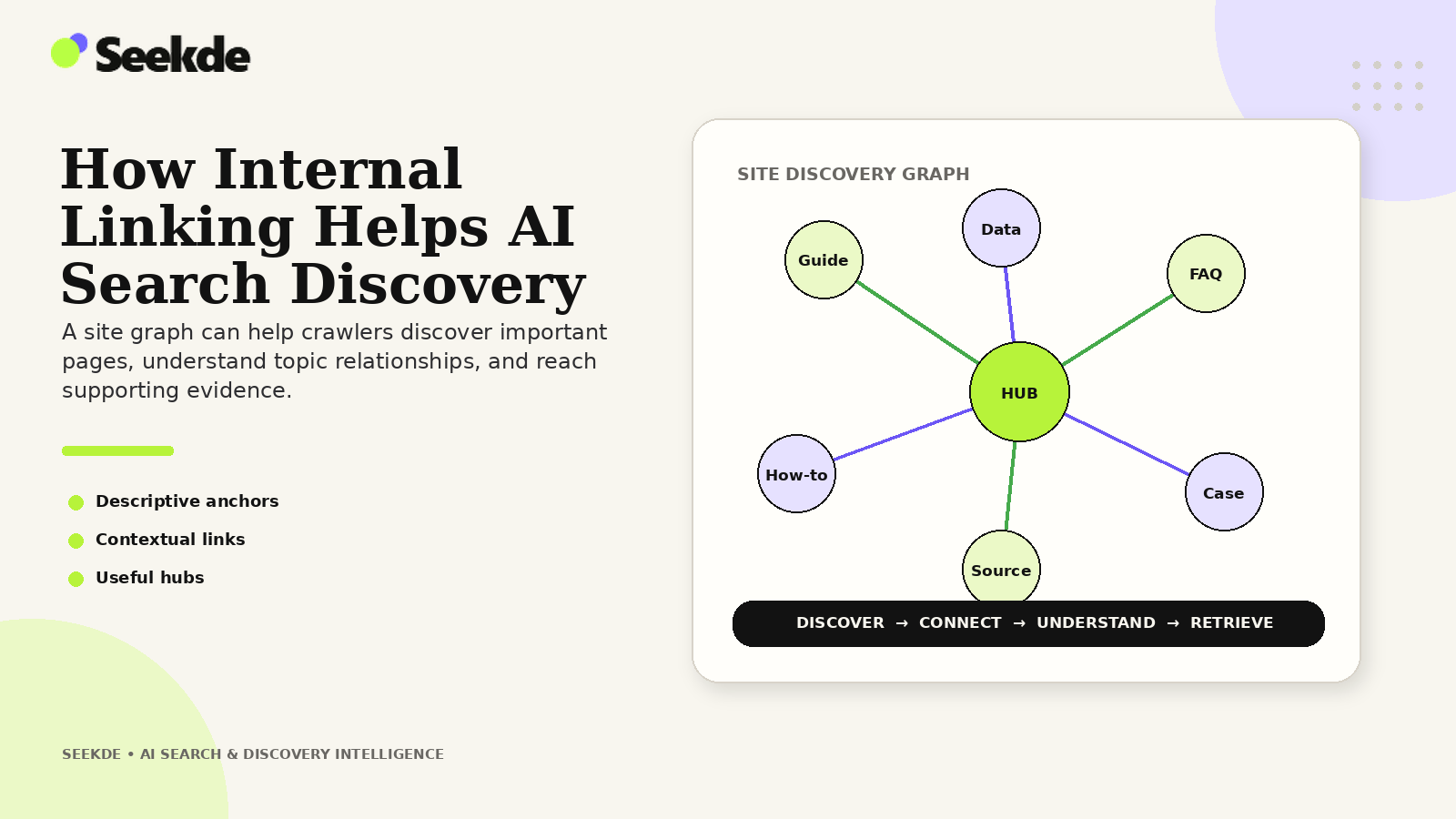
Internal linking accelerates AI search discovery by guiding automated crawlers along shallow, structured crawl paths and establishing clear semantic relationships between parent pillars and specialized subtopics. In generative answer engines like ChatGPT Search, Google AI Overviews, and Perplexity, retrieval systems do not independently invent knowledge; they retrieve source documents from underlying search indexes populated by web crawlers. If an authoritative page is buried deep within site architecture or isolated as an orphan page, search crawlers will fail to discover it, permanently excluding it from Retrieval-Augmented Generation (RAG) candidate sets.
To structure internal links effectively, technical teams must maintain a critical distinction: we do not assert that proprietary language models use internal links as a direct, internal ranking factor in their hidden generation algorithms. Rather, internal links establish the crawl paths, indexation pathways, and contextual entity relationships in the web index layer upon which answer engines rely. A disciplined internal linking graph ensures fast discovery for newly published content, passes topical context via descriptive anchor text, and prevents crawl traps that waste bot bandwidth.
How AI Search Systems Ingest Site Architecture
To understand why internal linking matters for generative search, examine how modern AI retrieval engines interact with a website’s link graph:
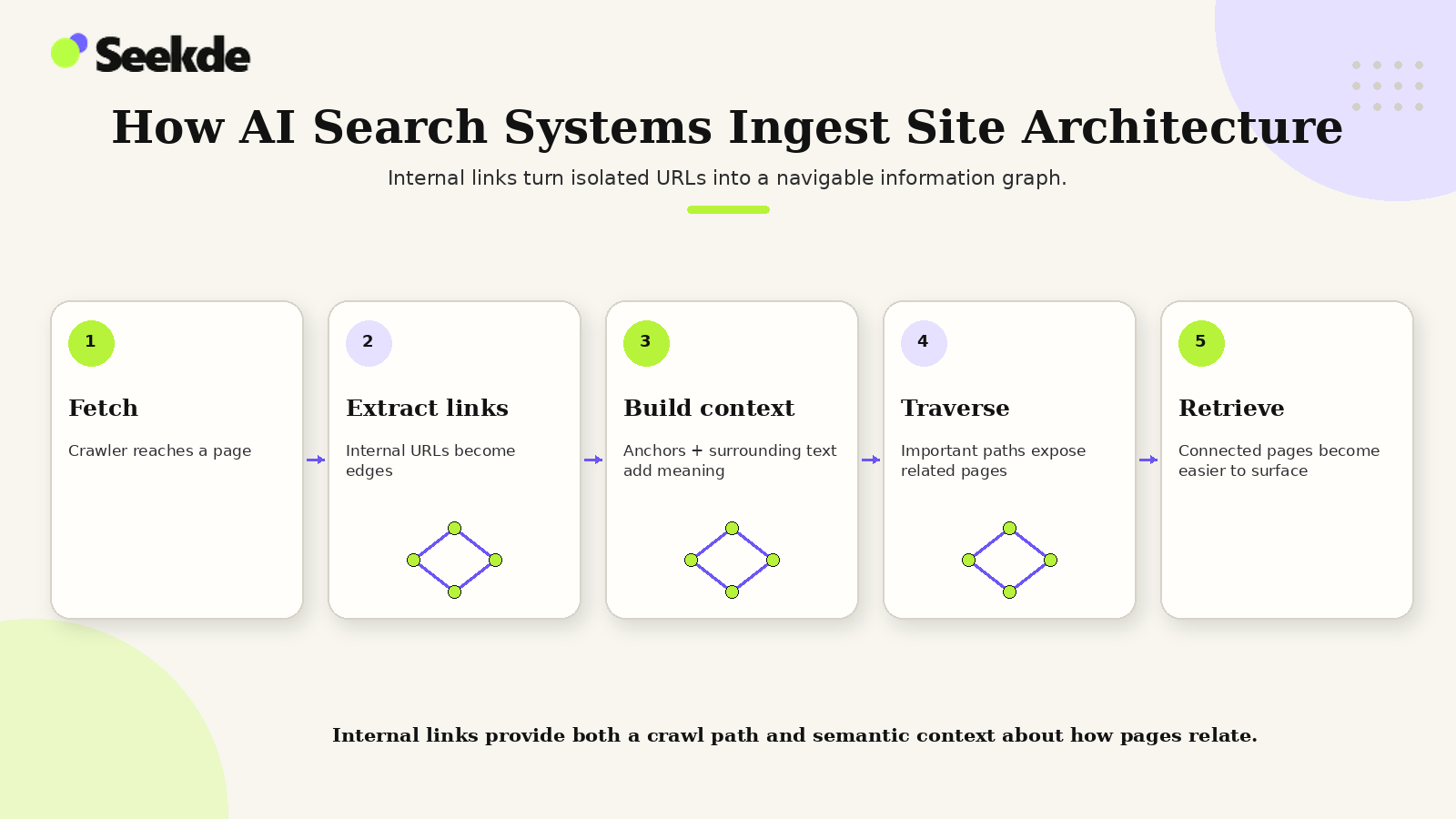
1. Crawl Depth and Bot Scheduling
AI search bots—such as Googlebot, OAI-SearchBot, and PerplexityBot—operate under resource constraints known as crawl budgets. In official documentation such as Google Search Central’s Get Started Guide, search engines explain that every page should be reachable by a crawlable link from another findable page, supplemented by XML sitemaps. While search engines do not mandate a specific click-depth threshold, Seekde recommends maintaining a practical architectural heuristic where high-priority content sits within 2–3 clicks of the homepage:
- Depth 1–2 (Seekde Recommended Core): Homepage, primary navigation hubs, and featured pillar guides receive the highest discovery priority.
- Depth 3 (Seekde Recommended Spoke Limit): Secondary topic spokes and categorized technical articles remain easily discoverable on routine schedules.
- Depth 4+ (Risk of Discovery Delays): Pages buried deeply in complex directory chains risk slower traversal and discovery latency.
This 2–3 hop guideline is a Seekde operational architecture heuristic rather than an engine-prescribed rule; Google’s documented standard focuses on ensuring reachability via crawlable links from other findable pages.
2. Semantic Context Passing via Anchor Text
When neural search systems build embedding vectors for a target webpage, they evaluate both the text on the page itself and the surrounding context of links pointing to that page. In vector space, anchor text acts as an external semantic descriptor:
- A link with descriptive anchor text like
[RFC 9309 robots.txt compliance](/robots-txt-ai-crawlers/)passes strong topical coordinates to the destination document. - A generic link like
[click here](/robots-txt-ai-crawlers/)or[read more](/robots-txt-ai-crawlers/)provides zero semantic value, forcing the retrieval engine to rely exclusively on on-page text parsing.
3. Topic Clusters and Topical Authority
Search engines organize web knowledge into semantic topic clusters. When a central pillar page links out to eight specialized spoke articles, and each spoke links back to the pillar and cross-links to relevant siblings, the linking structure forms a closed topical cluster. This reinforces to search engines that the publisher maintains deep, comprehensive coverage of the subject entity.
For a strategic overview of topic clusters in AI optimization, consult our foundational guide on What Is Generative Engine Optimization?.
First-Party Case Study: Analyzing Seekde’s Internal Link Graph
To evaluate how an intentional link graph functions in production, we programmatically analyzed the complete internal linking topology of Seekde’s live published corpus (Maps 1–32).
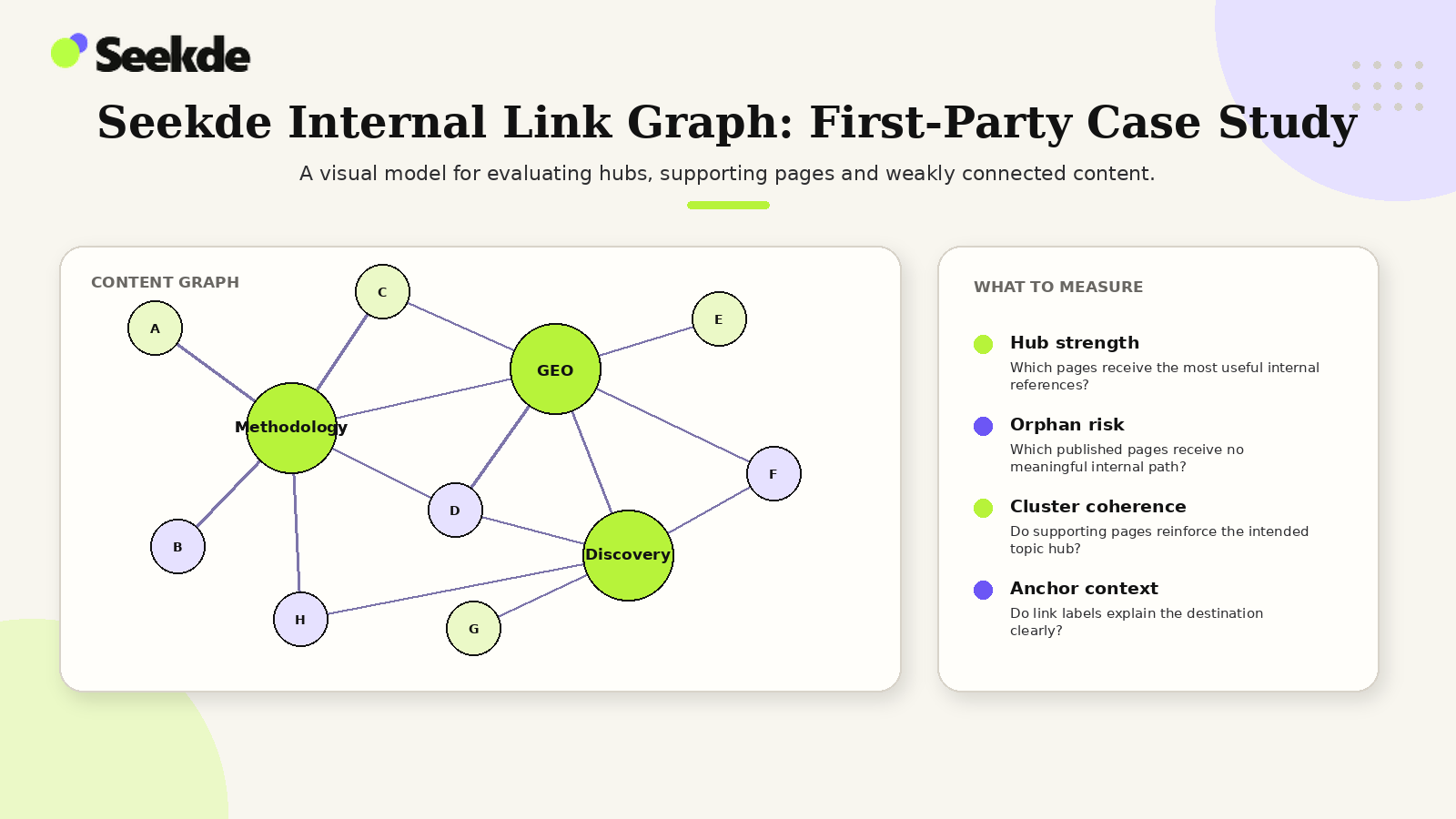
Connecting to Pillar: What Is AI Search Visibility? (Map 25)
Brand Measurement
- Map 26: Core Measurement Protocols
- Direct bidirectional links to Pillar
- Empirical brand presence tracking
AI Share of Voice
- Map 27: Share of Voice Frameworks
- Direct bidirectional links to Pillar
- Competitive domain visibility metrics
Citations vs Mentions
- Map 28: Terminology & Attribution
- Direct bidirectional links to Pillar
- Attributed citations vs unlinked mentions
Empirical In-Degree Distribution
Using a PHP graph analysis script across the Markdown source corpus, we measured the exact inbound internal link counts (in-degree) for all published documents:
| Rank | Canonical Target URL | Document Role | Inbound Internal Links (In-Degree) | Strategic Function in Architecture |
|---|---|---|---|---|
| 1 | /methodology/ |
Core Governance Pillar | 38 | Serves as the primary E-E-A-T anchor and methodology baseline across all technical deep dives |
| 2 | /what-is-generative-engine-optimization/ |
Foundational Pillar | 24 | Master conceptual hub defining Generative Engine Optimization (GEO) |
| 3 | /how-ai-search-engines-find-and-cite-content/ |
Retrieval Pillar | 17 | Core technical explainer detailing the multi-step retrieval and citation funnel |
| 4 | /google-ai-overviews-seo/ |
Platform Deep Dive | 14 | Primary reference for Google’s generative search behavior and SERP mechanics |
| 5 | /architecture-of-generative-answer-engines/ |
Systems Explainer | 13 | Explains the underlying vector database, embedding, and RAG retrieval layers |
| 6 | /blog/ |
Publication Archive Hub | 11 | Main chronological archive providing shallow 1-click depth from all article headers |
| 7 | /geo-vs-seo-vs-aeo/ |
Comparative Guide | 11 | Clarifies boundaries between traditional SEO, GEO, and Answer Engine Optimization |
| 8 | /query-fan-out-ai-search/ |
Retrieval Explainer | 11 | Explains query decomposition and multi-intent retrieval in AI engines |
| 9 | /chatgpt-search-seo/ |
Platform Deep Dive | 11 | Primary reference for OpenAI’s search architecture and crawler requirements |
| 10 | /what-is-answer-engine-optimization/ |
Foundational Pillar | 9 | Focuses on direct question-and-answer extraction systems |
Key Architectural Insights from the Seekde Corpus
- Pillar In-Degree Concentration: The top three foundational pillars account for 79 combined internal inbound links within the published editorial corpus. This concentration ensures that any search crawler traversing the content repository encounters frequent pathways back to the master conceptual hubs.
- Editorial Connectivity & Orphan Avoidance: Across the 32 published markdown technical documents, every single published article receives at least two inbound editorial links from related guides, establishing strong cross-document topical associations in vector embeddings.
- Methodological Distinction (Content Graph vs. Site-Wide Crawl Depth): Measuring true site-wide click depth involves analyzing the live rendered graph—including the homepage, global header/footer navigation, chronological blog archives (
/blog/), category indexes, and pagination edges. While editorial cross-linking creates local semantic clusters, global navigation templates and XML sitemaps ensure search engines discover pages regardless of content-level link density.
Designing a Hub-and-Spoke Cluster for AI Retrieval
To replicate this performance, technical teams should structure content into disciplined hub-and-spoke topologies:
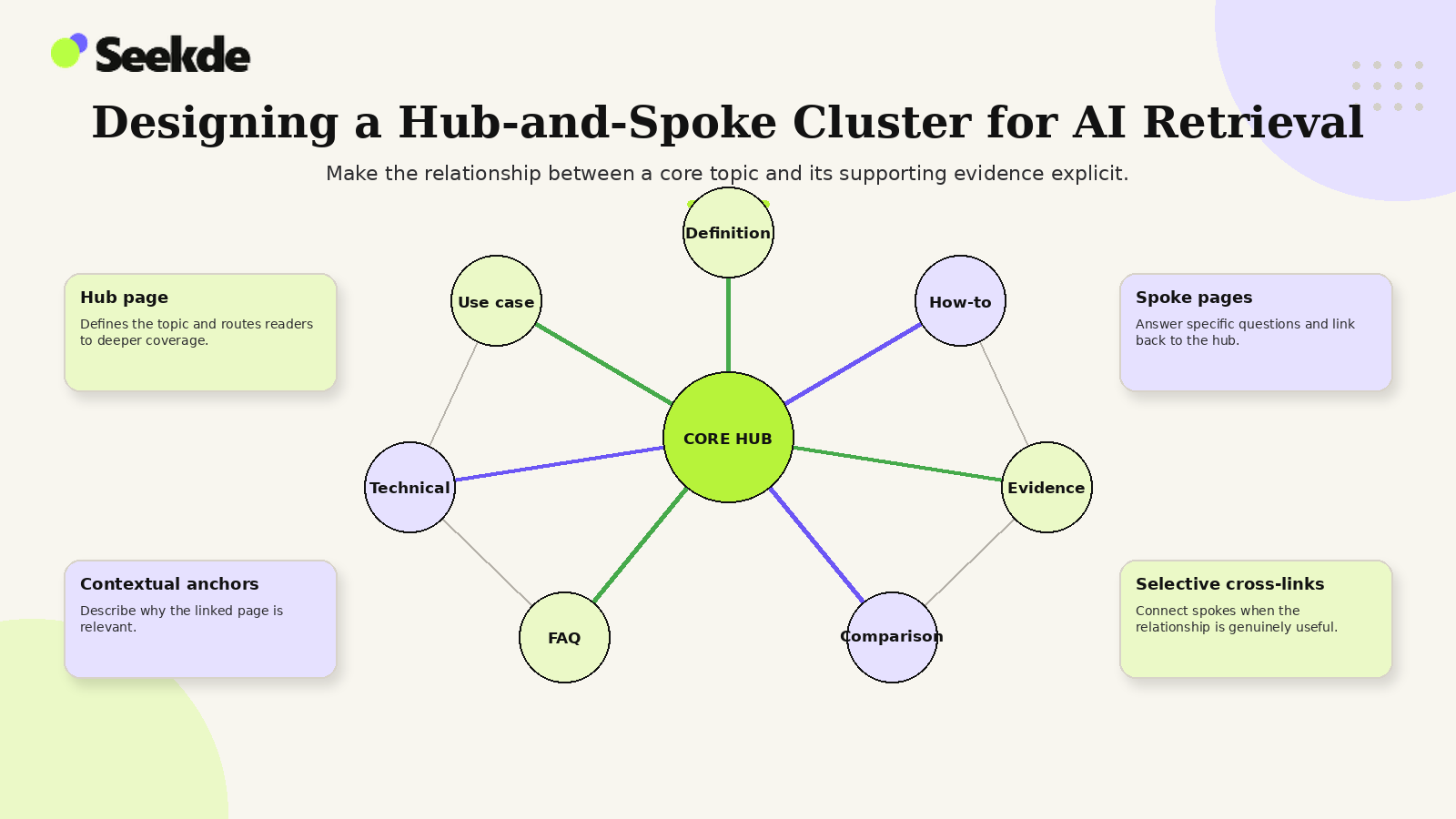
Pillar Hub
Broad authoritative guide providing comprehensive topic coverage and bidirectional links to all child spokes.
Spoke Article A
Granular technical guide on a specific subtopic; links back to the pillar hub and reciprocal sibling spokes.
Spoke Article B
Focused deep-dive on methodology; links back to the central hub and related sister spokes.
The Three Rules of Hub-and-Spoke Linking
- The Upward Anchor: Every granular spoke article must link back to its parent pillar guide within the opening two paragraphs using clear conceptual anchor text (e.g., "This technical analysis builds upon our foundational framework on AI search visibility…").
- The Downward Roster: The pillar hub must link downward to every spoke in the cluster, organizing links into thematic sections with descriptive paragraph summaries rather than a bare list of bullet points.
- The Lateral Bridge: Each spoke should cross-link to 2–3 sibling articles within the same cluster where topics naturally intersect (e.g., our robots.txt guide cross-links directly to our OAI-SearchBot vs GPTBot comparison).
Anchor Text Optimization: Entity-Rich vs. Generic
In traditional search optimization, anchor text was primarily analyzed for exact keyword matching. In AI search and RAG retrieval systems, anchor text is processed as semantic embedding coordinates.
Comparing Anchor Text Strategies
| Target URL | Weak / Generic Anchor | Over-Optimized / Spammy Anchor | Recommended Semantic Anchor |
|---|---|---|---|
/robots-txt-ai-crawlers/ |
[click here] |
[best cheap robots txt ai tools] |
[how to configure robots.txt for AI search crawlers](/robots-txt-ai-crawlers/) |
/schema-markup-ai-search/ |
[read more] |
[buy geo schema markup services] |
[Schema.org structured data implementation](/schema-markup-ai-search/) |
/ai-search-crawlability-audit/ |
[this page] |
[audit audit audit] |
[10-step AI search crawlability audit](/ai-search-crawlability-audit/) |
/ai-crawlers-explained/ |
[link] |
[ai crawlers ai bots list 2026] |
[directory of documented AI search crawlers](/ai-crawlers-explained/) |
Best Practices for Semantic Anchors
- Descriptive and Natural: Ensure the anchor text accurately describes the topic or technical entity of the target document.
- Contextual Sentence Integration: Embed the link naturally within an explanatory sentence rather than isolating it as a standalone call-to-action button.
- Avoid Exact-Match Saturation: Vary phrasing naturally (e.g., alternate between "robots.txt configuration," "RFC 9309 rulesets," and "crawler exclusion directives").
Common Internal Linking Failures That Cripple AI Discovery
During site audits, technical teams frequently discover structural errors that prevent search bots from discovering pages:
The Orphan Page
- No inbound internal
- links exist. Crawlers
- can only discover URL
- via XML sitemaps.
The JavaScript Trap
- Links coded as JS click
- handlers (onClick) inst
- of standard crawlable
- <a href> elements.
The Infinite Trap
- Faceted navigation or
- ead infinite scroll loops
- drain crawl budget
- without discovering docs.
Pitfall 1: The Orphan Page Trap
An orphan page is a public URL that has zero inbound internal links from other pages on the same domain. While the page may be listed in an XML sitemap, search crawlers prioritize link traversal to judge page importance. Orphan pages are crawled at significantly lower frequencies and are frequently treated as low-confidence documents by search indexing pipelines.
Pitfall 2: JavaScript-Only Click Handlers
A widespread problem in Single-Page Applications (SPAs) and modern JavaScript frameworks (React, Vue, Next.js) is constructing navigation using client-side event listeners:
<!-- CRAWLER DEFECT: Bots cannot follow this link -->
<div class="nav-card" onclick="window.location.href='/robots-txt-ai-crawlers/'">
  Configure Robots.txt
</div>

<!-- VALID STANDARD: Crawlable by all bots -->
<a class="nav-card" href="/robots-txt-ai-crawlers/">
  Configure Robots.txt
</a>
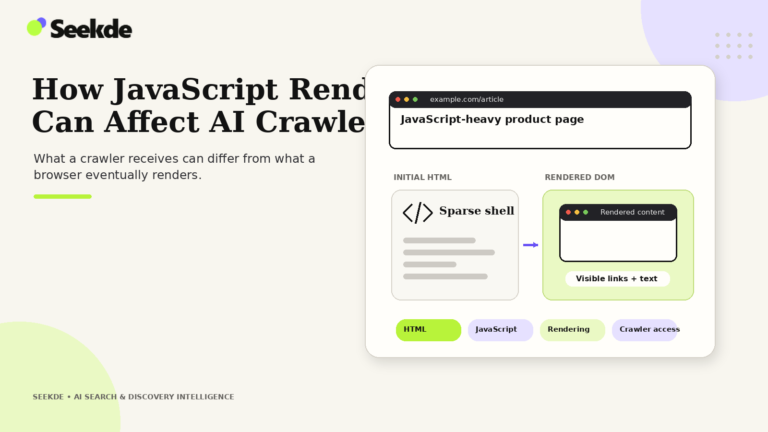
As documented in Google’s Guide to Making Links Crawlable, crawlers like Googlebot, OAI-SearchBot, and Bingbot extract links by parsing HTML anchor tags with valid href attributes. They do not simulate mouse clicks on arbitrary <div> or <span> elements. For detailed rendering analysis, review How JavaScript Rendering Can Affect AI Crawlers.
Pitfall 3: Crawl Traps in Faceted Navigation
Websites with complex filtering systems (such as eCommerce stores or real estate portals) can generate millions of duplicate parameterized URLs via interactive facet combinations (e.g., ?color=blue&size=medium&sort=price). Crawlers can become trapped traversing endless parameter permutations, exhausting server capacity and failing to crawl high-value technical articles.
How to Programmatically Audit Your Internal Link Graph
Technical teams can audit their internal linking graph using lightweight scripts to detect orphans, measure click depth, and verify anchor text quality.
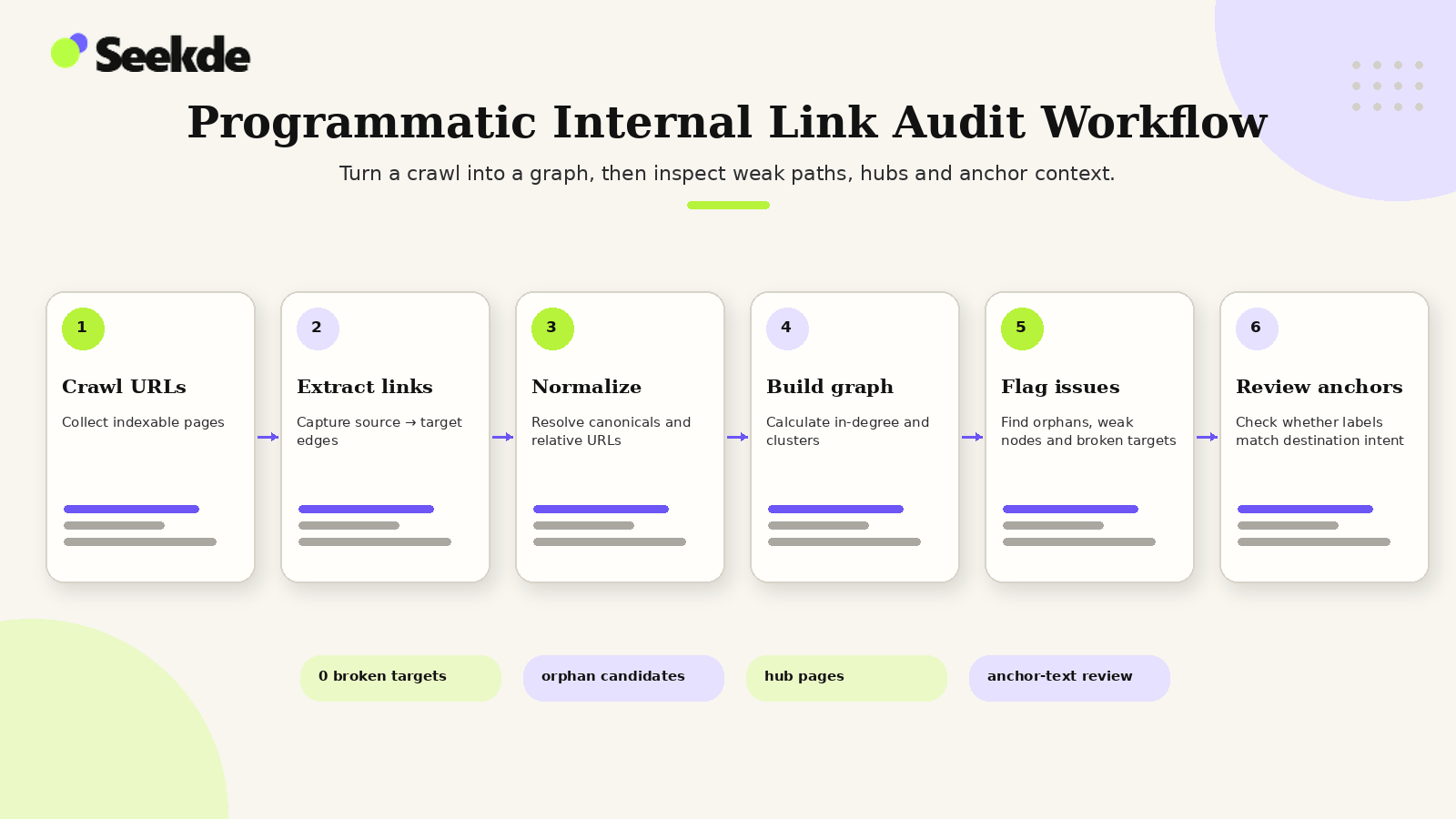
Python Script: Finding Orphan Pages and Measuring In-Degree
This script parses a local directory of HTML or Markdown files and reports inbound link counts for every document:
import os
import re
from collections import defaultdict

docs_dir = "./content/maps"
link_counts = defaultdict(int)
all_slugs = set()

# Regex to capture markdown internal links: [text](/slug/)
link_pattern = re.compile(r'[([^]]+)]((/[^)]+/))')

# Phase 1: Collect all valid document slugs
for filename in os.listdir(docs_dir):
    if filename.endswith(".md"):
        slug = filename.replace("map-", "").replace(".md", "")
        all_slugs.add(slug)

# Phase 2: Count internal links across documents
for filename in os.listdir(docs_dir):
    if filename.endswith(".md"):
        with open(os.path.join(docs_dir, filename), "r", encoding="utf-8") as f:
            content = f.read()
            matches = link_pattern.findall(content)
            for anchor, target_path in matches:
                clean_target = target_path.strip("/")
                link_counts[clean_target] += 1

# Phase 3: Identify orphans and rank by popularity
print("=== TOP LINKED DOCUMENTS ===")
for slug, count in sorted(link_counts.items(), key=lambda x: x[1], reverse=True)[:10]:
    print(f"/{slug}/ : {count} inbound links")

print("n=== POTENTIAL ORPHAN PAGES ===")
for slug in all_slugs:
    if link_counts[slug] == 0:
        print(f"ORPHAN DETECTED: /{slug}/ (0 inbound links)")
Running periodic graph audits ensures that as your site expands, no technical spokes are accidentally left isolated.
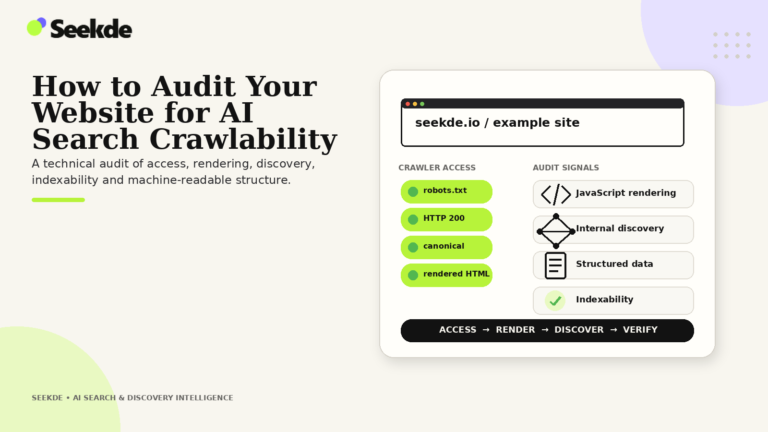
For a comprehensive 10-step protocol covering status codes, robots rules, and server logs, follow our complete guide to How to Audit Your Website for AI Search Crawlability.
Summary: Key Takeaways for Technical Teams
- Foundational Discovery Layer: Internal links build the web index pathways that feed RAG retrieval systems; without crawl discovery, generative citation is impossible.
- Shallow Click Depth (Seekde Heuristic): As a practical architecture heuristic, keep high-value articles within 2–3 clicks of the homepage to maximize crawler visitation frequency and maintain reachable paths from findable pages.
- Semantic Anchors: Use descriptive, entity-rich anchor text to pass meaningful semantic context in vector embedding spaces.
- Hub-and-Spoke Discipline: Structure content into interconnected clusters with reciprocal links between parent pillars and specialized spokes.
- Zero Orphan Policy: Ensure every published article receives at least two inbound internal links from established, indexable pages.
- Use Valid HTML Anchors: Implement links using standard
<a href="...">tags to avoid rendering failures in automated bots.
Related Technical Resources
- AI Crawlers Explained: Googlebot, OAI-SearchBot, GPTBot and More
- How to Configure Robots.txt for AI Search Crawlers
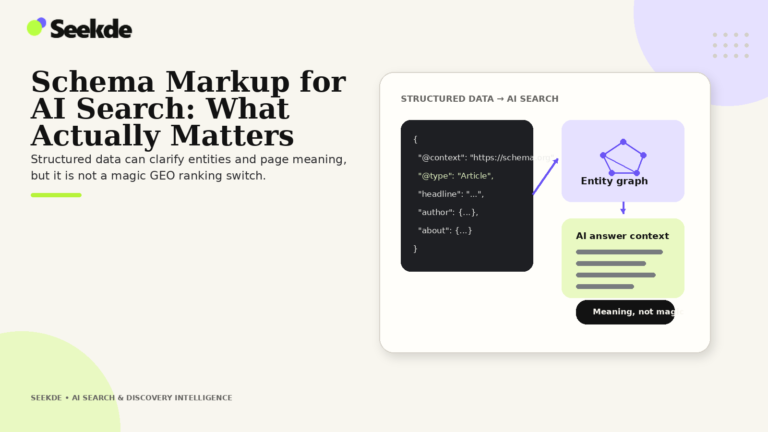
- Schema Markup for AI Search: What Actually Matters
- How JavaScript Rendering Can Affect AI Crawlers
- How to Audit Your Website for AI Search Crawlability
- How AI Search Engines Find and Cite Content
- Query Fan-Out in AI Search