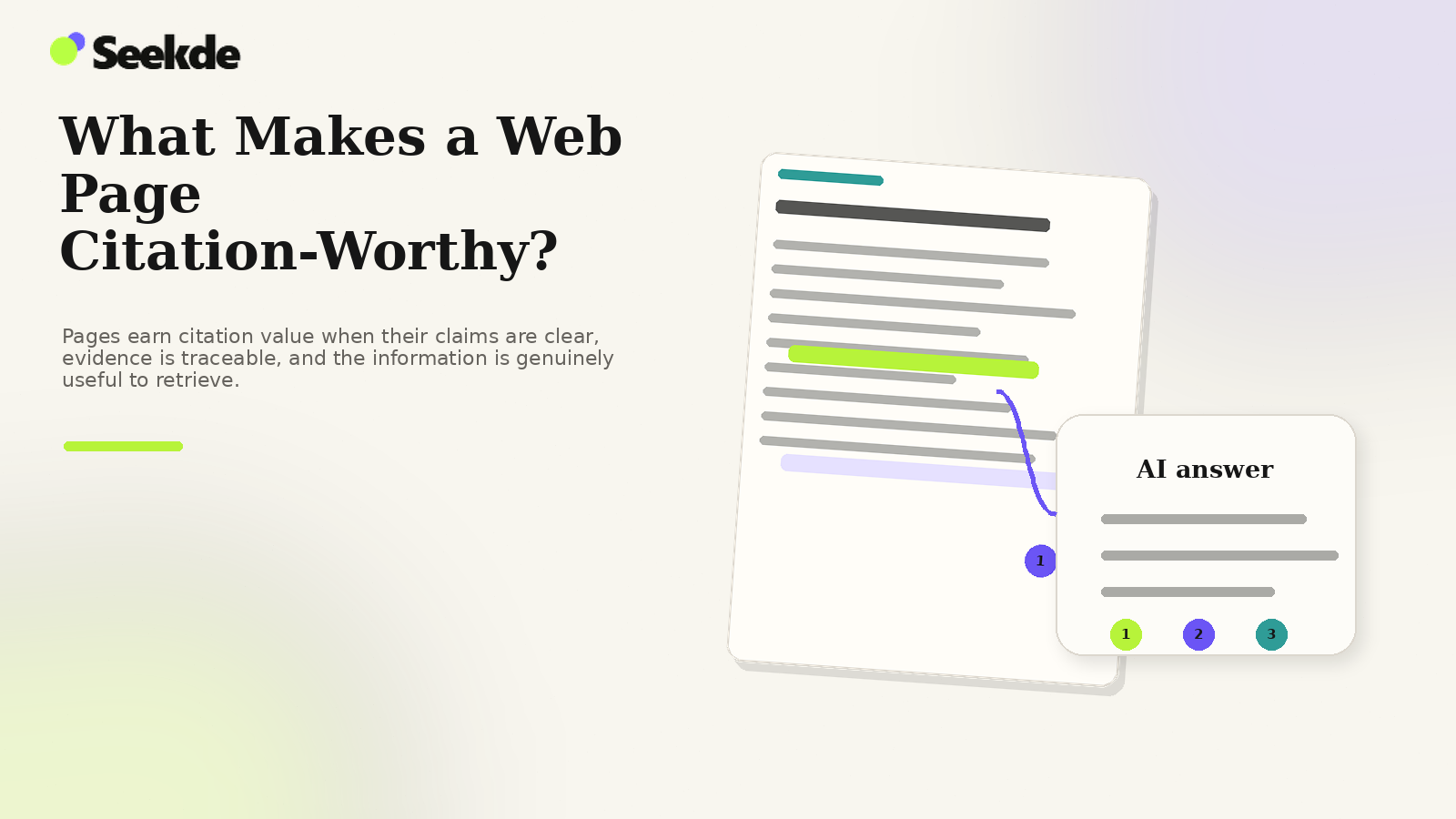
What makes one page worth citing while another is ignored? Citation-worthy pages combine clear claims, primary evidence, precise attribution, original information, and technically accessible structure. This guide breaks those qualities into a practical five-part audit framework, with examples of passages that are easier—or harder—for AI search systems to retrieve and cite.
Generative answer engines—such as Google AI Overviews, Perplexity, ChatGPT Search, and Microsoft Copilot—do not cite sources out of politeness or algorithmic courtesy. They link to external domains because their underlying language models rely on verifiable grounding to satisfy user intent, defend factual assertions, and prevent factual drift.
Understanding citation-worthiness involves moving beyond conventional SEO ranking concepts. In standard organic search, a page can rank on page one through accumulated domain authority, keyword targeting, and backlink volume even if its content merely summarizes existing top-ranking articles. In generative search, however, models actively compress and deduplicate redundant information. If your article only restates what five other indexed sources have already published, neural rerankers discard your passages as redundant token overhead.
To earn repeated, resilient citations, a web page must satisfy distinct algorithmic and editorial criteria that establish it as an authoritative, primary node in the retrieval graph.
The Algorithmic Imperative: Why Generative Search Engines Cite Sources
Language models suffer from a fundamental engineering challenge: probabilistic generation produces plausible-sounding hallucinations when factual knowledge is absent or contradictory. Retrieval-Augmented Generation (RAG) mitigates this by querying an external index at runtime and injecting relevant document passages into the model’s working context window (as detailed in our technical guide on how AI search engines find, retrieve, and cite web content).
When a model synthesizes an answer, attribution algorithms compare the generated sentences against the grounding passages. A web page is cited when:
- The passage contains the exact factual anchor needed to resolve the user’s specific sub-query.
- The domain exhibits strong topical authority and entity consistency within the semantic domain.
- The statement provides primary attribution, allowing the engine to trace a statistic, policy, or finding back to its originator rather than an intermediary aggregator.
If an engine must choose between citing an original benchmark study that collected the data versus a marketing blog that quoted the study second-hand, the reranking cross-encoder strongly prioritizes the primary originator.
The Five Dimensions of Citation-Worthiness: The Seekde Audit Rubric
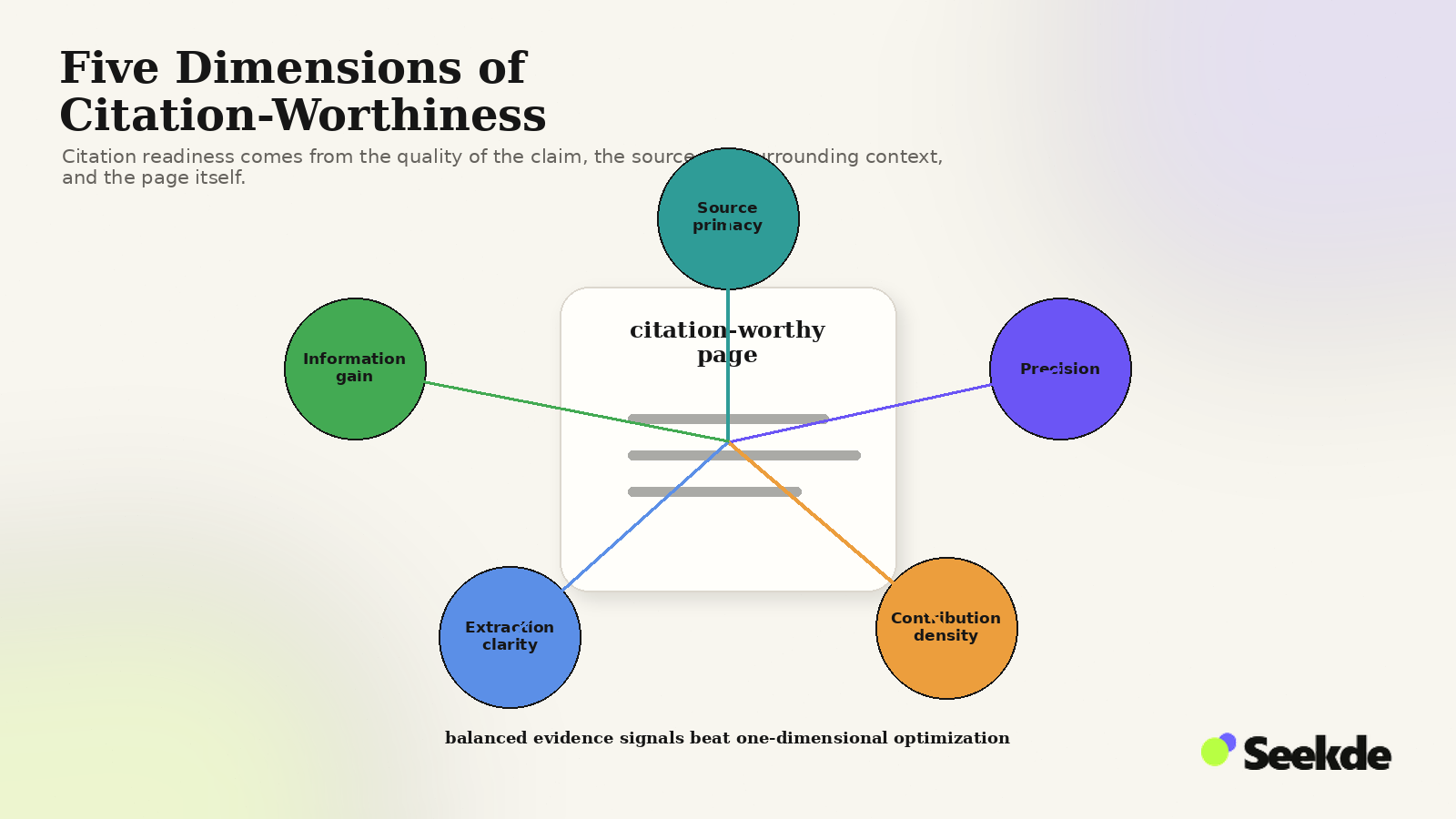
Seekde evaluates web content through a multi-factor analytical model known as the Citation-Worthiness Rubric. This framework isolates the five specific attributes that separate frequently cited source pages from ignored content:
Source Primacy
- (Original Origin) P
Propositional Corroboration Extraction
- recision Density
Information
- Autonomy Gain
| Dimension | Evaluation Criteria | Technical Justification in RAG Pipelines |
|---|---|---|
| 1. Source Primacy | Is the content the primary originator of the data, methodology, or event? | Engines actively penalize circular citation loops; primary documentation receives higher authority weighting. |
| 2. Propositional Precision | Are claims quantified, bounded, dated, and attributed to specific entities? | Ambiguous or hyperbolic assertions trigger safety and hallucination-prevention filters. |
| 3. Corroboration Density | Can the factual claims be verified across the broader knowledge graph? | Non-unique factual claims must align with established consensus; novel claims must provide verifiable proof. |
| 4. Extraction Autonomy | Does the passage convey complete semantic meaning when chunked in isolation? | RAG chunkers slice text into 200–500 token windows; unresolved pronouns destroy retrieval relevance. |
| 5. Information Gain | Does the page contribute new perspectives, data, or tooling absent from the index? | Google’s Information Gain patents explicitly score novel content contributions against existing document sets. |
Dimension 1: Source Primacy (Primary vs. Derivative Authority)
A primary source directly generates or documents evidence: original research studies, formal specification documents (e.g., RFC 9309 for robots.txt), official product documentation, or firsthand investigative reporting. A derivative source merely summarizes, paraphrases, or aggregates primary findings.
When an AI engine synthesizes a technical answer—such as how a specific crawler handles robots.txt directives—it will cite the official vendor documentation (OpenAI Developer Documentation or Google Search Central) over a third-party agency blog that copied the directives. Derivative pages earn citations only when they add substantial analytical value, comparative testing, or synthesis that the primary documentation lacks.
Dimension 2: Propositional Precision
Generative search engines value numeric and categorical precision. Consider the difference between these two assertions:
- Low Precision: "Most companies are blocking AI bots to save server costs."
- High Precision: "In an audit of 500 enterprise publishing domains, 34% blocked GPTBot in their robots.txt files, while only 12% restricted OAI-SearchBot."
The high-precision statement provides unambiguous data points (500 enterprise domains, 34% blocked GPTBot, 12% restricted OAI-SearchBot) that an answer engine can directly lift into a response bullet point with linked attribution.
Dimension 3: Corroboration Density
When an engine encounters a factual assertion that contradicts established knowledge bases, its confidence score drops. If a page asserts an unverified claim—such as "Googlebot now runs fully headless browser rendering on every single HTTP request within 5 milliseconds"—neural rerankers will downweight the chunk because it conflicts with documented Google WRS queuing reality. Highly citable pages anchor radical insights within corroborating technical consensus while citing authoritative standards.
Dimension 4: Extraction Autonomy
As established in our guide to creating citation-ready content, chunking algorithms do not ingest document preambles alongside body paragraphs. If an important finding is framed as:
"Consequently, they decided to terminate it because the aforementioned framework failed to yield expected returns."
The chunk cannot be cited because they, it, and the aforementioned framework have no semantic referents within the chunk’s embedding. Standalone passages must explicitly name the entity, the technology, and the outcome.
Dimension 5: Information Gain
Google’s published research and patents on Information Gain Scores formalize how modern retrieval systems evaluate redundant content. When an engine retrieves ten documents for a query, it measures the incremental utility that Document B provides after Document A has already been processed. If Document B contains 0% unique factual propositions, its information gain score is zero, and it is excluded from synthesized citations.
Editorial Teardown: Cited vs. Ignored Passages
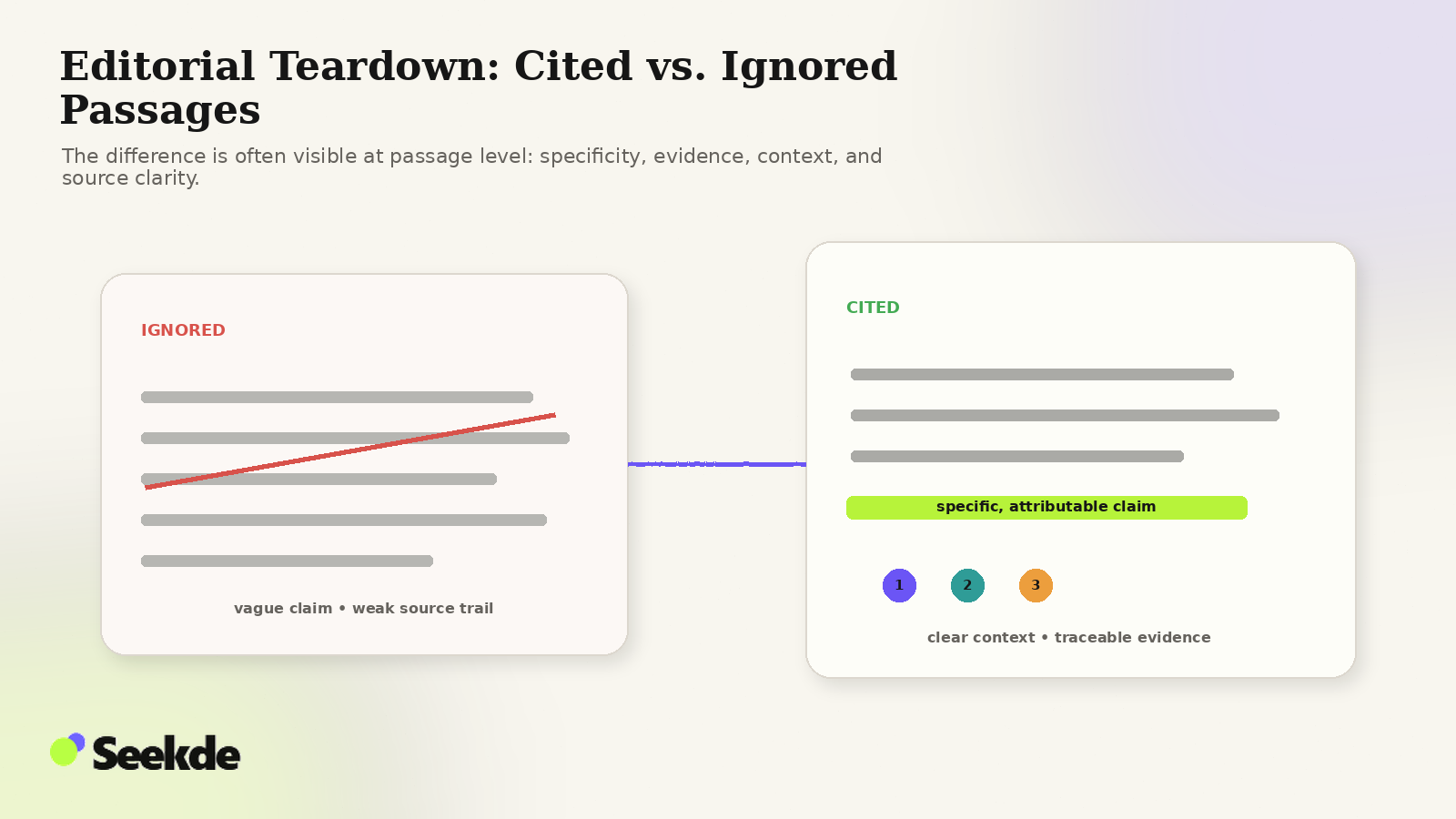
To observe how citation criteria operate in practice, inspect these side-by-side editorial teardowns based on real-world generative search synthesis behavior.
Teardown 1: Technical Explainer on Robots.txt Configuration
The Ignored Passage (Derivative, Low Density, Fluffy)
Robots.txt is an essential part of any technical SEO strategy, especially now
that artificial intelligence is taking over the search landscape. In this
section, we will explore why you should carefully consider your bot settings.
Many website owners wonder whether they should block AI bots. The answer is
that it depends on your overall business goals and content strategy. If you
want visibility, you should probably let them crawl, but if you value privacy,
you might want to disallow them.
Why RAG Engines Ignore It:
- Zero specific entities: Does not mention a single user-agent string (
GPTBot,ClaudeBot,PerplexityBot). - No actionable directives: Fails to provide RFC-compliant syntax (
User-agent,Disallow,Allow). - Zero information gain: Generic platitudes ("it depends on your goals") provide no factual propositions to ground an answer.
The Cited Passage (Propositionally Dense, Autonomous, Primary)
To permit ChatGPT Search citation indexing while preventing OpenAI from using
site content for foundation model training, webmasters must configure distinct
User-agent directives in robots.txt under RFC 9309 standards:

User-agent: OAI-SearchBot
Allow: /

User-agent: GPTBot
Disallow: /

Disallowing GPTBot restricts offline training dataset harvesting, whereas
allowing OAI-SearchBot preserves conversational citation links in ChatGPT Search.
Why RAG Engines Cite It:
- Explicit entity disambiguation: Distinguishes between
OAI-SearchBot(search citations) andGPTBot(model training). - Verifiable syntax: Provides standard, copy-pasteable configuration code blocks.
- Autonomous causality: Clearly states the exact operational consequence of each directive within 80 words.
Teardown 2: Analytical Industry Definition
The Ignored Passage (Vague, Circular, Generic)
AI Share of Voice is the new frontier for digital marketers looking to dominate
conversational search. It represents your brand's overall footprint in the AI
ecosystem. When people ask chatbots about products in your industry, you want
your company to be mentioned prominently. Having a high share of voice means
you are winning the battle for consumer attention across modern AI tools.
Why RAG Engines Ignore It:
- Circular definition: Defines Share of Voice as "your brand’s footprint" without defining how that footprint is quantified.
- No methodology: Provides no formula, metrics, or sampling guidelines.
- Pure sentiment: Marketing hype ("dominate conversational search", "winning the battle") triggers objective-tone filters.
The Cited Passage (Formally Defined, Methodological, Quantified)
AI Share of Voice (AI-SoV) is the percentage of total brand mentions or domain
citations an organization captures across a standardized, repeatable set of
generative search prompts within a defined category:

AI-SoV (%) = (Brand Citations in Prompt Set / Total Category Citations) * 100

Unlike traditional search impressions, AI-SoV requires longitudinal sampling
across 30-day rolling windows to account for non-deterministic model variance
and temperature-induced output fluctuations.
Why RAG Engines Cite It:
- Mathematical formulation: Delivers an explicit, citable equation.
- Methodological constraint: Notes the necessity of standardized prompt sets and longitudinal rolling windows.
- Definitional authority: Acts as a clean reference anchor for conversational models answering "How do you calculate AI Share of Voice?" (as explored in our pillar on what is AI share of voice?).
Technical Factors That Elevate Citation Eligibility
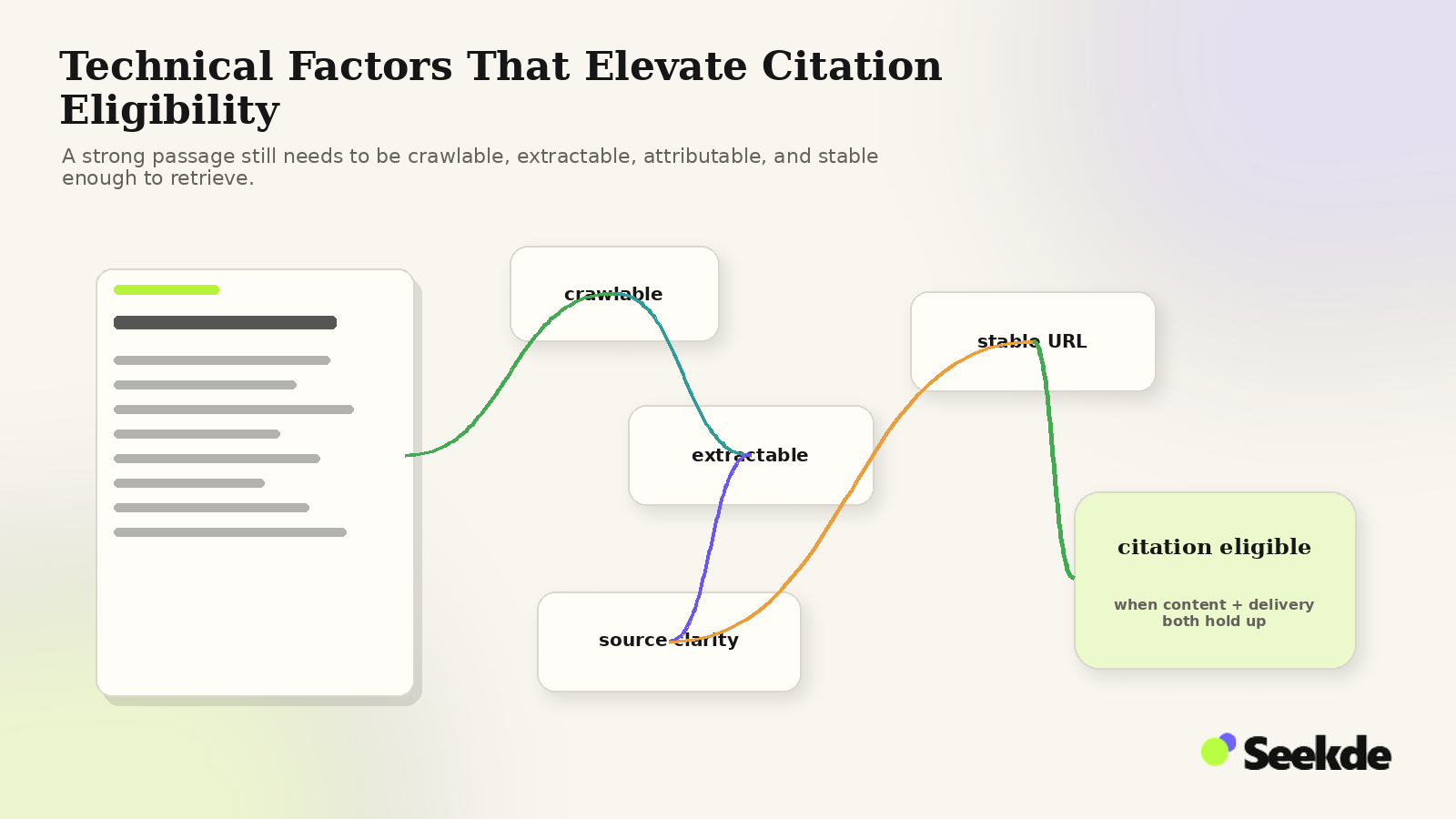
While content quality determines whether a passage is citation-worthy, technical infrastructure determines whether the passage can be retrieved in the first place:
| Technical Prerequisite | Implementation Requirement | Failure Consequence |
|---|---|---|
| Server Crawlability | Ensure robots.txt explicitly allows search bots (e.g., Googlebot, OAI-SearchBot, Claude-SearchBot). |
Blocked bots cannot ingest passages; citation eligibility drops to zero. |
| Clean Initial HTML | Render all critical text, definitions, and data in server-side HTML rather than client-side JavaScript. | As detailed in our guide on JavaScript rendering and AI crawlers, non-Google bots rarely execute JS. |
| Self-Referencing Canonicals | Declare strict, absolute canonical tags on all indexable content. | Duplicated URL parameters dilute passage retrieval scores across redundant variants. |
| Structured Data Graphs | Implement schema markup (Article, TechArticle, Organization) with complete author and publisher attributes. |
Reinforced entity relationships improve model confidence during knowledge graph reconciliation. |
| Semantic Table Markup | Use native HTML <table>, <thead>, <th>, and <tbody> tags instead of CSS grid <div> containers. |
RAG parsers extract tabular relationships seamlessly from semantic tables, but often mangle CSS-only layouts. |
The Citation-Worthiness Scoring Matrix
Publishers can audit existing articles against this 100-point scoring matrix. Pages scoring above 80 points exhibit high resilience in generative answer engines:
| Category | Evaluation Question | Max Points |
|---|---|---|
| Primary Data (25 pts) | Does the page contain original research, firsthand testing, proprietary datasets, or novel benchmarks unavailable elsewhere? | 25 |
| Propositional Precision (20 pts) | Are assertions backed by specific numbers, dates, version numbers, and named entities rather than vague adjectives? | 20 |
| Extraction Autonomy (20 pts) | Can key subheadings and their opening paragraphs be understood in complete isolation from the rest of the document? | 20 |
| Information Gain (15 pts) | Does the article provide unique analysis, contrarian evidence, or detailed frameworks absent from the top 5 ranking Google results? | 15 |
| Structural Cleanliness (10 pts) | Are comparisons housed in HTML tables, procedures in ordered lists, and code in designated <pre><code> blocks? |
10 |
| Technical Accessibility (10 pts) | Is the text immediately accessible in server-delivered HTML with self-referencing canonicals and zero crawler blocks? | 10 |
| TOTAL SCORE | Sum of all categories (Passing threshold for citation-readiness: 80+) | 100 |
Summary: Building a Durable Citation Asset
Earning citations in AI search engines is not an optimization hack; it is an editorial standard. As search engines transition from displaying lists of links to synthesizing unified answers, the value of derivative, low-density content approaches zero.
To build web pages that modern search systems repeatedly cite:
- Provide original evidence that cannot be synthesized from public common knowledge.
- Frame answers in clean, standalone paragraphs with explicit entity antecedents.
- Structure comparative data in semantic HTML tables.
- Attribute external claims directly to primary technical sources.
- Maintain rigorous technical crawlability so automated agents can ingest and index your passages without friction.
By anchoring your editorial production in primary evidence and structural clarity, your publication becomes an indispensable source node in the evolving web of generative intelligence.
Related Guides and Research
- How to Create Content AI Search Engines Can Cite
- How Original Research Improves AI Search Visibility
- Do Statistics and Sources Improve AI Citations?
- How to Structure Articles for AI Search
- AI Citations vs Brand Mentions: What’s the Difference?
- How AI Search Engines Find, Retrieve and Cite Web Content
- What Is AI Share of Voice?