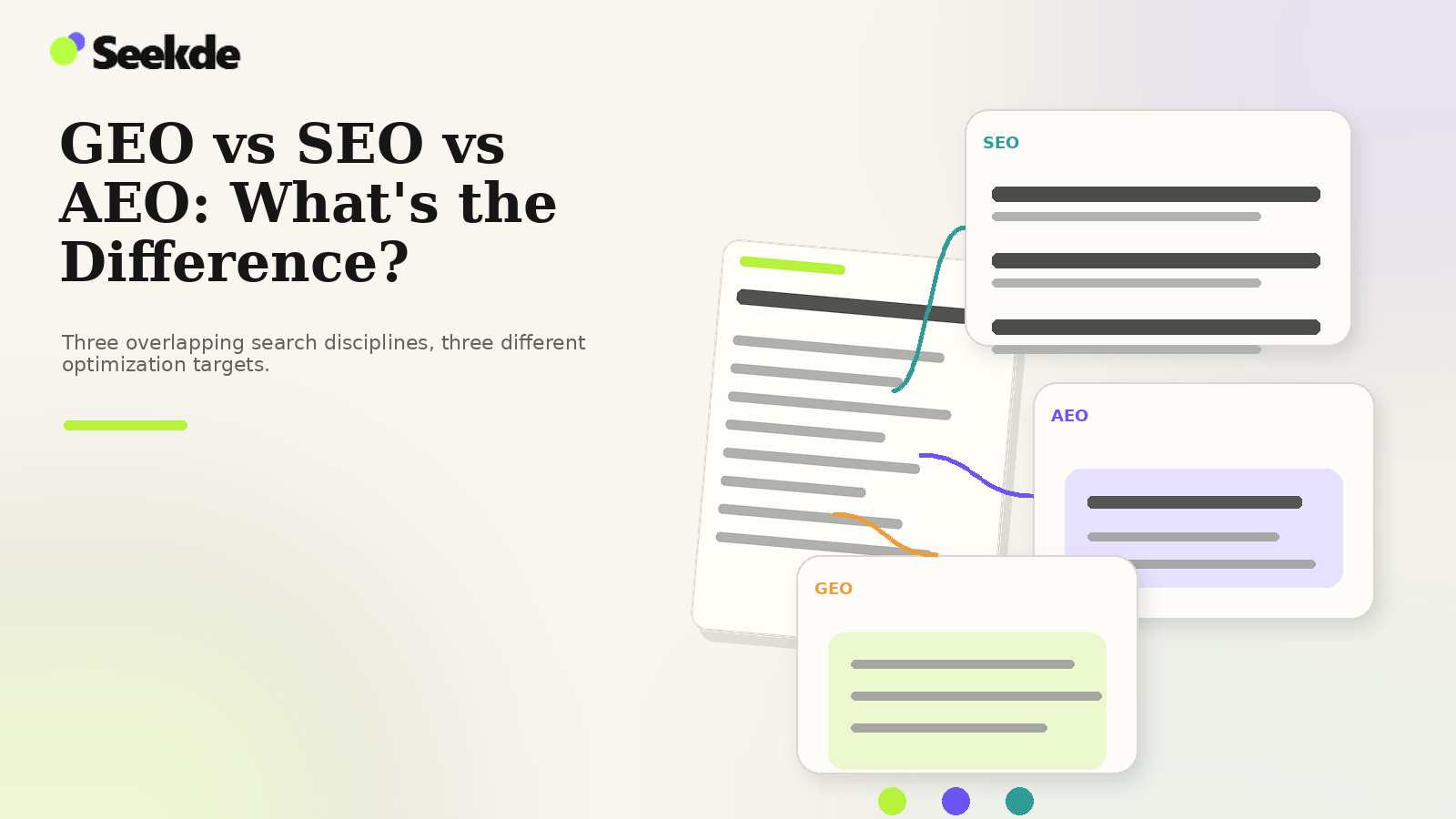
SEO focuses on ranking pages in traditional search, AEO focuses on making answers easy for search systems to extract, and GEO focuses on making content useful for generative systems to retrieve, synthesize, and cite. In practice, the three overlap and work best together rather than as replacements for one another.
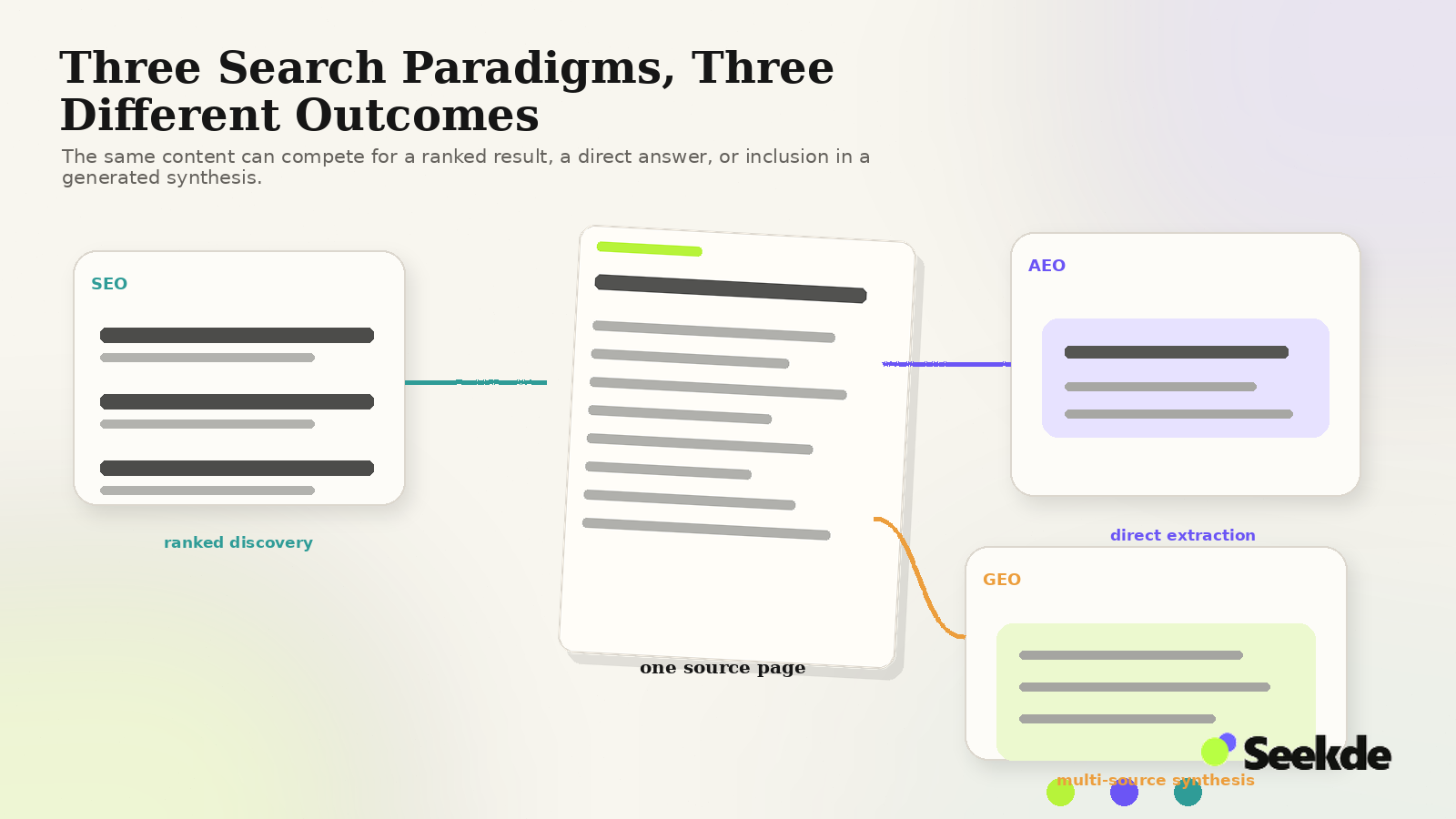
SEO focuses on ranking web documents in organic link listings; AEO focuses on extracting single-source factual answers for snippets and voice devices; GEO focuses on earning representation and citations within multi-source AI-synthesized responses.
The most common strategic mistake digital marketing teams make is treating these three approaches as isolated, competing disciplines. In reality, they form an integrated technical continuum: all three depend on a healthy web infrastructure, accessible HTML, authoritative topical depth, and verified entity clarity. Furthermore, as officially documented in Google Search Central guidance, terms like "AEO" and "GEO" are external industry descriptions; from Google’s architectural perspective, optimizing for AI Overviews and generative discovery remains fundamentally part of search engine optimization (SEO).
Understanding the operational differences among them allows growth leaders to allocate resources effectively, configure appropriate measurement tools, and optimize content for how searchers actually retrieve information today.
The Definitive Tripartite Comparison Matrix (Seekde Conceptual Taxonomy)
To evaluate how these paradigms differ across technical, editorial, and measurement dimensions, Seekde maintains the following high-level conceptual taxonomy. This comparative framework serves as an analytical model to guide strategy, rather than a disclosure of universal proprietary vendor internals:
| Dimension | Traditional SEO | Answer Engine Optimization (AEO) | Generative Engine Optimization (GEO) |
|---|---|---|---|
| Primary Objective | Earn top-ranking organic URL listings | Win single-source extracted answer boxes | Earn citations and brand recommendations inside synthesized text |
| Output Format | Title tag, URL slug, and meta description | Extracted verbatim passage or structured table | AI-generated prose combining multiple web sources with link cards |
| Target Surfaces | Desktop and mobile organic search results ("10 blue links") | Google Featured Snippets, Knowledge Panels, Voice Assistants (Siri/Alexa) | Google AI Overviews, ChatGPT Search, Perplexity, Microsoft Copilot |
| Underlying Mechanism | Inverted index matching keywords and PageRank link graphs | Programmatic extraction of discrete HTML text blocks and semantic schemas | Commonly utilizes Retrieval-Augmented Generation (RAG), combining vector embeddings, keyword search, and neural rerankers depending on vendor architecture |
| Primary KPIs | Rank position, organic impressions, organic click-through rate (CTR) | Snippet ownership rate, zero-click answer impressions, voice assistant share | Model mention share, domain citation frequency, sentiment, Share of Model |
| Measurement Volatility | Subject to core algorithm updates, re-indexing, and local intent | Algorithmic snippet rotation and query-testing shifts | Probabilistic variation across repeated prompt generations |
| Crawler Ecosystem | Traditional search spiders (e.g., standard Googlebot, Bingbot) | Standard search spiders augmented by entity knowledge graph extractors | Specialized AI search bots (e.g., OAI-SearchBot, PerplexityBot) alongside search crawlers |
| Content Structure | Comprehensive long-form guides optimized for topical authority | Modularly structured answers with immediate question-to-answer proximity | High claim density, original empirical data, verifiable quotes, and clear entity facts |
| Attribution Model | Direct click-through from SERP listing | Direct click-through from snippet header or zero-click brand recall | Inline source footnotes, side link cards, or unlinked brand co-occurrence |
| Primary Risk | Producing keyword-stuffed pages that rank but fail user intent | Creating shallow, fragmented "snippet bait" without comprehensive depth | Chasing speculative LLM hacks or relying on volatile single-prompt observations |
Deconstructing Each Paradigm
1. Traditional SEO: The Foundation
Search Engine Optimization remains the irreducible baseline for web discovery. For web-search-based discovery, crawlable and indexable content is required to enter that search engine’s web index. Other model knowledge paths, such as licensed or training corpora, are separate.
In traditional SEO, search engines index web documents and use complex algorithms (such as link graphs, topical relevance models, and user interaction signals) to rank URLs. The user’s primary interface is a list of results, and the publisher’s primary reward is direct referral traffic.
While generative interfaces are capturing market share, foundational SEO, technical accessibility and established Search ranking systems remain relevant where generative features draw from web search indexes. Specifically for Google generative Search features (such as AI Overviews), Google Search Central documentation notes that a web page must be indexable and eligible for standard search snippets to qualify for inclusion.
2. AEO: Direct Answer Extraction
As search engines evolved from directing users to external pages to answering questions directly on the SERP, AEO emerged. As detailed in our guide to What Is Answer Engine Optimization?, AEO focuses on single-source factual extraction.
In AEO, the search engine identifies a specific query (e.g., "How do you calculate churn rate?") and extracts a concise paragraph, an ordered list, or a table directly from one winning website. The primary editorial focus is question clarity and self-contained syntax.
3. GEO: Multi-Source Generative Synthesis
Generative Engine Optimization represents the current paradigm shift. In generative search, rather than extracting a single passage, an AI system may execute multi-query expansions, retrieve passages across multiple candidate pages, and synthesize a combined answer from that retrieved context.
As explained in our foundational guide on What Is Generative Engine Optimization?, GEO focuses on optimizing for how language models read and attribute information. Academic research by Aggarwal et al. (arXiv:2311.09735) evaluating content on the GEO-BENCH benchmark demonstrated that enriching content with authoritative citations and primary data yielded up to a 40% visibility improvement within the study’s experimental setting. Instead of asking "What position do we rank?", GEO practitioners ask: "When users research our product category, is our brand recommended, and is our website cited as evidence?"
To understand the broader business implications of this shift across corporate marketing teams, explore our AI search optimization framework.
The Seekde Search Investment Allocation Framework (Illustrative Planning Heuristics)
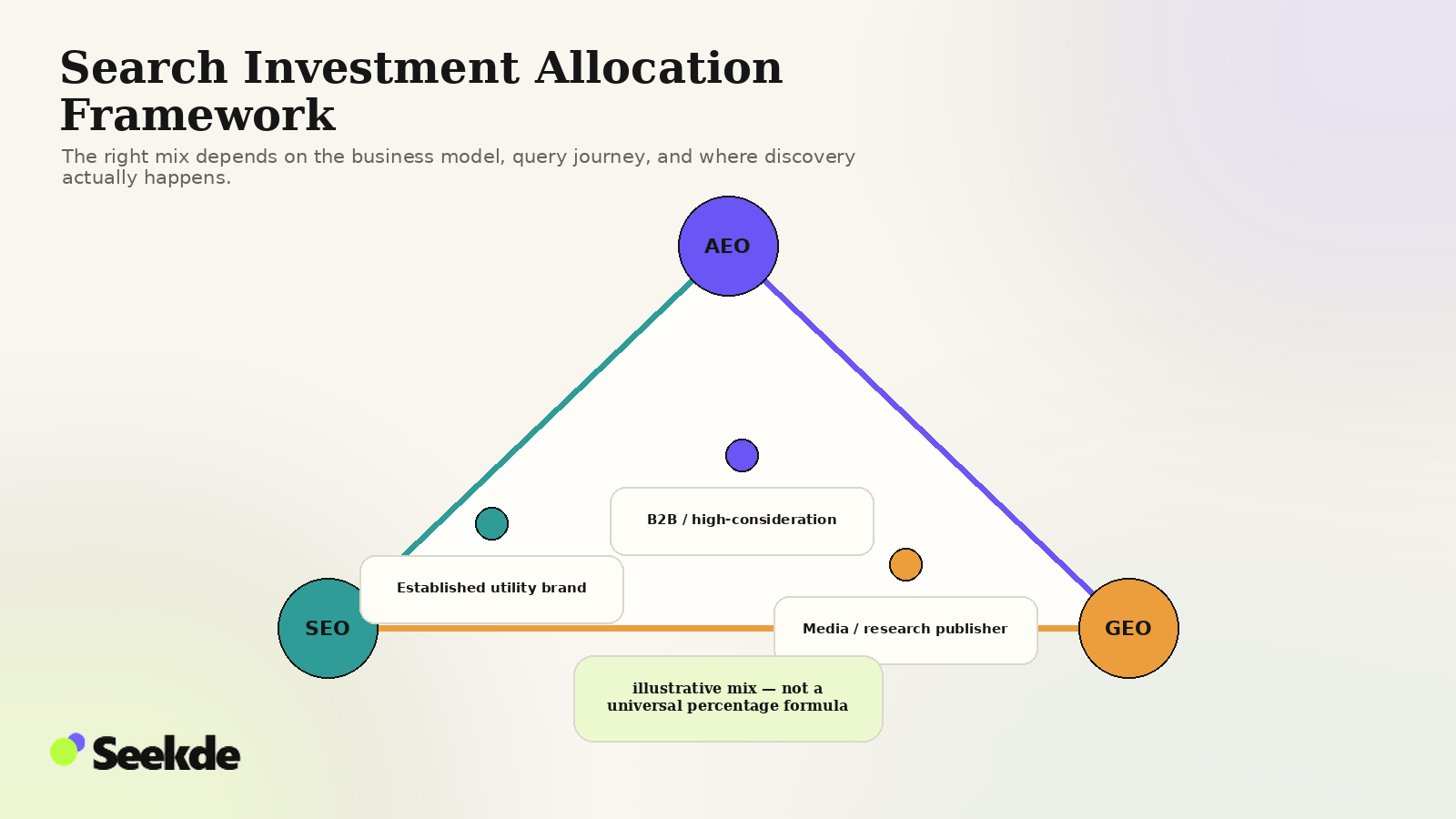
How should an organization distribute its editorial and technical budget across SEO, AEO, and GEO? Seekde models strategic allocation based on your market category and buyer research journey.
Seekde Planning Heuristics:
The budget allocation models below (60/30/10, 30/20/50, and 40/20/40) represent Seekde illustrative planning heuristics designed to guide resource distribution across organizational workflows. They are directional models for strategic planning, not empirical industry benchmarks or fixed algorithmic requirements.
| Category Maturity | Illustrative Allocation (SEO / AEO / GEO) | Strategic Priority |
|---|---|---|
| 1. Established / Utility(High-intent e-commerce, local services, B2C) | 60% SEO | 30% AEO | 10% GEO | Capture transactional rank and featured snippets; maintain crawl health. |
| 2. B2B / High-Consideration(Enterprise software, financial, advisory) | 30% SEO | 20% AEO | 50% GEO | Build multi-source comparisons, buyer guides, and AI recommendation presence. |
| 3. Digital Media / News(Publishers, research institutes, portals) | 40% SEO | 20% AEO | 40% GEO | Protect organic referral traffic while earning attribution in real-time answers. |
Strategy 1: Established / High-Intent Utility Brands
For businesses where users seek specific products, locations, or pricing (e.g., local legal services, plumbing, commodity e-commerce), traditional organic search and direct snippet answers remain primary. Buyers rarely conduct multi-turn conversational research to find a local emergency plumber; they want an instant phone number, opening hours, or direct checkout.
- Resource Focus: 60% traditional technical SEO and localized ranking; 30% AEO for direct snippet answers; 10% GEO monitoring.
Strategy 2: B2B & High-Consideration Solutions
For complex B2B software, professional services, or major capital purchases, the research journey is conversational and multi-stakeholder. Buyers query answer engines with complex constraints: "What are the top 3 HIPAA-compliant telemedicine platforms for clinical practices with under 50 providers?"
- Resource Focus: 30% foundational SEO; 20% AEO; 50% GEO focused on earning citations and recommendations across comparative prompt clusters.
Strategy 3: Digital Media & Research Publishers
Media companies face structural disruption from generative search interfaces. Top-of-funnel search traffic is declining as search engines answer basic informational queries directly on-surface. Publishers must defend their core indexation while earning direct attribution and licensing opportunities.
- Resource Focus: 40% traditional SEO; 20% AEO; 40% GEO focused on publishing primary research, verified reporting, and high-density analysis.
Conclusion: Orchestrating an Integrated Search Strategy
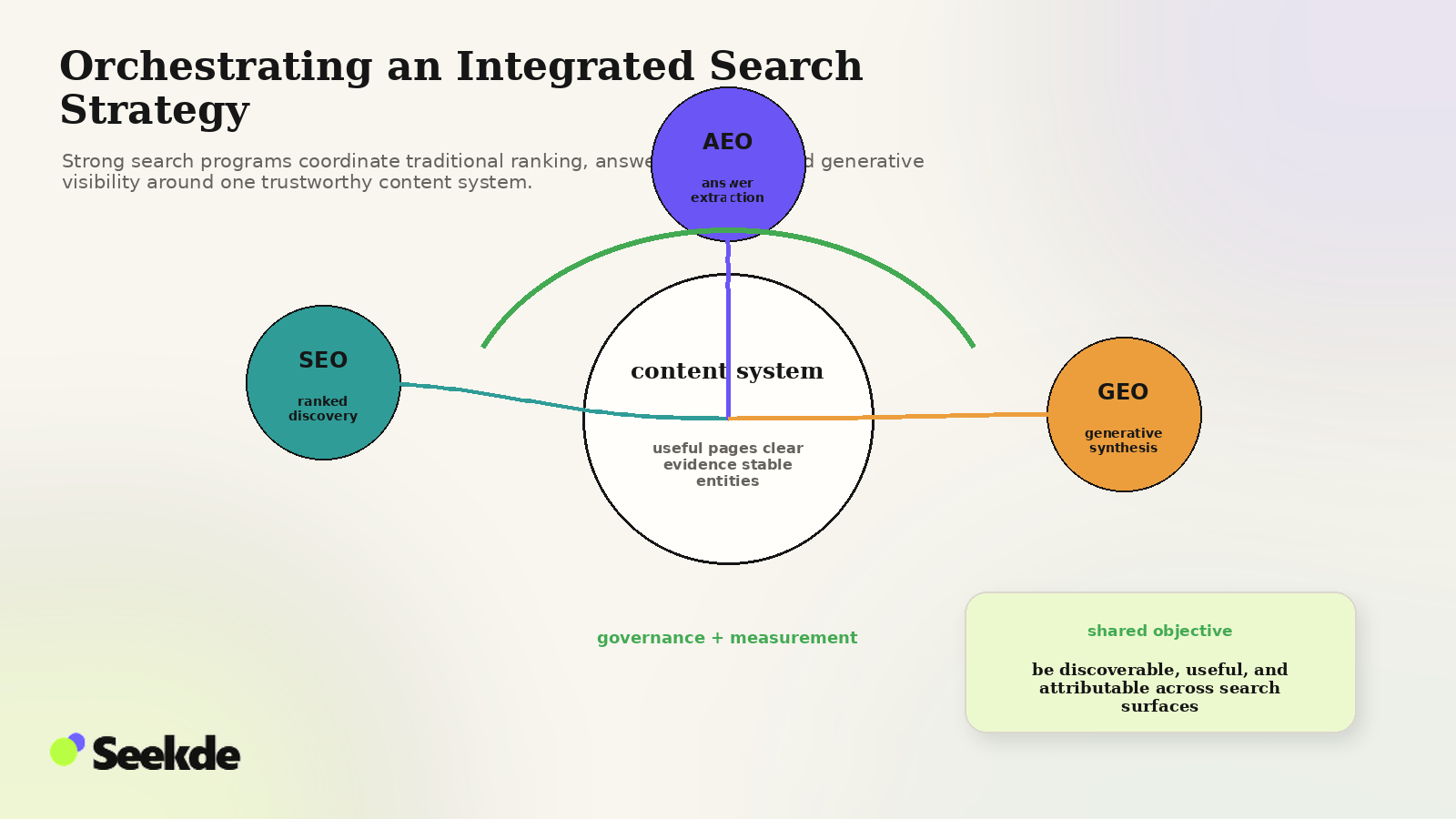
Winning in modern search does not require abandoning SEO in favor of speculative generative tactics. Effective strategy involves recognizing that traditional link ranking, direct snippet extraction, and multi-source generative synthesis are complementary expressions of the same underlying retrieval ecosystem.
By maintaining technically pristine web foundations (SEO), engineering extractable answers for discrete questions (AEO), and establishing authoritative entity citation signals for complex prompts (GEO), organizations build resilient search visibility across both legacy search engines and emerging conversational answer platforms.