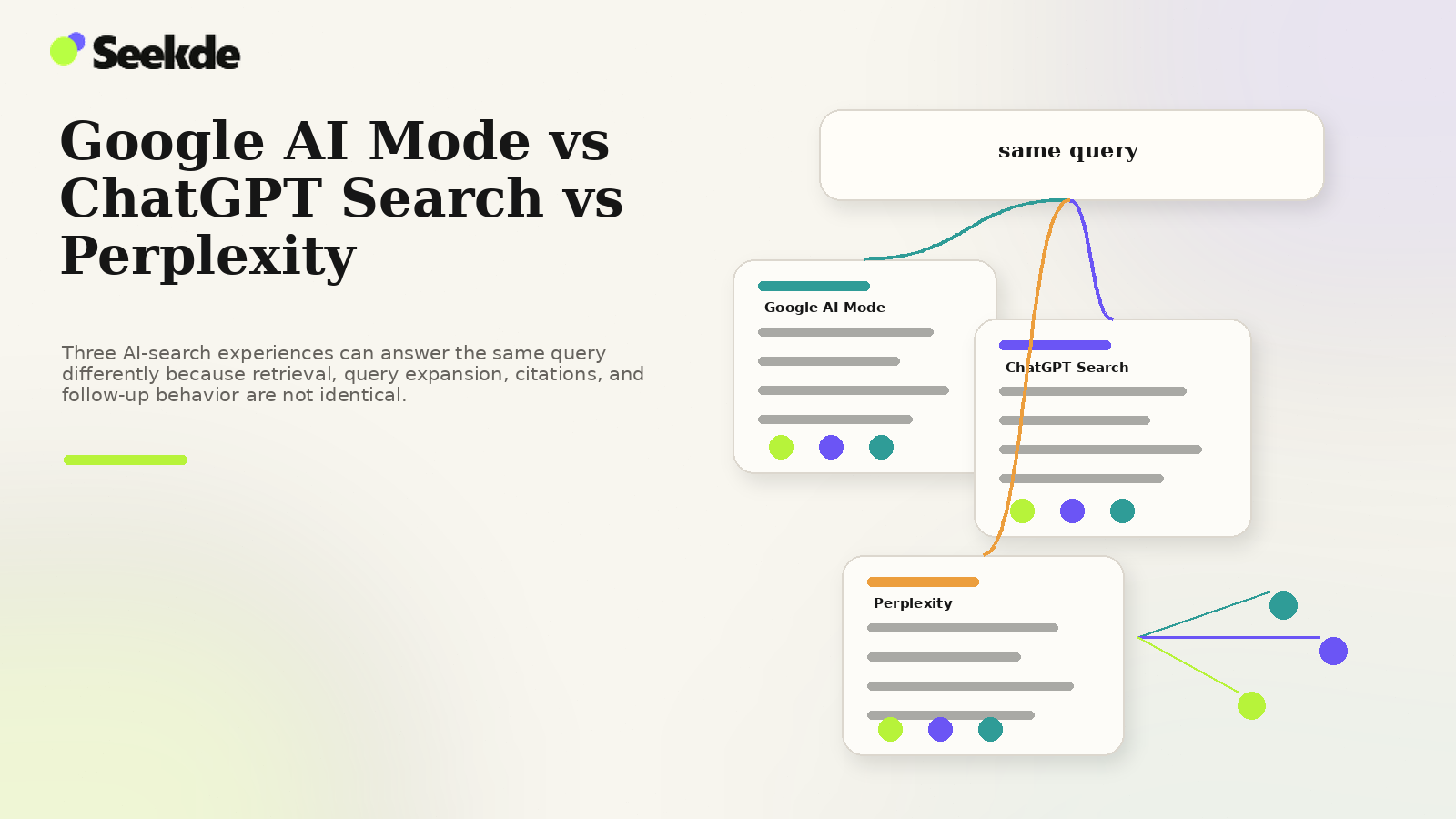
Google AI Mode, ChatGPT Search, and Perplexity all answer questions with current web information, but they do not behave identically. They differ in how they expand queries, retrieve and ground sources, present citations, preserve conversational context, and expose publisher visibility. The practical winner therefore depends on the query and whether you value Google’s search ecosystem, ChatGPT’s conversational workflow, or Perplexity’s source-forward research experience.
While all three platforms deliver synthesized answers grounded in web data, their underlying retrieval mechanisms and webmaster interfaces are not interchangeable. Optimizing a website for one engine does not guarantee visibility across the others.
From a publisher and digital marketing perspective, understanding the technical differences among these three leading generative engines is critical:
- Google AI Mode: An integrated, conversational search experience within Google Search, capable of using query fan-out to issue multiple related searches across subtopics and data sources to ground responses in supporting web pages.
- ChatGPT Search: A retrieval-augmented conversational assistant that may leverage third-party search providers alongside direct crawling via
OAI-SearchBot, rewriting user prompts into targeted search queries. - Perplexity: A specialized answer engine that performs live web searches, deploying its own crawler
PerplexityBotalongside third-party crawler partners to index permitted content for synthesis.
To build an effective publishing strategy, digital teams must evaluate the documented technical specifications, empirical user interface presentations, and measurement capabilities of each platform.
Quick Comparison: The Big Three Generative Engines
The following comparison synthesizes official platform documentation, verified technical specifications, and controlled empirical observations collected across all three platforms.
| Evaluation Dimension | Google AI Mode | ChatGPT Search | Perplexity |
|---|---|---|---|
| Retrieval & Grounding Architecture | Grounded directly in Google Search systems and the comprehensive Google web index. | Retrieval-augmented model; may use third-party search providers and direct crawling via OAI-SearchBot. |
Performs live web searches; utilizes PerplexityBot and third-party crawler partners. |
| Query Expansion & Intent Processing | Executes simultaneous sub-queries across Google’s index using query fan-out mechanics. | Dynamically analyzes user intent and may rewrite prompts into one or more targeted search queries. | Executes multi-step search queries, particularly when utilizing Pro Search reasoning. |
| Primary Search Crawler | Googlebot (standard search crawling and indexing infrastructure). |
OAI-SearchBot (crawls content to support search discovery and surfacing). |
PerplexityBot (crawls and indexes permitted web content for search and answers). |
| Training Crawler / Control | Google-Extended (controls whether crawled content may be used for training future generations of Gemini models powering Gemini Apps and Vertex AI API for Gemini, for grounding in Gemini Apps, and for Grounding with Google Search on Vertex AI; does not control Google Search inclusion or ranking). |
GPTBot (scrapes web data for foundation model training; separate from Search crawling). |
Perplexity states it does not build foundation models; PerplexityBot is not used for model pretraining. |
| Webmaster Controls & Directives | Blocking Googlebot prevents crawling; to prevent indexing, Google documents using noindex. Search Generative AI control manages AI features. | Robots.txt manages OAI-SearchBot crawling for summaries; noindex prevents link/title surfacing if crawled. | Robots.txt disallow prevents indexing text content; Perplexity notes domain/headline/summary may remain. |
| Source Citation UI (Observed 2026 Sample) | Interactive citation cards, source pills, side carousels, and expandable source panels. | Inline rounded pill badges concluding factual sentences, paired with a dedicated footer Sources button. |
Numbered superscript bracket citations (e.g., [1]), paired with a prominent top-level source card carousel. |
| Publisher Measurement / Attribution | Google Search Console provides dedicated Search Generative AI impression reporting. | Outbound citation links officially append the query parameter utm_source=chatgpt.com. |
No proprietary referral UTM parameter documented; publishers inspect analytics and server logs for referral behavior. |
| Conversational Follow-Up Handling | AI Mode supports follow-up questions and can use the conversational context to continue exploration. | ChatGPT maintains conversational context and may search the web again when a follow-up would benefit from current information. | Maintains thread history; suggests follow-up queries and uses Pro Search for multi-step refinement. |
| Seekde Practical Testing Priorities | High-authority Google indexing, clear entity relationships, and extractable definition passages. | Unrestricted OAI-SearchBot access, direct factual answer sentences, and clean HTML tables. |
Immediate factual clarity, structured statistical data, and verified crawlability by PerplexityBot. |
Retrieval Systems and Web Grounding
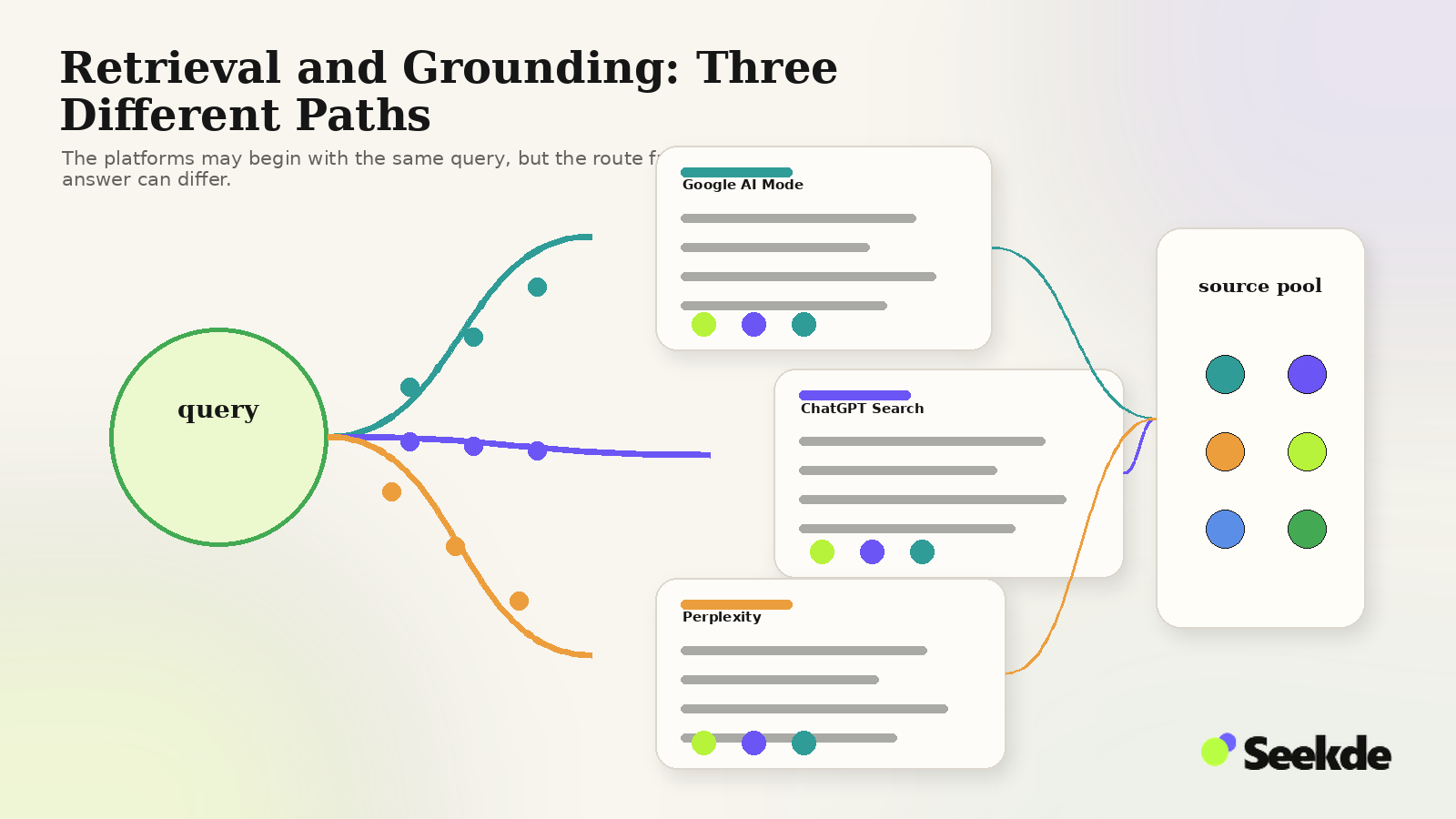
The most fundamental distinction among these platforms lies in how they access, index, and retrieve external web content to ground their generative responses.
Google AI Mode: Direct Core Index Grounding
As documented in official Google Search Central guidance on AI features, AI Mode is part of Google Search and may use query fan-out, issuing multiple related searches across subtopics and data sources to develop a response and identify supporting web pages.
AI Mode uses the same foundational Search technical requirements: the page must be indexed and eligible for a snippet, with no additional technical requirements. For a page to appear as a supporting link in AI Mode, Google requires it to be indexed and eligible for a Google Search snippet. Blocking Googlebot in robots.txt prevents crawling, but is not a guaranteed deindexing mechanism; publishers seeking to prevent indexing should use Google’s documented noindex control while allowing Googlebot to crawl the directive. Crawling, indexing, and serving in Google Search remain discretionary, and placement is not guaranteed. A detailed exploration of Google’s conversational architecture is available in our dedicated guide to Google AI Mode SEO, as well as our analysis of Google AI Overviews SEO.
ChatGPT Search: Hybrid Retrieval and OAI-SearchBot
OpenAI’s approach to search retrieval combines direct crawling with third-party search providers. According to official OpenAI documentation for publishers and developers and product announcements:
- Third-Party Providers: ChatGPT Search may utilize third-party search providers to retrieve candidate web results.
- Direct Crawling via OAI-SearchBot: OpenAI also deploys its own crawler,
OAI-SearchBot, to crawl content to support search discovery, surfacing, summaries, and citations for public websites. - Non-Dedicated Indexing: Publishers must not assume OpenAI operates a complete, dedicated search index equivalent to Google’s index. Rather,
OAI-SearchBotsupports discovery and surfacing within OpenAI’s broader retrieval framework.
Because OpenAI does not disclose an exclusive, fixed search provider, site owners must ensure their web infrastructure is accessible to OAI-SearchBot while maintaining general search discoverability. Further platform details are covered in our comprehensive report on ChatGPT Search SEO.
Perplexity: Live Web Search and Index Building
Perplexity positions itself as a conversational "answer engine." According to Perplexity’s official crawler documentation and Perplexity Help documentation on robots.txt:
- Live Web Retrieval: Perplexity executes real-time web searches to gather contemporary facts before generating an answer.
- PerplexityBot Crawling: Perplexity deploys its automated web crawler,
PerplexityBot, to discover and index permitted content. - Third-Party Crawler Partners: Perplexity explicitly documents that third-party crawler partners assist in building and augmenting its search index.
- No Foundation Model Pre-Training: Perplexity states that it does not build foundation language models from scratch, and confirms that
PerplexityBotis not utilized for foundation model pre-training.
Publishers optimizing for Perplexity must focus on how real-time search queries evaluate live web content. For a deep examination of this engine, review our guide to Perplexity SEO.
Query Expansion and Intent Resolution
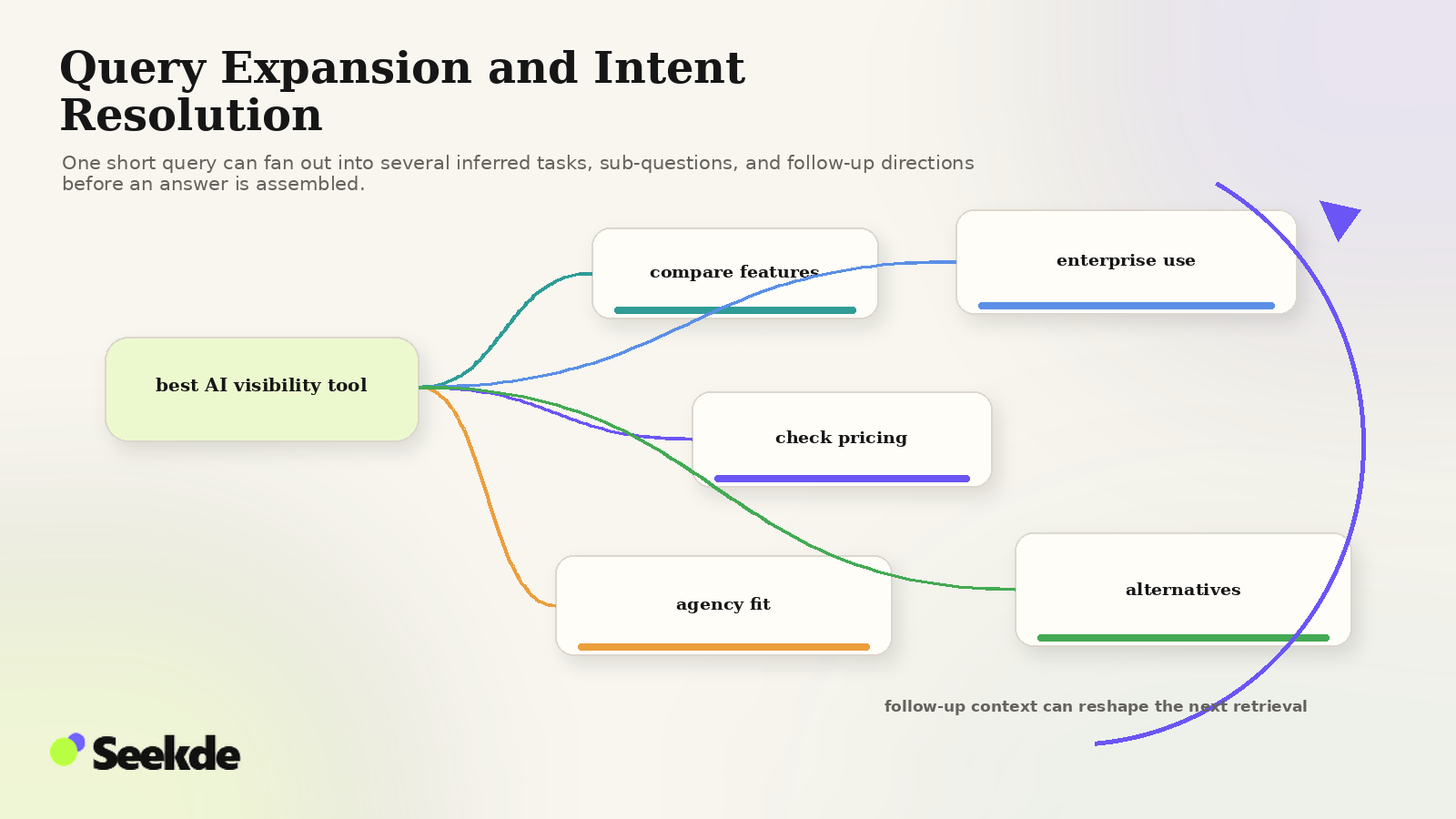
When users enter conversational questions, all three engines translate natural-language inputs into structured search queries. However, their execution models vary significantly.
Google AI Mode: Simultaneous Query Fan-Out
Google AI Mode utilizes query fan-out, issuing multiple related searches across subtopics and data sources to develop a response and identify supporting web pages. When presented with an exploratory question:
- A query such as "Compare heat pump efficiency in sub-zero climates versus standard electric heating" may lead the system to issue multiple related searches across subtopics and data sources to develop a response and identify supporting web pages.
This fan-out behavior is analyzed thoroughly in our study of query fan-out in AI search.
ChatGPT Search: Dynamic Prompt Rewriting
OpenAI documents that ChatGPT Search analyzes the user’s conversational intent and may rewrite the prompt into one or more targeted search queries before retrieving external documents.
For instance, a conversational query like "What happened with the latest EU AI regulations this morning?" may be rewritten into specific keyword queries including dates, regulatory bodies, and legal designations. Content relevant to those rewritten queries may be retrieved and considered when it otherwise satisfies ChatGPT Search eligibility requirements; matching a rewritten query does not itself guarantee retrieval or citation.
Perplexity: Multi-Step and Pro Search Reasoning
According to Perplexity’s current Pro Search documentation, Pro Search conducts multiple searches across the web, analyzes and synthesizes information from multiple sources, provides direct citations, and maintains context for follow-up questions.
Webmaster Controls and Crawler Governance
Managing how automated artificial intelligence crawlers access, index, and utilize proprietary content involves careful attention to platform-specific user agents and directives.
| Platform | Search Crawler | Training Crawler / Token | Governance Separation | Disallow / Control Impact |
|---|---|---|---|---|
Googlebot |
Google-Extended |
Complete separation: Google-Extended is a standalone product token controlling whether crawled content may be used for training future generations of Gemini models powering Gemini Apps and Vertex AI API for Gemini, for grounding in Gemini Apps, and for Grounding with Google Search on Vertex AI. It does not control ordinary Google Search inclusion and is not a Search ranking signal. |
Blocking Googlebot prevents crawling (use noindex to deindex). Search Generative AI control in Search Console manages AI feature participation. |
|
| OpenAI | OAI-SearchBot |
GPTBot |
Complete separation: OAI-SearchBot crawls content for search discovery/summaries; GPTBot is dedicated to foundation model training. |
Disallowing OAI-SearchBot prevents crawling for summaries/snippets; disallowing GPTBot does not affect search inclusion. |
| Perplexity | PerplexityBot |
None (Perplexity does not pretrain foundation models) | Crawler used for search indexation and answer generation. | Disallowing PerplexityBot prevents indexing page text; Perplexity notes domain, headline, and brief summary may remain. |
Key Takeaways for Technical Teams:
- Never Assume One Token Governs All Functions: Blocking OpenAI’s
GPTBotprotects training data but leaves ChatGPT Search intact; blockingGoogle-Extendedprotects content from Gemini model training without compromising Google Search traffic. - Search Crawlers Depend on Clear Permissions: If your organization policy restricts all automated scrapers by default, you must explicitly allowlist
Googlebot,OAI-SearchBot, andPerplexityBotif you intend to participate in their respective search ecosystems. - Snippet-Level Governance: Google supports granular snippet directives (such as
nosnippetanddata-nosnippet) as well as the Search Generative AI control in Search Console.
Source Citation Presentations Observed in 2026
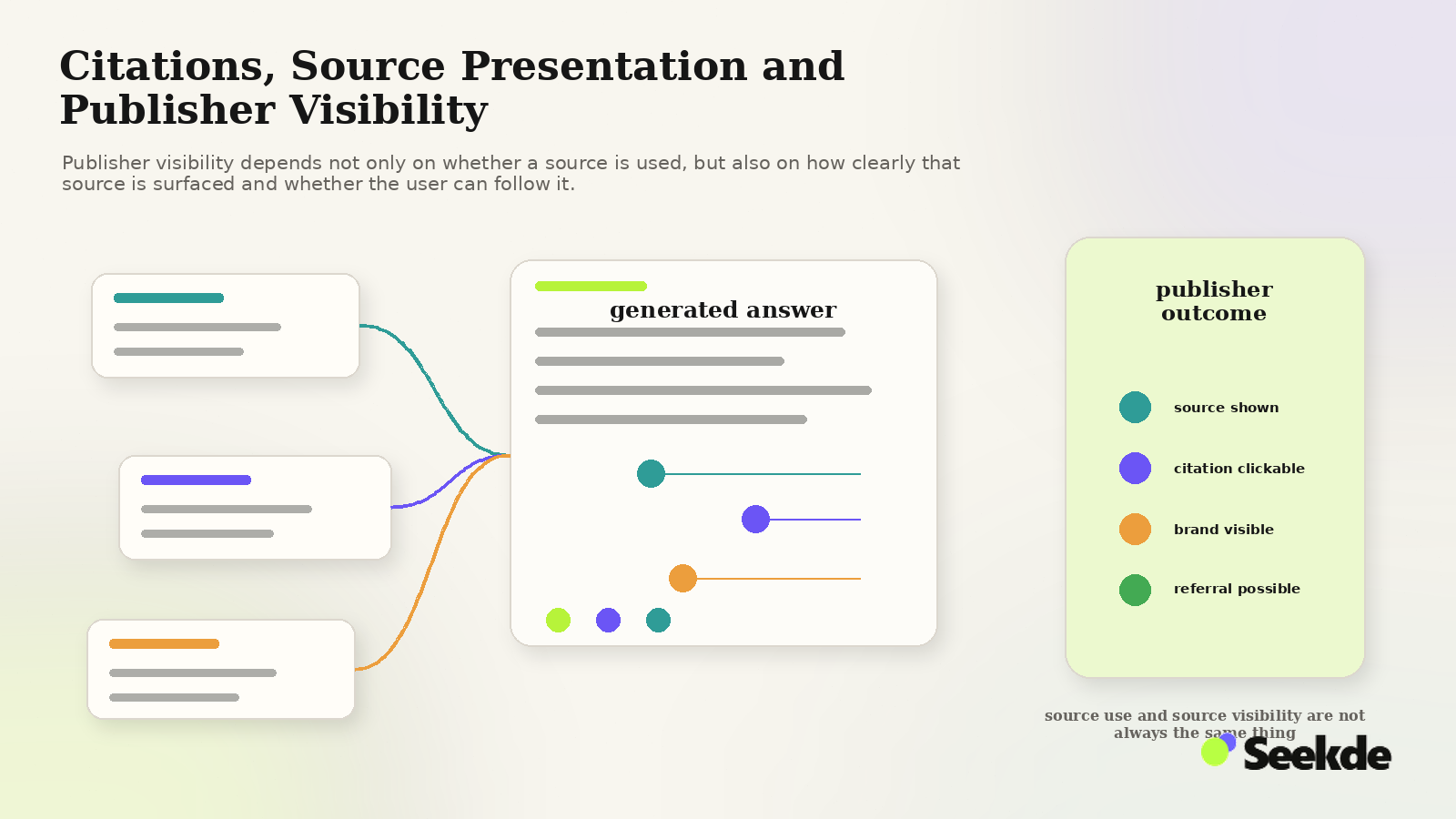
User interface presentation directly impacts how users interact with source links and whether an AI answer generates downstream website referrals. In our controlled empirical observations conducted in September 2026, the three platforms exhibited distinct citation presentation patterns:
Google AI Mode (Observed September 2026 Sample)
- Visual Presentation: Google AI Mode integrates citations through multifaceted visual components, including interactive source cards with high-resolution site favicons, compact pill buttons, and expandable side drawers.
- Card Carousels: For comparative and entity-driven queries, AI Mode frequently renders horizontal card carousels positioned alongside or directly beneath the synthesized answer block.
- Dynamic Exploration: Users can expand specific paragraphs to inspect the underlying source documents that contributed to each specific assertion.
ChatGPT Search (Observed September 2026 Sample)
- Inline Citation Pills: ChatGPT Search places rounded citation badges directly at the end of factual sentences and assertions (e.g.,
[OpenAI Developers],[Publisher Name]). - Dedicated Sources Button: At the conclusion of a searched response, the interface renders a prominent rounded button labeled
Sources. - Attribution Drawer: Clicking the
Sourcesbutton opens a sliding attribution sheet detailing destination URLs, article titles, publisher brand names, and favicons.
Perplexity (Observed September 2026 Sample)
- Top Source Carousel: In Seekde’s accepted controlled 2026 sample, Perplexity displayed a prominent horizontal carousel of source cards at the very top of the response, featuring publication favicons, publication names, and article snippets.
- Numbered Superscript Brackets: Within the synthesized text, factual claims were substantiated with numbered bracket citations (e.g.,
[1],[2]). - Interactive Footnotes: Clicking or interacting with a numbered citation revealed an immediate pop-up card containing the source URL, title, and an excerpt of the extracted passage.
Note: These observations represent empirical user interface behaviors captured during controlled guest-session testing in 2026. Interface designs, citation placements, and badge geometries evolve continuously as platforms iterate their consumer experiences.
Publisher Measurement / Attribution
Quantifying traffic and commercial return from generative engines involves understanding each platform’s distinct measurement and telemetry mechanisms.
Google AI Mode: Impression-Oriented Reporting
Google provides first-party measurement through Google Search Console via the dedicated Search Generative AI performance report.
- Impression Reporting: As documented by Google Search Central, this report tracks impressions generated by supported Search generative AI features.
- Measurement Boundary: Official documentation supports impression-oriented tracking; it does not currently provide isolated, click-level referral attribution that separates AI Mode clicks from standard organic web search clicks in standard server logs.
ChatGPT Search: Documented Tracking Parameter
OpenAI provides transparent URL-level attribution for webmasters. According to official OpenAI publisher documentation:
- Referral Parameter: Outbound citation links clicked by users within ChatGPT Search append an official URL parameter:
utm_source=chatgpt.com - Analytics Isolation: Webmasters can filter incoming sessions in Google Analytics 4 (GA4) or server logs by querying for this specific UTM tag, isolating ChatGPT referral traffic without relying solely on HTTP Referer headers.
Perplexity: Analytics and Server Log Monitoring
No proprietary referral UTM parameter is documented in the reviewed first-party source set. Publishers can inspect their own analytics and server logs to determine referral behavior on their sites.
Conversational Persistence and Follow-Up Queries
Generative engines are fundamentally conversational, enabling users to refine and extend queries over multi-turn dialogues.
- Google AI Mode: AI Mode supports follow-up questions and can use the conversational context to continue exploration.
- ChatGPT Search: Operates within OpenAI’s conversational interface. ChatGPT maintains conversational context and may search the web again when a follow-up would benefit from current information.
- Perplexity: Built around conversational threads and Pro Search capabilities. Perplexity maintains thread context, suggests follow-up queries, and allows users to explore related subtopics through iterative web searches.
For publishers, follow-up behavior can change the retrieval context; publishers should not assume that an initial citation will persist into later turns.
Seekde Practical Testing Priorities
Because generative engines evaluate content for synthesis rather than merely matching keyword frequencies, publishers should adopt structured, cross-platform publishing practices. These techniques represent Seekde practical testing priorities, not guaranteed platform ranking factors:
1. Maintain Unrestricted Crawler Accessibility
Ensure that your server infrastructure and firewalls allow legitimate crawling by Googlebot, OAI-SearchBot, and PerplexityBot. Regularly verify that your robots.txt configuration reflects your intended balance between search discovery and foundation model training governance.
2. Craft Direct Factual Answer Passages
Structuring informational pages with clear, concise definitions placed directly below descriptive H2 and H3 subheadings serves as a practical publishing structure to aid extractability during automated summarization.
3. Implement Clean Semantic Tables and Lists
Organizing comparative metrics, technical specifications, and tabular data into semantic HTML <table> elements serves as a clear formatting heuristic to establish explicit entity-attribute relationships.
4. Maintain Source Attribution and Original Research
Publishing primary data, empirical test results, expert quotes, and explicit methodology details creates substantive, sourceable material that automated systems can reference.
5. Monitor Each Engine Separately
Do not treat generative search traffic as a monolithic metric. Configure dedicated analytics segments for Google Generative AI impressions, ChatGPT UTM parameters (utm_source=chatgpt.com), and Perplexity referral traffic observed in your own analytics. Evaluate which content types resonate on each individual platform.
6. Avoid Cross-Platform Visibility Assumptions
Visibility in Google AI Mode does not imply visibility in ChatGPT Search or Perplexity. Because each platform operates different retrieval pipelines, query expansion rules, and partner data sources, publishers must audit and optimize for each engine independently.
To explore the broader theoretical foundation of optimizing for generative systems, review our analysis of what is generative engine optimization? and our detailed investigation into how AI search engines find and cite content.
Conclusion
The generative search landscape is not a single, uniform destination. Google AI Mode, ChatGPT Search, and Perplexity represent fundamentally different approaches to information retrieval, crawler governance, and source attribution.
By understanding how Google grounds in its core index, how ChatGPT combines third-party search providers with OAI-SearchBot, and how Perplexity indexes live web data, publishers can replace speculative guesswork with disciplined engineering. Ensuring crawl accessibility, presenting verifiable facts in extractable formats, and establishing independent measurement across all three platforms can improve technical readiness and make content eligible for evaluation, without guaranteeing visibility or citation. To examine the empirical methodologies guiding our research, inspect the complete Seekde research methodology.