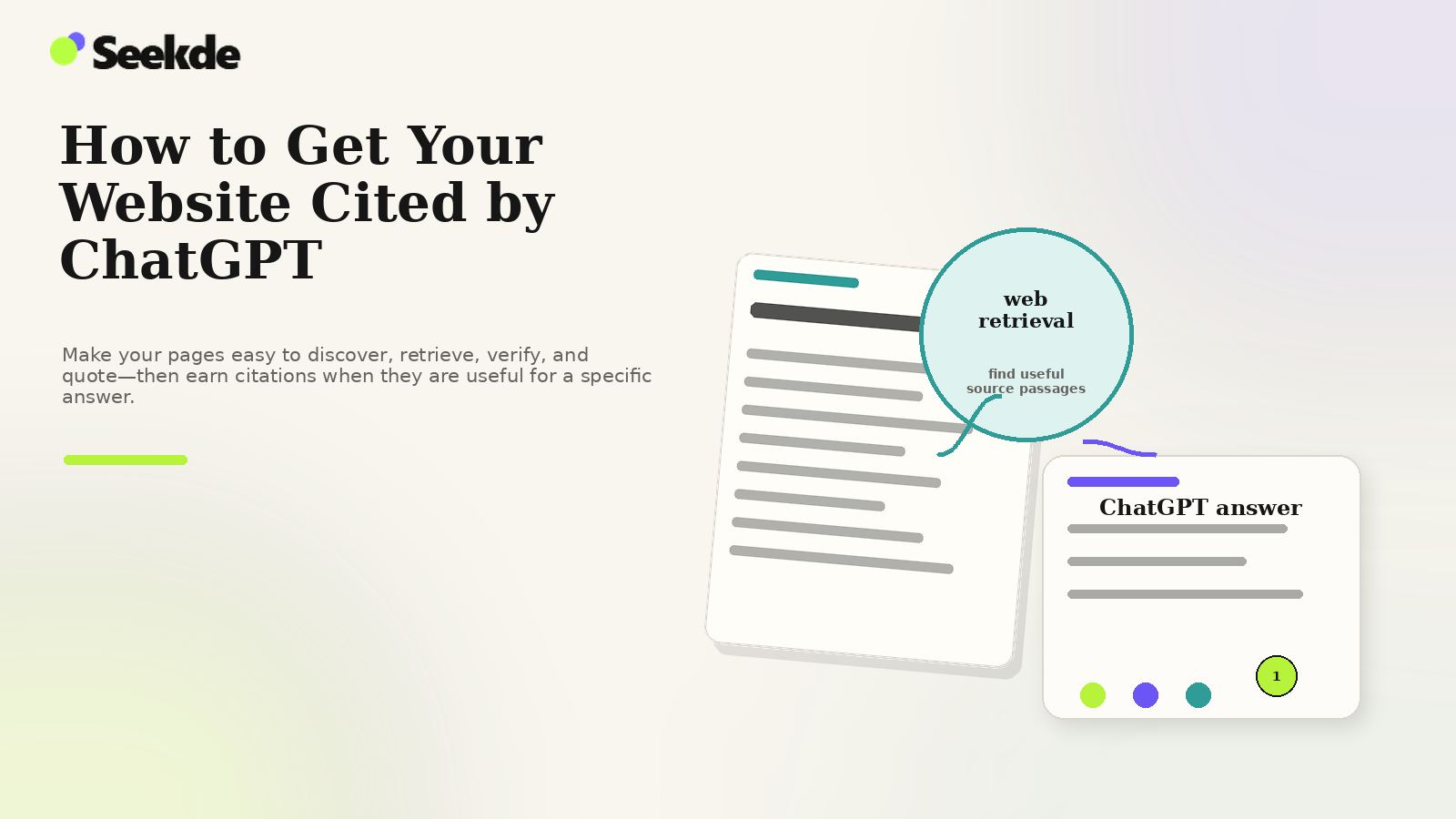
To improve your chances of being cited by ChatGPT, make your pages crawlable and easy to retrieve, publish clear self-contained answers supported by credible evidence, keep important facts current, and use clean HTML and stable source URLs. Allowing search-oriented crawling can make a page eligible for retrieval, but no technical setting or content format can guarantee that ChatGPT will cite it for a given query.
According to official OpenAI documentation for publishers and developers, allowing OAI-SearchBot helps web content be discovered, surfaced, summarized, cited, and linked in ChatGPT Search. There is no secret markup formula, proprietary configuration file, or commercial arrangement that guarantees a citation.
As conversational artificial intelligence platforms transform from static language models into real-time answer engines, digital publishers and webmasters face a fundamental shift. Understanding how ChatGPT retrieves web content, managing crawler permissions, and analyzing empirical citation behavior allows publishers to build an evidence-grounded strategy rather than chasing unverified search engine optimization myths.
How ChatGPT Finds Web Sources
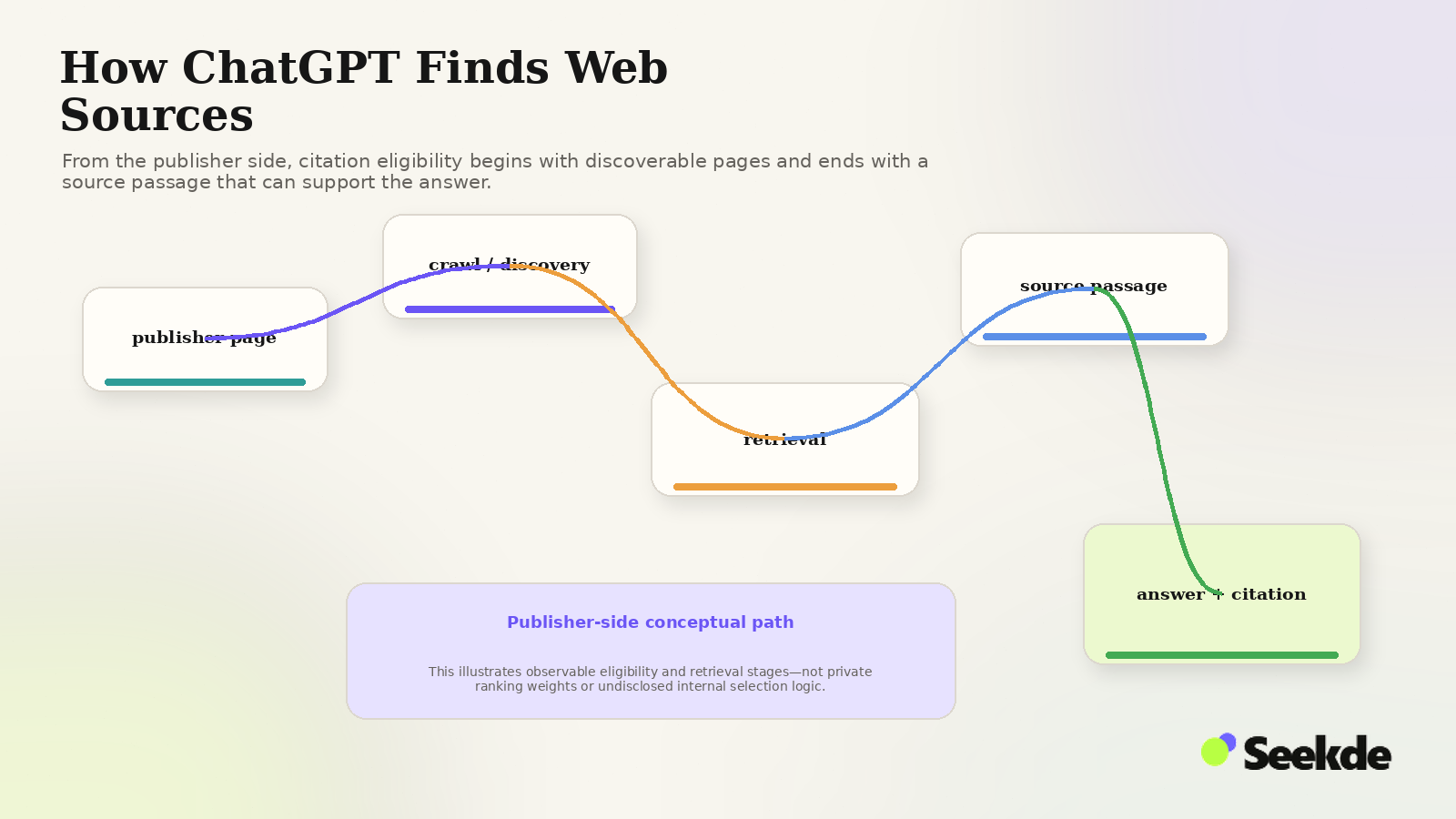
To optimize for citation visibility, site owners must first understand how ChatGPT discovers and retrieves external information. Unlike traditional web crawlers that index the entire internet into a single monolithic index, ChatGPT operates through a flexible retrieval architecture:
- Third-Party Search Providers: Official OpenAI Help documentation on searching the web with ChatGPT confirms that ChatGPT Search may use third-party search providers to retrieve relevant web results when addressing user prompts.
- Direct Crawling via OAI-SearchBot: OpenAI also deploys its own dedicated web crawler,
OAI-SearchBot, to crawl content to support search discovery, surfacing, summaries, and citations for public websites. - Dynamic Prompt Rewriting: When a user enters a complex or conversational question, ChatGPT’s underlying models analyze the query intent. If external information is required, the system may rewrite the user prompt into one or more targeted search queries before retrieving external web pages.
This multi-step query generation mirrors the broader concept of query fan-out in AI search, where conversational engines divide user questions into specific search parameters across diverse data sources. For site owners, this means that a page does not need to match the user’s exact conversational prompt to be cited. Instead, it must satisfy the underlying factual queries generated during the retrieval phase. A comprehensive overview of these mechanics is explored in our guide on how AI search engines find and cite content.
Make Your Site Eligible for ChatGPT Search
Before content quality or on-page formatting can influence citation selection, a website must satisfy baseline technical accessibility requirements. If OpenAI’s crawler cannot reach your server or parse your HTML, your pages cannot appear in ChatGPT search summaries.
1. Ensure Unrestricted Public Accessibility
Pages intended for ChatGPT Search must be publicly accessible without authentication barriers. Content behind subscriber paywalls, hard login walls, or interactive CAPTCHA gates cannot be indexed by automated search crawlers. While selective snippet access can sometimes be configured, pages requiring user interaction to reveal primary text will generally be excluded from search retrieval.
2. Configure Robots.txt for OAI-SearchBot
OpenAI identifies its search crawler using the user-agent token OAI-SearchBot. To allow ChatGPT Search to crawl, summarize, and cite your content, your robots.txt file must grant access to this crawler:
User-agent: OAI-SearchBot
Allow: /
If your robots.txt file disallows OAI-SearchBot across your root domain or specific subdirectories, OpenAI is prevented from crawling the page content to generate snippet summaries or text citations. OpenAI notes that a blocked URL’s link and title may still be surfaced in certain product contexts (such as ChatGPT Atlas) if that URL is discovered through another source. Publishers seeking to prevent link and title surfacing should use the documented noindex directive, which requires crawl access for the bot to read the tag.
3. Allowlist Verified OpenAI IP Addresses
Many enterprise websites, ecommerce platforms, and content hubs employ Web Application Firewalls (WAFs) such as Cloudflare, AWS WAF, or Fastly. These security systems frequently block unfamiliar automated user-agents or flag high-frequency bot requests as distributed denial-of-service (DDoS) attempts.
To prevent inadvertent blocking, OpenAI publishes its official, machine-readable IP ranges in JSON format at https://openai.com/searchbot.json. Network administrators and DevOps teams should incorporate these CIDR blocks into their firewall allowlists, ensuring legitimate OAI-SearchBot requests receive valid 200 OK HTTP responses.
4. Respect Documented Indexing Directives
OpenAI’s current publisher guidance specifically documents the noindex meta tag for preventing the blocked-page link/title behavior described above. If a page includes a <meta name="robots" content="noindex"> tag, it will not appear in search results or citation links, provided the crawler is permitted to access the page and read the directive.
Meeting every technical prerequisite guarantees eligibility, not placement. Just as having a crawlable website does not guarantee a top-three organic ranking on traditional search engines, allowing OAI-SearchBot simply permits the engine to evaluate your pages during retrieval synthesis.
OAI-SearchBot vs. GPTBot
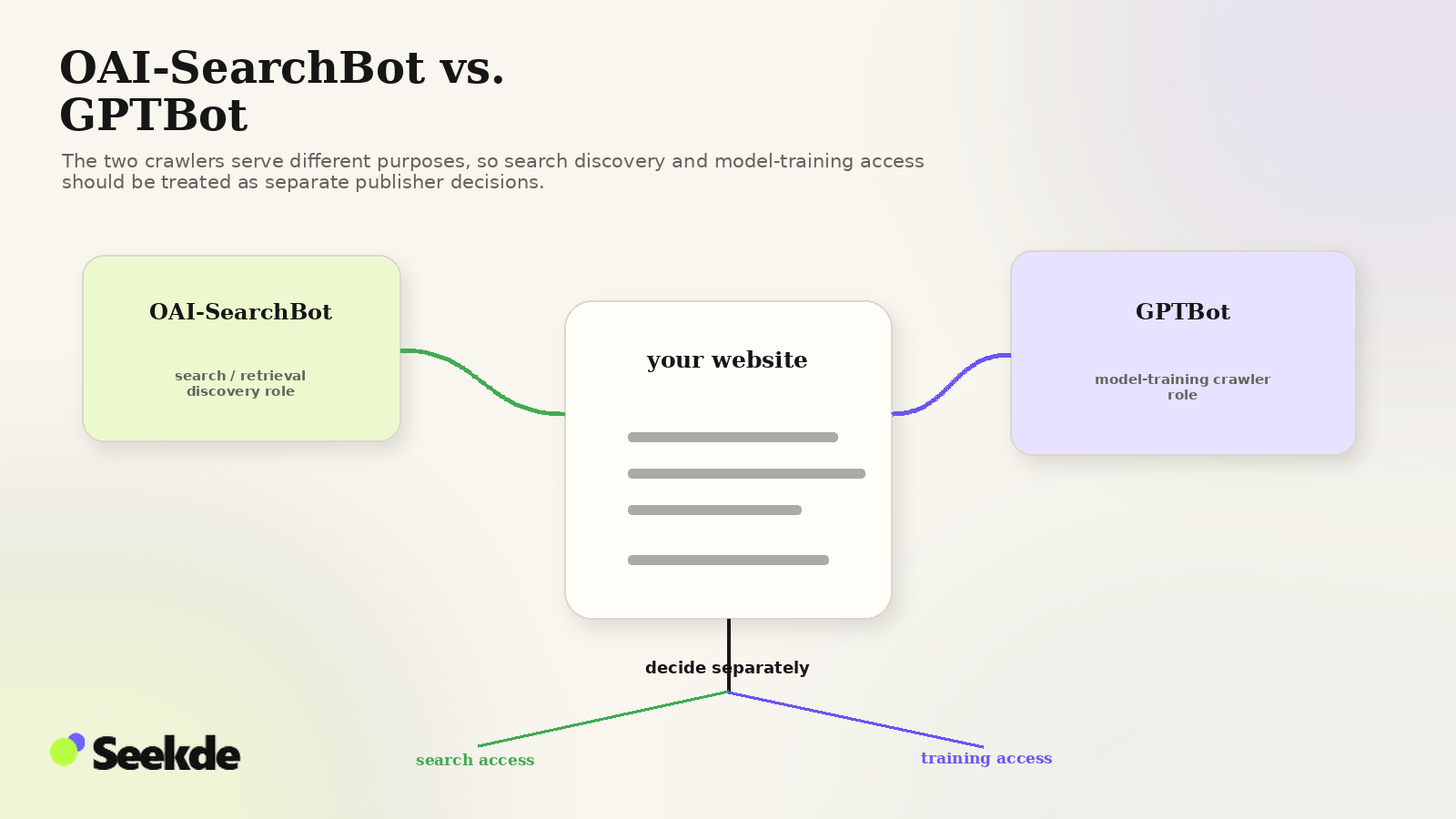
A frequent source of confusion among publishers is the distinction between crawlers used for search retrieval and crawlers used for artificial intelligence foundation model training. Conflating these bots has led many organizations to inadvertently disallow search crawling when their intention was merely to protect proprietary content from AI pre-training.
OAI-SearchBot (Search Retrieval)
- Core Purpose: Crawls content to support search discovery, surfacing, summaries, and citations in ChatGPT Search.
- Impact of Disallowing: Prevents OpenAI from crawling page content for summaries and snippets. (Links/titles may still surface if learned via another source unless noindex is read).
- Model Training: OpenAI explicitly states that
OAI-SearchBotis not used to train foundation models. - Placement: Content inclusion and citation placement are entirely algorithmic and never guaranteed.
- Documented User-Agent:
OAI-SearchBot
GPTBot (Model Training)
- Core Purpose: Used to scrape public web content to train and refine OpenAI’s foundation AI models.
- Impact of Disallowing: Blocking
GPTBotprevents content from being ingested for foundation model pre-training. - Search Discovery: Disallowing
GPTBotdoes not remove your site from ChatGPT Search ifOAI-SearchBotis allowed. - Documented User-Agent:
GPTBot
This structural boundary provides publishers with granular governance. Site owners who choose not to have their content utilized for general AI model training can safely disallow GPTBot while keeping OAI-SearchBot allowed for live search traffic:
# Allow ChatGPT Search discovery and citation links
User-agent: OAI-SearchBot
Allow: /

# Disallow scraping for AI model training
User-agent: GPTBot
Disallow: /
Understanding this distinction ensures that intellectual property policies do not unintentionally destroy organic AI visibility. A deeper examination of platform-level search infrastructure can be found in our comprehensive analysis of ChatGPT Search SEO.
What We Observed in ChatGPT Search
To understand how ChatGPT Search surfaces web sources under live operating conditions, Seekde conducted controlled empirical observations in September 2026 using an unauthenticated guest browser session on https://chatgpt.com/.
Our observation plan was deliberately bounded: we evaluated two distinct query executions representing different user intents, capturing four detailed observation artifacts across those sessions.
Observation 1: Broad Conceptual Definition (No Search Invoked)
In our first test run (RUN-CHATGPT-01), we submitted a broad conceptual question: "What is Generative Engine Optimization and what are the main optimization strategies?"
- Observed Behavior: ChatGPT generated a comprehensive, multi-paragraph conceptual explanation without visibly invoking live web search.
- Citation Presentation: No external web citations, inline badges, or source drawers appeared anywhere in the response.
- Analytical Governance: In this single controlled run, no visible web-search invocation or source citations appeared. This observation does not establish whether the response relied solely on model knowledge or whether any non-visible retrieval occurred.
Observation 2: Technical Webmaster Query (Web Search Invoked)
In our second test run (RUN-CHATGPT-02), we submitted an explicit, time-sensitive technical prompt: "Search the web for the latest official OpenAI crawler user agents and IP verification feeds in 2026."
- Observed Search Telemetry: The interface immediately displayed an active in-flight status indicator reading "Searching the web" before beginning token generation.
- Inline Citation Badges: The generated response included multiple rounded citation pills positioned directly at the conclusion of relevant sentences and factual claims (such as
[OpenAI Developers]and[OpenAI]). - Footer Sources Trigger: At the bottom of the completed answer, ChatGPT rendered a dedicated, clickable rounded button labeled
Sources. Clicking this button revealed an attribution sheet detailing destination page titles, publisher brand names, and domain favicons. - Structured Data Integration: The synthesized answer organized the retrieved crawler specifications into a clean markdown table, directly linking to OpenAI’s raw JSON feed endpoints (
searchbot.jsonandgptbot.json).
Strict Governance Rules on Observations
When evaluating live answer engine behavior, researchers must avoid speculative causal inferences:
- Uncited Pages Were Not Necessarily Ignored: The fact that a specific URL was not cited does not mean it was never retrieved during initial search phases; models summarize and compress candidate sources.
- Absence of Visible Search Is Not Proof of Parametric Memory: Interface indicators reflect UI design choices, not an exhaustive audit of backend retrieval pipelines.
- Selection Does Not Prove Universal Ranking Rules: The appearance of OpenAI developer documentation in a technical query reflects obvious entity relevance; it does not prove that tables, headings, or specific word counts caused the citation.
What Publishers Can Actually Improve
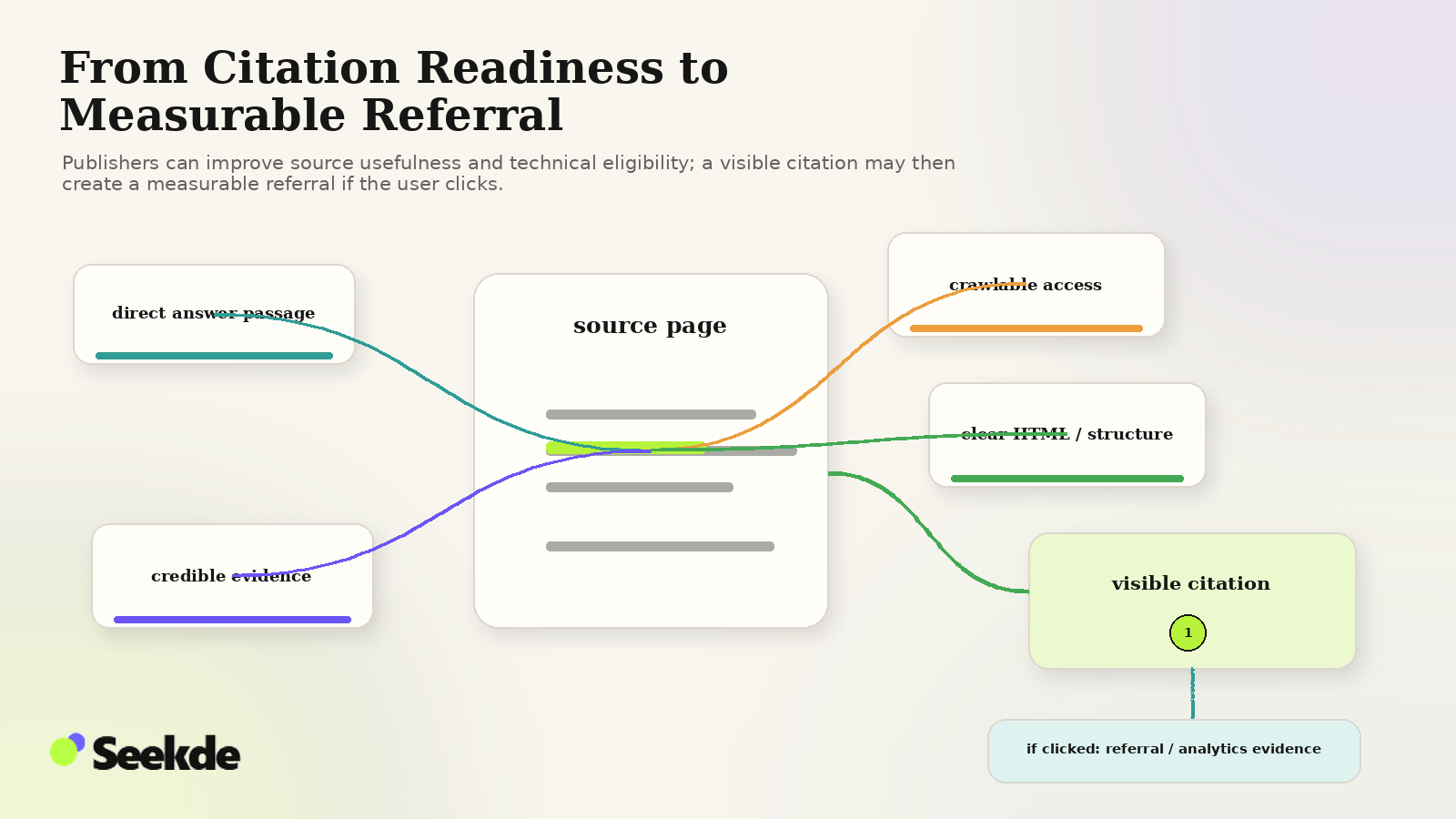
Because generative engines evaluate content for synthesis rather than merely matching keyword frequencies, publishers should adopt structured, evidence-aligned publishing practices. These techniques represent Seekde practical testing priorities, not guaranteed platform ranking factors:
1. Direct Factual Answer Passages
Generative models excel at extracting discrete, self-contained factual definitions. Placing a direct, unambiguous answer sentence immediately below an H2 or H3 question heading serves as a practical publishing structure to aid extractability during model summarization:
Example: "OAI-SearchBot is OpenAI’s dedicated web crawler used to crawl content to support search discovery, surfacing, and citations for ChatGPT Search without training foundation models."
Structuring definitions clearly reduces ambiguity during multi-document synthesis.
2. Semantic Data Tables and Lists
When presenting comparative data, pricing tiers, technical specifications, or chronological schedules, use clean HTML <table> elements and structured unordered lists. Tabular data provides clear relationship anchors between entities and attributes, making numerical facts and feature matrices readily parseable by automated extractors.
3. Clear Topical Hierarchy
Use logical heading nesting (H2 for primary topics, H3 for subtopics) to establish unambiguous topical relationships. Descriptive headings allow retrieval algorithms to identify which specific section of a long-form article answers a sub-query generated during prompt rewriting.
4. Precise Entity Naming and Fact Consistency
Avoid vague pronouns or conflicting assertions across your domain. Consistent entity terminology across your domain reduces ambiguity and improves factual clarity during automated content extraction.
5. Original Data and Source Attribution
Publishing original, supportable information, empirical test results, expert quotes, and unique industry surveys creates substantive, sourceable material that automated systems can reference. Citing authoritative primary sources within your own content reinforces factual consensus.
6. Fast, Textually Accessible HTML
Ensure that your primary textual content and tabular data reside in readily accessible textual HTML rather than relying on complex, client-side JavaScript rendering. While server-side rendering may reduce rendering latency and execution dependencies, it is not an OpenAI-documented eligibility requirement.
For a broader conceptual understanding of optimizing for generative models across search platforms, review our foundational guide on what is generative engine optimization?.
Can You Submit a Website Directly to ChatGPT?
A common question among search practitioners is whether OpenAI offers a webmaster console, a URL submission endpoint, or an XML sitemap upload tool comparable to Google Search Console or Bing Webmaster Tools.
The answer is straightforward: OpenAI’s current publisher guidance does not document or require a manual submission process for ChatGPT Search eligibility.
OpenAI documents OAI-SearchBot access and published searchbot IP access as the requirements for making a website eligible for inclusion. ChatGPT Search may also use third-party search providers when retrieving web results. Site owners should focus on technical crawl accessibility and content discoverability rather than seeking unverified manual submission shortcuts.
How to Measure ChatGPT Referrals
When users click external source links within ChatGPT Search answers, webmasters can track and quantify that inbound traffic in their web analytics platforms.
Documented URL Referral Parameter
OpenAI officially documents that outbound referral links clicked from ChatGPT Search results append the following query parameter:
utm_source=chatgpt.comThis tracking parameter enables digital marketers to isolate ChatGPT Search traffic within Google Analytics 4 (GA4), Adobe Analytics, or custom server logs.
Setting Up Analytics Reporting
To track ChatGPT traffic effectively:
- Google Analytics 4 Filters: In GA4, navigate to Reports > Acquisition > Traffic Acquisition. Filter the report by
Session source = chatgpt.comor create a custom channel group specifically identifying AI Search Referrals. - Server Log Monitoring: Search server access logs for incoming HTTP
GETrequests containingutm_source=chatgpt.comto capture raw session counts, landing page distributions, and status codes. - Preserve Query Parameters: Ensure that internal server redirects (such as non-www to www, HTTP to HTTPS, or trailing slash normalizations) pass incoming query parameters intact. If a 301 redirect strips query strings, the
utm_sourcetag will be lost, misclassifying the visitor as direct traffic. - Primary Attribution Mechanism: Because OpenAI explicitly documents the UTM parameter, publishers should use that parameter as the primary documented attribution mechanism rather than depending on browser Referer behavior.
As generative interfaces capture user attention from traditional search engine result pages, tracking referral traffic is essential for understanding commercial ROI. For an in-depth perspective on this shifting user behavior, explore our analysis of how search is changing from links to generated answers.
Citation Readiness Checklist
Before publishing content intended to compete for visibility in generative search environments, evaluate your technical and editorial infrastructure against this readiness checklist:
- [ ] Robots.txt Access:
User-agent: OAI-SearchBotis explicitly allowed to crawl the site or directory path to permit content summaries and snippet extraction. - [ ] Network / WAF Allowlisting: Corporate firewalls, Cloudflare, or AWS WAF configurations permit verified IP ranges from
https://openai.com/searchbot.json. - [ ] Noindex Directives: Pages are verified free from unintended
<meta name="robots" content="noindex">tags, ensuring crawlers can read the directive where applied. - [ ] Training Crawler Governance: If AI model training is restricted by company policy,
GPTBotis disallowed inrobots.txtwhileOAI-SearchBotremains allowed. - [ ] Textually Accessible Content: Primary factual statements, data tables, and definitions are accessible in textual HTML to minimize client-side rendering dependencies (Seekde heuristic).
- [ ] Extractable Answer Formats: Key informational questions are answered directly beneath descriptive H2/H3 subheadings in concise, self-contained sentences (Seekde testing priority).
- [ ] Data Densification: Complex specifications, statistics, and comparative metrics are presented in semantic HTML tables (
<table>) (Seekde testing priority). - [ ] Entity Consistency: Names, technical terms, and product features are referenced consistently across all site documents to reduce extraction ambiguity.
- [ ] Analytics Tracking: Inbound URL handling is configured to preserve
utm_source=chatgpt.comthrough all redirects and server routing rules. - [ ] Realistic Expectations: Editorial teams understand that technical eligibility enables search evaluation, but citation placement is determined algorithmically by model synthesis and never guaranteed.
Conclusion
Securing citations in ChatGPT Search is neither an impenetrable mystery nor an arbitrary exercise in keyword density. It is an engineering and editorial discipline grounded in technical discoverability and informational clarity.
By ensuring OAI-SearchBot has unrestricted access to your public pages, maintaining clean textual HTML, presenting authoritative factual assertions in extractable formats, and diligently tracking inbound referral parameters, publishers position their content to participate actively in the next generation of conversational search. For a rigorous look at how Seekde evaluates these emerging search systems, review our complete research methodology.