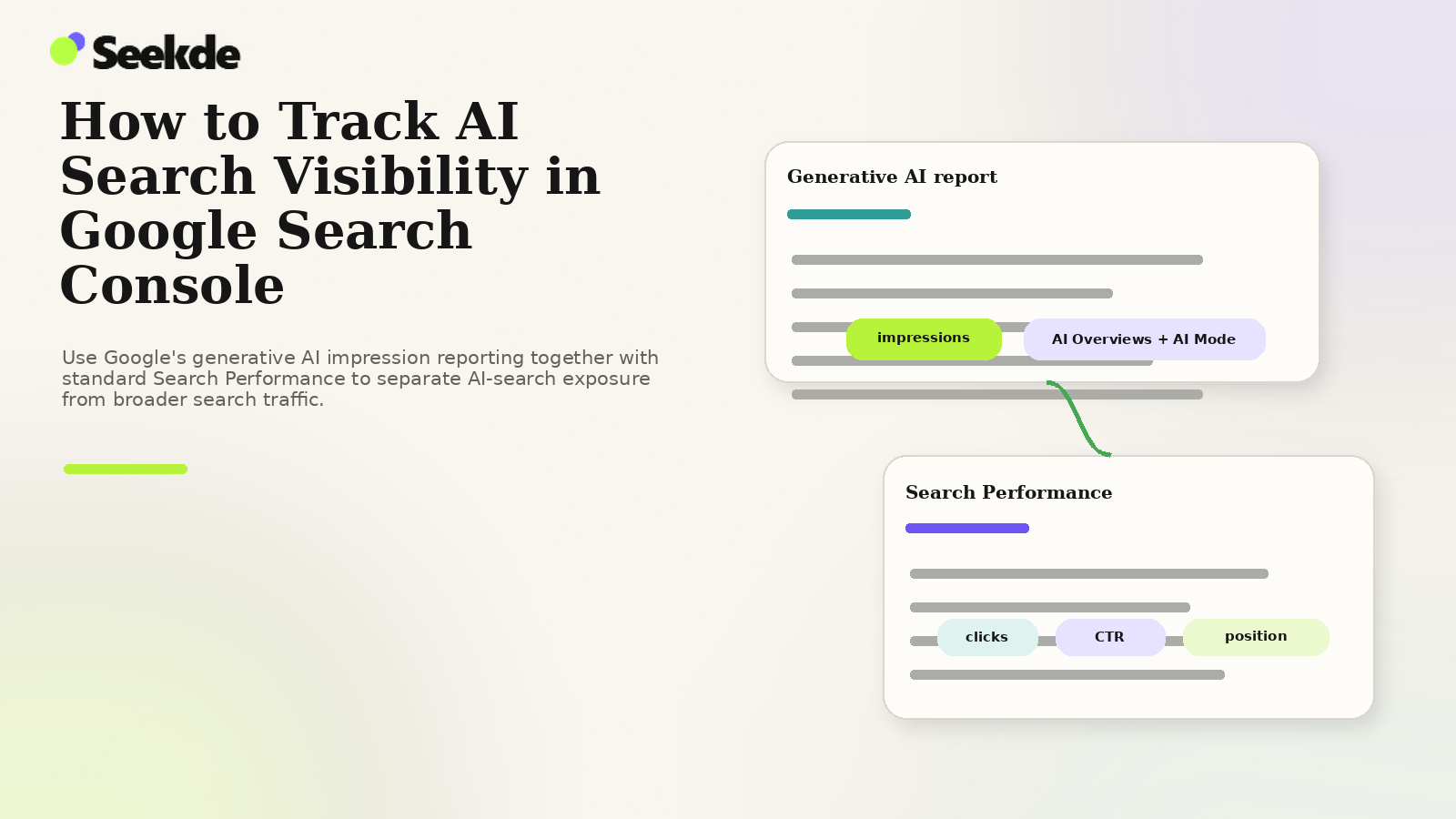
Google Search Console can track part of your AI search visibility through its dedicated Generative AI performance report, which records impressions from supported generative Search features such as AI Overviews and AI Mode. Pair that exposure data with standard Search Performance for clicks, CTR, and position, because Search Console does not provide a complete prompt-level view of citations, mentions, or competitor visibility.
Rolled out worldwide on August 31, 2026, this dedicated report separates generative search visibility from standard organic web results. Under Google’s Generative AI performance report documentation, the report provides dedicated impression tracking and dimensions for both Google AI Overviews and Google AI Mode, detailing when pages are cited within synthesized answers.
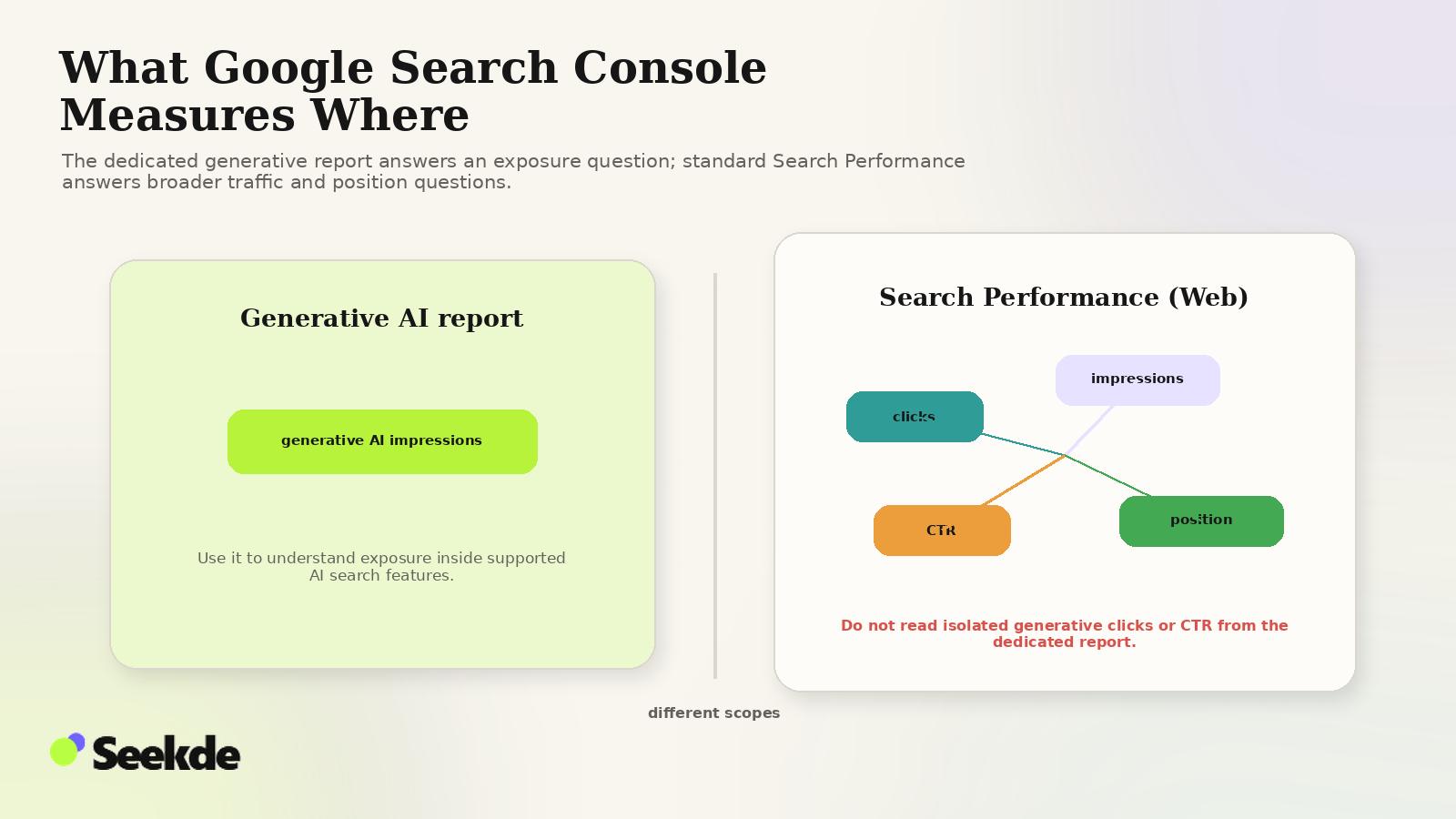
Crucially, the dedicated Generative AI report is an impressions-only report focusing on generative-AI impressions across page, country, date, and device dimensions, while broader Search clicks, total impressions, CTR, and average position remain reported within the standard Performance report for Search results. Understanding how to use this dedicated report—while cross-referencing normal web performance data and on-site analytics—enables search teams to evaluate generative discoverability accurately. This guide details the reporting architecture, the official position calculation methodology in underlying Search Performance data, and how to evaluate generative impact without conflating metrics.
1. The Generative AI Performance Report Architecture
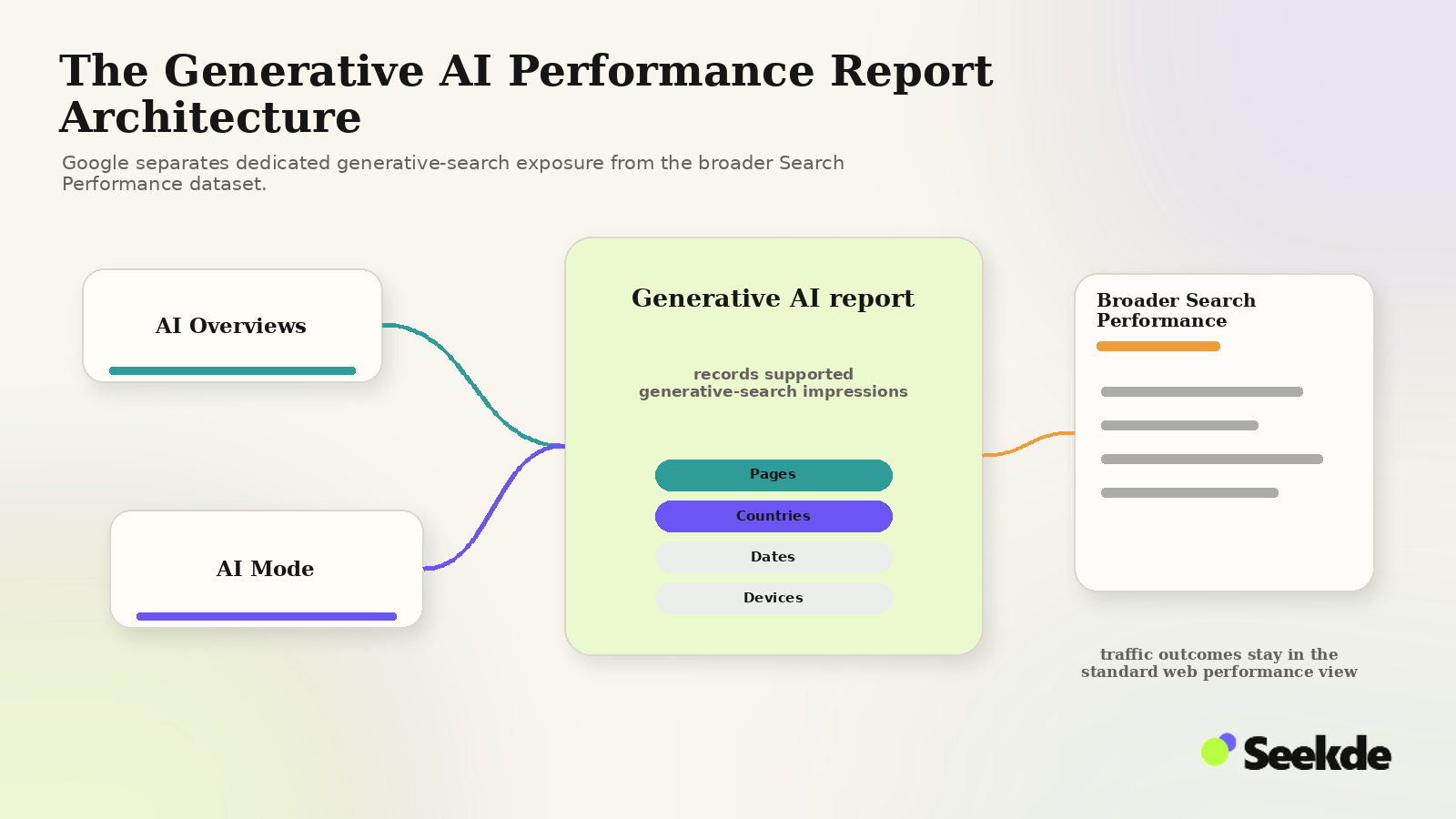
Google Search Console organizes generative search data under a dedicated performance view within the Search Console navigation. This interface isolates generative impressions from traditional web, image, and video search.
Performance > Generative AI (Search)
Google AI Overviews & Google AI Mode
Generative Impressions
Pages, Countries, Dates, Devices
Clicks, Impressions, CTR, Average Position
Surfaces Covered
The report aggregates impression data across Google’s primary generative search interfaces:
- Google AI Overviews: Synthesized snapshot answers displayed directly at the top of standard Google Search result pages for complex or informational queries.
- Google AI Mode: Google’s interactive, multi-turn conversational search experience designed for extended exploratory research.
Publishers can analyze impression volume across all generative surfaces combined, or apply dimension filters to inspect AI Overviews and AI Mode independently where supported.
2. Official Metrics & Position Calculation Methodology
Google applies specific logging rules to generative search features in Search Console:
Impression Logging in the Dedicated Report
As documented in Google’s clicks, impressions, and position methodology guidelines, an impression is recorded in the dedicated Generative AI report when a link pointing to your site becomes visible within the user’s viewport inside an AI Overview or AI Mode interface:
- Top-Level Citation Cards: If an AI Overview displays source cards or link pills in its default rendered state, visible URLs receive impressions immediately.
- Collapsed References: If citations are housed within an expandable accordion or secondary dropdown, an impression is logged only if the user expands the module and the link scrolls into the viewport.
Clicks and Position in Standard Search Performance
When a user clicks any active link, source card, or citation pill within an AI Overview or AI Mode response, Google registers an organic search click.
However, search teams must recognize an essential structural boundary: the dedicated Generative AI performance report does not provide an isolated clicks, CTR, or average-position metric. Outbound clicks and ranking positions from generative features are included within the broader Search Performance report alongside standard organic blue links. The dedicated report focuses strictly on generative-AI impressions and their associated dimensions.
The Single-Position Rule for AI Overviews
Historically, SEO practitioners debated how links inside AI Overviews were scored for average position. Google’s official documentation on About AI Overviews and its position methodology specification clarify how position behavior is recorded in standard Search Performance:
The Single-Position Rule: An AI Overview occupies a single search-result position on the SERP. All links contained within that AI Overview receive that exact same position.
For example:
- If an AI Overview appears as the very first organic block below sponsored ads, the AI Overview occupies Position 1.
- Every link embedded within that AI Overview—whether displayed in the top source carousel, within an inline pill, or in a reference list—is assigned Position 1 for that query execution.
- If a traditional web result for your site also ranks at organic Position 6 on the same SERP, Search Console calculates the average position based on the highest-ranking link (Position 1).
Position Methodology in AI Mode
For conversational interactions, Google documents in its Search Console methodology guidelines that AI Mode follows the same position methodology as a Google Search results page. Links are evaluated based on their location within the rendered conversational results display, adhering to the same fundamental calculation rules established across Google Search.
Note: These position calculations govern how rankings are logged in standard Search Performance reports; average position is not exposed as a metric in the dedicated Generative AI impressions report.
3. Dimensions Available in Generative AI Reporting
The Generative AI performance report supports core analytical dimensions for isolating impressions:
| Dimension | Analytical Application |
|---|---|
| Pages | Identifies which specific content assets, research reports, or product pages are most frequently cited as ground truth in generative responses. |
| Countries | Evaluates international visibility and regional generative rollout differences across territories. |
| Devices | Compares desktop vs. mobile generative search exposure, highlighting mobile layout and citation variations. |
| Dates | Tracks longitudinal impression trends and measures the impact of content refreshes over time. |
4. Supplemental Diagnostic Analysis: Evaluating Zero-Click Demand & Web Clicks
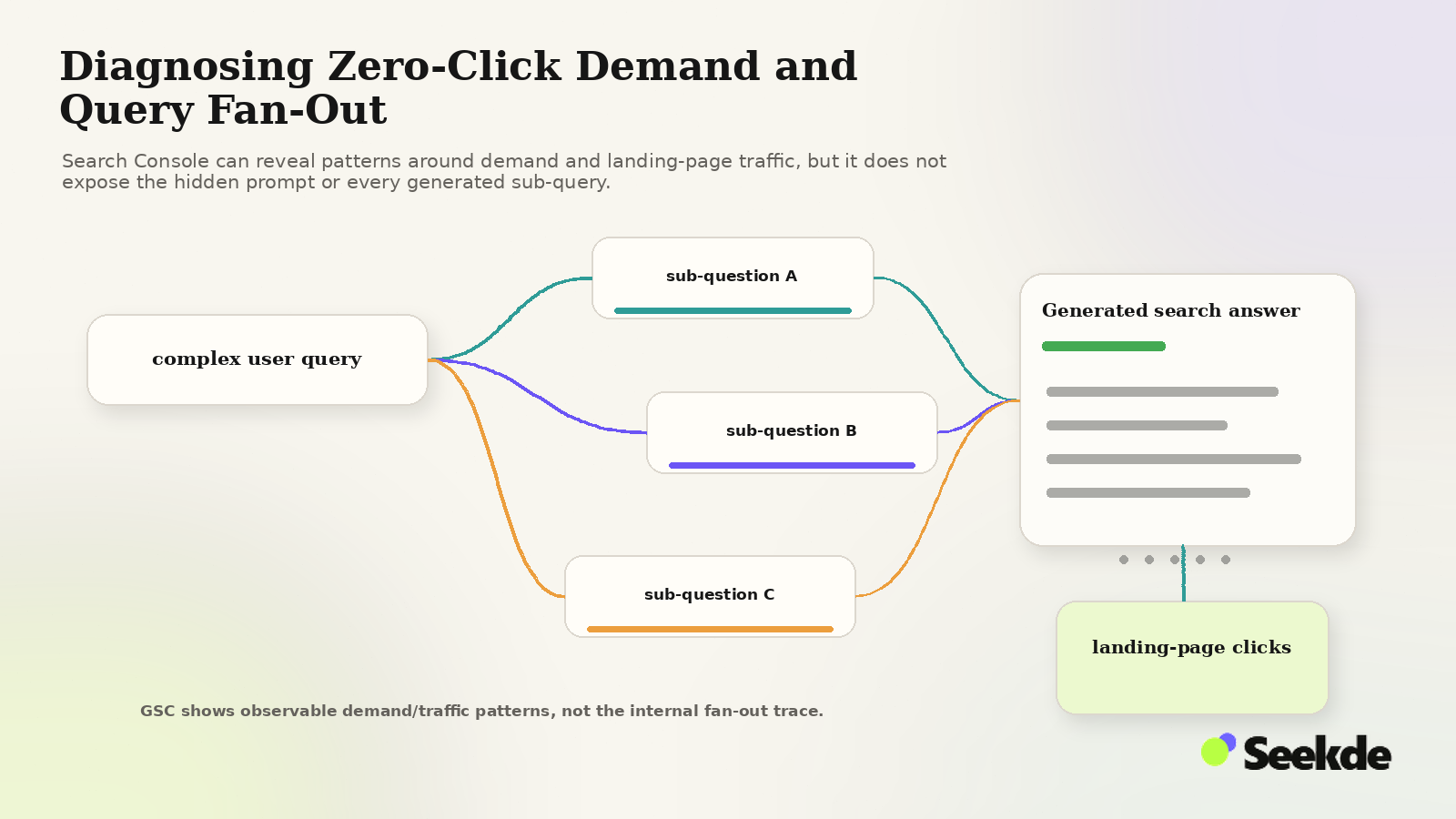
Because the dedicated Generative AI report isolates impressions rather than clicks or position, advanced search analysts pair generative impression trends with landing page click data in the standard Web report to evaluate traffic outcomes.
Compare Generative Impr vs Web Clicks
Regex filter for conversational stems
Bridge pre-August 2026 data
1. Assessing Zero-Click Search Dynamics
Generative AI often answers user questions directly on the SERP, satisfying intent without generating an outbound click.
By comparing landing page data between the standard Web performance report and the dedicated Generative AI impressions report:
- High Generative Impressions with Flat Web Clicks: Indicates that your page is frequently selected as authoritative ground truth, but the AI snapshot fully satisfies the user’s informational query on-page (a classic zero-click dynamic).
- Surging Generative Impressions with Rising Web Clicks: Indicates that citations within the generative snapshot function as an effective teaser, compelling searchers to click through to your domain for comprehensive tools, data tables, or procedural depth.
2. Identifying Query Fan-Out Footprints
As examined in What Is Query Fan-Out in AI Search?, Google’s retrieval engine decomposes complex user prompts into multiple semantic sub-queries.
To isolate conversational query families that drive generative retrieval, apply custom regular expression filters in the standard Search Performance report:
^(who|what|where|when|why|how|can|is|are|does|should|compare)b.*Filtering for queries with five or more words (^([^ ]+ ){4,}[^ ]+$) reveals conversational, multi-clause inquiries where Google’s retrieval pipeline actively extracts supporting passages from your content.
5. What Google Search Console Still Cannot Reveal
Despite the powerful addition of dedicated Generative AI reporting, search teams must recognize remaining analytical boundaries:
- Isolated Generative Clicks, CTR, and Average Position: The dedicated Generative AI performance report provides impression data across pages, countries, dates, and devices, but does not provide segregated generative-AI clicks, CTR, or position metrics. Outbound clicks and ranking positions from generative surfaces remain folded into total Web search traffic.
- Unlinked Brand Mentions: Search Console only tracks indexed URLs that appear as links on the SERP. If an AI Overview or AI Mode response names your company in prose without embedding a clickable link, GSC logs zero data.
- Underlying Prompt Sub-Queries: GSC reports user search queries in the standard performance view, but does not expose internal retrieval sub-queries generated by Google’s neural query-expansion models.
- Sentiment and Contextual Framing: GSC records impressions, but cannot evaluate whether your brand was recommended enthusiastically, mentioned neutrally, or cited as an example of a problem.
- Third-Party Platform Performance: GSC reflects only Google’s search ecosystem. It provides zero intelligence regarding performance across ChatGPT Search, Perplexity, or Microsoft Copilot.
6. The Complete Generative Measurement Triad
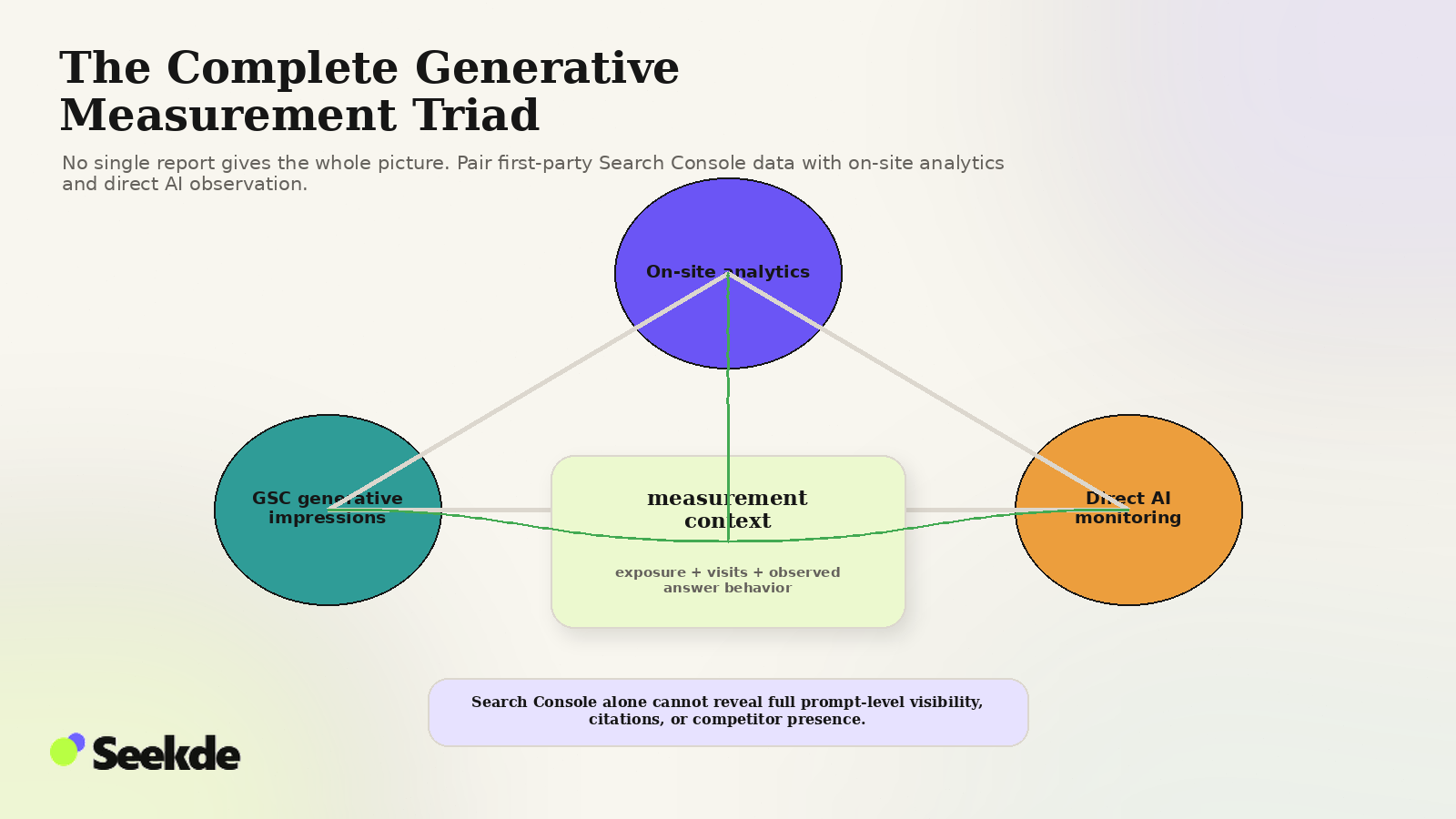
To build an exhaustive generative intelligence capability, Google Search Console must function as one component of a three-pillar measurement model:
First-party Google search data
On-site post-click conversions
Live prompt sampling & mentions
- Google Search Console (Pillar 1): Measures first-party Google visibility, tracking generative impressions and cited landing pages in the dedicated Generative AI report, alongside clicks, impressions, and single-position rankings across AI Overviews and AI Mode in regular Search Performance.
- Google Analytics 4 (Pillar 2): Tracks on-site user behavior after arrival, isolating referral traffic from ChatGPT, Perplexity, and Copilot using Custom Channel Groupings in GA4.
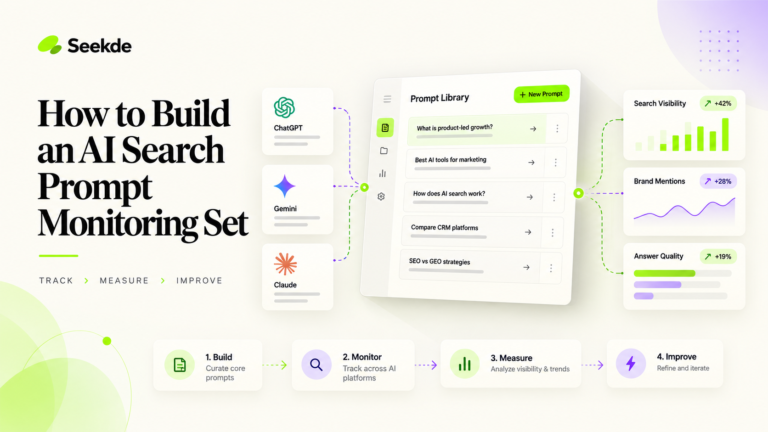
- Empirical Prompt Auditing (Pillar 3): Evaluates unlinked mentions, qualitative sentiment, and competitive displacement across all engines using the methodologies in How to Measure Brand Visibility in AI Search and How to Build an AI Search Prompt Monitoring Set.
Pairing these three pillars transforms isolated metrics into a comprehensive, verified discovery strategy.
Related Guides & Methodologies
- What Is AI Search Visibility?
- AI Citations vs Brand Mentions: What’s the Difference?
- Seekde Research Methodology
Authoritative Primary Sources
- Google Search Central: Generative AI Performance Report (Search): Official documentation for the dedicated report covering generative impressions, supported features (AI Overviews and AI Mode), and dimensions (Pages, Countries, Dates, Devices).
- Google Search Central: Performance Report (Search Results): Official documentation on regular Search Performance reporting, detailing clicks, impressions, CTR, and average position.
- Google Search Central: Clicks, Impressions, and Position Methodology: Authoritative documentation detailing impression logging, click registration, and position calculation rules for AI Overviews and AI Mode.
- Google Search Central: About AI Overviews and Your Website: Official guidance confirming the single-position rule for AI Overviews and Search integration.