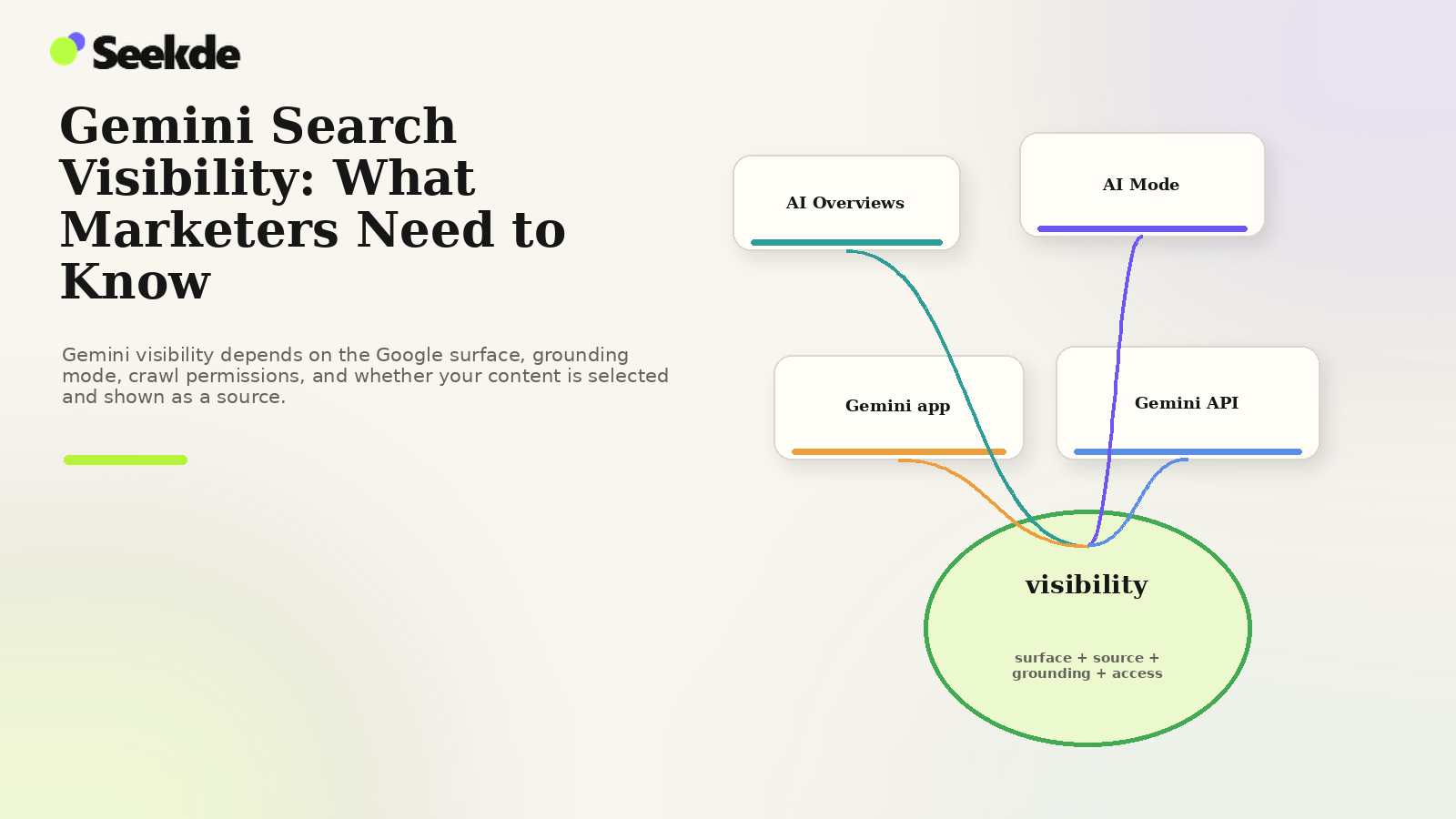
Gemini search visibility is the observable presence of your brand or website across Google’s AI-powered search and Gemini experiences, including when your pages are used, linked, or surfaced as sources in grounded answers. Marketers should measure each surface separately because AI Overviews, AI Mode, the consumer Gemini app, and Gemini API experiences can differ in retrieval, grounding, citation presentation, and crawl requirements.
In digital marketing discussions, "Gemini" is frequently used as an umbrella term that conflates consumer chat applications, developer APIs, and Google Search generative features. However, these are distinct product surfaces with different controls, interfaces and documented behaviors; their complete internal retrieval implementations are not publicly disclosed. A credible visibility strategy begins by identifying the exact technical surface you are analyzing.
To evaluate how a brand or publication appears across Google’s generative ecosystem, teams must distinguish between consumer grounding, enterprise developer APIs, standard SERP overviews, and conversational search tabs.
The Four Google AI Surfaces: Architectural Demarcation
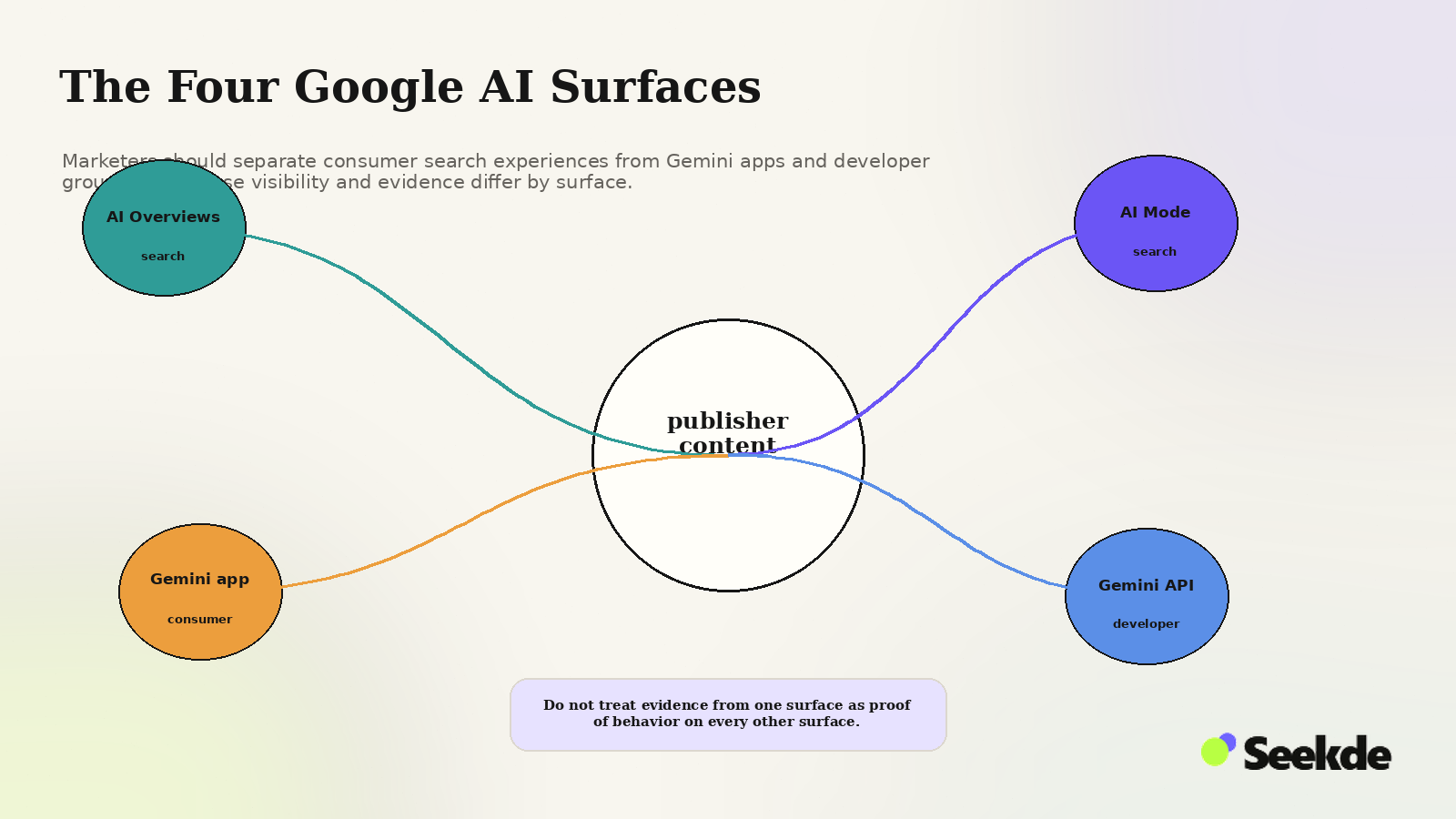
Google deploys generative technology across four primary surfaces, each governed by different technical controls and user contexts:
| Surface Dimension | Consumer Gemini App | Gemini API Grounding | Google AI Overviews | Google AI Mode |
|---|---|---|---|---|
| Primary Interface | Web app (gemini.google.com/app) and mobile app |
Developer endpoints (Google AI Studio / Vertex AI) | Top of standard Google SERP (single-query results) | Dedicated conversational tab in Search (udm=50) |
| Retrieval Pipeline | Gemini Apps may provide sources and related web links. In Seekde’s September 2026 controlled test set, visible Google Search grounding/source links were observed | Optional google_search tool in API calls (older models used google_search_retrieval) |
Google Search index; AI Overviews may use query fan-out depending on the query. | Conversational Google Search experience supporting follow-up questions; AI Mode may use query fan-out. |
| Crawling Directives | Google-Extended controls Gemini model training and Gemini Apps grounding; does not affect Google Search indexing | Google-Extended controls inclusion in Grounding with Google Search on Vertex AI |
Standard Google Search technical requirements apply: pages must be indexed and eligible to appear with a Search snippet; normal Googlebot and preview controls apply. | Standard Google Search technical requirements apply: pages must be indexed and eligible to appear with a Search snippet; normal Googlebot and preview controls apply. |
| Citation Display | Inline citation pills, linked sources, and response verification aids | Version-dependent search and citation metadata payload in JSON response | Inline numbered badges and static right-panel card carousel | Dynamic right-rail source cards updating across turns |
| Governance Scope | Consumer conversational AI visibility | Enterprise software development reference | Core Search generative visibility (Map 17) | Conversational Search visibility (Map 18) |
As outlined above, evaluating consumer Gemini requires an understanding of consumer application features, while optimizing for Google Search requires adherence to Search Central’s standard webmaster guidelines. Conflating these distinct environments leads to misallocated engineering effort and faulty performance attribution.
Grounding vs. Parametric Model Knowledge
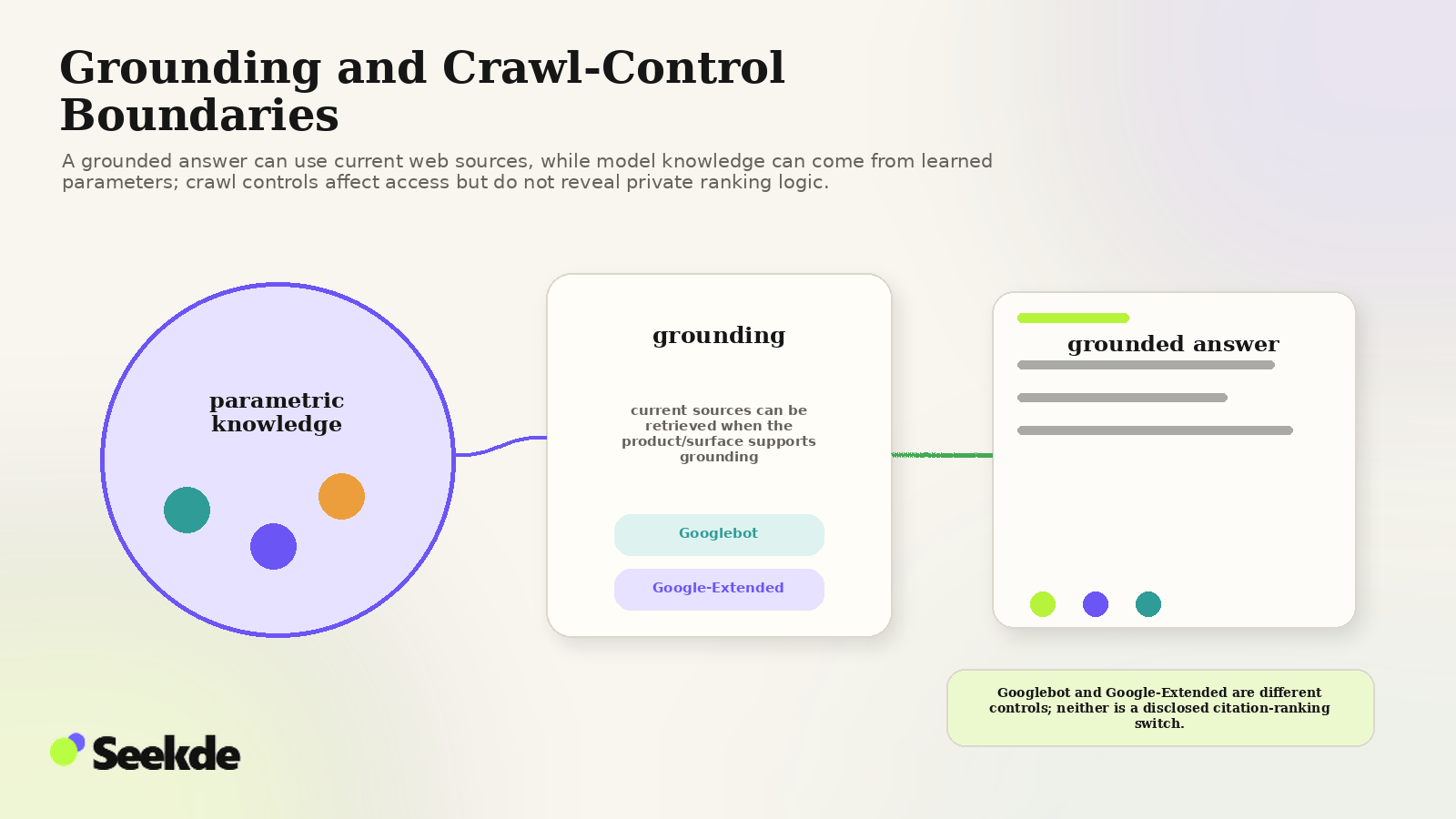
When an answer engine responds to a prompt, it draws upon two fundamentally different knowledge mechanisms:
- Parametric Knowledge: Information encoded directly into the neural network’s weights during pre-training and fine-tuning. This knowledge is static, reflecting the model’s training data cutoff. It cannot be updated without retraining or fine-tuning, and it does not generate direct outbound web citations.
- Grounding via Web Retrieval: A retrieval-augmented generation process where the model connects to external data sources. When activated, the model retrieves relevant documents and synthesizes an answer supported by source references.
According to official Google Search Central documentation on AI features, Google does not require proprietary markup, custom schema types, or files like llms.txt for generative features in Google Search. Google Search Central specifies that a page must be indexed by Googlebot and eligible to appear with a snippet to be eligible for Google Search generative features (such as AI Overviews and AI Mode).
However, this Search prerequisite must not be conflated with consumer Gemini Apps, where Google has not published an identical eligibility requirement. In consumer Gemini, official user guidance notes that Gemini Apps may surface sources and related web links, but not all responses include sources or web citations.
To explore the deeper technical pipeline behind retrieval-augmented generation, review our guide on the architecture of generative answer engines and our comparative analysis of GEO vs SEO vs AEO.
Crawling Directives: Googlebot vs. Google-Extended
A persistent misconception among web publishers is that blocking Google-Extended in robots.txt prevents content from appearing in Google Search AI features, or conversely, that allowing Googlebot grants permission for model training.
According to Google’s canonical documentation on common crawlers and fetchers, Google defines a strict separation between these user-agents:
- Googlebot: Googlebot is the primary crawler used for Google Search. Blocking Googlebot prevents it from crawling page content and can make that content unavailable for Search features (including Google AI Overviews and Google AI Mode) that depend on indexed, snippet-eligible pages. A
robots.txtblock should not be described as a guaranteed deindexing mechanism for an already-known URL. Search removal and crawl control are separate concepts. - Google-Extended: A standalone
robots.txtproduct token that gives webmasters control over whether content Google crawls may be used for:- Training future generations of Gemini models powering Gemini Apps and Vertex AI API for Gemini
- Grounding in Gemini Apps
- Grounding with Google Search on Vertex AI
Crucially, Google-Extended does not affect inclusion in Google Search or Google Search ranking. Search features operate directly on the core Google Search index powered by Googlebot.
# Example: Allow Google Search indexing while controlling Gemini model training and grounding
User-agent: Googlebot
Allow: /

User-agent: Google-Extended
Disallow: /
Publishers who wish to maintain full visibility in Google Search and its generative features while managing content usage for Gemini model training and grounding can implement this configuration.
Developer API Grounding vs. Consumer Experience
In technical documentation, Google provides guidance on Grounding with Google Search in the Gemini API. Through this API feature, enterprise developers can connect Gemini models to web retrieval in custom applications. Current models utilize the google_search tool (older models used google_search_retrieval), returning search and citation metadata alongside synthesized responses.
However, marketing and SEO teams must recognize that Gemini API Grounding is a developer reference, not a direct proxy for consumer search behavior.
Enterprise developers configure custom system instructions, temperature settings, and tool configurations that alter API response behavior. Conducting automated visibility audits by querying the raw Gemini API with default search tooling will not accurately replicate what a human user observes in the consumer Gemini web interface (gemini.google.com/app) or in Google Search.
Controlled Observational Evidence: Consumer Gemini Grounding
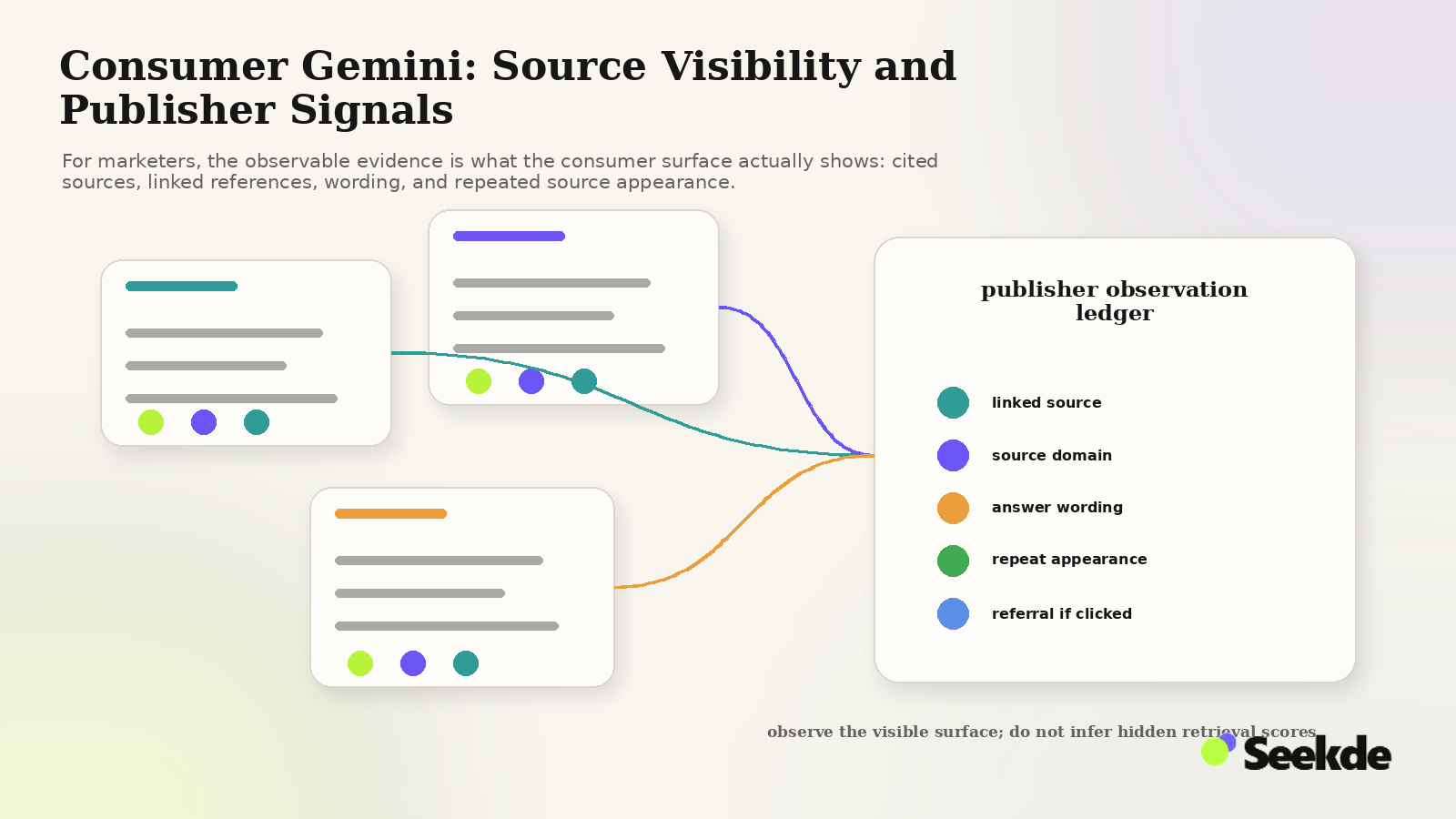
To document how consumer Gemini utilizes web grounding in live operation, Seekde conducted a controlled testing sequence across eight base queries across four categories (two informational, two technical, two commercial/comparison, and two time-sensitive), followed by repeated verification runs.
Testing was executed in the consumer Gemini web interface. The interface identified the underlying engine as Gemini Flash-Lite (Observed at test time; classified as time-sensitive).
| Query Category | Submitted Prompt | Search Grounding | Observed Inline Citations |
|---|---|---|---|
| Informational | “what is retrieval augmented generation in search” | Active | cloud.google.com, databricks.com |
| Informational | “how do search engines use large language models for answering questions” | Active | rosella.agency, searchengineland.com |
| Technical | “how to block ai crawlers using robots txt” | Active | developers.google.com, openai.com |
| Technical | “llms txt standard specification for ai agents” | Active | llmstxt.org, cursor.com |
| Commercial / Comparison | “best enterprise search engines comparing elasticsearch and algolia” | Active | bcloud.ai, elastic.co |
| Commercial / Comparison | “cloudflare vs fastly cdn edge caching performance and pricing” | Active | pagespeedmatters.com, cloudflare.com |
| Time-Sensitive | “latest news on google search console generative ai reporting” | Active | support.google.com, searchenginejournal.com |
| Time-Sensitive | “latest perplexity sonar model updates and agent api migration” | Active | docs.perplexity.ai, perplexity.ai |
Observational Findings & Methodology Boundaries
(Seekde Controlled Observational Sample — September 2026)
- Observed Sample Behavior: In this specific 8-query test set, visible Google Search grounding and inline source pills were observed across all eight base queries. The interface displayed inline source pills that linked directly to supporting publisher pages.
- Source Variation Across Repeated Runs: When identical prompts were resubmitted in separate sessions, the system maintained factual consistency while showing source variation. For example, in the time-sensitive Search Console query, Run 1 cited
support.google.comandsearchenginejournal.com, whereas Run 2 citedagencydashboard.ioandsupport.google.com. - Methodology Boundary: Marketers must not assume that "Gemini always searches Google" or that every response is grounded. In accordance with Google Help guidance, not all Gemini responses include sources or related links. The presence of citations across all eight base queries in this test is a property of this specific query sample, not proof of a platform-wide grounding rule or an unobservable internal triggering threshold. Absence of a visible source link does not prove whether or not a retrieval occurred behind the scenes.
Full test logs and capture metadata are archived in our research methodology repository.
Sources and Related Links in Gemini Apps
Gemini Apps may provide source and related-content links within or below a response. When sources are available, users may see them inline or through a Sources control that opens relevant links. Google also notes that not every Gemini response includes sources or related links.
For visibility analysis, these links can be recorded as observable source appearances. They should not be interpreted as ranking scores, authority scores, or proof of the complete retrieval process.
Seekde Editorial Principles for Gemini Visibility
Achieving sustained visibility across Google’s AI surfaces does not involve manipulating hidden prompts or injecting unverified metadata. Instead, Seekde recommends aligning your website architecture with sound information retrieval and clarity principles:
1. Maintain Consistent Entity Facts
Contradictory facts across an organization’s digital footprint—such as outdated pricing on older blog posts paired with updated tiers on product pages—create ambiguity for readers and automated systems. Maintaining centralized, canonical specification hubs for all core entities is an essential editorial hygiene practice.
2. Prioritize Primary Information Gain
Because large language models can summarize common knowledge without consulting external documents, generic definitions rarely offer distinctive value. Publishing original benchmark studies, verified technical documentation, transparent pricing matrices, and firsthand case histories ensures your content contributes genuine information gain. Discover how this fits into a comprehensive framework in What Is Generative Engine Optimization (GEO)?.
3. Ensure Accessible Web Crawlability
Ensure that important facts, pricing, and comparison details are accessible to crawlers and available in textual form that relevant systems can render and process. Server-side rendering can simplify accessibility, but it is not a documented AI Overview, AI Mode, or Gemini visibility requirement. Review our detailed analysis of how AI search engines find and cite content to audit your server infrastructure.
Internal References & Reading
- Google AI Overviews SEO: Complete Guide
- Google AI Mode SEO: How Websites Get Discovered
- What Is Generative Engine Optimization (GEO)?
- GEO vs SEO vs AEO: Architectural Comparison
- Architecture of Generative Answer Engines
- How AI Search Engines Find and Cite Content
- Seekde Research Methodology & Evidence Standards