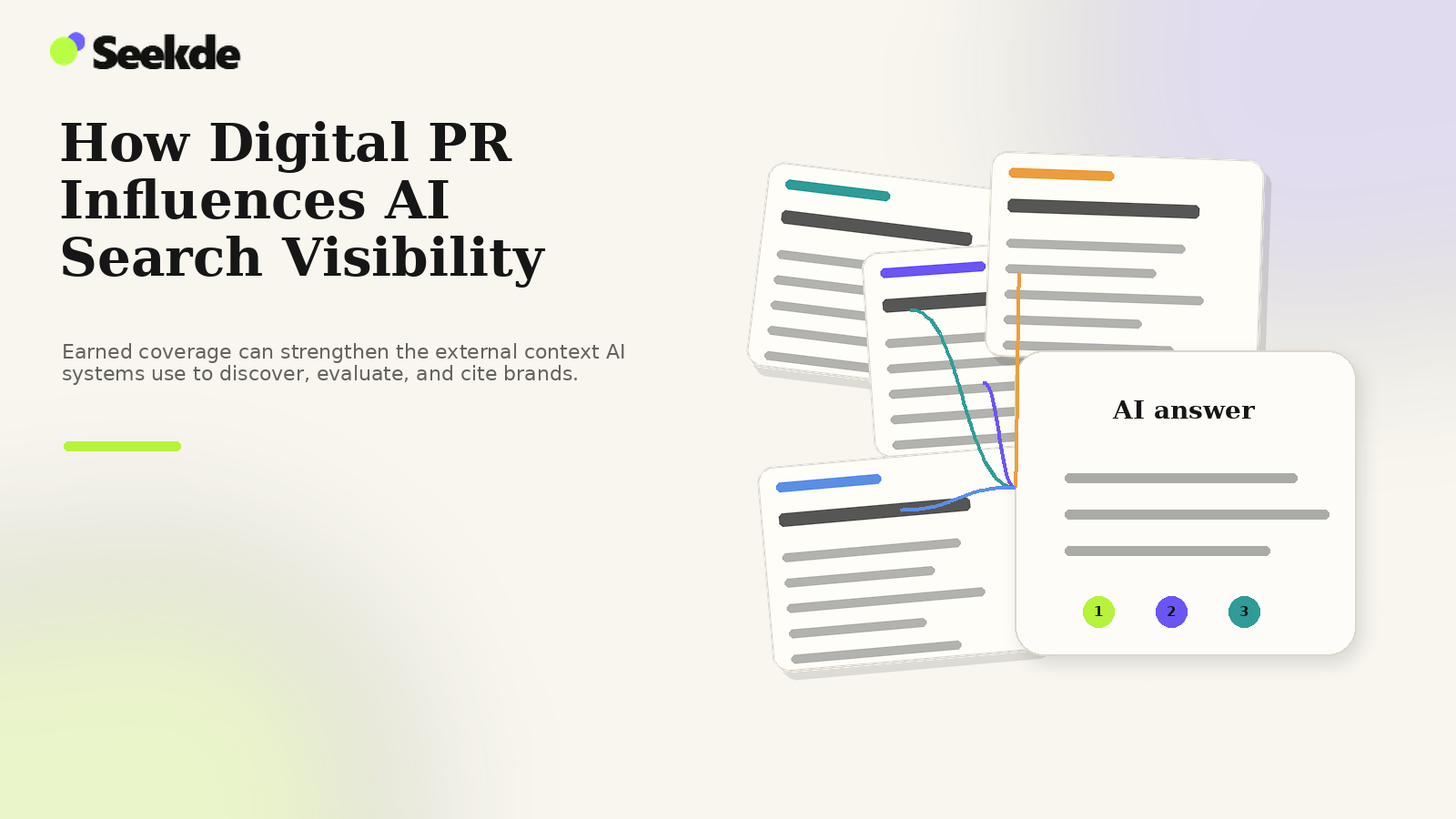
Digital PR influences AI search visibility by establishing authoritative brand co-occurrences across trusted publications, seeding foundation model training sets, and validating entity relationships within real-time retrieval pools. In traditional organic search, the primary objective of digital PR was acquiring hyperlinked equity (PageRank) to pass algorithmic authority to commercial landing pages. In generative answer engines—such as Google AI Overviews, Perplexity, ChatGPT Search, and Microsoft Copilot—the mechanics of visibility have expanded far beyond hyperlinks.
Large language models are trained on billions of web documents and real-time news feeds. When a brand is repeatedly discussed in reputable tier-1 journalism, trade media, and peer-reviewed journals, neural algorithms map the brand’s entity to specific industry attributes, product capabilities, and comparative benchmarks. Even when media coverage omits a clickable hyperlink, unlinked brand mentions and semantic co-citations establish high-confidence entity associations that directly determine whether a model recommends your brand when answering conversational buyer queries.
Understanding how to engineer digital PR for generative search involves moving beyond generic press release blasts and mastering the algorithmic ingestion pathways that feed AI search systems.
(Note: Search engine vendors have not documented digital PR or unlinked brand mentions as direct, isolated algorithmic ranking factors. Rather, digital PR reinforces brand visibility through well-documented mechanisms of entity corroboration, third-party source retrieval in RAG pipelines, and cross-web authority consensus. The pathways described below represent Seekde’s analytical model of these observable information retrieval dynamics.)
The Shift from Backlinks to Semantic Co-Occurrence
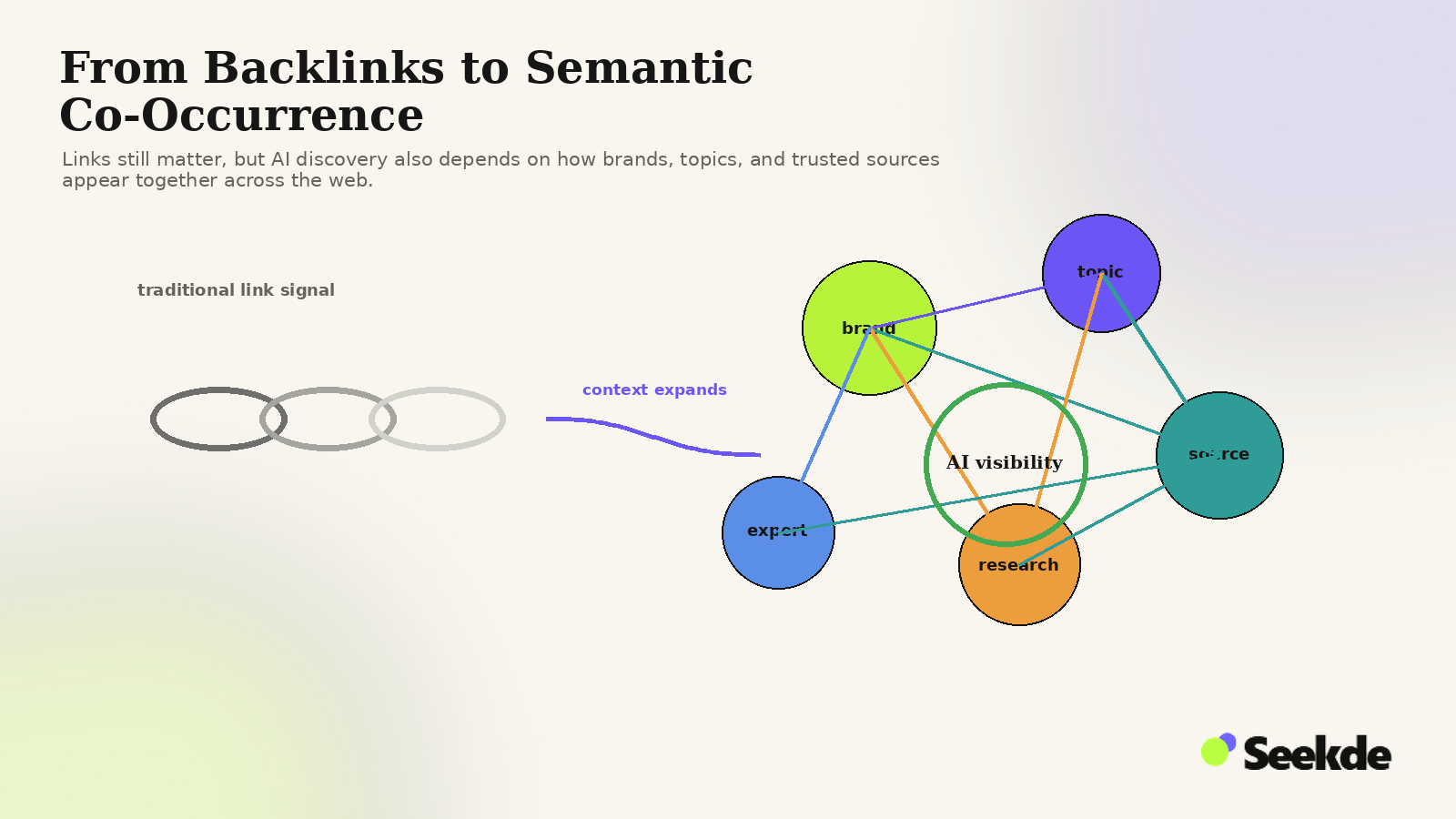
Traditional search engines rely heavily on hyperlinks as directional votes of trust. While links remain essential for web crawlers discovering URLs, generative language models process web text through word embedding vectors and transformer attention mechanisms:
Hyperlink with Anchor Text PageRank Transferred to URL
Entity Co-Occurrence Vectors LLM Knowledge Graph Embeddings
When an authoritative publication (such as The Wall Street Journal, TechCrunch, Reuters, or a leading industry trade journal) covers your company, the language model analyzes the semantic context surrounding your brand name:
- Does your brand co-occur with terms like "enterprise security", "SOC 2 compliance", or "automated crawl analysis"?
- Is your brand mentioned alongside established market leaders in comparative listicles?
- Does the article quote your founder or data as the definitive source of an industry statistic?
Through multi-head self-attention mechanisms, transformer models compute high cosine similarity between your brand entity and those technical competencies. Consequently, when a user asks ChatGPT Search or Google AI Mode: "What are the most secure AI visibility platforms for enterprise agencies?", the model retrieves your brand because the entity associations were pre-computed and corroborated across authoritative third-party corpora.
The Digital PR to Discoverability Conceptual Model: Three Ingestion Pathways
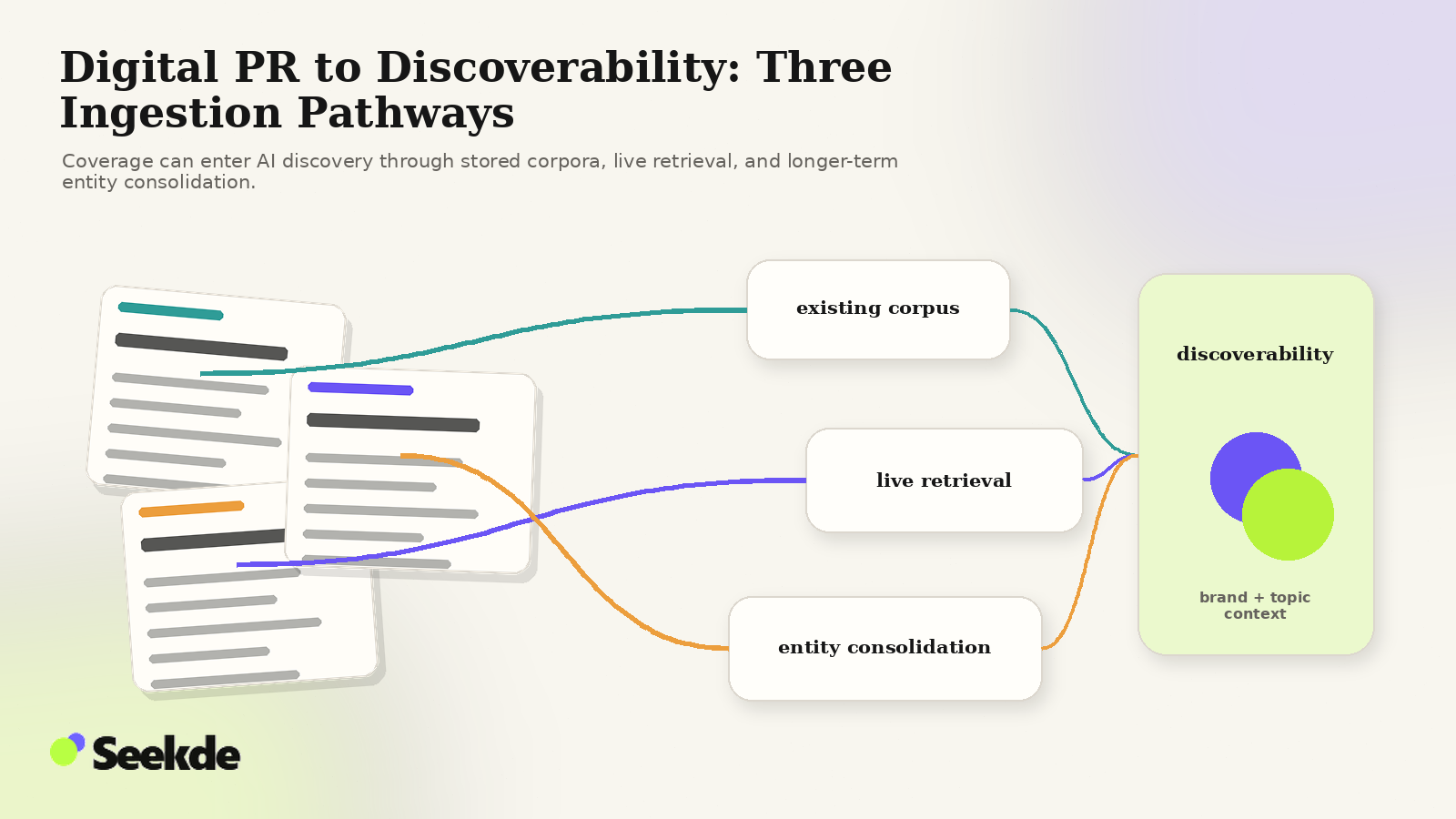
To systematically capture visibility across generative search engines, PR and marketing teams must understand the Three Ingestion Pathways through which media coverage enters AI search models:
Pathway 1: Training
- Corpus Seeding
- (Parametric Foundation)
Pathway 2: Real-Time
- Retrieval Pools
- (RAG Grounding Web)
Pathway 3: Knowledge
- Graph Corroboration
- (Entity Disambiguation)
| Ingestion Pathway | Search Engine Architecture | Mechanics & Ingestion Timing | Digital PR Objective |
|---|---|---|---|
| 1. Training Corpus Seeding | Offline foundation pre-training & fine-tuning (e.g., Common Crawl, RefinedWeb, publisher licensing deals). | Ingested during periodic training cycles; permanently embedded into model weights and parametric memory. | Secure in-depth feature profiles and foundational benchmark citations across high-authority archive domains. |
| 2. Real-Time Retrieval Pools | Real-time search indexes queried during RAG synthesis (e.g., Bing API, Google real-time index, Perplexity Sonar). | Crawled and indexed within minutes to hours of publication; immediately eligible for live citation cards. | Place timely commentary, breaking survey findings, and news hooks on high-crawl-frequency media sites. |
| 3. Knowledge Graph Corroboration | Structured knowledge graph reconciliation engines (Google Knowledge Graph, Wikidata, entity recognition models). | Continuous cross-validation of entity attributes, founders, headquarters, and product taxonomies. | Ensure media coverage uses the brand’s canonical entity name and describes its core category consistently. |
Pathway 1: Training Corpus Seeding
Major AI laboratories (OpenAI, Anthropic, Google DeepMind, Meta) curate high-quality web subsets for training future model generations. Curated datasets heavily weight reputable news archives, academic repositories, and encyclopedic sites while filtering out low-quality commercial blogs and spam directories.
Earning prominent mentions across tier-1 editorial publications ensures your brand is represented in the pre-training datasets that form the model’s core parametric memory. This allows the model to "know" who you are even when performing offline, zero-search completions.
Pathway 2: Real-Time Retrieval Pools
When answer engines execute real-time searches to answer volatile queries, they prioritize media sites with high publication frequency and clean server response times. If a user asks Perplexity "What is the best alternative to [Competitor]?", the engine frequently retrieves recent third-party review roundups from major industry publishers. If your digital PR program has secured inclusion in those specific editorial comparison roundups, your product appears directly in the synthesized answer.
Pathway 3: Knowledge Graph Corroboration
Generative models cross-reference claims against structured knowledge bases to avoid hallucination. If your brand website claims you are the "fastest-growing analytics tool", the model treats this as subjective self-promotion. However, when independent financial reporting, trade association awards, or reputable tech journalism corroborates the claim, search algorithms validate the assertion as an objective factual entity attribute.
Unlinked Brand Mentions: The Invisible Authority Metric
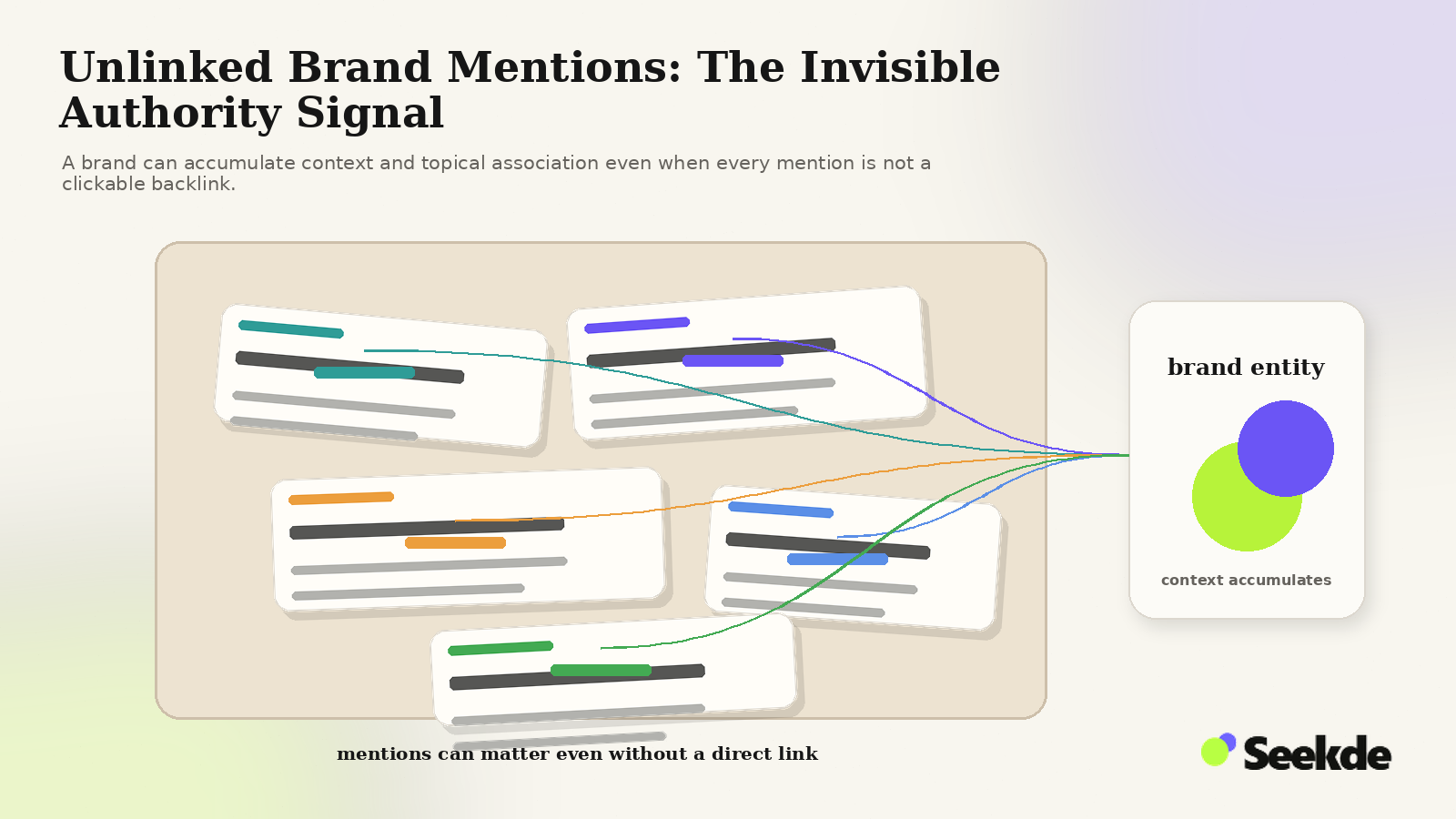
One of the most profound differences between legacy SEO and AI search optimization is the valuation of unlinked brand mentions.
In conventional SEO, a media mention without a backlink was historically viewed as a missed opportunity or a wasted PR asset. In AI search optimization, unlinked mentions carry immense semantic value:
- Entity Salience Reinforcement: Natural Language Processing (NLP) models extract entity names regardless of whether an HTML
<a>tag surrounds the text. A paragraph in an authoritative trade publication discussing your methodology establishes entity salience just as effectively as a hyperlinked mention. - Sentiment and Contextual Weighting: Models evaluate the sentiment and semantic tone surrounding the mention. Brands mentioned in contexts associated with reliability, technical innovation, and customer satisfaction earn favorable probabilistic weighting during conversational brand recommendations.
- Citation Cross-Referencing: When a generative engine attempts to cite your website in an answer, having widespread third-party unlinked mentions across reputable domains provides the necessary algorithmic confidence to display your primary URL as a trusted citation source.
As detailed in our comparison of AI citations vs. brand mentions, mentions build the underlying entity trust that makes direct hyperlinked citations possible.
Four Digital PR Strategies Tailored for AI Search Visibility
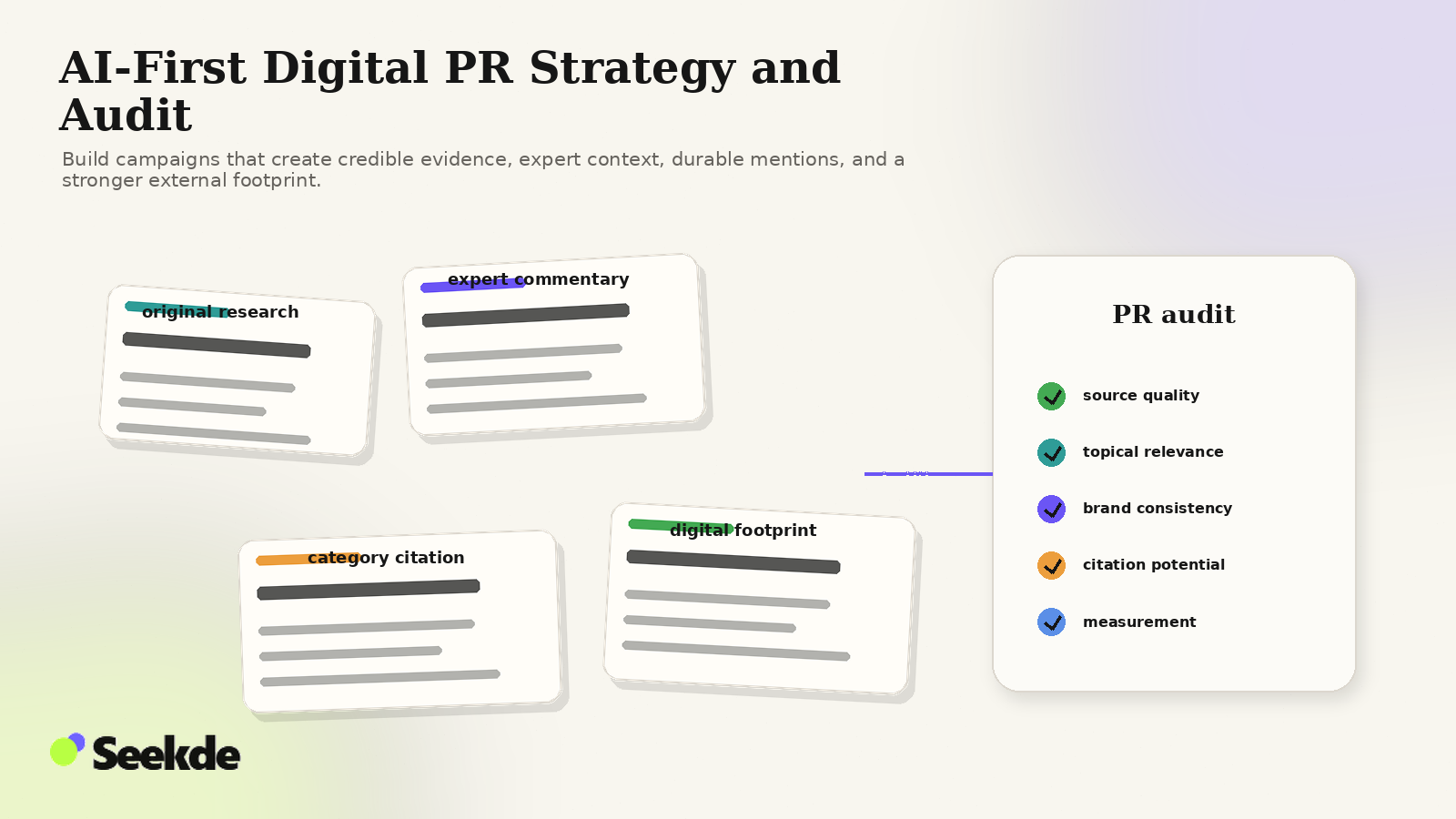
To optimize PR campaigns for conversational discovery, marketing teams should deploy four specialized execution frameworks:
1. The Proprietary Data Hook (Original Benchmark PR)
Journalists and technical writers are constantly searching for credible, verified data points to anchor their reporting. By publishing proprietary technical audits, market share benchmarks, or platform telemetry (as outlined in our original research strategy guide), your brand becomes the definitive citation source.
- Execution: Survey 500 industry practitioners or audit 1,000 server logs. Release the key findings in an un-gated report.
- Outcome: Trade publications quote your statistics directly: "According to Seekde’s Q1 2026 crawl audit, 41% of domains restrict AI scrapers…" Language models ingest this coverage and cite your domain whenever users query that statistic.
2. The Definitive Category Co-Citation Campaign
When buyers ask conversational engines for software recommendations ("What are the top 5 tools for tracking AI search visibility?"), models generate lists based on the frequency with which brands co-occur in third-party listicles, category reviews, and comparison guides.
- Execution: Identify the 25 most authoritative editorial roundups and buyer guides within your vertical. Conduct targeted outreach to editors, providing updated product feature matrices, pricing tiers, and expert commentary to secure inclusion alongside incumbent category leaders.
- Outcome: Your brand becomes firmly embedded in the model’s category list vector, ensuring routine inclusion in generative buyer recommendations.
3. The Expert Commentary & Thought Leadership Network
Generative engines heavily weight quotes from recognized subject-matter experts to answer nuanced, controversial, or forward-looking prompts.
- Execution: Position company founders and lead researchers as available sources for breaking technical developments (e.g., major search crawler updates, copyright policy changes, or algorithmic shifts).
- Outcome: Journalists quote your executives as named experts, linking the personal entity of the author to the organizational entity of your brand, elevating E-E-A-T scores across the knowledge graph.
4. Direct Digital Footprint Disambiguation
Ensure that all PR distribution channels reinforce the brand’s canonical entity statement without deviation.
- Execution: Standardize boilerplate text across all press releases. Explicitly state the brand name, founding year, core product category, and official URL.
- Outcome: Prevents entity fragmentation and ensures automated press syndication engines cleanly map the PR coverage to your primary knowledge graph ID.
Digital PR Strategy Comparison: Traditional SEO vs. AI Search
| Strategy Dimension | Legacy SEO Digital PR | AI Search Digital PR |
|---|---|---|
| Primary KPI | Quantity and Domain Authority (DA) of dofollow backlinks. | Entity co-occurrence density, sentiment polarity, and RAG retrieval presence. |
| Unlinked Mentions | Low value; pursued aggressively for link reclamation. | High value; directly processed by LLMs to build entity understanding. |
| Target Media | Any high-DA website, regardless of contextual relevance. | Highly specialized, authoritative tier-1 journalism and vertical trade publications. |
| Anchor Text | Keyword-rich anchor text (best AI SEO tool). |
Natural brand entity mentions (According to Seekde...). |
| Content Asset | Infographics, linkbait, generic consumer surveys. | Deep empirical benchmarks, technical audits, reproducible methodologies. |
| Measurement Timeline | 3–6 months for PageRank flow and organic ranking shifts. | Immediate (hours for real-time RAG) to medium-term (months for model re-training). |
The AI-Era Digital PR Audit Checklist
Use this 6-point checklist to evaluate whether your PR activities build generative search discoverability:
- [ ] 1. Canonical Entity Consistency: Does every press release and media kit use the identical 50-word canonical entity description?
- [ ] 2. Primary Data Anchoring: Does your pitch revolve around original empirical research, verified benchmarks, or proprietary telemetry?
- [ ] 3. Entity Co-occurrence Alignment: Is your brand consistently mentioned alongside the exact category keywords and industry peers you wish to be associated with?
- [ ] 4. Tier-1 Archive Placement: Are you earning coverage in publications indexed by Common Crawl and licensed AI training partners?
- [ ] 5. Unlinked Mention Monitoring: Are you systematically tracking unlinked editorial mentions across digital news surfaces?
- [ ] 6. Conversational Output Auditing: Are you regularly testing multi-turn prompts across ChatGPT Search, Perplexity, and Google AI Overviews to observe whether recent media coverage has influenced brand recommendation rates?
Summary: Building the External Consensus That Models Trust
In the age of generative search, an organization cannot simply declare itself an authority on its own website. Conversational artificial intelligence relies on external consensus.
When digital PR systematically seeds your brand’s entity, statistics, and expert perspectives across high-credibility media publications, you provide language models with the multi-source corroboration required to recommend your business with complete confidence.
By aligning your PR initiatives with the Three Ingestion Pathways and prioritizing empirical research assets, you transform public relations into a powerful, compounding engine for AI search visibility.