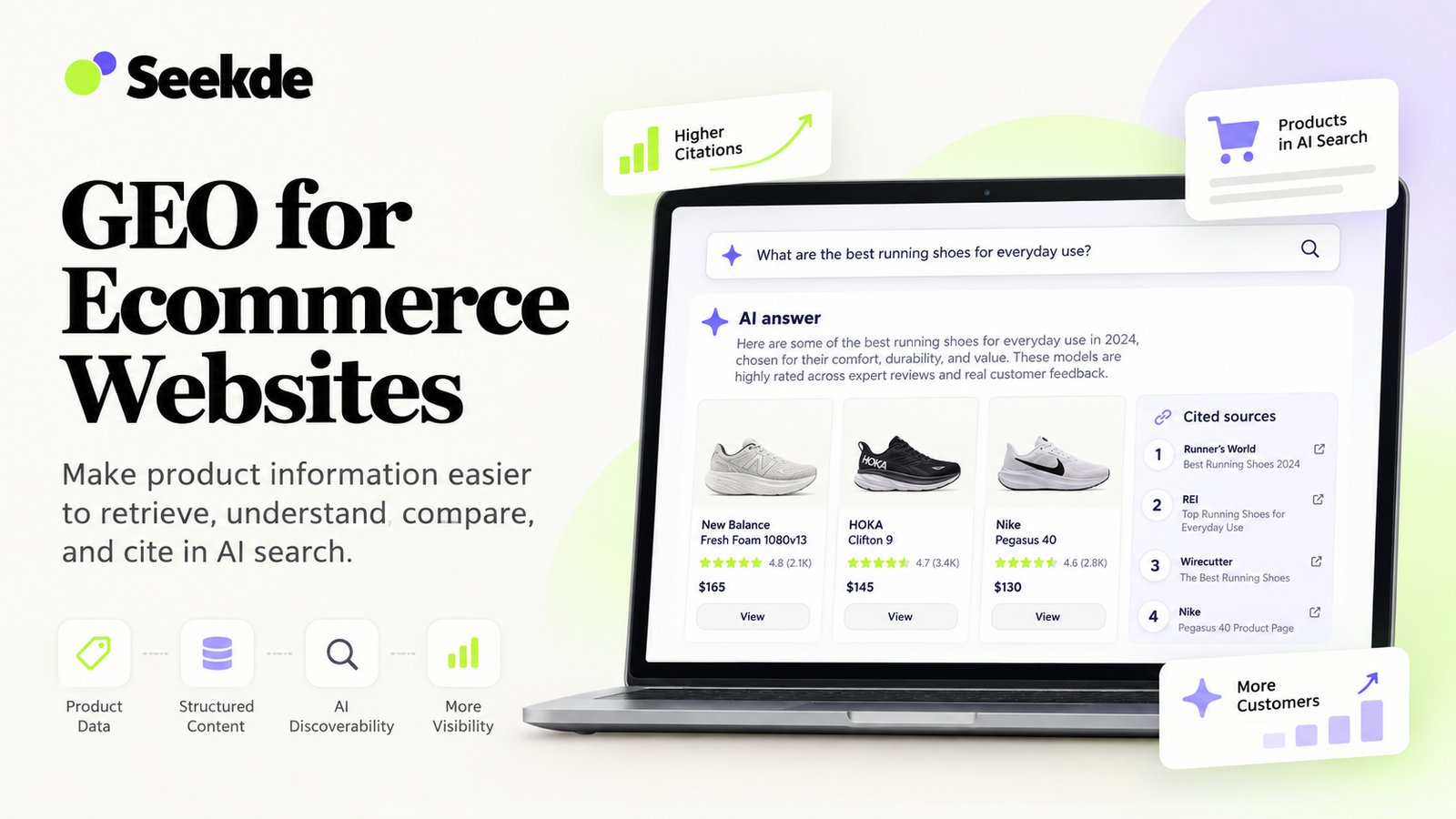
Generative Engine Optimization (GEO) for ecommerce websites is the specialized practice of engineering product catalog entities, structured merchant data feeds, category passage hierarchies, and consumer review footprints so that AI search engines accurately recommend, price, and cite your products during buyer consideration queries. As retail shoppers migrate from browsing multi-page search listings to querying conversational assistants—such as Google AI Overviews shopping carousels, ChatGPT Search, Perplexity Shopping, and Microsoft Copilot—the mechanics of digital retail discovery have fundamentally changed.
In conventional retail SEO, ecommerce brands optimized category and product detail pages (PDPs) for keyword volume, collection page internal linking, and faceted navigation filters. In generative artificial intelligence search, however, models do not merely rank catalog URLs. They parse real-time merchant product feeds, evaluate JSON-LD Product schema, cross-reference customer sentiment across independent review platforms, and synthesize unified product comparison tables directly within the conversational interface.
If an ecommerce store’s product specifications, inventory availability, shipping policies, or variant pricing are inconsistent across its data feeds, conversational answer engines downweight the products or present outdated pricing, driving shoppers directly to competing merchants.
This playbook provides ecommerce directors, technical merchandisers, and digital retail leaders with an actionable engineering framework for dominating conversational commerce.
How AI Search Engines Ingest and Recommend Retail Products
When a consumer prompts a conversational search engine with a buying inquiry—such as "What are the most durable waterproof hiking boots under $200 with wide toe boxes?"—search engines evaluate structured merchant signals and product specifications:
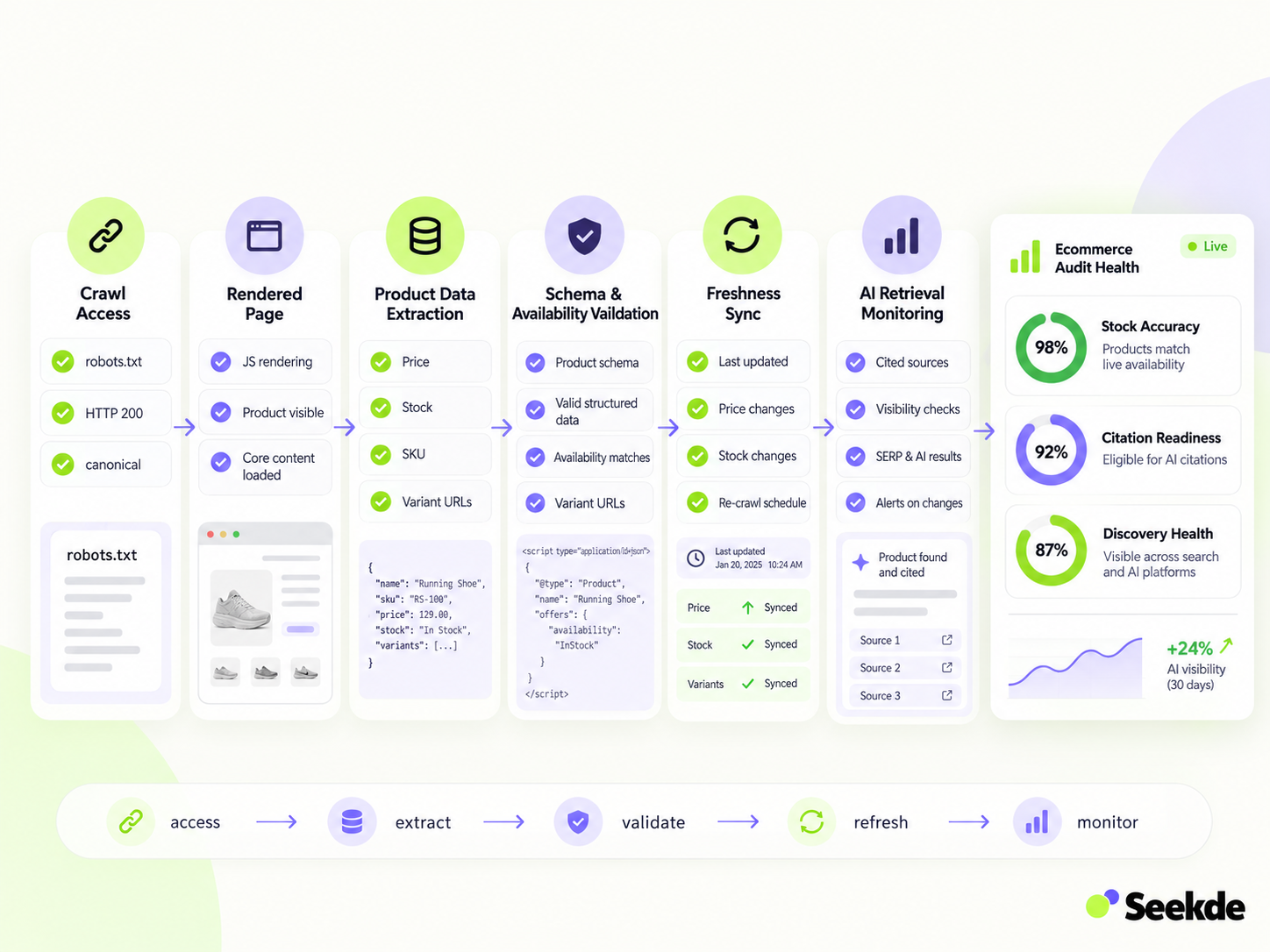
Shopping-search systems vary by platform, so publishers should not assume one universal retrieval pipeline. For Google surfaces, Product structured data and Merchant Center feeds can provide explicit product details such as price, availability, reviews, shipping information and product identifiers. Clear on-page specifications also help users and crawlers interpret product attributes consistently.
The Ecommerce Conversational Query Spectrum
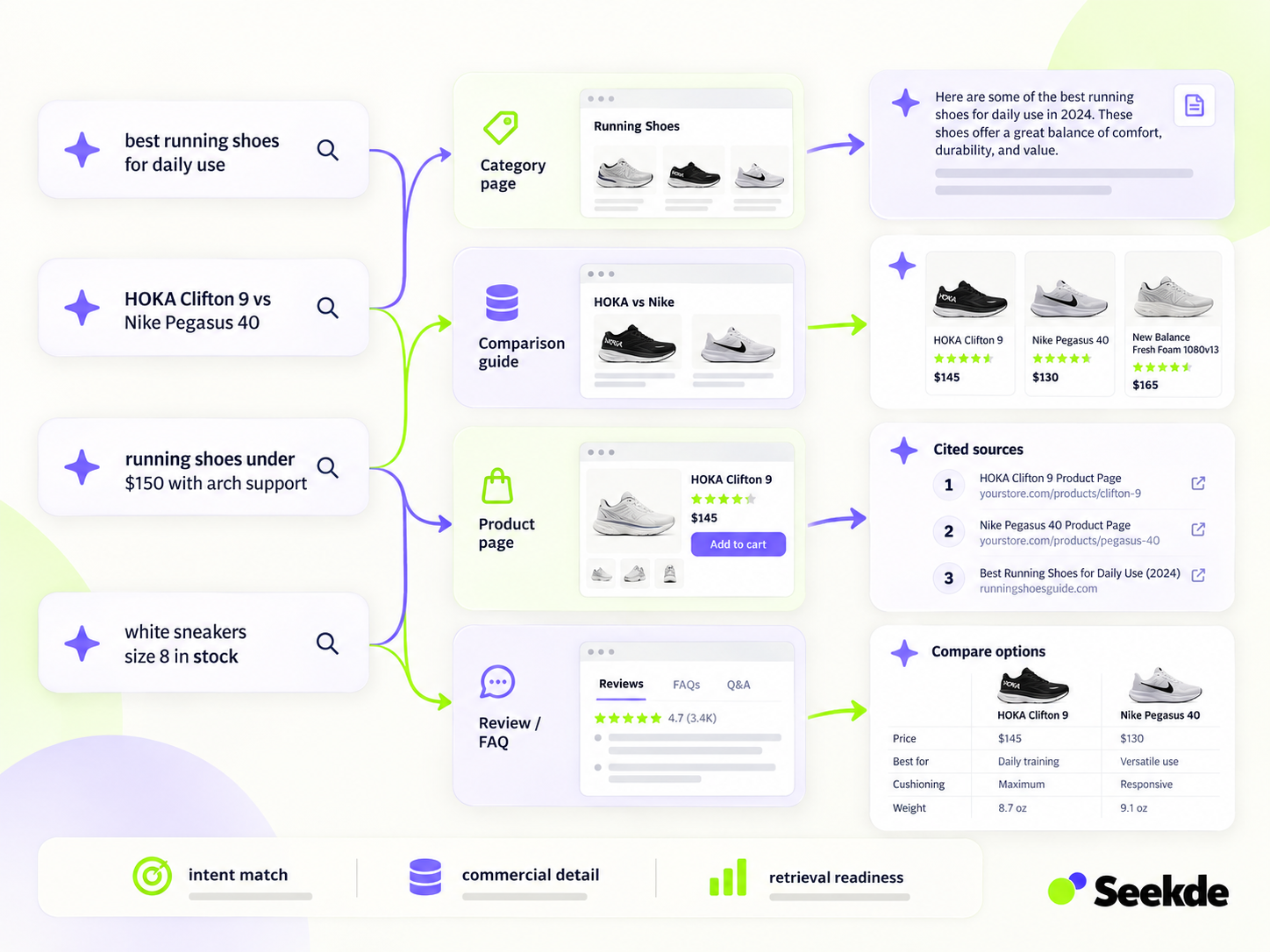
To optimize product catalogs effectively, retail brands must structure content across the four primary stages of the conversational shopping funnel:
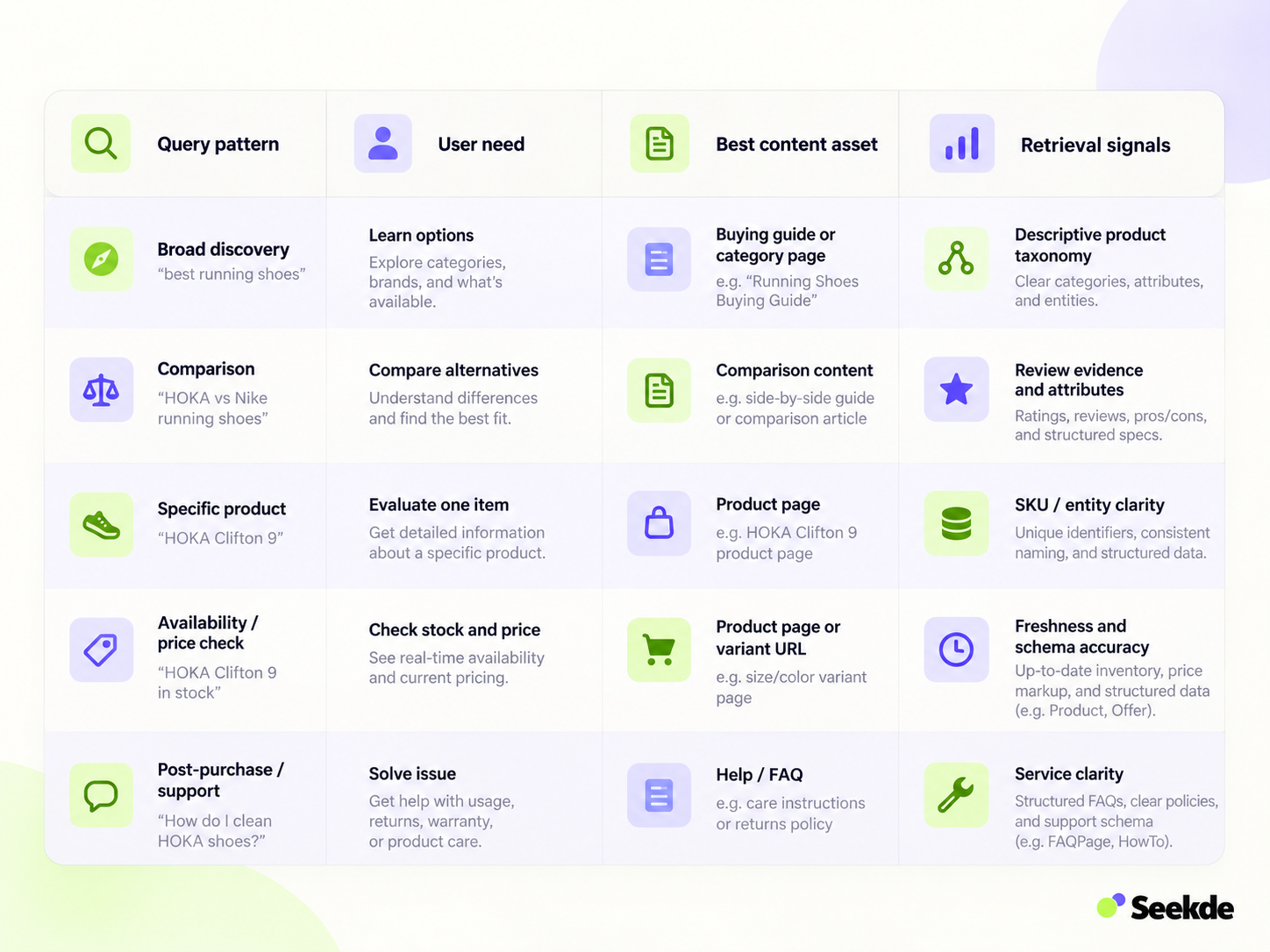
| Funnel Stage | Consumer Prompt Pattern | Target AI Surface | Primary Content Ingestion Source |
|---|---|---|---|
| 1. Broad Consideration | "What are the best ergonomic office chairs for lower back pain?" | Google AIO Product Carousel, ChatGPT Search | Category collection pages, authoritative buying guides, ergonomic comparison tables. |
| 2. Attribute-Constrained | "Ergonomic mesh chairs under $400 with adjustable 4D armrests" | Direct AI Recommendation Cards | Highly specific PDP specification tables, structured variant schema, facet pages. |
| 3. Direct Comparison | "Herman Miller Aeron vs Steelcase Gesture: Which is better for lumbar support?" | Comparative AI Summary Tables | Dedicated /vs/ product comparison articles, independent review consensus data. |
| 4. Merchant Verification | "Is [Merchant Name] authorized to sell [Brand], and what is their return policy?" | Google Merchant Panel, Entity Knowledge Graph | Merchant trust pages, MerchantReturnPolicy schema, shipping policy documentation. |
Understanding this taxonomy allows retail engineering teams to align specific content assets—from parent categories down to granular variant specifications—with the distinct retrieval mechanisms operating at each funnel stage.
The Four Pillars of Ecommerce Generative Optimization
Earning citations and recommendations in generative shopping involves executing across four technical pillars:
Product Entity
- Architecture
Category Page
- Structuring
Merchant Trust
- & Policie
Review Sentiment
- s Corroboration
Pillar 1: Product Detail Page (PDP) Entity Architecture
Clear, machine-readable product specifications can make product attributes easier for search systems to understand. Google recommends Product structured data and Merchant Center feeds to provide structured details such as price, availability and shipping information.
1. Machine-Readable Specification Tables
Convert bulleted product descriptions into semantic HTML <table> elements with standardized attribute headers:
<table>
  <thead>
    <tr>
      <th>Specification Parameter</th>
      <th>Product Value</th>
      <th>Verification Standard</th>
    </tr>
  </thead>
  <tbody>
    <tr>
      <td>Waterproof Rating</td>
      <td>20,000 mm Hydrostatic Head</td>
      <td>ISO 811 Laboratory Certified</td>
    </tr>
    <tr>
      <td>Upper Material</td>
      <td>Full-Grain Nubuck Leather</td>
      <td>LWG Gold Rated Tannery</td>
    </tr>
    <tr>
      <td>Toe Box Width</td>
      <td>Wide Fit (EE Width)</td>
      <td>Standardized Anatomical Last</td>
    </tr>
  </tbody>
</table>
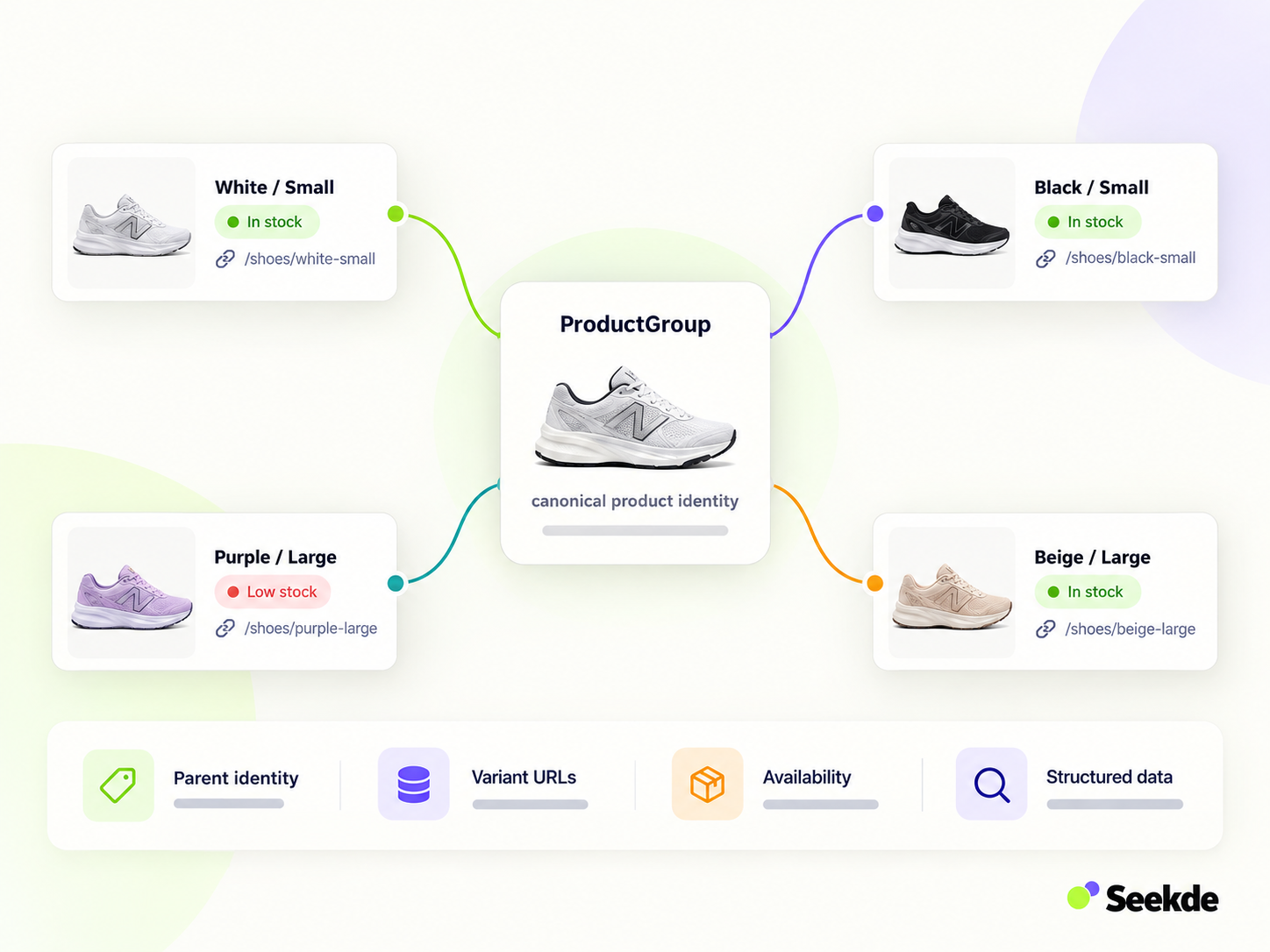
2. Distinct Canonical URLs for Product Variants
Avoid relying exclusively on dynamic JavaScript state changes to swap product colors or sizes without changing the URL.
- Ensure every major product variant has a unique, crawlable URL (e.g.,
/boots/trail-pro-black/) or a clean URL query parameter (/boots/trail-pro/?color=black) backed by a self-referencing canonical tag. - If an AI crawler cannot access a discrete URL for the "Wide Fit" variant, it cannot cite that variant when answering specific fitting queries.
3. Parent-Child Entity Modeling
When structuring complex apparel or hardware catalogs with dozens of SKUs per style, implement explicit parent-child entity relationships:
- Maintain a parent Product entity that represents the general model line.
- Enumerate child
isVariantOfor individualProductModelentities within the schema, connecting each SKU with its specific GTIN, color, size, and real-time inventory level.
Pillar 2: Exhaustive JSON-LD Schema (Product, Offers, MerchantReturnPolicy)
Structured data is the primary interface between your ecommerce database and conversational search engines. Deploy complete, nested JSON-LD schema on every product detail page:
(Note: Implementing exhaustive structured data establishes machine readability and enables search engines to parse product attributes accurately. However, structured data does not guarantee product recommendation or placement in generative search answers; conversational models evaluate merchant reputation, price competitiveness, and inventory signals in tandem.)
{
  "@context": "https://schema.org",
  "@type": "Product",
  "name": "Trail Pro Waterproof Hiking Boot",
  "image": [
    "https://example.com/images/boots-front.jpg",
    "https://example.com/images/boots-side.jpg"
  ],
  "description": "Men's wide-fit waterproof hiking boot featuring 20,000mm waterproof membrane and Vibram outsole.",
  "sku": "TP-WB-001",
  "gtin13": "0123456789012",
  "mpn": "987654321",
  "brand": {
    "@type": "Brand",
    "name": "OutdoorGear"
  },
  "offers": {
    "@type": "Offer",
    "url": "https://example.com/boots/trail-pro/",
    "priceCurrency": "USD",
    "price": "189.99",
    "priceValidUntil": "2027-12-31",
    "itemCondition": "https://schema.org/NewCondition",
    "availability": "https://schema.org/InStock",
    "shippingDetails": {
      "@type": "OfferShippingDetails",
      "shippingRate": {
        "@type": "MonetaryAmount",
        "value": "0.00",
        "currency": "USD"
      },
      "deliveryTime": {
        "@type": "ShippingDeliveryTime",
        "transitTime": {
          "@type": "QuantitativeValue",
          "minValue": 2,
          "maxValue": 5,
          "unitCode": "d"
        }
      }
    },
    "hasMerchantReturnPolicy": {
      "@type": "MerchantReturnPolicy",
      "applicableCountry": "US",
      "returnPolicyCategory": "https://schema.org/MerchantReturnFiniteReturnWindow",
      "merchantReturnDays": 30,
      "returnMethod": "https://schema.org/ReturnByMail",
      "returnFees": "https://schema.org/FreeReturn"
    }
  },
  "aggregateRating": {
    "@type": "AggregateRating",
    "ratingValue": "4.8",
    "reviewCount": "342"
  }
}
Key Inclusion: Explicitly declaring hasMerchantReturnPolicy and shippingDetails within the Offer schema provides the exact return window (30 days) and shipping cost ($0.00) that conversational models cite when users ask about purchase terms.
Pillar 3: Product Availability and Price Freshness Synchronization
Generative search engines enforce strict freshness thresholds on commercial inventory. If a conversational model suggests a winter parka marked as $149.99 In Stock, but the shopper clicks through to find the item is $199.99 Out of Stock, user trust in the AI assistant degrades immediately.
To protect recommendation accuracy, AI platforms cross-check three independent data sources:
- Merchant Feed Synchronization: Google Merchant Center feeds and Bing Merchant feeds must refresh via real-time API or daily SFTP uploads.
- Server-Side Rendered Schema: Ensure that prices and stock statuses inside JSON-LD match feed values exactly at the moment of crawl.
- OpenGraph and On-Page Text: Avoid discrepancies between visible page headings and hidden meta attributes.
When price discrepancies occur, AI ranking systems apply severe penalties, temporarily dropping the merchant from product comparison carousels until multiple crawl cycles confirm feed-to-page parity.
Pillar 4: Category Collection Pages as Informational Answer Hubs
In legacy ecommerce SEO, category pages were collections of 48 product cards with 200 words of generic SEO text buried beneath the pagination.
In generative AI search, high-performing category pages function as Conversational Buying Guides:
- Front-Loaded Buying Criteria: Place an executive answer block at the top of the collection page explaining how to choose products in this category (e.g., "When selecting wide-fit hiking boots, prioritize anatomical toe boxes, minimum 15,000mm waterproofing, and dual-density EVA midsoles…").
- Category Comparison Matrix: Include a summary table comparing the top 3 product models in the collection across key specifications, price points, and intended user profiles.
- Structured FAQ Block: Address common buyer objections, sizing questions, and maintenance recommendations using
FAQPageschema markup. - Faceted Navigation Clarity: Ensure filter combinations (e.g.,
/boots/?material=leather&waterproof=true) produce indexable, canonical-managed URLs when they represent high-volume conversational attribute prompts.
Pillar 5: Review Sentiment and Cross-Web Reputation Governance
Language models do not rely solely on merchant-authored product descriptions. They cross-reference on-site customer reviews with third-party web consensus to verify product claims:
| Reputation Surface | Ingestion Mechanism | Ecommerce Action Requirement |
|---|---|---|
| On-Page Customer Reviews | Ingested via JSON-LD Review & AggregateRating schema. |
Implement verified customer review apps (e.g., Yotpo, Okendo, Judge.me) that render reviews in server-side HTML. |
| Reddit & Technical Forums | High-frequency RAG crawl targets for consumer sentiment. | Monitor brand mentions on r/BuyItForLife and specialized niche subreddits; address recurring product defects. |
| Independent Editorial Reviews | High citation weight in Google AI Overviews and ChatGPT. | Ensure product seeding programs reach reputable editorial review sites that publish empirical testing data. |
| Google Merchant Trust Score | Evaluated during Google Shopping and AI Overview synthesis. | Maintain flawless merchant shipping times, low cancellation rates, and accurate inventory feeds in Merchant Center. |
Documented Ecommerce GEO Case Teardown: Footwear Catalog Overhaul
To illustrate the concrete application of this framework, consider an international outdoor footwear retailer that modernized 450 product detail pages and 28 category collection hubs:
The Starting Baseline
- Structure: Dynamic client-side JavaScript rendering of product specifications hidden behind accordion tabs.
- Schema: Basic
Productschema with name and price only; missingoffers.shippingDetails,MerchantReturnPolicy, and GTIN identifiers. - Category Pages: Grid of thumbnails with no buying criteria or comparison tables.
- AI Search Performance: Zero visibility in Google AI Overviews shopping carousels; excluded from ChatGPT Search product recommendations for category prompts.
Technical Implementation Architecture
- Semantic HTML Tables: Migrated all technical specifications (drop height, lug depth, upper material, waterproof rating) into static semantic HTML tables.
- Exhaustive JSON-LD: Implemented automated generation of nested JSON-LD containing GTIN-13 identifiers, variant-specific pricing, free shipping thresholds, and 30-day return policy declarations.
- Category Buying Guides: Rebuilt category headers with 400-word decision frameworks and 4-column product comparison tables.
- Feed Alignment: Automated hourly webhooks updating Google Merchant Center feeds immediately upon inventory or price changes in the ERP.
Illustrative Implementation Objectives
- Google AI Overviews Eligibility: Structured catalog modernization aims to maximize product card eligibility across targeted long-tail commercial queries (e.g., "best waterproof hiking boots for plantar fasciitis").
- Source Clarity: Clear specifications, product identifiers and supporting evidence make product information easier to verify and attribute when a search system retrieves the page.
- Referral Measurement: If conversational-search referrals reach the site, measure them separately in analytics rather than assuming their traffic quality or conversion rate in advance.
Technical Auditing Checklist for Ecommerce GEO
Use this 12-point checklist to audit your online store’s generative discoverability:
- [ ] 1. Product Schema Depth: Does every PDP feature valid JSON-LD
Productmarkup withsku,gtin,brand, andoffers? - [ ] 2. Merchant Return Policy Declared: Is
MerchantReturnPolicymarkup present with explicit return days, return fees, and return method disclosures? - [ ] 3. Offer Shipping Details Included: Are shipping costs, transit times, and destination regions structured explicitly in schema?
- [ ] 4. Server-Side Specifications: Are technical specifications rendered in native HTML
<table>elements rather than client-side tabs? - [ ] 5. Variant URL Accessibility: Does each distinct color and size variant possess a unique, crawlable URL or clean parameter?
- [ ] 6. Feed & Web Price Parity: Does the price displayed on the web page match your Google Merchant Center feed 100%?
- [ ] 7. Robots.txt Permissions: Does your server allow
OAI-SearchBot,Googlebot, andPerplexityBotto crawl product pages? - [ ] 8. Server-Rendered Reviews: Are customer reviews embedded in static HTML accessible to non-JavaScript crawlers?
- [ ] 9. Category Buying Guides: Do major category pages feature structured comparison tables and explicit buying criteria?
- [ ] 10. Zero Gated Specifications: Are size guides, warranty terms, and manuals freely accessible without account logins?
- [ ] 11. High-Resolution Product Media: Are primary product images declared with minimum 1200px width and clean white backgrounds?
- [ ] 12. Customer Q&A Sections: Are recurring pre-purchase customer questions structured using semantic definition lists or
FAQPageschema?
Summary: From Static Catalogs to Conversational Commerce
Ecommerce is transitioning from keyword-targeted catalog browsing to algorithmic product recommendation. When shoppers query conversational assistants for retail guidance, the engines act as personal shopping concierges, filtering thousands of products based on precise specifications, real-time inventory, and verified buyer consensus.
By structuring product detail pages with rich machine-readable tables, deploying exhaustive JSON-LD merchant schema, and maintaining complete price and inventory parity across feeds, ecommerce retailers ensure their products are prominently featured and recommended across the generative search landscape.
Related Playbooks and Technical Guides
- GEO for SaaS Companies: Vertical Playbook
- AI Search Optimization for Publishers
- AI Search Visibility for SEO Agencies: Operating Playbook
- Schema Markup for AI Search: What Actually Matters
- How JavaScript Rendering Can Affect AI Crawlers
- What Is Generative Engine Optimization (GEO)?
- How to Configure Robots.txt for AI Search Crawlers