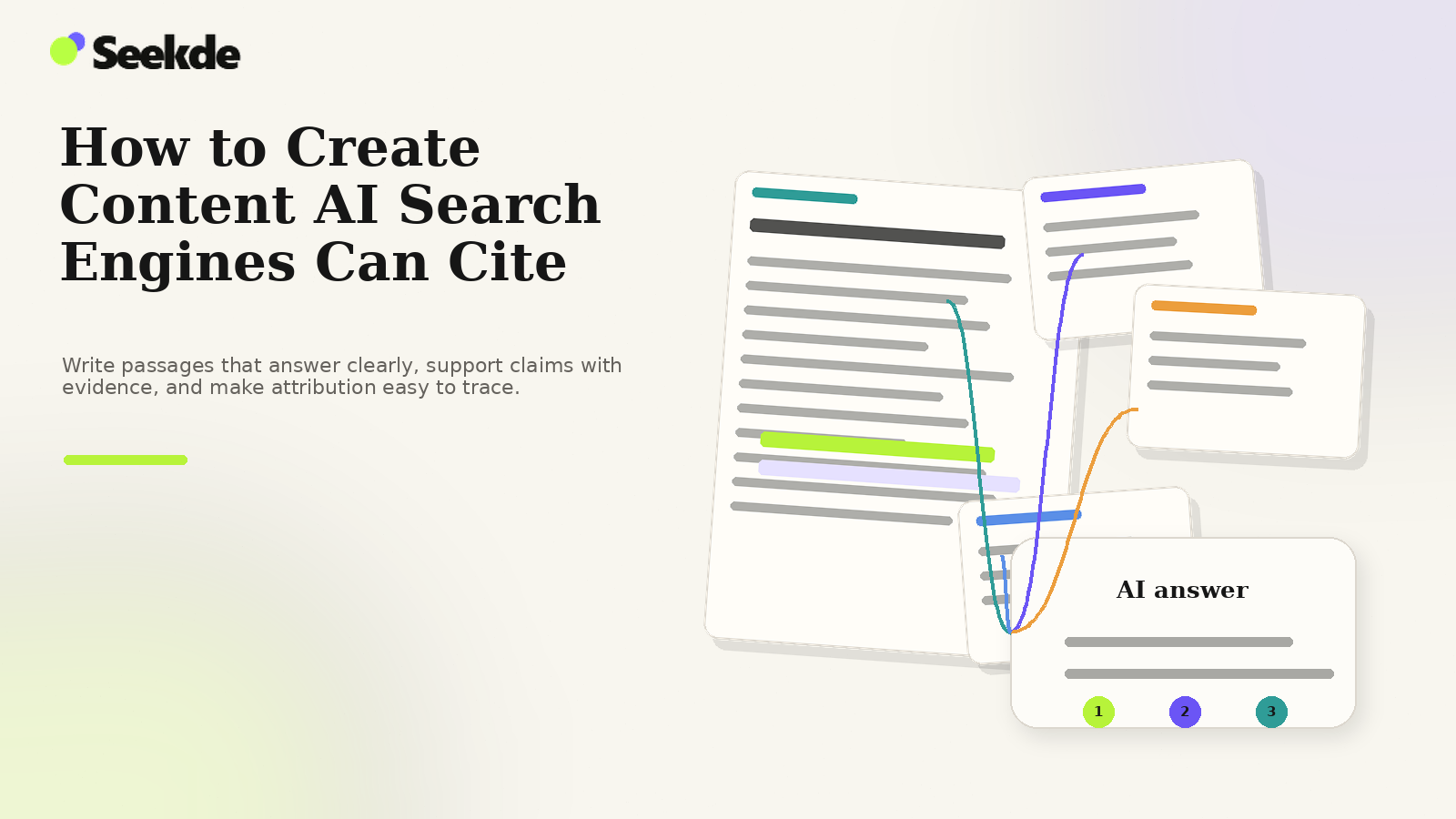
AI search engines do not cite every relevant page they retrieve. They tend to surface passages that answer the query directly, make important claims specific, and keep the supporting evidence easy to trace. This guide turns those principles into a practical writing workflow using Seekde’s Quotability Framework, citation-ready passage design, and a final readiness audit.
Retrieval-Augmented Generation (RAG) systems deployed by Google AI Overviews, ChatGPT Search, Perplexity, and Microsoft Copilot do not read entire web pages the way human readers browse. Instead, their automated ingestion pipelines decompose web documents into discrete chunks, score passage relevance through neural embeddings, and synthesize the highest-confidence factual propositions into generated answers with linked attribution.
Earning citations in generative search results is not a matter of keyword density, metadata trickery, or repetitive restatement. Conversational answer engines actively filter out redundant narrative fluff to conserve context window limits and avoid hallucination. To become an attributed source, your content must be structurally accessible, dense with verifiable facts, and formatted so that retrieval algorithms can extract standalone answers without losing contextual meaning.
While no optimization workflow can guarantee inclusion in non-deterministic generative models, implementing a disciplined, evidence-based authoring protocol substantially elevates the probability that neural retrieval engines identify, extract, and cite your pages.
The Mechanics of AI Citation: How RAG Pipelines Select Sources
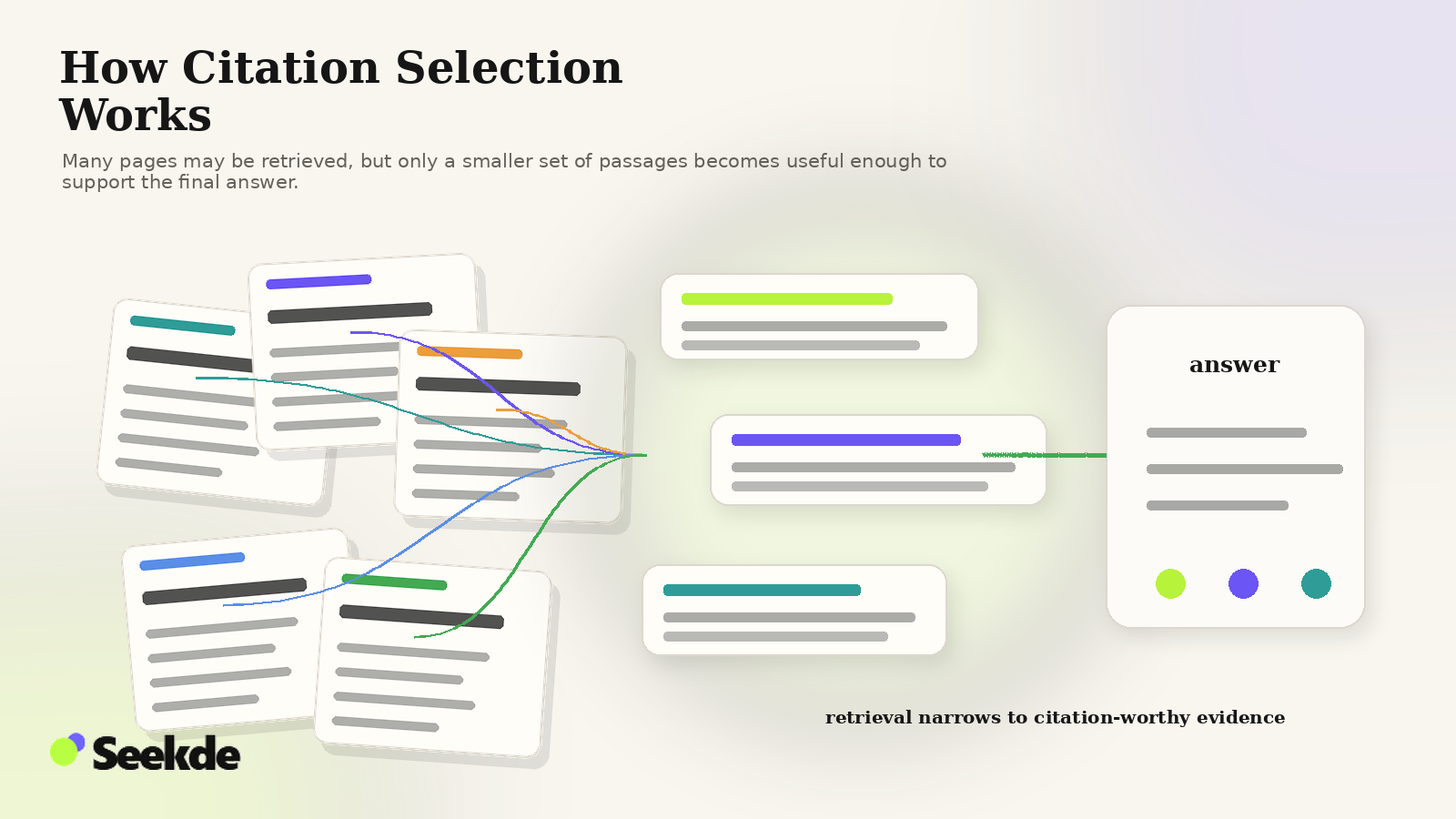
To understand how to write for conversational search systems, creators must first understand the technical extraction pipeline. When a user submits a query to an answer engine, the platform executes a multi-stage retrieval architecture:
- Query Decomposition and Fan-Out: Complex conversational prompts are broken down into multiple sub-queries that execute across traditional search indexes and dense vector databases (as explored in our analysis of query fan-out in AI search).
- Initial Document Retrieval: Crawlers and search APIs retrieve candidate documents based on lexical matching (BM25) and dense semantic vector similarity.
- Passage Chunking and Segmentation: The platform breaks documents into chunks (typically 200 to 500 tokens) using sentence-boundary and semantic splitters.
- Neural Reranking: Advanced cross-encoder models score the individual chunks against the specific sub-queries. Irrelevant sections, marketing boilerplate, and verbose introductions are discarded.
- Context Window Injection: The top-scoring passages are packed into the language model’s prompt context as grounding reference material.
- Synthesis and Attribution: The model generates natural language summaries. Attribution algorithms match generated claims back to the source spans in the grounding context, generating inline citation badges and source cards.
According to foundational research in Retrieval-Augmented Generation (Lewis et al., 2020), generative models minimize factual errors when grounding passages contain unambiguous, entity-linked assertions. If your content depends on a reader synthesizing three disparate sections of a page to understand a single fact, automated chunking systems can fail to capture the complete context within a single retrieval window.
The Seekde Quotability Framework: Three Pillars of Citation-Ready Writing
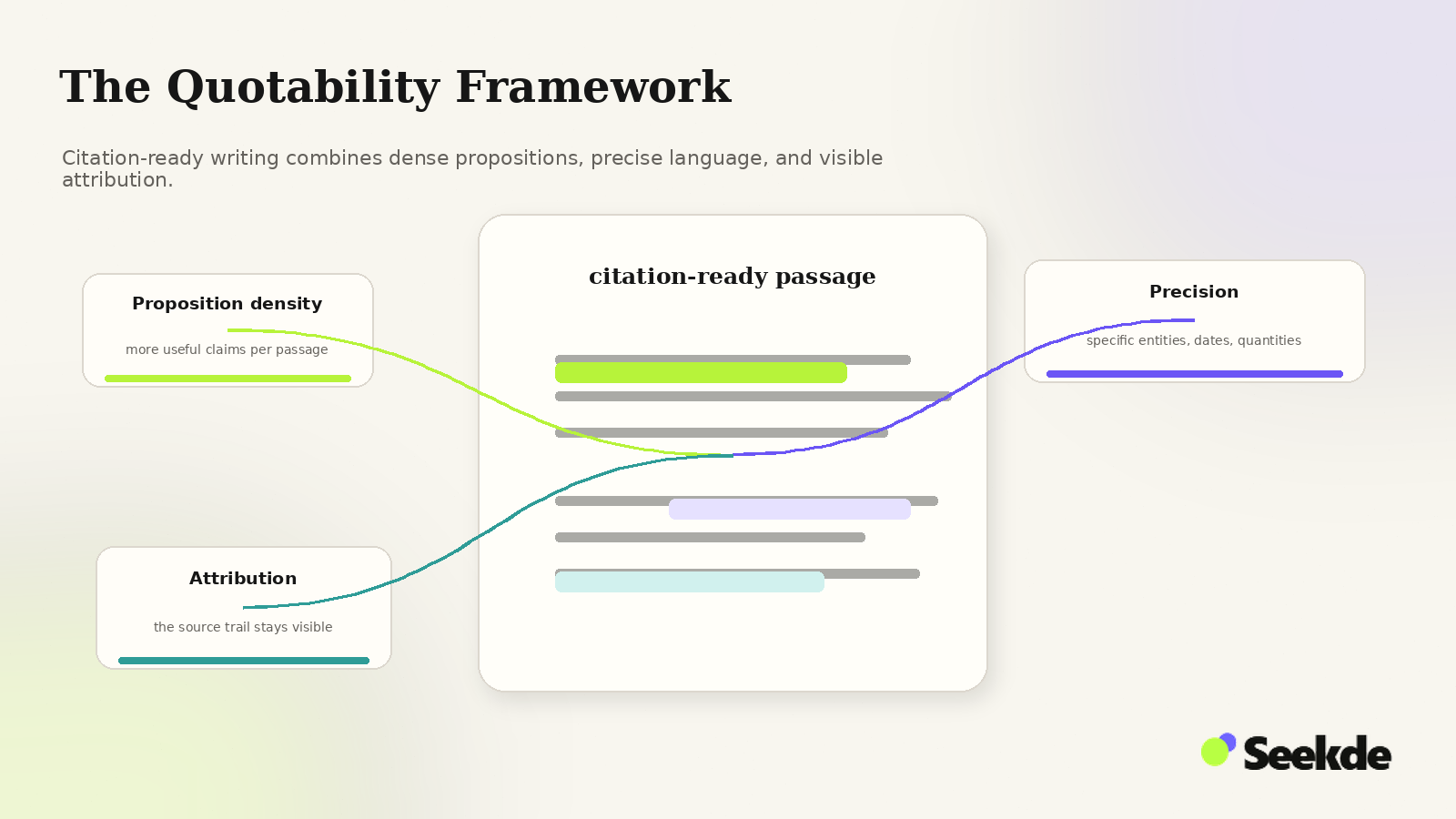
Seekde has developed the Quotability Framework—an editorial standard designed to structure technical and informational prose for automated retrieval pipelines without degrading human readability.
| Pillar | Core Objective | Optimization Mechanism | Common Failure Mode |
|---|---|---|---|
| 1. Propositional Density | Maximize meaningful information per paragraph | High ratio of entities, numbers, and facts to total words | Fluffy transitional prose and decorative introductory padding |
| 2. Extraction Autonomy | Ensure passages make complete sense when extracted in isolation | Standalone sentence structures with explicit noun antecedents | Vague pronoun chains ("This means that it happens when…") |
| 3. Attribution Hooks | Provide explicit, verifiable claims that models can reference safely | Clear methodology, named authorities, and dates for volatile data | Unsubstantiated opinions masquerading as factual consensus |
1. Propositional Density
Language models operate under strict compute and context-window budgets. When an engine evaluates two passages that cover the same topic, it favors the passage that delivers verified information in the fewest tokens.
Consider this comparison:
- Low Propositional Density (Verbose): "In the modern digital landscape of today, when companies consider whether they should monitor their visibility across emerging AI search engines, it is increasingly critical to bear in mind that search is changing rapidly and traditional metrics may no longer suffice for tracking brand awareness." (45 words, 0 specific facts, 0 actionable metrics)
- High Propositional Density (Citation-Ready): "AI search visibility measures how frequently and prominently a brand appears in synthesized answers and citation links across generative engines like Google AI Overviews, Perplexity, and ChatGPT Search, replacing static keyword rank tracking with prompt monitoring." (36 words, 4 named entities, 2 distinct metric concepts)
The second passage provides discrete factual propositions that a neural reranker can easily score and an LLM can cite as an authoritative definition.
2. Extraction Autonomy (The Self-Contained Passage Rule)
When chunking algorithms divide an article, sentences that rely heavily on pronouns (it, they, this, these platforms) lose their semantic meaning if separated from preceding paragraphs.
To achieve extraction autonomy:
- Name the subject explicitly in the opening sentence of key sections.
- Avoid starting critical definitions with "As mentioned above" or "Because of this".
- Ensure that the core question, definition, and qualification can exist within a single 150-word text block.
3. Attribution Hooks
Answer engines cite sources because they need to ground their assertions in verifiable external authority to avoid hallucination. If an article asserts that "70% of users prefer AI search" without specifying the study, year, sample size, or methodology, an answer engine is less likely to cite it—or may cite a competitor who provides the primary source. Provide explicit attribution hooks:
- Name the primary entity conducting the test or observation.
- Include the exact observation window and sample size.
- State whether the claim represents a direct observation, a platform specification, or an editorial inference.
Step-by-Step Protocol: Writing Content That Generative Engines Cite
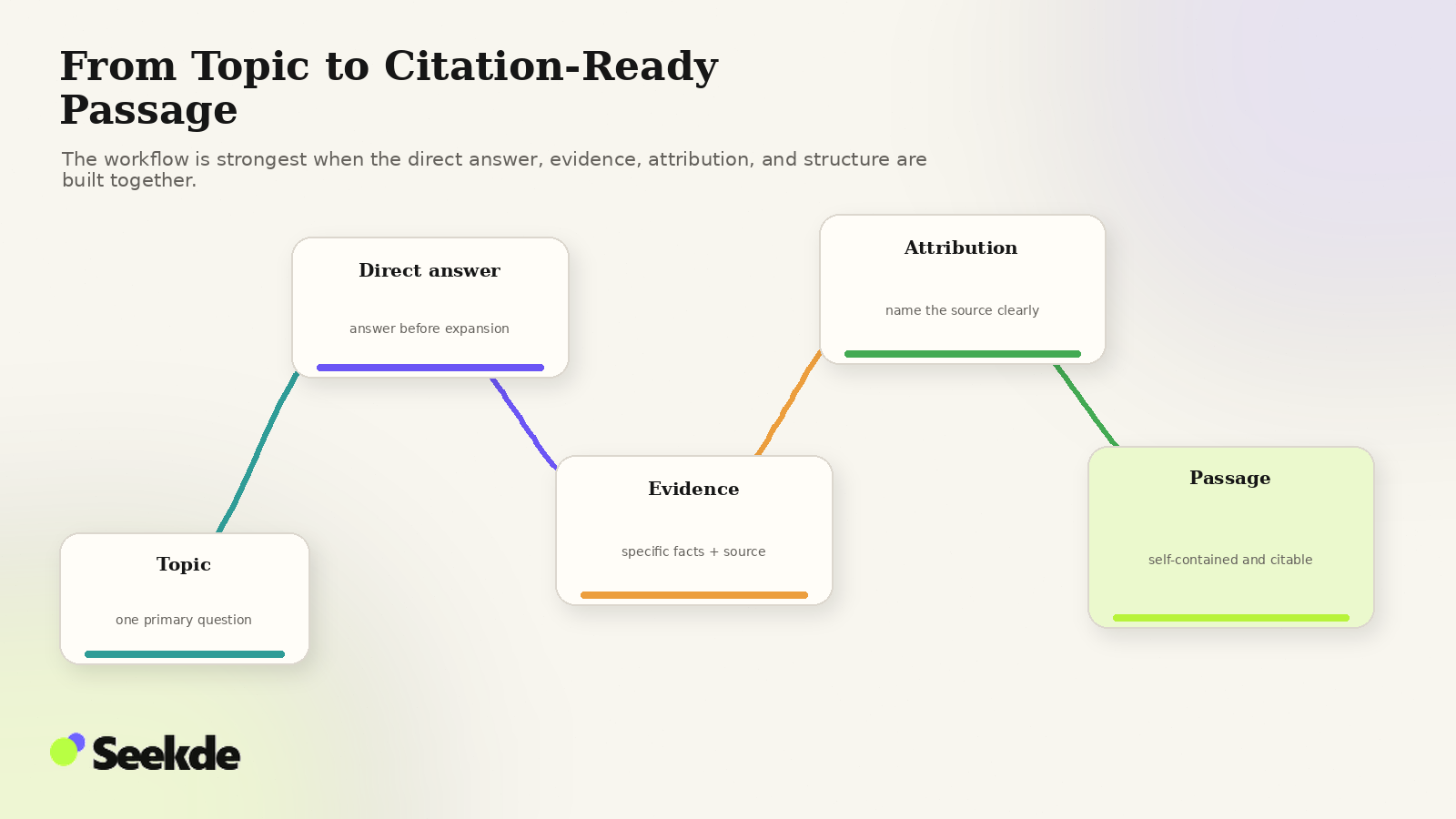
To apply these principles to your publishing workflow, follow this five-step content creation protocol.
Step 1: Isolate Intent to a Single Primary Task
Before drafting, identify the exact informational or procedural query the page satisfies. Articles that attempt to cover five broad topics in a single guide produce fragmented semantic signals.
- Weak Editorial Intent: "A complete guide to artificial intelligence in modern business."
- Strong Editorial Intent: "How to configure robots.txt directives to block training scrapers while allowing search discovery bots."
A focused document architecture aligns directly with the targeted sub-queries generated during query fan-out.
Step 2: Front-Load the Direct Answer (The Inverted Pyramid)
Place the definitive summary answer within the first 100 to 150 words of the page, immediately following the title or introductory lead. Do not withhold the answer until the conclusion to artificially inflate dwell time.
Generative crawlers prioritize initial content blocks. If a user queries "Does llms.txt help AI search rankings?", your opening section should state clearly:
"No empirical evidence or official search engine documentation indicates that llms.txt influences search rankings in Google, OpenAI, or Microsoft Copilot. It is an experimental developer standard used primarily by LLM agents for documentation retrieval."
Providing the answer immediately establishes the primary answer node that search engines extract, while subsequent sections elaborate on technical mechanics, edge cases, and testing protocols.
Step 3: Implement Entity and Topical Precision
Replace ambiguous jargon with specific, machine-readable entities recognized by knowledge graphs. Use standardized naming conventions for protocols, search products, algorithms, and organizations.
- Instead of saying "the search engine’s crawler", specify
Googlebot,OAI-SearchBot, orBingbot. - Instead of saying "the protocol", specify
RFC 9309orJSON-LD Schema.org. - Instead of saying "traffic from ChatGPT", distinguish between real-time search referral sessions and ChatGPT-User browsing visits.
This entity precision allows generative models to verify assertions against their own training embeddings and knowledge repositories, establishing high confidence in the passage’s factual consistency.
Step 4: Present Comparative and Quantitative Data in Structured HTML Tables
Language models parse structured HTML tables with high accuracy. Tables provide immediate semantic associations between entities, attributes, and values. When presenting comparative features, crawler behaviors, or benchmark metrics, convert narrative bullet points into clean, semantic <table> elements with descriptive <th> column headers.
<table>
  <thead>
    <tr>
      <th>User-Agent Token</th>
      <th>Primary Operator</th>
      <th>Documented Purpose</th>
      <th>Robots.txt Group</th>
    </tr>
  </thead>
  <tbody>
    <tr>
      <td><code>OAI-SearchBot</code></td>
      <td>OpenAI</td>
      <td>Search indexing and citation snippets</td>
      <td>Search discovery</td>
    </tr>
    <tr>
      <td><code>GPTBot</code></td>
      <td>OpenAI</td>
      <td>Foundation model training data collection</td>
      <td>Training opt-out</td>
    </tr>
  </tbody>
</table>
Generative answer engines frequently synthesize structured comparison tables directly into AI Overview response cards because the tabular format eliminates ambiguity.
Step 5: Execute an Evidence and Citation Audit Pass
Before publishing, review every factual assertion, numeric statistic, and platform claim in the draft. Verify that each claim is backed by a primary link, a documented observation, or a formal disclaimer.
- Link directly to Google Search Central documentation, OpenAI documentation, or W3C/IETF standards.
- Remove vague superlatives ("the ultimate tool", "the most revolutionary breakthrough").
- Ensure that Seekde methodology is explicitly labeled as proprietary analysis rather than universal platform doctrine.
The Seekde Citation-Readiness Checklist
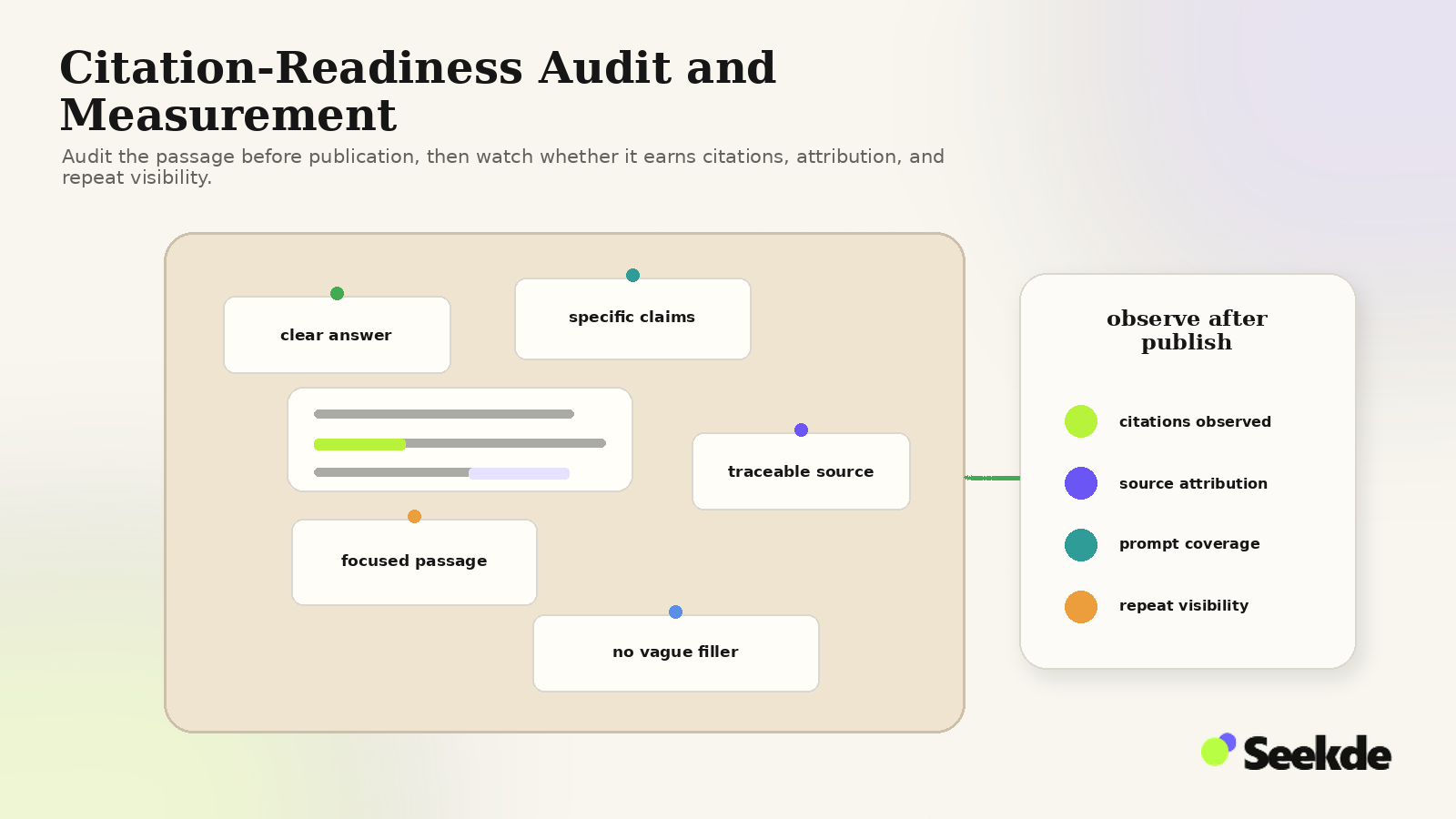
Use this 12-point quality assurance rubric prior to submitting any technical article or editorial guide for production staging:
- [ ] 1. Singular Intent: Does the article solve one unambiguous query or technical challenge?
- [ ] 2. Immediate Answer Placement: Is the core definition or solution delivered within the first two paragraphs?
- [ ] 3. Standalone Passage Cohesion: Can each major subsection be extracted and understood without reading the surrounding context?
- [ ] 4. Pronoun Disambiguation: Are subjects explicitly named in introductory sentences rather than masked by generic pronouns?
- [ ] 5. High Propositional Density: Are conversational fluff, throat-clearing transitions, and repetitive summaries eliminated?
- [ ] 6. Entity Specificity: Are organizations, software agents, protocols, and metrics identified by their canonical technical names?
- [ ] 7. Tabular Synthesis: Are comparative or multi-attribute datasets structured in semantic HTML tables?
- [ ] 8. Verifiable Source Citations: Are external platform claims supported by direct links to primary technical documentation?
- [ ] 9. Epistemic Humility: Are empirical observations, platform specifications, and theoretical inferences clearly separated?
- [ ] 10. Heading Semantics: Does the document utilize exactly one theme
<h1>, with logically nested<h2>and<h3>tags that reflect the content outline? - [ ] 11. Semantic Schema Integration: Is structured data (e.g.,
Article,TechArticle, orBreadcrumbList) present to reinforce entity connections (as detailed in our schema markup for AI search guide)? - [ ] 12. Zero Promise of Rankings: Does the text avoid claiming that following these steps guarantees search placement or AI citation?
What to Avoid: Common Editorial Patterns That Prevent AI Citations
| Problematic Pattern | Why RAG Engines Ignore or Demote It | Recommended Correction |
|---|---|---|
| Narrative Fluff & Throat-Clearing | "In today’s fast-paced digital world, content has always been king…" consumes token capacity without adding propositional value. | Eliminate opening generalizations. Begin immediately with the core technical subject and operational definition. |
| Bait-and-Switch Answers | Hiding the direct answer behind 1,200 words of background history forces chunkers to score multiple low-density passages. | Deliver the direct answer in a summary block at the top, then unpack the nuance and methodology below. |
| Unsupported Aggregate Statistics | Stating "Studies show 85% of businesses use AI" without naming the survey, year, or methodology triggers hallucination filters. | Provide exact attribution: "According to a 2025 survey of 450 IT leaders conducted by [Organization]…" |
| Unanchored Relative Time | Writing "Recently, Google updated its policy last month" becomes misleading when crawled six months later. | Use ISO dates or explicit calendar months and years: "In March 2025, Google updated its crawler documentation…" |
| Image-Only Data Presentations | Placing key data tables or flowcharts inside PNG or JPEG images without HTML text equivalents leaves data invisible to text crawlers. | Accompany every visual chart with an accessible, machine-readable HTML table or structured descriptive text. |
Measuring AI Citations and Attribution
Publishing citation-ready content is an iterative engineering process. Once your content is live and indexed:
- Track Referral Traffic from Generative Engines: Monitor referral paths in GA4 to isolate sessions originating from
chatgpt.com,perplexity.ai, andclaude.ai(as detailed in our guide on how to track ChatGPT referral traffic in GA4). - Track Generative AI Impressions in Google Search Console: Use the dedicated Generative AI performance filters in GSC to observe queries where your pages appear as grounding sources in AI Overviews (detailed in tracking AI search visibility in Google Search Console).
- Deploy Prompt Monitoring Sets: Regularly sample multi-engine responses across standardized prompt sets to evaluate whether your brand or domain is cited for key informational queries (see building an AI search prompt monitoring set).
- Evaluate Citation Volatility: Understand that generative models are probabilistic; citation appearance will naturally fluctuate based on sampling temperature, prompt variations, and live index updates (as explored in our guide on AI visibility ranking volatility).
By focusing on information gain, structural clarity, and rigorous primary verification, publishers create assets that serve human readers first while providing generative search engines with the exact evidence pathways they require for attributed synthesis.
Related Guides and Technical Resources
- What Makes a Web Page Citation-Worthy?
- How Original Research Improves AI Search Visibility
- How to Structure Articles for AI Search
- Do Statistics and Sources Improve AI Citations?
- Schema Markup for AI Search: What Actually Matters
- What Is Generative Engine Optimization (GEO)?
- How AI Search Engines Find, Retrieve and Cite Web Content