Publishing original empirical research is the single most defensible strategy for securing sustainable citations in AI search engines and conversational answer systems. While generative language models can effortlessly synthesize definitions, summarize guides, and rephrase common industry knowledge without citing an external source, they cannot invent primary empirical facts without hallucinating. When users ask questions that require fresh data, statistical benchmarks, or comparative platform metrics, retrieval-augmented models are algorithmically required to query external indexes and attribute the source of the data.
In traditional search engine optimization, original research was primarily valued as a "linkable asset"—content designed to acquire editorial backlinks that passed PageRank to commercial pages. In Generative Engine Optimization (GEO), however, original research functions as a primary grounding node. By publishing proprietary survey findings, platform performance benchmarks, or longitudinal datasets, an organization transforms its website into the authoritative origin of a fact.
When conversational search engines answer queries involving that fact, your publication becomes the primary citation target, earning direct referral traffic and solidifying brand authority across model knowledge bases.
(Note: While original research substantially elevates citation probability by providing unique empirical grounding, generative engines operate probabilistically; publishing research does not guarantee automatic AI ranking boosts or universal citations across all user queries.)
The Information Gain Imperative: Why LLMs Prioritize Primary Data
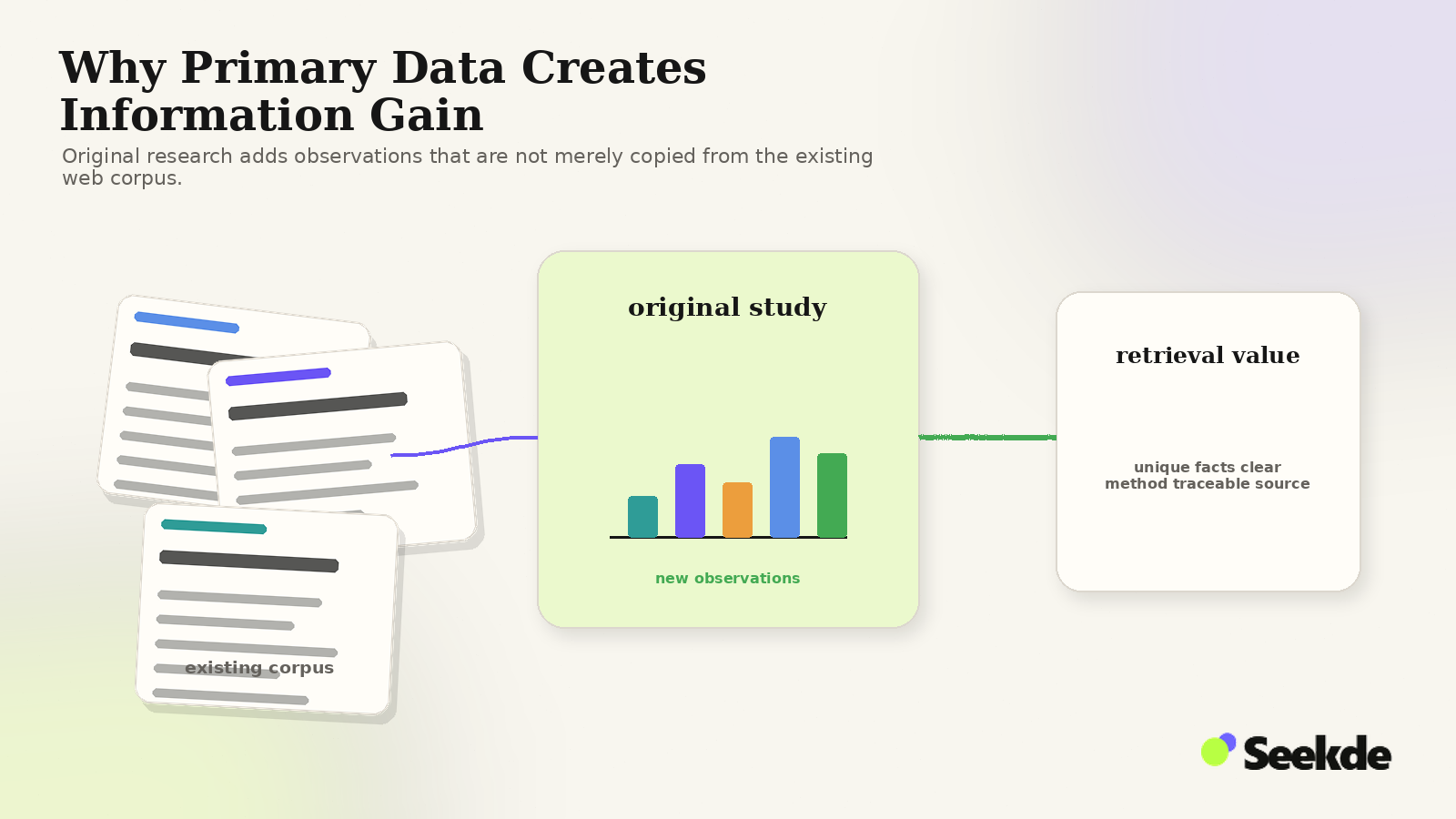
Generative search systems operate under strict constraints: context window capacity, retrieval latency, and hallucination avoidance. To optimize response quality, engines evaluate retrieved candidate documents using Information Gain algorithms.
Google’s patented information gain scoring system (US Patent 10,878,054) measures the novelty and incremental value a document provides relative to what the searcher has already encountered. In a generative search environment:
LLM Parametric Memory Zero External Citations Required (No Search Query)
RAG Index Retrieval High Information Gain Passage Attributed Citation (Real-Time Search) (Original Research Source)
- Common Knowledge Queries: Questions like "What is robots.txt?" or "Define search visibility" can be answered directly from the model’s parametric weights or aggregated from hundreds of interchangeable guides. No single domain owns the answer, resulting in low citation stability.
- Empirical and Benchmark Queries: Questions like "What percentage of websites block GPTBot?" or "How much does AI search result volatility fluctuate across identical queries?" cannot be answered reliably from training weights. The engine must retrieve real-time data, and the algorithm rewards the domain that first established and documented the finding.
When an organization publishes original research, it injects novel tokens and entity relationships into the web index that competitors cannot reproduce without citing the original study.
Three Mechanisms: How Original Data Enters the AI Citation Graph
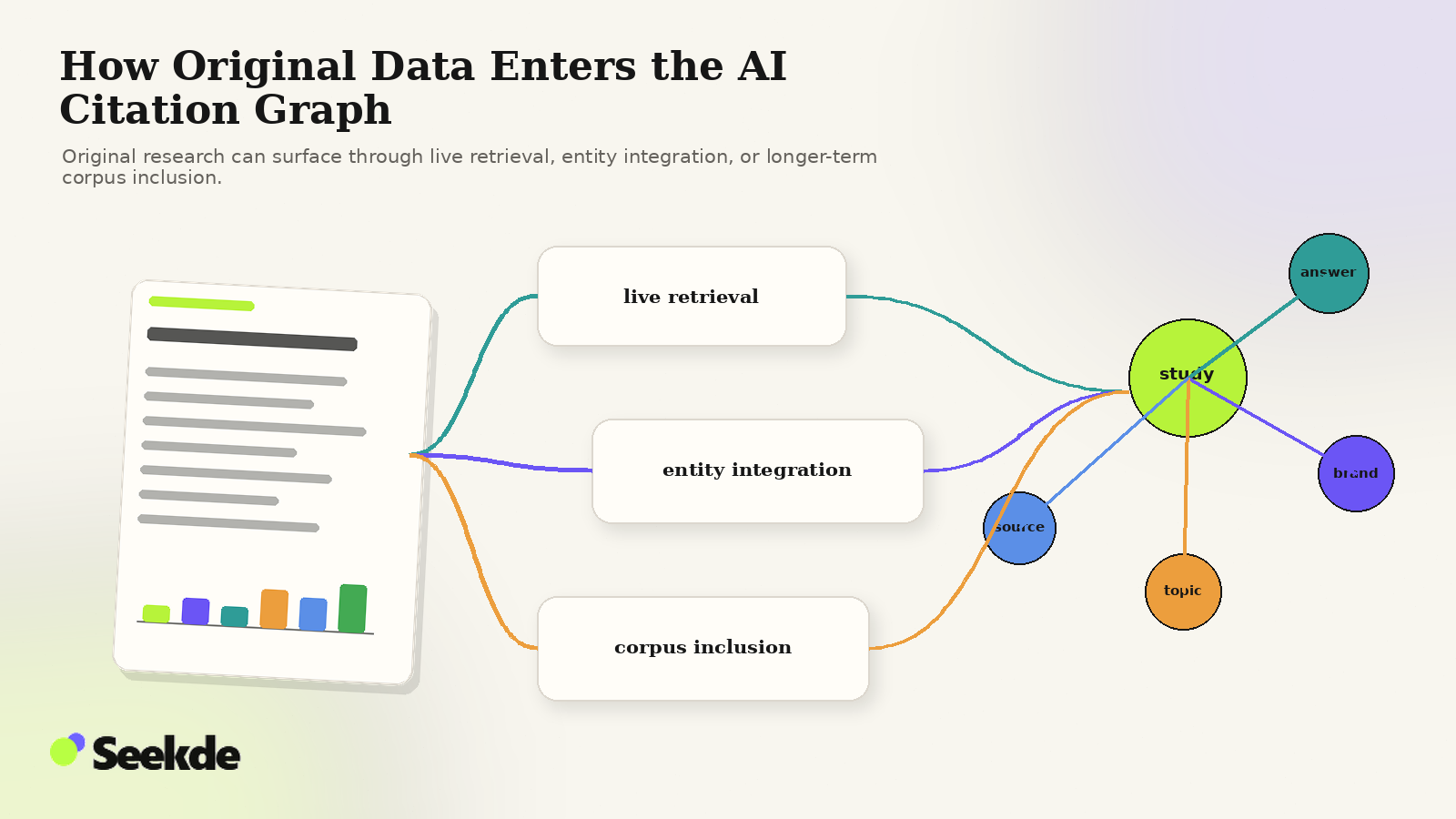
Original research influences generative visibility through three distinct technical pathways across search architectures:
| Ingestion Pathway | Search Engine Mechanism | Long-Term Visibility Impact |
|---|---|---|
| 1. Real-Time RAG Grounding | Active search agents (Google AI Overviews, Perplexity Sonar, ChatGPT Search) retrieve the study to substantiate generated statistics. | Direct hyperlinked citations on high-intent informational and commercial queries. |
| 2. Entity Knowledge Graph Ingestion | Structured data and high cross-web consensus associate your brand entity with specific industry metrics and benchmarks. | Enhanced brand authority in conversational entity disambiguation and market landscape summaries. |
| 3. Model Pre-Training & Fine-Tuning | High-authority research papers, whitepapers, and dataset tables are ingested into foundation training corpora (e.g., Common Crawl, RefinedWeb). | Long-term parametric memory retention; the model cites or references your findings even without live search queries. |
Pathway 1: Real-Time RAG Grounding
When a user asks Perplexity or Google AI Mode for current conversion benchmarks or market share figures, the system executes real-time retrieval fan-out queries. If your publication provides a clean, machine-readable table with an exact sample size and year, neural rerankers score that chunk with high relevance. The model extracts the percentage and generates an inline citation badge directly to your URL.
Pathway 2: Knowledge Graph Ingestion
As other authoritative industry publications, news outlets, and trade blogs report on your research, they cite your domain as the primary source. This multi-source corroboration establishes an entity relationship in search engine knowledge graphs (e.g., Google Knowledge Graph or Wikidata reconciliation). The engine learns that [Your Brand] is the definitive authority on [Topic Benchmark].
Pathway 3: Pre-Training Corpus Memorization
Foundational model scrapers (such as GPTBot, ClaudeBot, and Google-Extended) prioritize structured datasets, academic papers, and analytical reports for pre-training and fine-tuning datasets. High-rigor empirical research often gets memorized directly into the model’s weights, making your brand a default reference point in future model generations.
What Makes Research "Citable" to an AI: The Four R’s of Empirical Content
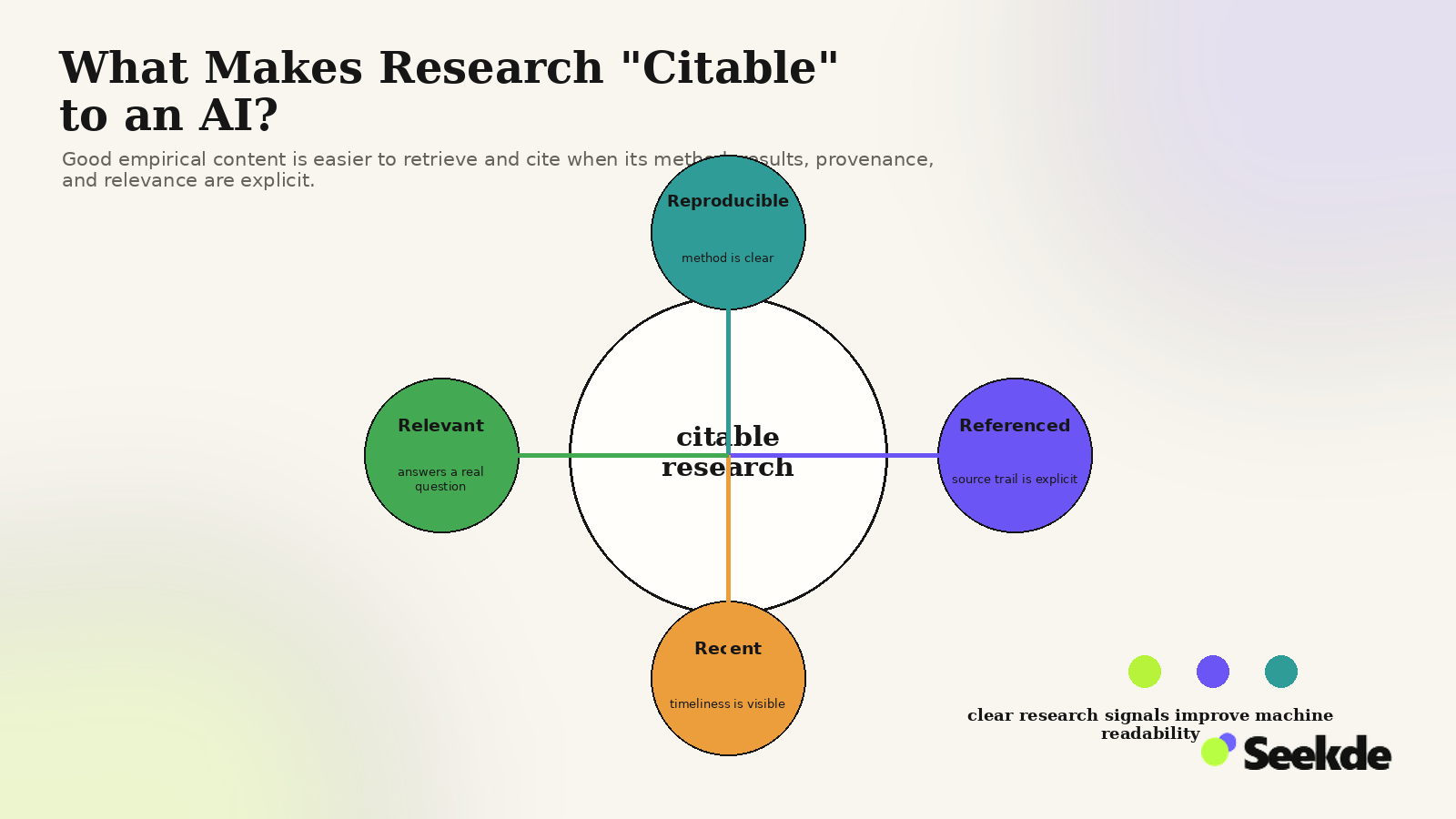
Not all original data succeeds in earning generative citations. Whitepapers filled with vague executive opinions or unscientific customer polls are frequently filtered out by retrieval algorithms. Citable research satisfies The Four R’s of Empirical Authority:
Rigorous
- (Methodology)
Relevant
- (Intent Fit)
Reusable
- (Format Fit)
Refreshable
- (Longitudinal)
- Rigorous (Transparent Methodology): The study must disclose sample size, date range, collection mechanism, and analytical limitations. Anonymous surveys with 20 respondents lack statistical confidence; audits of 5,000 domains with documented Python collection scripts provide incontrovertible evidence.
- Relevant (High-Intent Prompt Alignment): The research must answer questions people and executives actually query. Formulate research hypotheses based on common industry debates, unverified assumptions, or emerging technical changes.
- Reusable (Machine-Readable Packaging): Data points must be extractable in standalone sentences and structured HTML tables. If your statistics exist only inside PDF downloads, gated forms, or infographic images, text-based AI crawlers will bypass them.
- Refreshable (Longitudinal Tracking): Single snapshot studies become obsolete within 12 months. Establishing an annual, quarterly, or rolling benchmark creates recurring citation authority as models look for the most recent year’s data.
The Seekde Mini-Research Publication Protocol
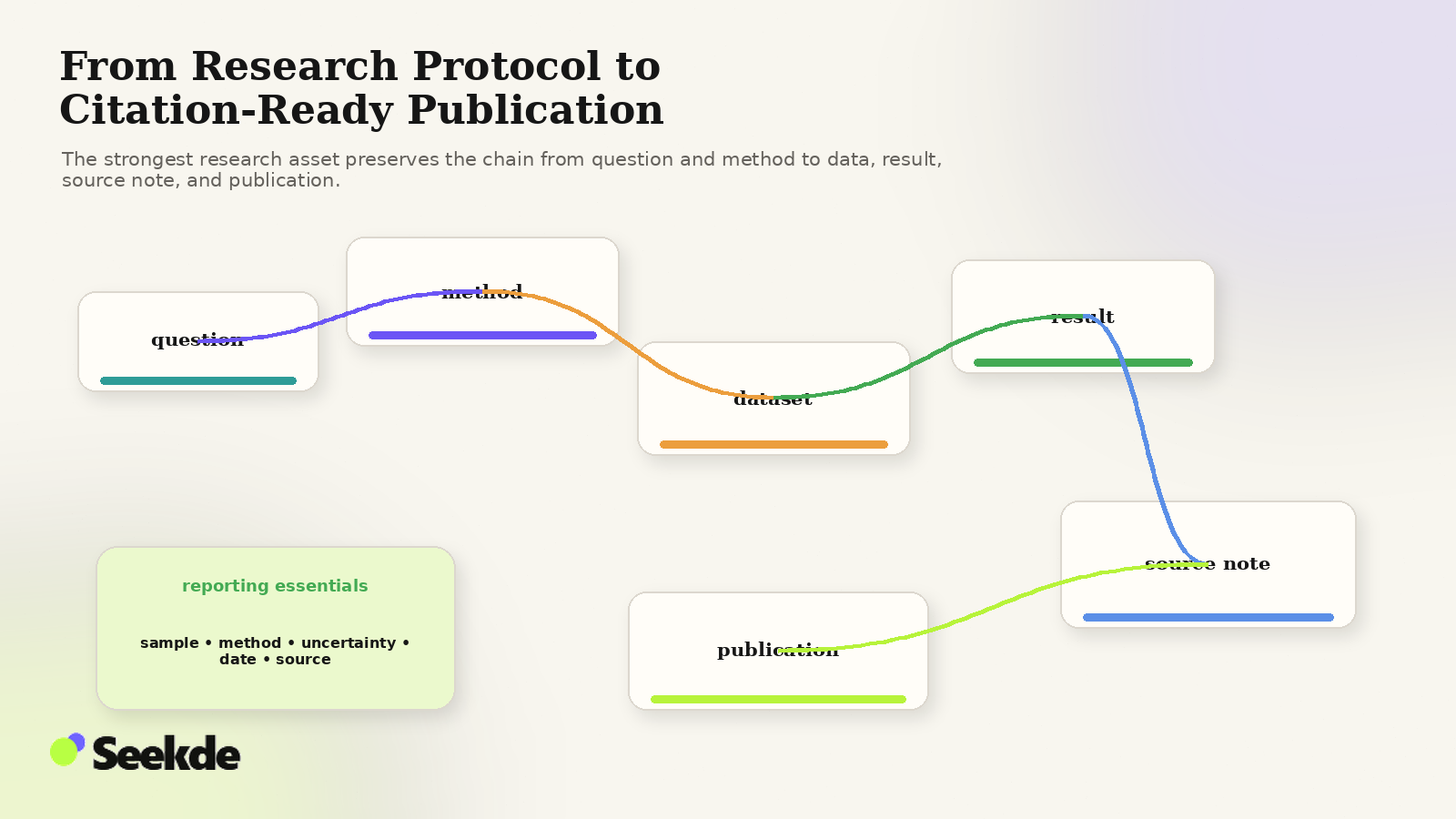
Organizations do not need million-dollar budgets or academic research laboratories to publish citable empirical data. Following Seekde’s Mini-Research Publication Protocol, technical teams and marketers can produce high-impact, highly citable studies in four focused phases:
Phase 1: Hypothesis and Scope Definition
Identify a narrow, unresolved question within your market. Avoid generic satisfaction surveys. Focus on objective, measurable technical or behavioral facts:
- Example Hypothesis: "What percentage of SaaS documentation sites allow OAI-SearchBot while disallowing GPTBot?"
- Target Metric: Distinct robots.txt permission distributions across top 500 SaaS domains.
Phase 2: Systematic Data Collection
Collect data using a reproducible, documented script or standardized audit protocol:
- Document the exact collection tool (e.g., Python
requests, headless Playwright, public API endpoint). - Freeze the raw dataset with a timestamp and cryptographic checksum to guarantee integrity.
- Separate direct empirical observations from editorial commentary (as required in our research methodology standards).
Phase 3: Structured Packaging and Tabular Presentation
Publish the findings using HTML tables, clear quantitative summaries, and standalone highlight callouts:
- Place the core aggregate statistics in a summary table immediately beneath the executive overview.
- Use explicit column headers (
Domain Category,Sample Size (N),Allowed %,Blocked %). - Provide a downloadable raw CSV or GitHub repository link for academic and industry peer review.
- Add an explicit methodology subsection outlining sample selection criteria, confidence intervals, and potential selection biases.
Phase 4: Amplification and Knowledge Graph Seeding
Distribute the study through targeted digital PR and technical practitioner communities:
- Distribute an un-gated press release highlighting the single most counterintuitive or surprising statistic.
- Engage with industry practitioners on technical forums, newsletters, and podcasts.
- Ensure that third-party coverage links directly to the research report rather than the corporate homepage.
Case Anatomy: How an Original Research Asset Earns RAG Ingestion
To understand the lifecycle of an empirical research report, consider this structural anatomy based on successful technical audits published across the search industry:
When a user submits a prompt to Perplexity or ChatGPT Search asking "How common is it for websites to block GPTBot?", the retrieval model identifies the exact statistics in Section 1 and Section 2. The cross-encoder verifies that the finding is supported by a documented sample size (N=1,200) and methodology in Section 4, resulting in an inline citation badge directly to the study URL.
The Statistical Reporting Standard for Citation-Ready Articles
When reporting empirical findings, technical authors must adhere to a standardized statistical notation that generative models can parse without semantic ambiguity:
- Explicit Sample Notations: Always declare the population sample size immediately following the metric, using standardized notation:
(N = 450)or(n = 82). - Confidence Intervals and Significance: When reporting comparative differences or sample inferences, state the confidence interval or p-value where applicable:
(p < 0.01)or(95% CI [38.4%, 44.0%]). - Temporal Anchoring: Never report findings using relative terms like "in our latest study" or "recently". Anchor every observation with a specific calendar quarter or date range:
(audited January 15–28, 2026). - Boundary Definitions: Explicitly define the boundary conditions of your sample. If you audited the top 1,000 domains, state whether they were selected by Alexa rank, Tranco list, organic traffic, or market capitalization.
Adhering to these conventions signals high methodological rigor to both human peer reviewers and automated text classification algorithms.
Comparative Matrix: Types of Original Research and Their AI Citation Potential
| Research Format | Production Effort | AI Citation Potential | Primary Ingestion Mechanism | Best For |
|---|---|---|---|---|
| Technical Corpus Audit | Moderate | Exceptional (90+) | Direct RAG snippet extraction & tabular synthesis | Analyzing server logs, robots.txt files, schema markup adoption, or crawl response codes across large URL sets. |
| Platform Behavior Shootout | Moderate | High (80–90) | Comparative RAG answers and entity evaluation cards | Side-by-side prompt benchmarking across multiple generative engines (e.g., comparing citation rates between ChatGPT and Google). |
| Proprietary Platform Telemetry | Low (if data exists) | High (75–85) | Definitive market share and usage benchmarks | Aggregated, anonymized customer usage trends, referral traffic breakdowns, or processing volume statistics. |
| Industry Practitioner Survey | High | Moderate (65–75) | Secondary citation and media quote extraction | Budget allocations, strategic priorities, and organizational challenges across verified professional cohorts (min. N=300). |
| Theoretical Opinion Paper | Low | Low (<40) | Rarely cited; treated as derivative opinion | Essays and subjective predictions lacking quantitative datasets or reproducible methodologies. |
Pitfalls to Avoid in Research-Driven Discoverability
- Gating Data Behind Lead Generation Forms: If an engine’s crawler encounters a PDF download form, modal popup, or mandatory email gate, it cannot parse the text. All primary statistical findings must reside directly in the crawlable HTML document.
- Burying Data Inside Images and Charts: Beautiful data visualizations delight human readers, but text crawlers cannot reliably extract numeric data points from charts without explicit alt text or accompanying HTML tables. Pair visual graphs with machine-readable data tables.
- Omitting the Sample Size and Date: A statistic stated as "82% of enterprises experience search traffic loss" without indicating the sample size (
N=412), industry vertical, or observation date (Q1 2026) is often rejected by generative verification filters as unverified conjecture. - Fabricating or Embellishing Numbers: Language models cross-reference claims against external sources. Releasing fabricated survey data or manipulated testing results inevitably leads to public debunking, damaging brand entity trust across knowledge graphs permanently.
Summary: Becoming the Source of Truth
In the generative search era, the websites that survive and dominate conversational answers are those that produce primary truth. When you publish rigorous original research, you cease competing with other publishers to summarize existing knowledge—you become the original knowledge provider that the entire industry, and every generative engine, must cite.
By following systematic research protocols, publishing machine-readable data tables, and maintaining complete methodological transparency, organizations build durable, high-authority citation assets that compound in value across every AI search ecosystem.
Related Guides and Empirical Frameworks
- How to Create Content AI Search Engines Can Cite
- What Makes a Web Page Citation-Worthy?
- Do Statistics and Sources Improve AI Citations?
- How to Structure Articles for AI Search
- How Digital PR Influences AI Search Visibility
- What Is AI Search Visibility?
- Seekde Research Methodology and Rigor Standards
- The State of AI Search Visibility 2027 (forthcoming empirical benchmark)