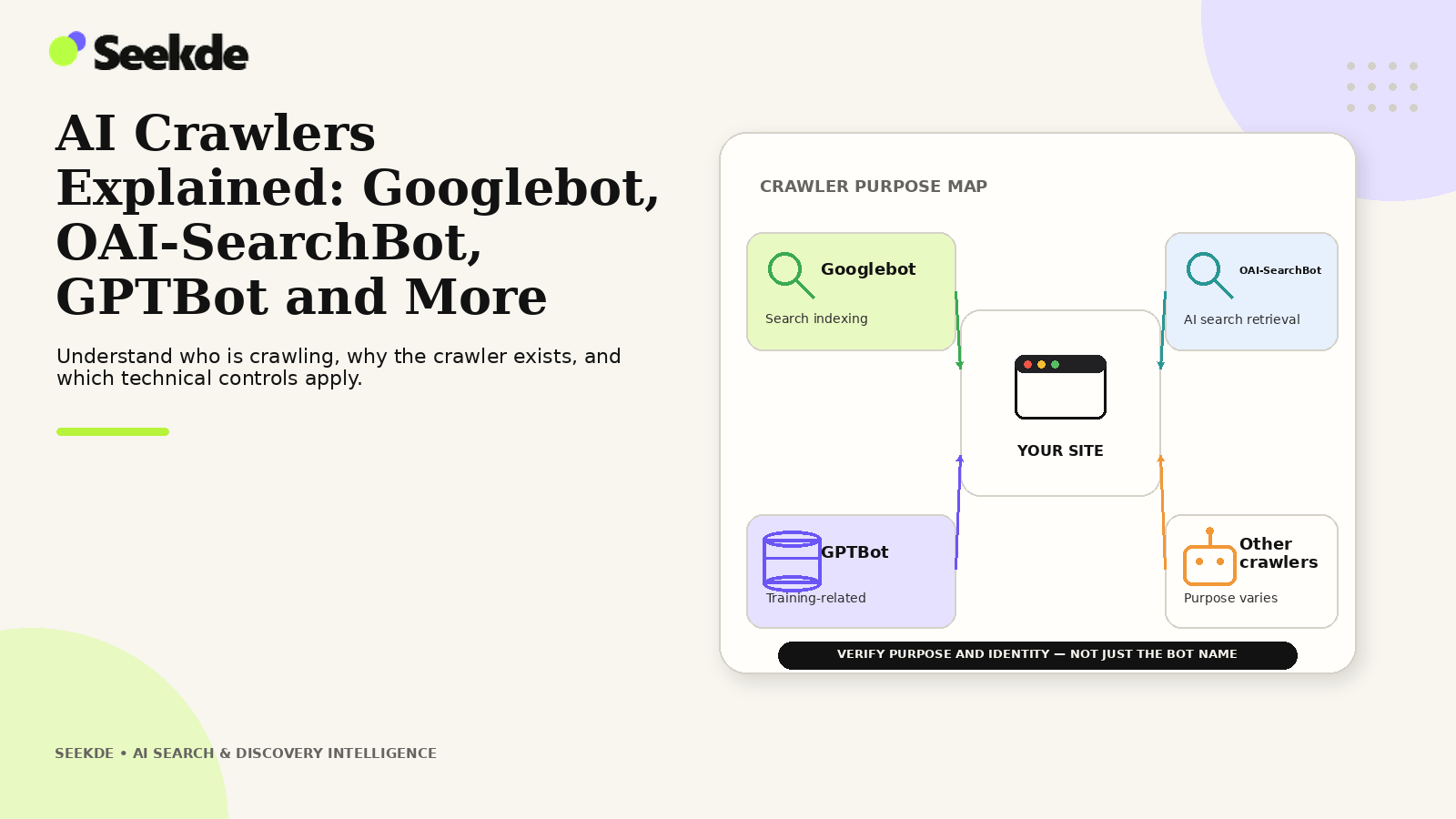
AI crawlers are automated software agents deployed by artificial intelligence and search platforms to discover, index, retrieve, or scrape web content. Not every bot associated with an AI company serves the same operational objective. Search discovery, real-time user-triggered retrieval, and foundation model training are fundamentally separate functions governed by distinct crawler identities, request behaviors, and robots.txt directives.
Treating all automated visits from technology companies as a monolithic "AI bot" category leads to severe operational errors: publishers inadvertently sever their visibility in conversational answer engines while attempting to block model training, or leave proprietary datasets exposed while believing they opted out of generative scraping. Establishing precise governance requires distinguishing between crawler functions, verifying genuine bot requests via reverse DNS and published IP ranges, and configuring targeted access policies at the server and edge layers.
The Three Core Categories of AI-Related Crawlers
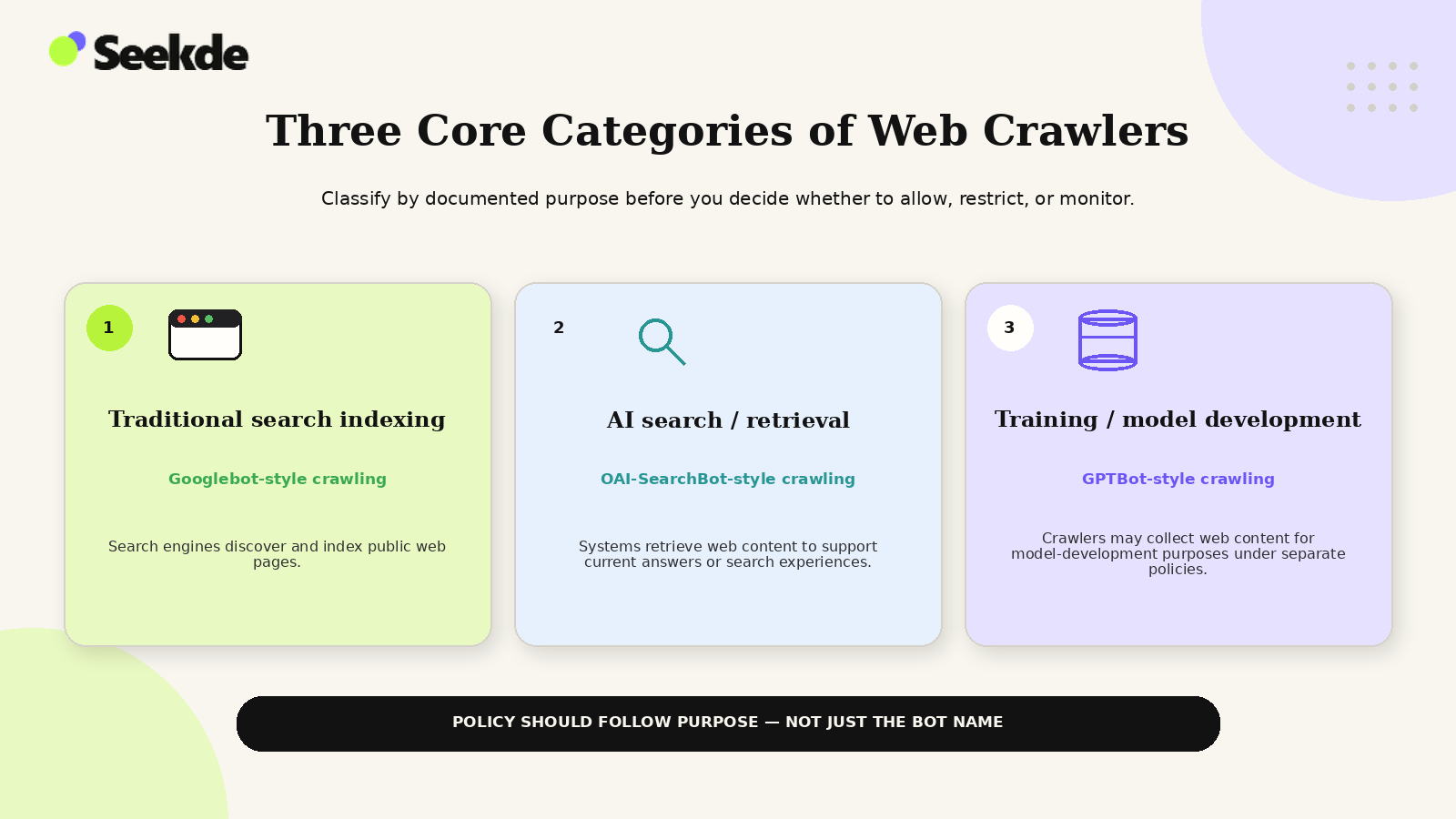
To make informed architectural decisions, technical teams must separate web agents into three operational tiers based on documented vendor behavior:
Search & Discovery Bots
Purpose: Real-time search
- Googlebot
- OAI-SearchBot
- Bingbot
- PerplexityBot
- Clau
- retrieval & citations
User-Triggered Fetchers
Purpose: Fetching URLs on
- ChatGPT-User
- Perplexity-User
- Claude-User
- de-Sea
- explicit prompt command
Model Training Scrapers
Purpose: Ingesting data
- GPTBot
- ClaudeBot
- Google-Extended
- Applebot-Extended
- rchBot
- for offline weight training
1. Search and Discovery Crawlers
These user agents crawl the web to build and maintain searchable indexes that power generative answer engines and hybrid search systems. When an answer engine answers a user prompt using Retrieval-Augmented Generation (RAG), it queries these indexes or sends search crawlers to find fresh, relevant documentation. Allowing these crawlers is necessary for a website to be cited as a source in generative search answers, though access alone does not guarantee citation.
Key examples include:
- Googlebot: Powers Google Search, Google AI Overviews, and AI Mode.
- OAI-SearchBot: Used by OpenAI specifically to discover and index content for ChatGPT Search.
- Bingbot: Powers Microsoft Bing and Microsoft Copilot web grounding.
- PerplexityBot: Gathers web content to populate the index used by Perplexity AI.
- Claude-SearchBot: Deployed by Anthropic specifically to crawl and index web content to improve web-search result quality and search grounding.
2. User-Triggered Fetchers
These automated agents operate exclusively on-demand in response to a specific human user prompt. When a user pastes a URL directly into an AI prompt or requests an analysis of a specific webpage, the platform dispatches a fetcher on behalf of that individual session.
Key examples include:
- ChatGPT-User: Dispatched when a ChatGPT user provides a URL in conversation or uses a browsing capability to inspect a specific link.
- Perplexity-User: Dispatched when an end-user provides a direct link in a Perplexity query.
- Claude-User: Dispatched by Anthropic when an end-user prompts Claude to browse or fetch a specific webpage.
User-triggered fetchers do not build autonomous web-wide indexes. Blocking them does not prevent a search engine from indexing your site, but it will cause direct user requests (such as "summarize this article: https://example.com/guide") to fail with an access error.
3. Foundation Model Training Scrapers
These scrapers ingest massive corpora of public text to train future weights and foundation models during offline pre-training or fine-tuning runs. Unlike search discovery bots, training scrapers do not provide direct real-time referral traffic or citation links in response to end-user queries.
Key examples include:
- GPTBot: OpenAI’s dedicated crawler for training dataset collection.
- ClaudeBot: Anthropic’s web crawler used to collect content for foundation model development and training datasets.
- Google-Extended: Google’s standalone product token that allows publishers to opt out of training Google’s Gemini and Vertex AI generative models without impacting Google Search indexing.
- Applebot-Extended: Apple’s standalone opt-out token for Apple Intelligence foundation model training.
Understanding these operational differences is crucial: a publisher can permit OAI-SearchBot vs GPTBot independently to maintain search discoverability while preventing automated model training.
Comprehensive Directory of Documented AI and Search Crawlers
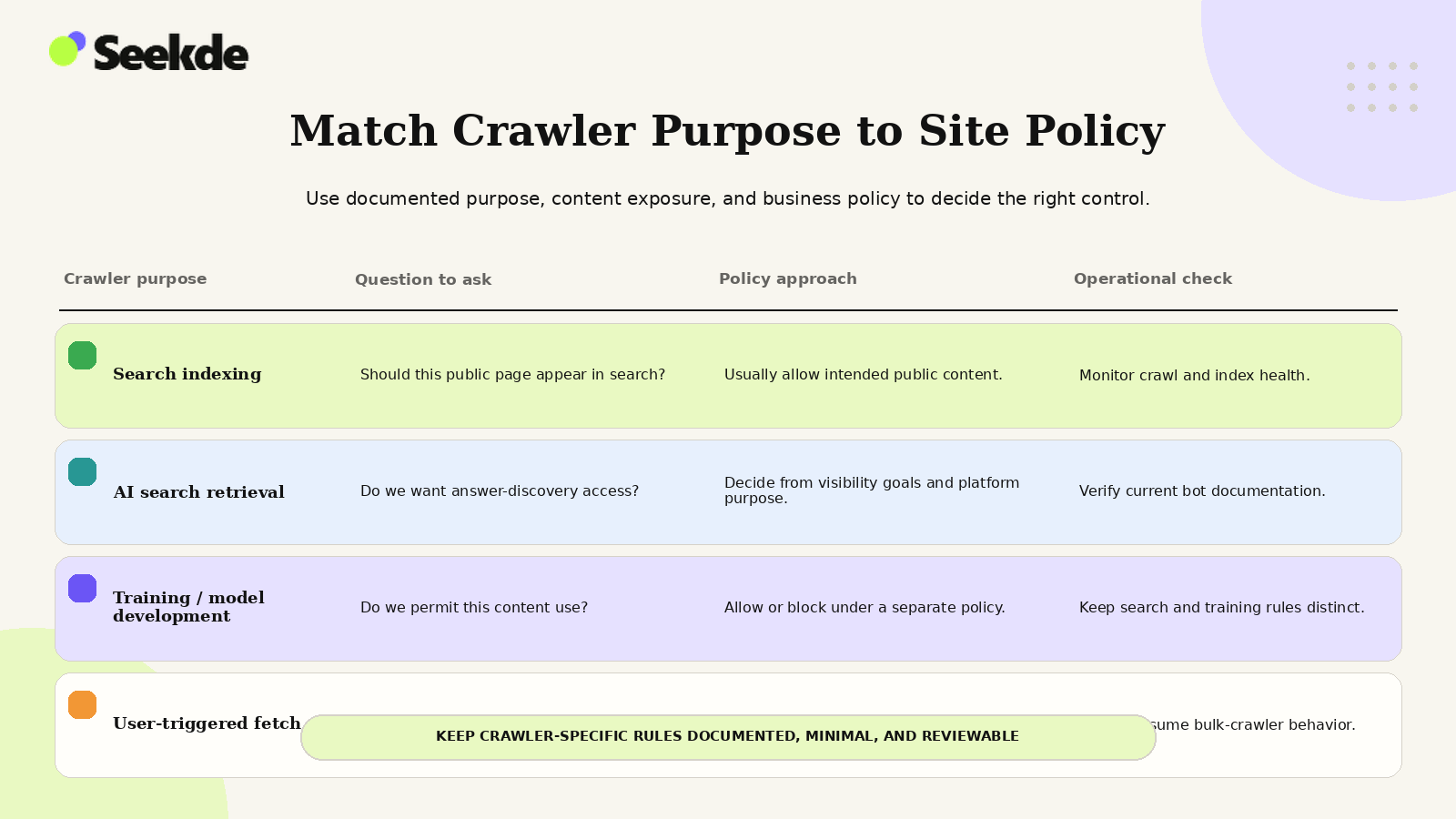
The following directory documents the major crawlers, their official User-Agent tokens, operational purposes, and robots.txt behavior according to vendor specifications:
| Crawler Name | User-Agent Token | Operator | Primary Documented Purpose | Respects Robots.txt | Verification Method |
|---|---|---|---|---|---|
| Googlebot | Googlebot |
General Search indexing, AI Overviews, AI Mode | Yes (RFC 9309) | Reverse DNS (.googlebot.com, .google.com) or published IP range JSON |
|
| Google-Extended | Google-Extended |
Opt-out control for Gemini and Vertex AI training | Yes (RFC 9309) | Managed via Googlebot crawler infrastructure | |
| OAI-SearchBot | OAI-SearchBot |
OpenAI | Indexing and search discovery for ChatGPT Search | Yes (RFC 9309) | Reverse DNS (search.openai.com) or published IP range JSON |
| GPTBot | GPTBot |
OpenAI | Model training dataset collection | Yes (RFC 9309) | Reverse DNS (openai.com) or published IP range JSON |
| ChatGPT-User | ChatGPT-User |
OpenAI | On-demand fetching triggered by ChatGPT user actions | Yes (RFC 9309) | Published IP range JSON (chatgpt-user.json) |
| Bingbot | Bingbot |
Microsoft | Bing search indexing, Copilot search grounding | Yes (RFC 9309) | Reverse DNS (.search.msn.com) or published IP range JSON |
| PerplexityBot | PerplexityBot |
Perplexity AI | Search indexing and content discovery for Perplexity | Yes (RFC 9309) | Published IP range list in official documentation |
| Perplexity-User | Perplexity-User |
Perplexity AI | On-demand user link navigation | Yes (RFC 9309) | Published IP range list in official documentation |
| ClaudeBot | ClaudeBot |
Anthropic | Training data collection and model improvement | Yes (RFC 9309) | Published source-IP list / User-Agent (robots.txt recommended over IP blocking) |
| Claude-SearchBot | Claude-SearchBot |
Anthropic | Crawling and indexing to improve web search result quality | Yes (RFC 9309) | Published source-IP list / User-Agent (robots.txt recommended over IP blocking) |
| Claude-User | Claude-User |
Anthropic | On-demand fetching triggered by user browsing actions | Yes (RFC 9309) | Published source-IP list / User-Agent |
| Applebot | Applebot |
Apple | Siri, Spotlight, Safari web search indexing | Yes (RFC 9309) | Reverse DNS (.applebot.apple.com) or published CIDR blocks |
| Applebot-Extended | Applebot-Extended |
Apple | Opt-out control for Apple Intelligence model training | Yes (RFC 9309) | Managed via Applebot crawler infrastructure |
Deep Dive: Major AI Search and Crawler Platforms
Googlebot and Google-Extended
Google’s architecture uses a unified search crawler. Google Search Central’s crawler documentation explicitly documents that Google does not operate a separate crawler for Google AI Overviews or AI Mode. If a document is crawlable and indexable by Googlebot, it is eligible for inclusion in both traditional search results and generative search features, provided it satisfies search quality and relevance criteria.
Publishers seeking to control generative AI exposure while maintaining Google Search visibility cannot do so through Googlebot directives. Instead, Google introduced the Google-Extended user-agent token.
According to Google Search Central:
- Specifying
User-agent: Google-ExtendedwithDisallow: /prevents Google from using site content to train its generative models, including Gemini and Vertex AI APIs. - Disallowing
Google-Extendeddoes not impact a site’s inclusion in Google Search, AI Overviews, or AI Mode. - Googlebot must remain allowed if the publisher wishes to appear in Google search features.
OAI-SearchBot vs. GPTBot vs. ChatGPT-User
OpenAI operates three distinct user agents with strictly differentiated responsibilities, detailed in the OpenAI Publisher FAQ and OpenAI Bot Documentation:
- OAI-SearchBot: Carries the user-agent header containing
OAI-SearchBot. OpenAI states this crawler is used exclusively to discover and index content for search features in ChatGPT. It does not train foundation models. AllowingOAI-SearchBotensures content is available for search summaries and attribution links when users execute conversational queries in ChatGPT Search. - GPTBot: Carries the user-agent header containing
GPTBot. This crawler operates asynchronously across the open web to gather text data for training future models. BlockingGPTBotin robots.txt expresses an explicit opt-out from model training datasets. - ChatGPT-User: Carries the user-agent header containing
ChatGPT-User. This agent operates only when an end-user explicitly prompts ChatGPT to inspect a specific URL. It does not crawl autonomously.
Detailed implementation comparisons, robots.txt code blocks, and policy decisions for OpenAI’s ecosystem are covered in our dedicated guide on OAI-SearchBot vs GPTBot.
PerplexityBot and Perplexity-User
Perplexity AI combines a custom web crawler with external search API integrations to synthesize direct answers. In its official technical crawler documentation, Perplexity documents two primary agents:
- PerplexityBot: An automated crawler that parses web pages to refresh Perplexity’s internal search index. It honors standard robots.txt exclusion rules under RFC 9309. If PerplexityBot is disallowed, Perplexity’s internal indexer will avoid crawling the specified paths.
- Perplexity-User: A fetcher that executes when a user queries Perplexity and the system determines that a real-time HTTP fetch of a specific cited domain is necessary to answer the prompt.
Publishers aiming to maximize citations in answer engines should review their server and firewall configurations to ensure Perplexity’s documented IP blocks are not inadvertently rejected by web application firewalls (WAFs). For strategic optimization frameworks, see our guide on Perplexity SEO.
Bingbot and Copilot Web Grounding
Microsoft Copilot uses Bing’s underlying search index for grounding responses. As documented in the Microsoft Bing Webmaster Guidelines, Microsoft does not deploy a separate "CopilotBot" for general web crawling; rather, Bingbot handles discovery, indexing, and content freshness checks.
When technical teams configure rules for Microsoft AI visibility, the primary control surface is standard Bingbot access. Blocking Bingbot in robots.txt or via WAF policies removes the domain from both standard Bing search results and Microsoft Copilot retrieval layers. Diagnostic verification should be performed using Bing Webmaster Tools, as detailed in our guide on Copilot and Bing AI Search SEO.
ClaudeBot, Claude-SearchBot, and Claude-User
As outlined in Anthropic’s web crawler documentation, Anthropic operates three distinct agents with differentiated operational purposes:
- ClaudeBot: A web crawler designed to collect data that can contribute content to model-development and training datasets for future model generations. Anthropic honors standard robots.txt exclusion protocols for
ClaudeBot. - Claude-SearchBot: A specialized crawler used to crawl and index web content to improve web-search result quality and search grounding.
- Claude-User: A user-directed agent dispatched when an active user requests web exploration, link analysis, or live retrieval within Claude.
Site owners should note that Anthropic respects robots.txt directives for all three user-agents, allowing publishers to selectively control search indexing, training scraping, and user fetching independently.
Applebot and Applebot-Extended
Apple’s web search and intelligence infrastructure uses two distinct tokens, documented in Apple’s official crawler guidelines:
- Applebot: Crawls web pages to power Siri, Spotlight suggestions, and Safari search.
- Applebot-Extended: A dedicated opt-out token introduced to allow web publishers to prevent their content from being used to train Apple’s foundation generative models (Apple Intelligence) without losing visibility in standard Applebot search indexing.
Crawler Verification: Preventing Spoofing and False Positives
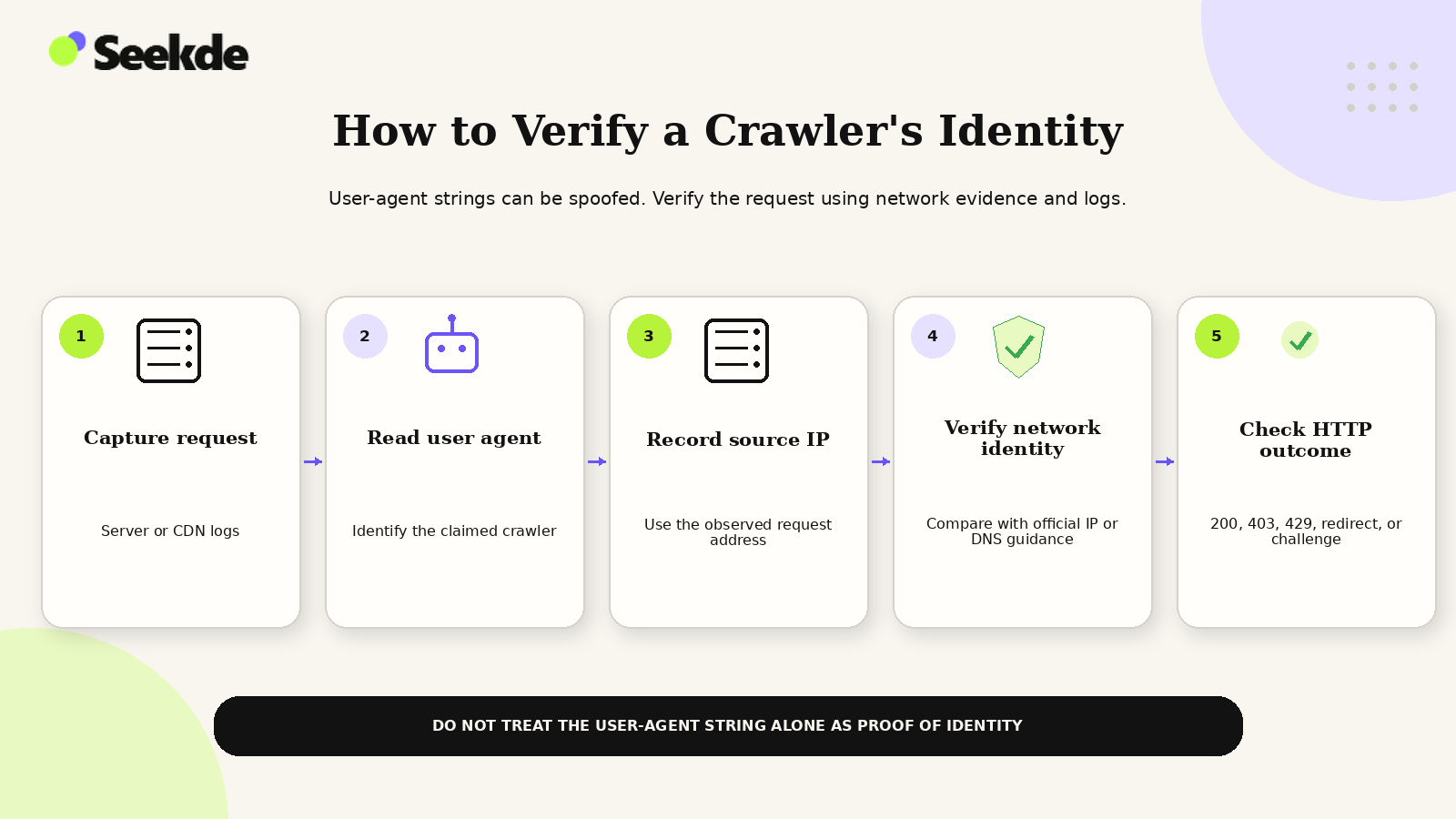
A common vulnerability in web server operations is relying solely on the incoming User-Agent HTTP header to identify search engines. Malicious scrapers, content scrapers, and automated exploit tools routinely spoof user-agent strings like Googlebot, OAI-SearchBot, or GPTBot to bypass standard firewall blocks.
Authoritative crawler verification requires cryptographic or network-level validation:
Matches Known AI User-Agent
- Extract Remote Client IP
- Execute
- Matche
- (e.g.
- s
- Yes
- Execute Forward DNS C
- Matches Client IP? I
- Yes No
- [VERIFIED] [SPOOFED]
Unrecognized Agent
- Apply Standard Security
- Reverse DNS Lookup
- s Verified Domain?
- , .googlebot.com,
- earch.openai.com)
- No
- heck Published IP Ranges
- P in Published JSON List?
- Yes No
- [VERIFIED] [SPOOFED]
Method 1: Two-Way Reverse DNS Lookup (rDNS)
Certain major search and AI providers support two-way reverse DNS verification, as documented in Google Search Central’s Verifying Googlebot Guide. This verification method confirms that the IP address originating the request maps to an authoritative domain owned by the provider, and that the domain resolves back to that same IP address. Providers supporting rDNS include Google (.googlebot.com), OpenAI (for OAI-SearchBot at search.openai.com and GPTBot at openai.com), Apple (.applebot.apple.com), and Microsoft Bing (.search.msn.com).
Step-by-Step CLI Verification
To verify a suspected Googlebot request originating from IP 66.249.66.1:
-
Run a reverse DNS query (
PTRrecord) on the IP address:host 66.249.66.1 # Output: 1.66.249.66.in-addr.arpa domain name pointer crawl-66-249-66-1.googlebot.com. -
Confirm the returned hostname ends with an authorized domain (
.googlebot.comor.google.com). -
Run a forward DNS query (
Arecord) on that returned hostname:host crawl-66-249-66-1.googlebot.com # Output: crawl-66-249-66-1.googlebot.com has address 66.249.66.1 -
If the forward IP matches the original client IP, the request is authentic. If the hostnames do not resolve, or resolve to a third-party host, the request is spoofed.
Similarly, authentic OAI-SearchBot requests resolve to hostnames within the search.openai.com domain, and authentic Applebot requests resolve to .applebot.apple.com.
Method 2: Validating Against Published IP Ranges
Because verification mechanisms are vendor-specific, administrators cannot apply a single universal rule to every crawler. Some providers publish machine-readable IP ranges, while others explicitly do not:
- OpenAI: Publishes official JSON feeds for
OAI-SearchBot(https://openai.com/searchbot.json),GPTBot(https://openai.com/gptbot.json), andChatGPT-User(https://openai.com/chatgpt-user.json). - Perplexity: Publishes dedicated crawler IP ranges for
PerplexityBotandPerplexity-Userwithin its official documentation. - Apple: Documents both reverse-DNS verification and published CIDR blocks in its official support guidelines.
- Google: Publishes official JSON feeds for Googlebot IP ranges at
https://developers.google.com/search/apis/ipranges/googlebot.json. - Microsoft Bing: Publishes IP ranges via the Bing Webmaster API and public JSON feeds.
- Anthropic: Anthropic provides a published source-IP list, noting that requests originating from IPs on that list indicate legitimate traffic from Anthropic. However, Anthropic explicitly emphasizes that IP blocking is not its recommended persistent opt-out mechanism; robots.txt is the documented standard for site owners to manage access.
How to Inspect Server Access Logs for AI Crawlers
Server access logs provide unvarnished, empirical evidence of how AI bots interact with your infrastructure. Analyzing these logs reveals whether bots are successfully fetching key pages, encountering 403 Forbidden blocks, or failing due to edge timeouts.
Parsing Access Logs via Command Line
For Apache, Nginx, or LiteSpeed servers using the standard Combined Log Format, you can extract crawler activity using standard terminal utilities.
Filter Requests by Crawler User-Agent
# Search access.log for OAI-SearchBot requests and output timestamp, status, and URL
grep "OAI-SearchBot" /var/log/nginx/access.log | awk '{print $4, $7, $9}' | head -n 20
Count Daily Crawl Requests by Bot Type
# Aggregate request volumes for major AI agents
egrep -o "(Googlebot|OAI-SearchBot|GPTBot|PerplexityBot|ClaudeBot)" /var/log/nginx/access.log | sort | uniq -c
Identify Edge Response Codes Served to AI Bots
# Check if GPTBot is receiving 403 Forbidden or 200 OK responses
grep "GPTBot" /var/log/nginx/access.log | awk '{print $9}' | sort | uniq -c
When evaluating log data, maintain technical discipline: a crawler request returning HTTP 200 confirms that the document was successfully transmitted to the bot’s egress client. It does not prove that the document was indexed, parsed into vector embeddings, or selected for synthesis.
Critical Distinction: Crawling vs. Indexing vs. Citation
A frequent misconception in technical AI optimization is equating crawl allowance with search visibility. Site operators often assume that because OAI-SearchBot or Googlebot accesses a page daily, that page is guaranteed to appear in generative answers.
In reality, web crawling is merely the baseline operational gate:
- Crawl Access (Eligibility Gate): The crawler must be allowed by robots.txt and WAF rules, receive an HTTP 200 status code, and fetch the payload within its latency window. If access is blocked here, the funnel terminates immediately.
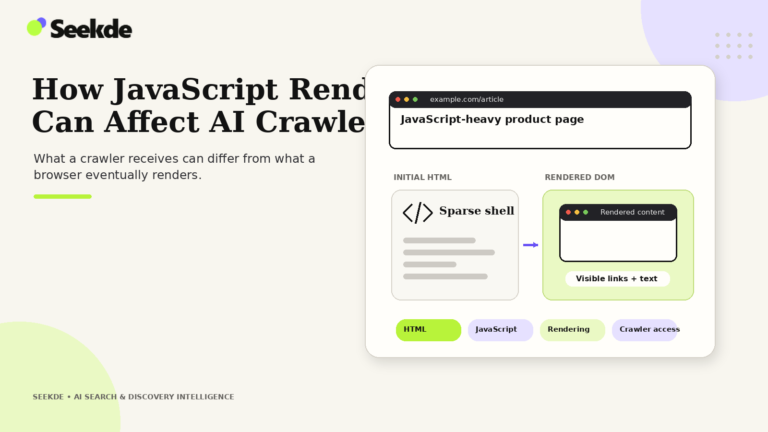
- Parsing & Ingestion: The crawler extracts visible text, metadata, and structured data. If content is trapped behind complex client-side scripts, some bots may fail to extract the text. See our analysis on JavaScript rendering and AI crawlers.
- Indexation & Vectorization: The engine evaluates page quality, authority, and factual density, storing relevant passages in its search index and embedding vectors.
- Retrieval: When a user inputs a query, the search engine executes query fan-out in AI search to identify candidate documents.
- Generative Synthesis & Citation: The language model evaluates the retrieved context passages for factual consistency and conciseness, selecting the top candidates to construct the generated response. Learn more about citation mechanics in How AI Search Engines Find and Cite Content.
Granting crawl access is an absolute prerequisite, but visibility is ultimately determined by content quality, topical authority, and factual clarity.
Edge and Firewall Governance: Beyond Robots.txt
Robots.txt operates as an advisory protocol under RFC 9309. It instructs cooperative user agents on which paths to avoid. However, infrastructure firewalls, Cloudflare bot protection, AWS WAF rules, and CDN security profiles operate at the network layer and evaluate incoming TCP/HTTPS connections before robots.txt directives are even read.
A common failure mode occurs when a site administrator allows OAI-SearchBot in robots.txt, but their edge CDN:
- Automatically issues a JavaScript challenge (e.g., Cloudflare Managed Challenge);
- Flags the crawler’s data center IP address as automated threat traffic;
- Enforces strict rate limits that terminate crawler connections with HTTP 429;
- Drops connections originating from non-residential autonomous system numbers (ASNs).
Because search crawlers and training scrapers do not interact with interactive JavaScript puzzles, any edge challenge returns an effective block (HTTP 403 or 503). To maintain visibility, infrastructure engineers must create explicit WAF bypass rules for verified AI search crawlers using reverse DNS hostname verification or official IP CIDR lists.
Decision Framework: Structuring Your Crawler Access Policy
Publishers should establish an explicit, documented policy for each crawler category. Rather than adopting an ad-hoc configuration, evaluate each bot against organizational objectives:
Do you want search traffic & AI citations?
ChatGPT Search, Perplexity, Google AI Overviews
- IF YES: Allow Googlebot, OAI-SearchBot, Bingbot, PerplexityBot
- IF NO: Block Googlebot, OAI-SearchBot, Bingbot, PerplexityBot
Do you want content used to train LLMs?
Offline foundation model training & corpus scraping
- IF YES: Allow GPTBot, ClaudeBot; Disallow Google-Extended (training allowed)
- IF NO: Block GPTBot, ClaudeBot, Google-Extended (training blocked)
Strategic Policy Profiles
Profile A: Maximum AI Search Visibility with Training Opt-Out
Ideal for independent publishers, news organizations, and SaaS brands that rely on discovery traffic and citations, but do not license their archives for model pre-training:
- Search Crawlers: Allow
Googlebot,Bingbot,OAI-SearchBot,PerplexityBot,Claude-SearchBot. - Training Scrapers: Disallow
GPTBot,ClaudeBot,Google-Extended,Applebot-Extended. - Implementation: Detailed in How to Configure Robots.txt for AI Search Crawlers.
Profile B: Complete Open Web Indexing
Ideal for open-source documentation, public research institutions, and promotional marketing portals:
- Search Crawlers: Allowed across all endpoints.
- Training Scrapers: Allowed across all endpoints.
- Maintenance: Focus primarily on server capacity and rate-limiting controls to prevent crawler-induced denial-of-service.
Profile C: Strict Paywall and Proprietary Data Protection
Ideal for subscription publishers, private databases, and sensitive enterprise content:
- Search Crawlers: Restricted to public preview and landing pages; disallowed across protected document libraries.
- Training Scrapers: Globally disallowed via robots.txt and blocked at the edge WAF layer.
- Authentication: Enforce server-side session authentication (OAuth, bearer tokens) rather than relying exclusively on robots.txt.
Summary Checklist for Technical Crawler Management
To maintain healthy technical discoverability across AI search ecosystems:
- Inventory User Agents: Classify every bot accessing your server into search discovery, user-fetcher, or training scraper categories.
- Review Robots Directives: Verify that your robots.txt file explicitly addresses
OAI-SearchBot,GPTBot,Google-Extended, andPerplexityBotaccording to corporate policy. - Verify Edge WAF Rules: Ensure CDN bot management tools do not issue JavaScript challenges to verified search crawlers.
- Audit Access Logs Regularly: Inspect raw HTTP status codes served to AI user agents to detect unexpected 403 or 429 errors.
- Implement Two-Way DNS Verification: Use automated rDNS scripts to confirm that incoming crawler traffic originates from verified vendor infrastructure.
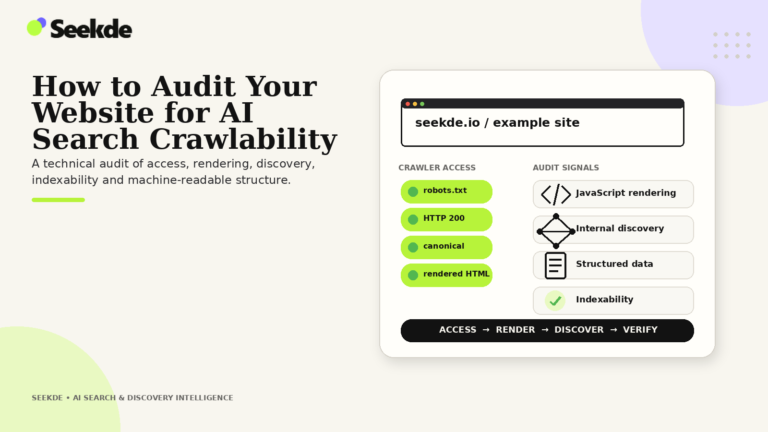
- Conduct End-to-End Audits: Periodically run a complete AI search crawlability audit to ensure new code releases have not introduced rendering or accessibility bottlenecks.