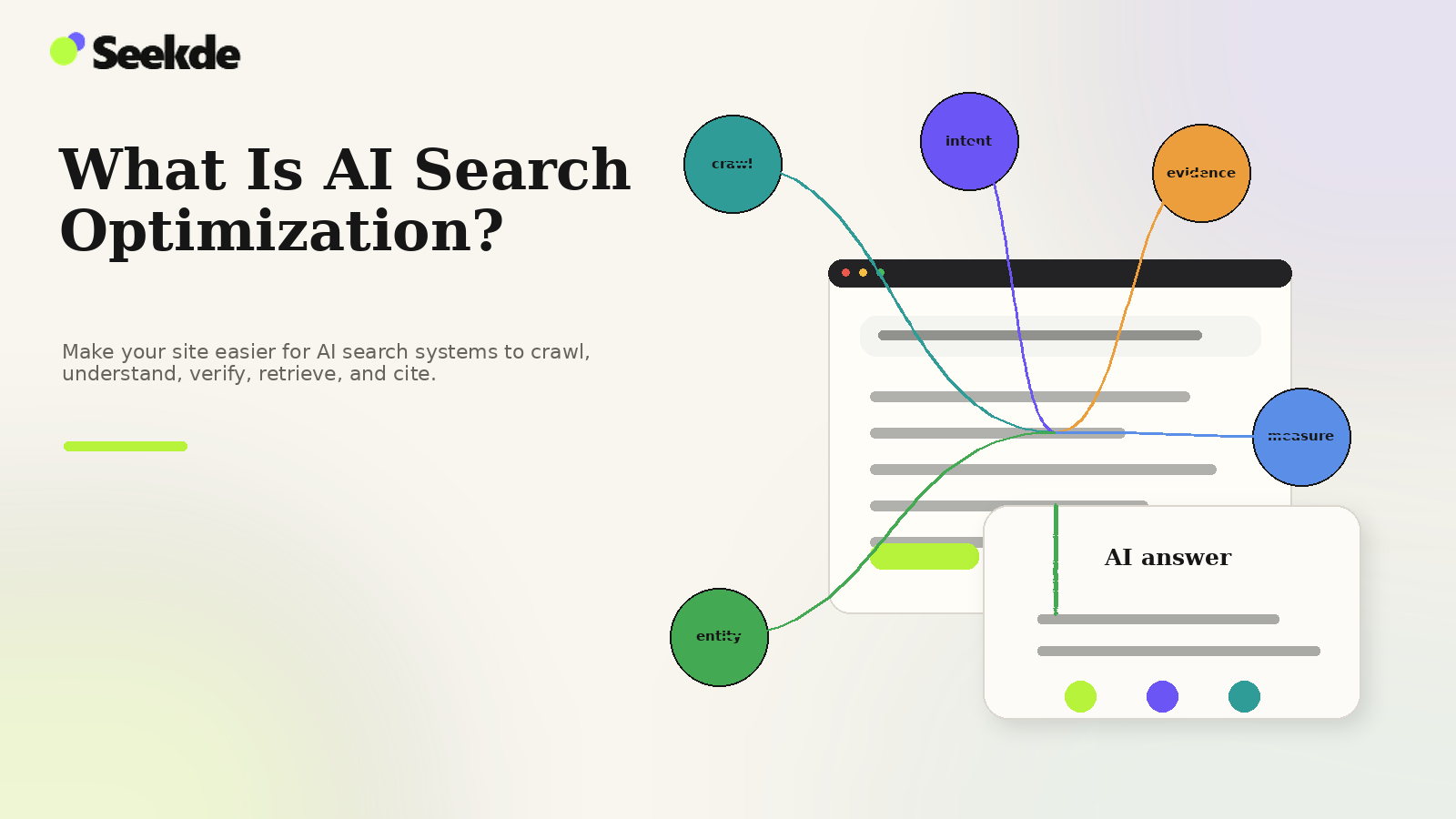
AI search optimization is the practice of making a website easier for AI search systems to crawl, understand, verify, retrieve, and cite. It combines technical accessibility with intent-focused content, reliable evidence, consistent entity signals, and cross-platform measurement so a brand can earn visibility in generated answers as well as traditional search.
As an overarching umbrella term, AI search optimization encompasses practitioner disciplines like Generative Engine Optimization (GEO) and Answer Engine Optimization (AEO), bridging tactical search execution with enterprise digital growth strategy.
For Chief Marketing Officers (CMOs) and digital growth leaders, AI search optimization represents a fundamental shift in how organizations think about discovery. In the legacy search landscape, marketing teams optimized web pages to rank for isolated, fragmented keywords on static search engine result pages. In modern AI search, users interact with intelligent agents through multi-turn, conversational dialogues, seeking direct recommendations, comparative analyses, and personalized solutions.
To succeed in this environment, businesses should look beyond traditional keyword search volumes and focus on entity authority, factual verifiability, and model presence.
The Shift From Keyword Matching to Intent Resolution
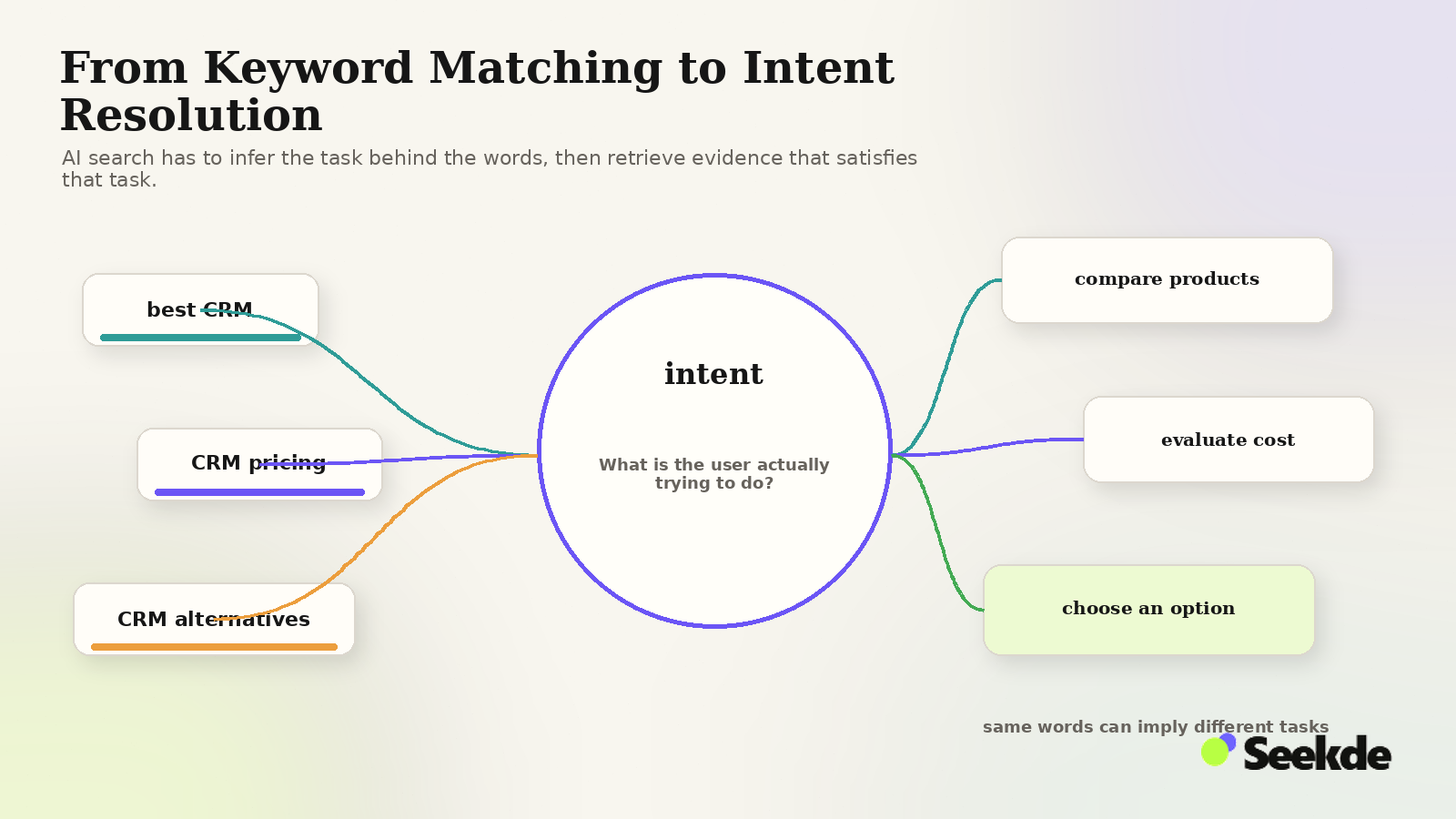
The transition to AI search transforms the consumer decision journey:
- From Disjointed Keywords to Natural Queries: Searchers no longer type "best project management software enterprise"; they submit complex, multi-constraint prompts: "Compare top 3 enterprise project management tools for a remote engineering team of 200, highlighting Jira integrations and SOC2 compliance."
- From Link Clicks to Immediate Answers: Rather than visiting five separate websites and aggregating facts manually, the user consumes an AI-synthesized evaluation directly inside the conversational interface.
- From Linear Funnels to Interactive Research: Users ask follow-up questions, request deeper clarifications, and challenge recommendations in real time.
This transition alters the referral economics of the open web, as analyzed in our study of the macro transition from links to answers. To maintain digital visibility, organizations must ensure their capabilities, pricing, and independent customer evidence are readily available to the background retrieval systems that feed AI engines.
The Seekde 5-Layer AI Search Readiness Framework
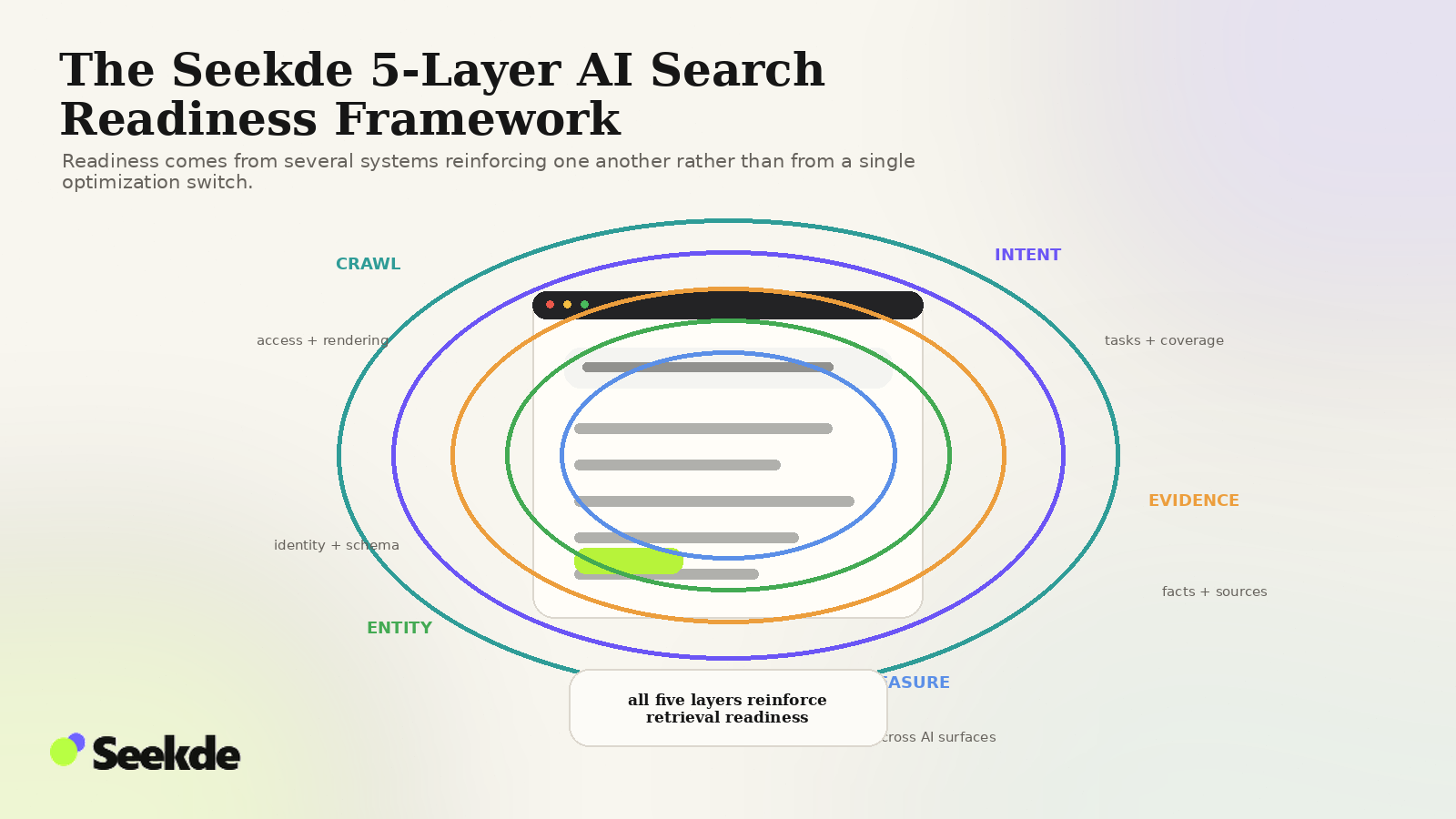
To help enterprise marketing and technology teams evaluate their readiness for conversational discovery, Seekde organizes AI search optimization into five operational layers:
| Layer | Operational Focus |
|---|---|
| Layer 5: Observation & Measurement | Prompt tracking & citation share |
| Layer 4: Entity Consistency & Schema | Organization schema & structured identity |
| Layer 3: Factual Verifiability | Original data, benchmarks, specs |
| Layer 2: Intent Resolution | Problem-to-solution task mapping |
| Layer 1: Technical Infrastructure | Bot access, rendering, canonical |
Layer 1: Technical Infrastructure & Crawler Access
For any specific AI search experience relying on live web retrieval, content discovery depends on the crawler access and rendering pathways of that underlying platform. This involves understanding the diverse crawler ecosystem:
- Search Engine Spiders: Standard crawlers like Googlebot and Bingbot remain foundational because platforms like Google AI Overviews and Microsoft Copilot rely on their core web indexes.
- Dedicated AI Search Crawlers: OpenAI operates OAI-SearchBot specifically for web navigation and search discovery in ChatGPT Search, separating it from
GPTBot(which crawls web data for model training). Similarly, Perplexity relies onPerplexityBotfor live web grounding. - Reliable Rendering Practices: Delivering critical product specifications, comparison tables, and pricing parameters in clean server-side HTML is a recommended engineering practice. While crawler JavaScript execution capabilities vary across search platforms, server-delivered content minimizes the risk of execution timeouts, deferred rendering, or incomplete extraction during real-time retrieval passes.
Layer 2: Intent Resolution & Task Mapping
In legacy SEO, teams frequently built dozens of near-identical pages targeting slight keyword variations. Current search guidance, including Google’s documentation, emphasizes that publishers do not need separate pages for every potential query variation or fan-out path. Instead, content teams should prioritize comprehensive, people-first resources that resolve an entire user task—answering the core inquiry alongside natural follow-up questions.
Layer 3: Factual Verifiability & Original Data
Original empirical data can provide distinctive, verifiable facts for readers and retrieval systems. When an organization publishes original industry research, proprietary benchmarks, transparent technical methodologies, or detailed case studies with quantitative outcomes, it creates high-value factual nodes. In Seekde’s editorial framework, primary empirical evidence provides clear, extractable reference points for readers and answer systems evaluating non-commodity information.
Layer 4: Entity Consistency & Structured Identity
To be cited accurately as a solution in a given category, an organization must establish clear entity boundaries. This involves:
- Implementing consistent Schema.org markup (
Organization,SoftwareApplication,Product). Structured data likesameAslinks to authoritative public profiles supports machine-readable identity consistency across platforms, though it should not be described as a magical or dedicated AI-search ranking factor. - Maintaining consistent brand naming and product descriptions across third-party software review directories, industry publications, and corporate profiles.
- Establishing clear topical associations: ensuring your brand is consistently mentioned in conjunction with your core category terminology across independent web sources.
Layer 5: Cross-Platform Observation & Measurement
Traditional rank tracking tools cannot accurately measure AI search performance. Growth teams must implement multi-model observation:
- Monitoring brand mention rates and sentiment across Google AI Overviews, ChatGPT Search, Perplexity, and Copilot.
- Tracking source attribution: determining whether your official domain is cited, or whether third-party review platforms are acting as intermediary authorities.
- Utilizing first-party reporting where available, including Google Search Console’s Generative AI performance reporting.
Strategic Governance: E-E-A-T as a Quality Framework and Trust Model
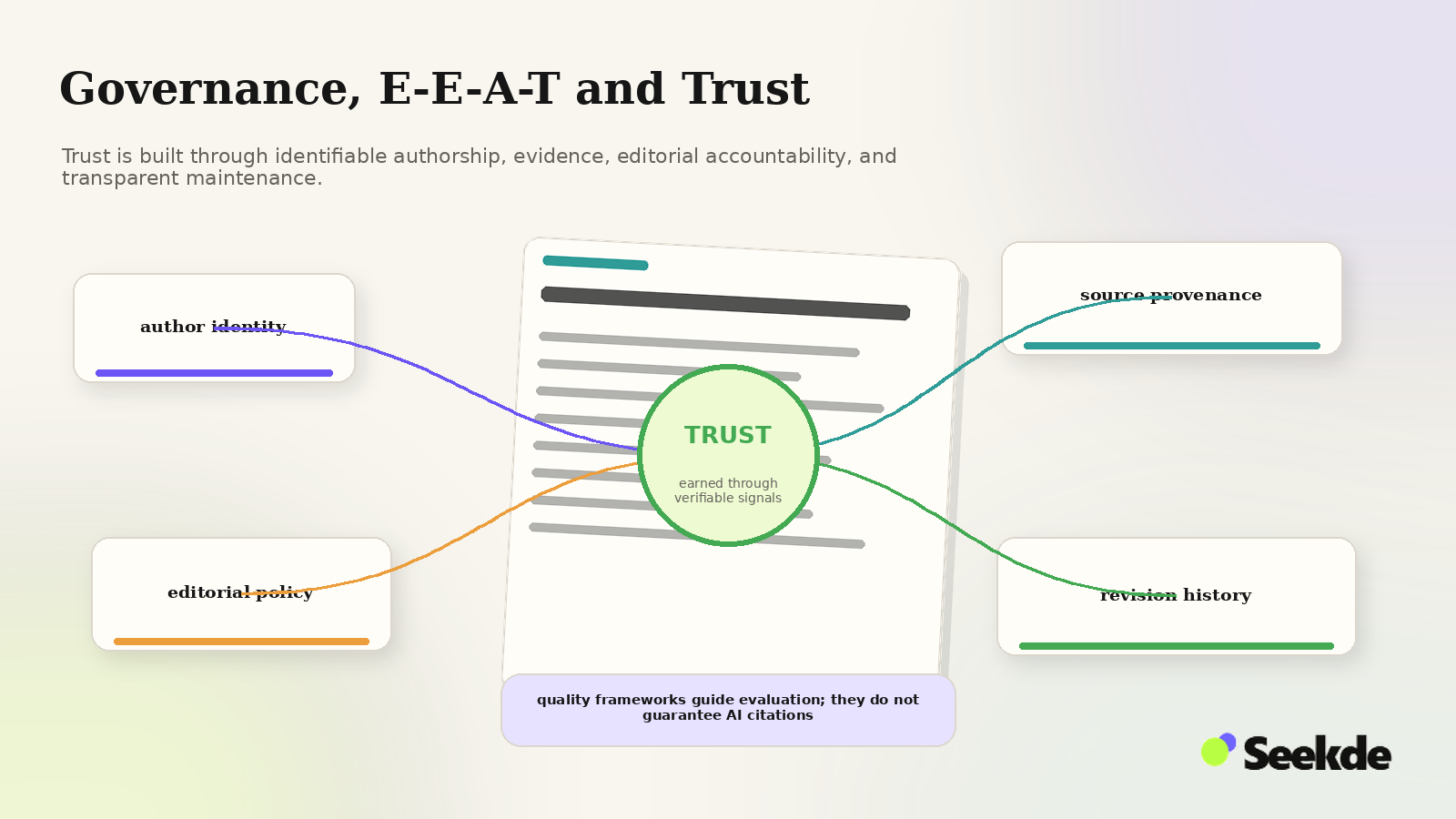
In search systems, Experience, Expertise, Authoritativeness, and Trustworthiness (E-E-A-T) functions not as a discrete automated ranking factor, but as an overarching search-quality evaluation framework and editorial trust model.
In an environment where low-quality, automated content can be generated at near-zero marginal cost, search evaluators and quality systems value content created by verifiable practitioners with demonstrable first-hand experience:
- Named Subject-Matter Experts: Every technical or medical guide should feature clear authorship credentials, professional backgrounds, and verifiable third-party profiles.
- Transparent Methodologies: When presenting data, disclose how metrics were gathered, sample sizes, and calculation methods, aligning with Seekde’s Research Methodology.
- Transparent Policy Disclosures: Prominently link to official governance policies, such as an institutional Source and Citation Policy and Corrections Policy.
Manipulative shortcuts—such as mass AI text generation without human review or hidden keyword injections—conflict with search quality guidelines and provide poor inputs for modern semantic retrieval architectures.
Conclusion: Building an Enterprise Discovery Engine
AI search optimization is not a replacement for traditional marketing fundamentals; it is the strategic evolution of search discovery.
By building on resilient technical infrastructure (Layer 1), resolving holistic user tasks (Layer 2), publishing verifiable original data (Layer 3), maintaining unambiguous entity identity (Layer 4), and monitoring multi-model performance (Layer 5), enterprises position their brands to capture high-intent discovery across the conversational web.