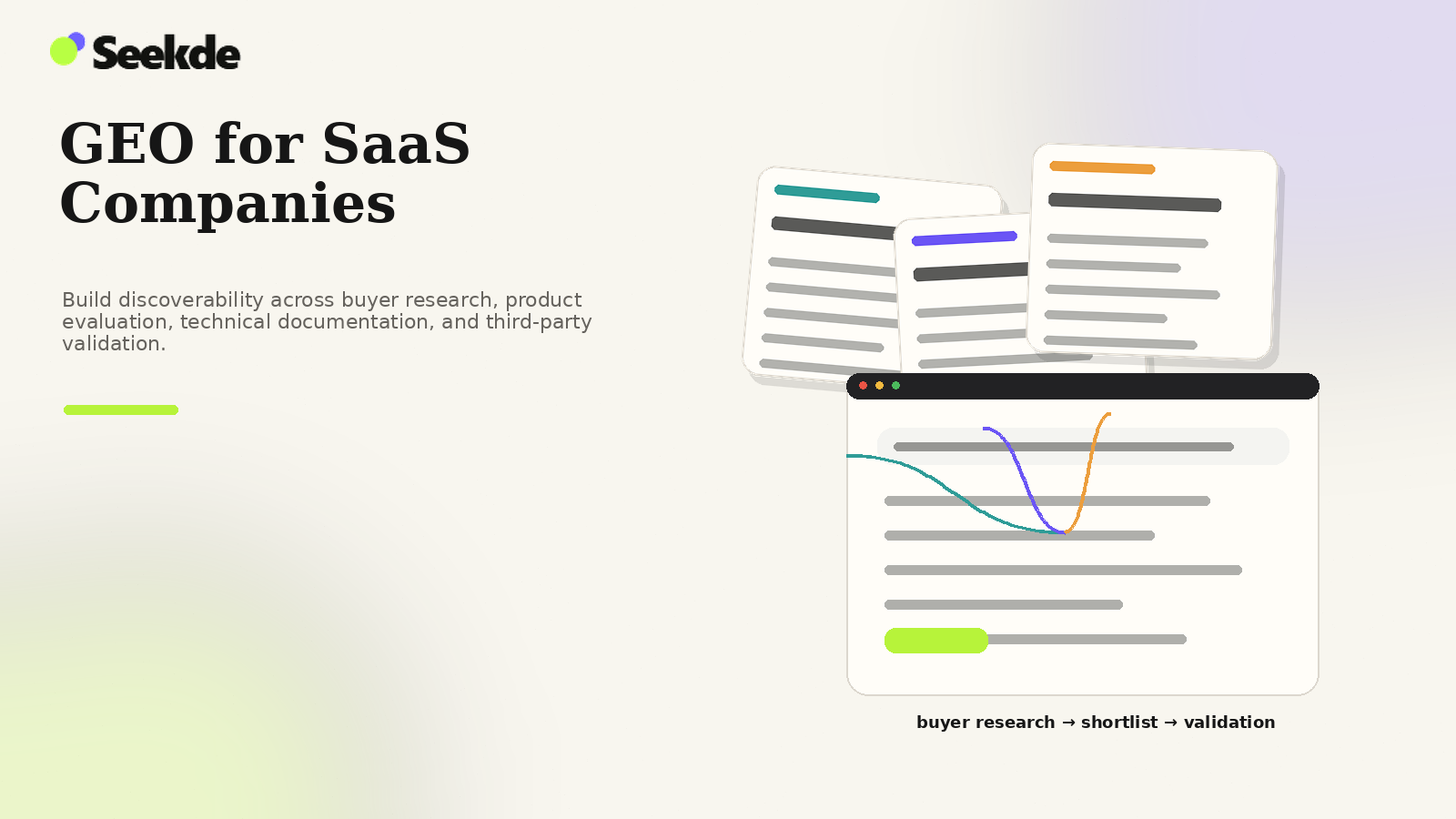
Generative Engine Optimization (GEO) for SaaS companies is the strategic practice of engineering software documentation, product architecture, technical content, and third-party review footprints so that conversational AI search engines accurately recommend and cite your software during buyer evaluation cycles. In the software-as-a-service industry, prospective buyers no longer navigate exclusively through Google’s traditional ten blue links to compile vendor shortlists. Instead, software buyers, developers, and enterprise procurement leaders increasingly query conversational answer engines—such as ChatGPT Search, Perplexity Sonar, Google AI Overviews, and Anthropic’s Claude—to compare feature specifications, evaluate API capabilities, and discover software alternatives.
When an engineering lead asks an answer engine: "What are the best SOC 2 compliance automation tools for AWS startups, and how do their pricing models compare?", the AI model does not simply rank homepages by domain authority. It executes multi-branch retrieval queries, ingests product documentation, extracts pricing tiers, analyzes user reviews from G2 and Capterra, and synthesizes a direct comparative answer.
If your SaaS company’s technical specifications, pricing models, and integration capabilities are hidden behind gated forms, dynamic JavaScript frameworks, or fragmented documentation, conversational models cannot parse your software entity. The AI will recommend your direct competitors while your brand remains completely invisible.
This comprehensive playbook provides enterprise and high-growth B2B SaaS organizations with an actionable, technical framework for dominating generative search discovery.
The SaaS Buyer Journey in Generative Search: The Four Decision Phases
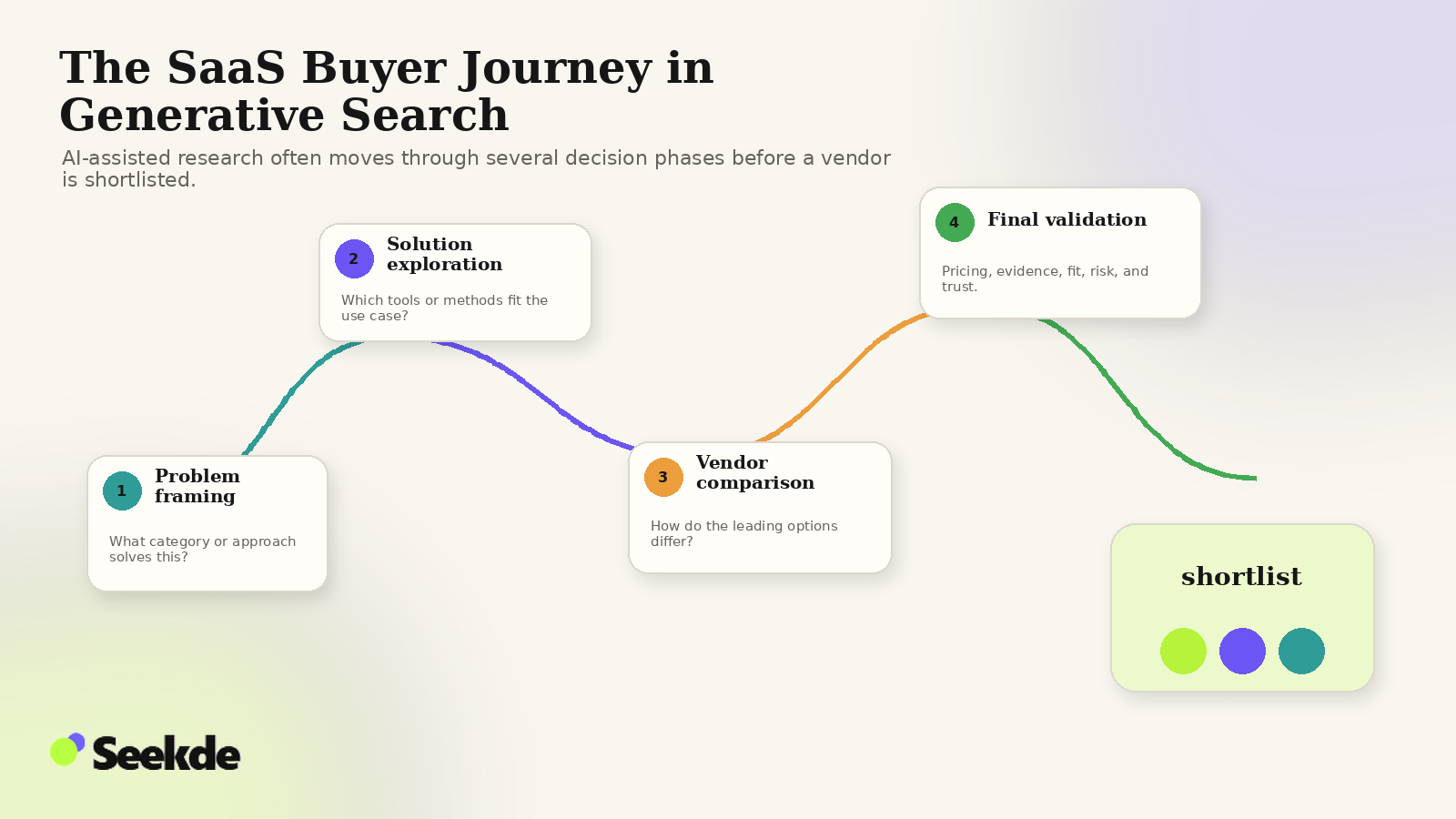
To optimize a software product for conversational engines, marketing and product teams must understand how generative search models process the SaaS buyer journey:
Example: "What tools automate continuous SOC 2 evidence collection on AWS?"
Example: "Which compliance automation tools have native Terraform integrations?"
Example: "Vanta vs Drata: Which has better API flexibility and transparent pricing?"
Example: "What is the typical enterprise implementation timeline and SLA commitment?"
Unlike traditional search, where a buyer might visit twelve different websites over three weeks, a conversational user frequently moves through all four phases within a single extended multi-turn chat session. If your product is omitted from the initial Phase 1 consideration set, you forfeit the entire procurement pipeline before the buyer ever visits a commercial website.
The SaaS AI Search Prompt Taxonomy
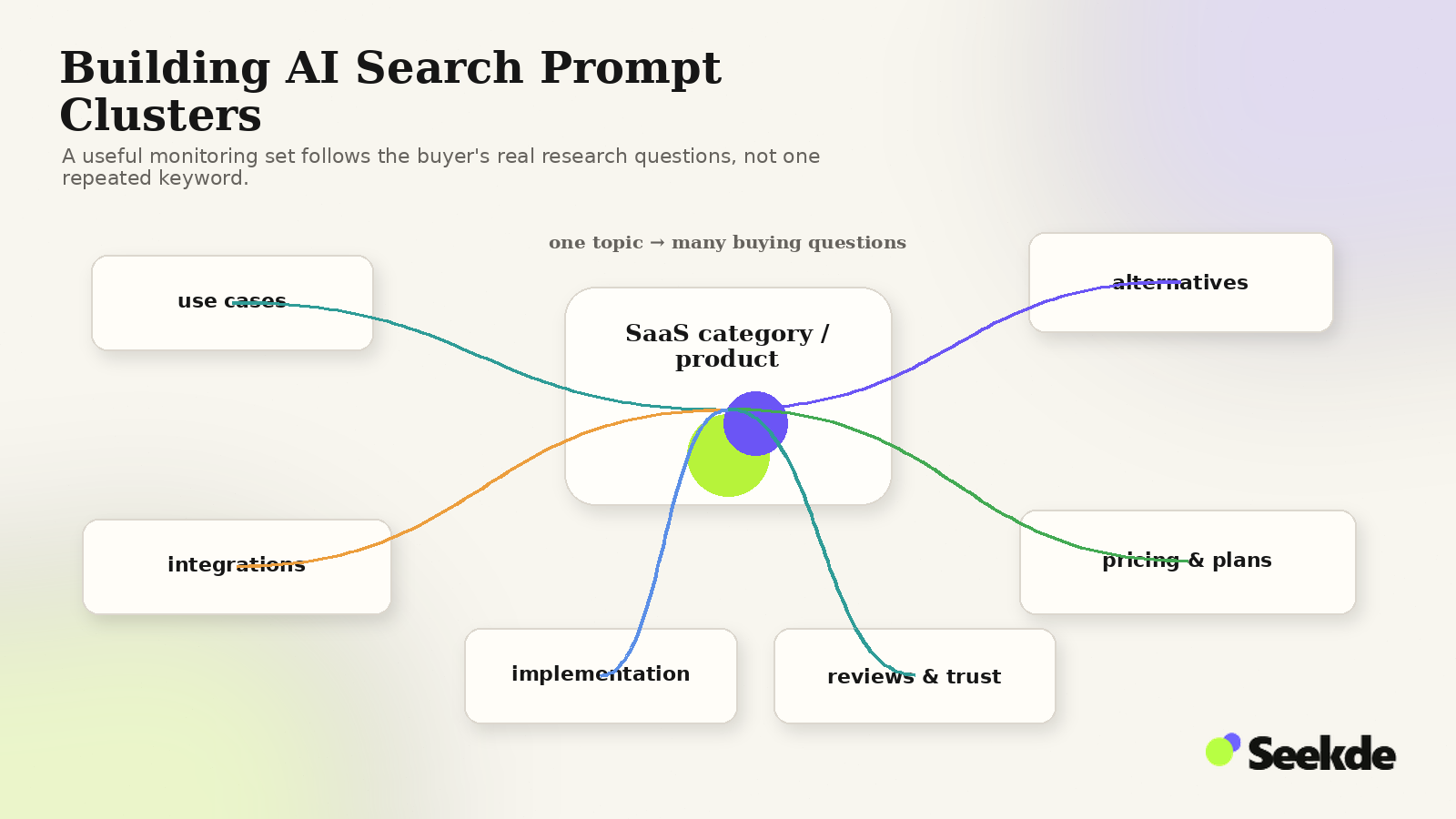
To systematically monitor and optimize brand visibility, SaaS companies must map their content assets against the SaaS Prompt Taxonomy—a five-tier framework categorizing the exact prompt patterns software buyers submit to AI search engines:
| Prompt Category | Intent Characteristics | Target Conversational Query | Primary Content Ingestion Surface |
|---|---|---|---|
| 1. Category Discovery | Unbranded informational queries seeking vendor shortlists within a defined functional vertical. | "What are the top enterprise tools for monitoring AI search visibility?" | Category landing pages, high-authority industry roundups, third-party review directories. |
| 2. Alternative / Displacement | Users seeking replacements for incumbent market leaders due to cost, complexity, or churn. | "What are the best affordable alternatives to Salesforce for mid-market tech?" | Dedicated /alternatives/ comparison pages, competitive migration hubs, community forums. |
| 3. Head-to-Head Comparison | Deep technical evaluations comparing two specific software products on features and pricing. | "Profound vs Peec AI: How do their prompt tracking features compare?" | Dedicated /vs/ comparison landing pages, feature-by-feature semantic tables. |
| 4. Integration & Tech Stack | Technical queries verifying whether a product functions within an existing corporate stack. | "Which feature flag tools support native Next.js server components and edge rendering?" | Developer documentation, API reference guides, integration directory pages. |
| 5. Pricing & Procurement | Highly sensitive commercial queries investigating licensing, seat tiers, and contract terms. | "How much does Snowflake cost per credit, and what are typical annual minimums?" | Transparent public pricing pages, tier sheets, contract calculators, changelogs. |
The Core SaaS Content Surfaces That Feed Generative Engines
Language models evaluate SaaS brands by synthesizing multiple distinct content surfaces across your web property and third-party ecosystems. Optimizing only your commercial marketing homepage is an operational error; models require deep technical grounding across five key asset layers:
Developer Docs & API Reference
- Ingested for code snippets, SDK params, and architectural specifications
Comparison Hubs (/vs/ Pages)
- Ingested by neural rerankers for consideration-stage buyer queries
Pricing & Tier Sheets
- Directly cited when prompts ask for seat costs and enterprise licensing
Changelogs & Release Notes
- Establishes crawler freshness and recency bias in multi-turn chats
Third-Party Review Nodes
- External consensus grounding from G2, Capterra, and Reddit discussions
1. Developer Documentation & Technical API Hubs
For technical SaaS products, developer documentation is often the single most cited surface in generative search. When software engineers query ChatGPT Search or Claude regarding API parameters, webhooks, rate limits, or SDK support, models retrieve direct passages from technical documentation portals (e.g., docs.domain.com).
- Optimization Imperative: Ensure documentation portals are rendered in clean, server-side HTML rather than heavy client-side JavaScript Single Page Applications (SPAs). As demonstrated in our guide on how JavaScript rendering affects AI crawlers, non-Google crawlers like
OAI-SearchBotoften bypass complex client-side JS. - Code Block Delimitation: Wrap code samples in semantic
<pre><code class="language-*">blocks with explicit language identifiers (python,bash,typescript).
2. Dedicated Comparison Hubs (/vs/ and /alternatives/ Pages)
Software buyers frequently prompt conversational engines to compare two products directly. If your website does not publish an objective, feature-by-feature comparison page, answer engines rely entirely on competitor-authored pages or outdated review aggregators.
- Optimization Imperative: Build dedicated
/vs/competitor-name/pages. Avoid biased marketing copy; generative engines heavily favor objective, balanced comparisons that acknowledge competitor strengths while highlighting your unique technical differentiators. - Semantic Comparison Tables: Present feature differences in clean HTML
<table>elements with descriptive column headers (Feature Dimension,Your Product,Competitor).
3. Transparent Pricing Pages & Tier Architecture
Pricing is one of the most volatile and frequently queried dimensions in SaaS procurement. When pricing is hidden behind mandatory sales demo gates, language models either report that pricing is "custom and opaque" or cite third-party Reddit threads with inaccurate, outdated estimates.
- Optimization Recommendation: Even if enterprise tiers involve custom sales quotes, publish clear baseline pricing, starting rates, billing units (per seat, per gigabyte, per API credit), and plan inclusions in crawlable HTML text.
- Temporal Anchoring: Explicitly label pricing tables with calendar dates: "Pricing verified and active as of Q1 2026".
4. Public Changelogs & Product Release Notes
Generative models frequently hallucinate that software lacks a feature simply because the model’s training data predates the feature’s release.
- Optimization Imperative: Maintain an indexable public changelog (
/changelog/or/releases/) with ISO date timestamps (YYYY-MM-DD). - Entity Specificity: Explicitly name new features, integrations, and supported platforms in standalone, propositional paragraphs that search crawlers can ingest to update their knowledge base.
5. Third-Party Software Review Nodes (G2, Capterra, TrustRadius)
Large language models ingest customer sentiment and feature ratings from authoritative software review directories during both offline pre-training and real-time RAG grounding.
- Optimization Imperative: Maintain active, claimed vendor profiles across G2, Capterra, Gartner Peer Insights, and TrustRadius. Ensure category tags, product descriptions, and feature checklists match your website’s canonical entity statement.
Technical GEO Architecture for SaaS: Entity Markup & Crawl Governance
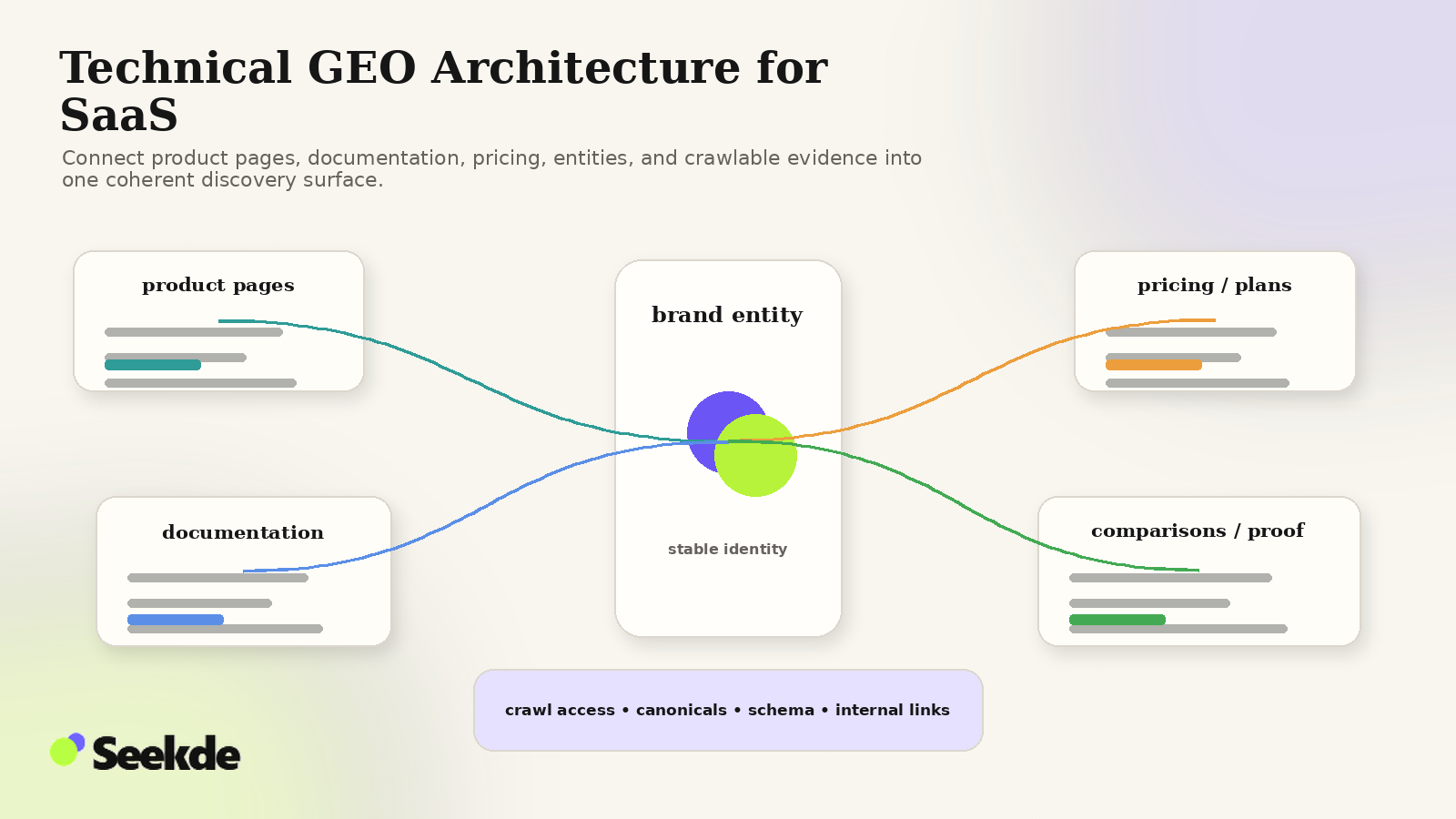
Beyond content drafting, SaaS companies must implement technical infrastructure to ensure reliable ingestion by AI crawlers:
1. SoftwareApplication JSON-LD Schema
Deploy rich SoftwareApplication or WebApplication structured data on your homepage and product pages, declaring core capabilities, operating systems, and pricing:
{
  "@context": "https://schema.org",
  "@type": "SoftwareApplication",
  "name": "Seekde",
  "operatingSystem": "All Web Platforms",
  "applicationCategory": "BusinessApplication",
  "url": "https://seekde.io",
  "description": "AI search visibility and answer engine intelligence platform providing prompt monitoring, citation tracking, and crawl log analytics.",
  "offers": {
    "@type": "Offer",
    "price": "0",
    "priceCurrency": "USD",
    "description": "Interactive Public Preview"
  },
  "featureList": [
    "AI Search Prompt Monitoring",
    "Citation Tracking",
    "Bot Log Analytics",
    "Share of Voice Modeling"
  ]
}
2. Robots.txt Crawler Access Policies
Ensure your robots.txt configuration reflects modern AI search discovery standards (as detailed in our guide to robots.txt for AI search crawlers):
- Explicitly permit search discovery bots (
Googlebot,OAI-SearchBot,Claude-SearchBot,PerplexityBot) across all documentation and public product marketing pages. - Isolate foundation model training scrapers (
GPTBot,ClaudeBot) if corporate copyright policies require opting out of model pre-training datasets.
# Seekde Recommended SaaS Robots.txt Ruleset
User-agent: *
Disallow: /app/
Disallow: /api/internal/
Disallow: /admin/
Allow: /docs/
Allow: /changelog/
Allow: /pricing/

User-agent: OAI-SearchBot
Allow: /

User-agent: Claude-SearchBot
Allow: /

User-agent: PerplexityBot
Allow: /
Use-Case Pages and Customer Support Documentation as Citation Engines
Beyond core product marketing and API references, high-growth SaaS organizations must optimize two frequently neglected content surfaces that generative engines heavily consult: Use-Case Landing Pages and Customer Support / Knowledge Base Documentation.
1. The Role of Vertical Use-Case Landing Pages
When prospective enterprise buyers evaluate software, they rarely search for generic software categories alone. Instead, they frame queries around specific operational workflows or industry-specific compliance requirements:
- "How do healthcare telemedicine platforms manage HIPAA-compliant video storage?"
- "Best billing and revenue recognition software for usage-based developer tools"
To capture these conversational evaluation queries, SaaS websites must build dedicated Use-Case Landing Pages (/solutions/healthcare-hipaa/, /use-cases/usage-based-billing/):
- Propositional Problem Framing: Avoid high-level marketing claims. State the exact regulatory or technical bottleneck the software resolves within the first 60 words.
- Workflow Architecture Diagrams: Include machine-readable step-by-step ordered lists outlining the data flow from ingestion to output.
- Integration Specificity: Enumerate the exact partner tools, EHR systems, or cloud databases the software natively connects with. Language models rely on these explicit noun pairings to verify solution compatibility.
2. Knowledge Base & Customer Support Documentation
When software buyers encounter technical friction or evaluate migration complexity, they query conversational answer engines about known product limitations, workarounds, and configuration steps:
- "Does Snowflake support automatic clustering on hybrid tables?"
- "How to configure SAML single sign-on in Datadog with Okta"
Support articles, setup guides, and troubleshooting documentation are indexed by search engines with high crawl frequency. If your knowledge base is publicly accessible, RAG retrieval agents extract direct technical solutions from your help docs and cite your domain as the definitive authority.
- Troubleshooting Table Architecture: Structure support articles with clear semantic tables linking symptoms, root causes, and terminal commands or configuration fixes.
- Eliminate Password Gates on Technical FAQs: Gating customer support behind Zendesk or Intercom user logins conceals your technical solutions from search crawlers, forcing models to cite community forums or Reddit threads instead.
Branded vs. Non-Branded Conversational Prompt Dynamics for SaaS
In traditional SEO, the boundary between branded queries ("Asana pricing") and non-branded queries ("project management software") was discrete. In generative artificial intelligence search, conversational prompts blur these distinctions through multi-turn dialogue:
"What are the best agile project tracking tools for software teams?"
"How does Asana handle sprint capacity planning compared to Jira?"
"Does Asana support custom GitHub webhook automation without Zapier?"
"What is the total cost for 50 users on Asana Enterprise vs Jira Cloud?"
Optimizing for the Multi-Turn Conversational Continuum:
- Defending the Branded Entity (Turns 2 & 4): Ensure that when your brand is explicitly named, the conversational engine retrieves primary facts directly from your website rather than third-party review scrapers. This calls for unambiguous pricing documentation, complete feature specs, and active changelogs.
- Winning the Unbranded Consideration Set (Turn 1): Unbranded category visibility relies on widespread third-party co-occurrence across industry listicles, digital PR coverage, and high-density educational guides.
- Winning the Constraint Pivot (Turn 3): When a user filters by a specific technical constraint ("custom GitHub webhook automation"), the model executes a secondary fan-out query. The vendor that publishes a detailed, indexable technical guide on that exact feature wins the citation and displacement recommendation.
Third-Party Reputation Management: Mitigating Negative Sentiment in AI Responses
Large language models evaluate third-party sentiment across review aggregators (G2, Capterra, TrustRadius, Gartner Peer Insights) and discussion forums (Reddit, Hacker News). When an AI search engine recommends your software, it frequently incorporates common user criticisms into the response:
"While [Platform Name] is praised for its intuitive interface and rapid deployment, users frequently cite steep renewal price increases and slow customer support response times as drawbacks."
To protect conversational brand reputation, SaaS marketing teams must implement active third-party reputation governance:
- Systematic Review Ingestion Auditing: Regularly sample commercial recommendation prompts in ChatGPT Search and Perplexity to identify recurring negative sentiment themes.
- Targeted Addressing of Product Criticisms: If models repeatedly claim your software lacks a feature that was recently launched, publish an explicit comparison article or changelog update addressing the historical limitation directly.
- Review Platform Optimization: Actively encourage satisfied enterprise customers to leave detailed, balanced reviews on G2 and Capterra, specifically highlighting implementation speed, enterprise security, and responsive customer support to balance historical critique.
The SaaS GEO Execution Checklist
Use this 12-point audit checklist to evaluate your software platform’s generative discoverability:
- [ ] 1. Public Documentation Crawlability: Are your developer guides and API references rendered in crawlable HTML without mandatory logins?
- [ ] 2. Competitor
/vs/Hubs Active: Do you maintain objective, feature-by-feature comparison pages against your top 5 direct competitors? - [ ] 3. Transparent Pricing Documentation: Does your website publish clear baseline pricing, billing metrics, and plan tiers in machine-readable text?
- [ ] 4. Active Public Changelog: Do you maintain a dated product release log that documents new integrations and capabilities?
- [ ] 5. SoftwareApplication Schema: Is valid JSON-LD
SoftwareApplicationmarkup deployed on core product pages? - [ ] 6. Claimed Review Ecosystem: Are your vendor profiles on G2, Capterra, and TrustRadius fully claimed and updated with canonical category tags?
- [ ] 7. Robots.txt Verification: Does your server configuration explicitly allow
OAI-SearchBot,Claude-SearchBot, andPerplexityBot? - [ ] 8. Standalone Proposition Density: Are product descriptions written with autonomous, entity-dense sentences that can be extracted in isolation?
- [ ] 9. Semantic Comparison Tables: Are technical feature matrices structured in native HTML
<table>elements with explicit headers? - [ ] 10. Systematic Prompt Monitoring: Does your marketing team track multi-model brand presence across a standardized SaaS prompt set?
- [ ] 11. Public Knowledge Base Access: Are customer support articles and technical FAQs indexable without login barriers?
- [ ] 12. Multi-Turn Consideration Defense: Do you maintain targeted content assets answering technical constraint prompts and migration queries?
Illustrative Case Architecture: How a B2B SaaS Dominates AI Answer Cards
To understand how these principles operate in a production environment, examine this illustrative architectural model of an enterprise DevOps software platform optimizing for generative citations:
"What are the best Kubernetes cost optimization tools for AWS EKS?"
RAG crawler retrieves /docs/integrations/aws-eks/, ingests semantic table, and cross-references reviews.
Generative model synthesizes concise recommendation highlighting automated pod-level cost allocation.
Prominent clickable citation card awarded to primary vendor documentation.
By providing deep, accessible technical documentation paired with clear entity signals, the SaaS platform earns a primary recommendation and an authoritative referral citation.
Summary: The New Frontier of Software Discoverability
In the modern software market, software buyers conduct extensive technical due diligence before ever contacting a sales representative. If conversational AI assistants cannot find, understand, and verify your product’s capabilities, your sales pipeline will dry up silently.
By architecting your developer documentation for machine extraction, publishing objective comparison hubs, maintaining transparent pricing data, and implementing structured schema markup, SaaS companies transform their web properties into authoritative, permanent knowledge anchors across the generative AI ecosystem.
Related guides
- GEO for Ecommerce Websites: Vertical Playbook
- AI Search Optimization for Publishers
- AI Search Visibility for SEO Agencies: Operating Playbook
- What Is Generative Engine Optimization (GEO)?
- How to Create Content AI Search Engines Can Cite
- How JavaScript Rendering Can Affect AI Crawlers
- How to Configure Robots.txt for AI Search Crawlers
- Best AI Search Visibility Tools (forthcoming comparative review)