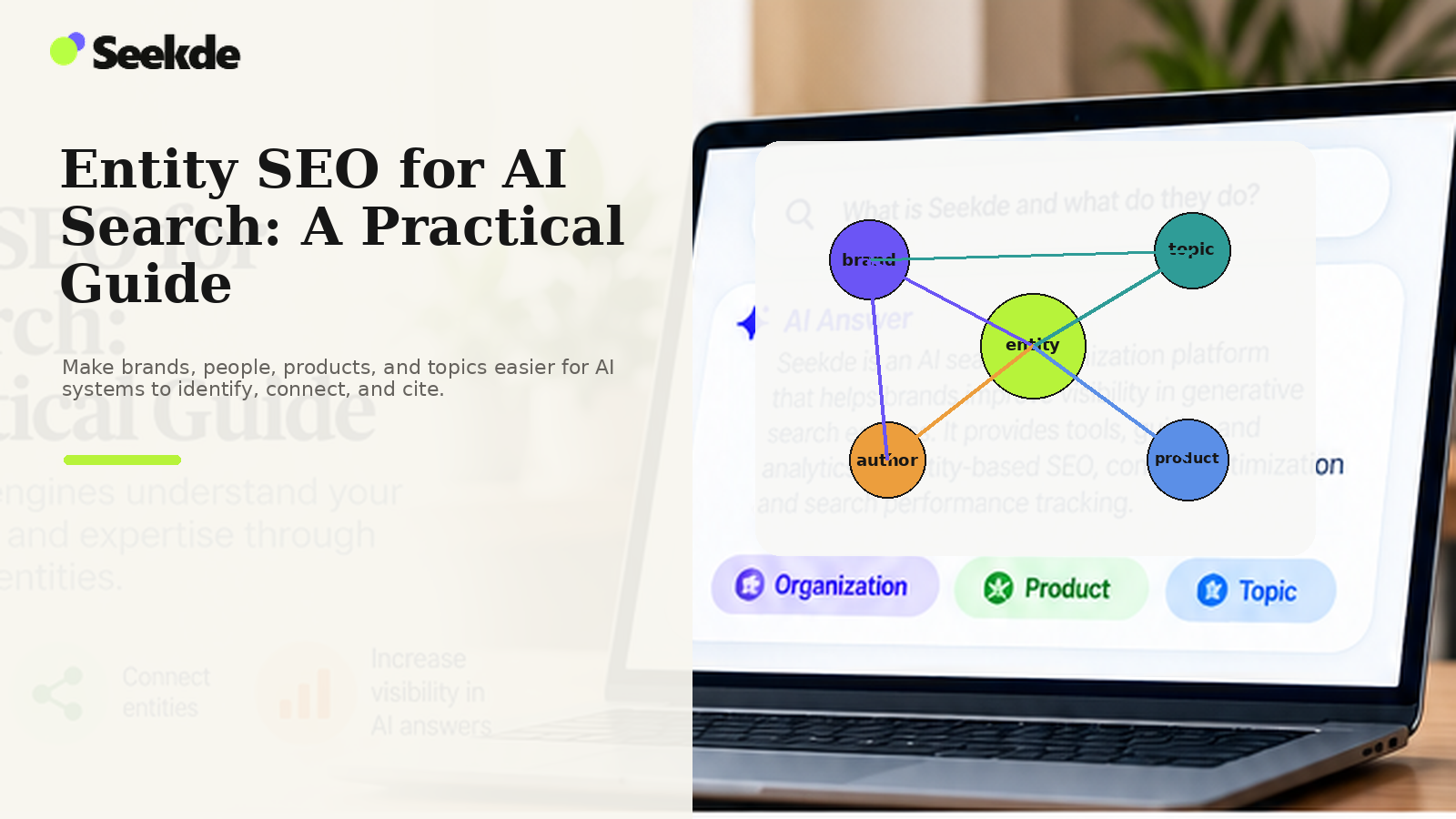
Entity SEO for AI search is the practice of defining, disambiguating, and reinforcing machine-readable concepts, brands, products, and experts across knowledge graphs and retrieval embeddings. Traditional search optimization focused on matching strings of text to user search queries. Generative artificial intelligence engines—such as Google AI Overviews, Perplexity, ChatGPT Search, and Microsoft Copilot—do not operate on raw keyword strings. They operate on entities: distinct, uniquely identifiable people, organizations, places, products, or concepts defined by their attributes and relationships within a semantic web graph.
When a user submits a conversational prompt to an answer engine, the underlying model resolves the prompt into known entities before retrieving passages from the web. If your brand or product is recognized as an unambiguous entity with verified relationships to specific topics, the engine can confidently synthesize your perspectives, cite your website, and recommend your offerings. If your entity footprint is fragmented, conflicting, or absent from knowledge repositories, conversational engines either conflate your brand with competitors or ignore your content entirely to avoid hallucination.
Building a resilient entity footprint calls for a disciplined, multi-surface optimization strategy combining structured data markup, third-party knowledge graph reconciliation, and entity-salience content engineering.
Strings to Things: How AI Search Systems Understand Entities
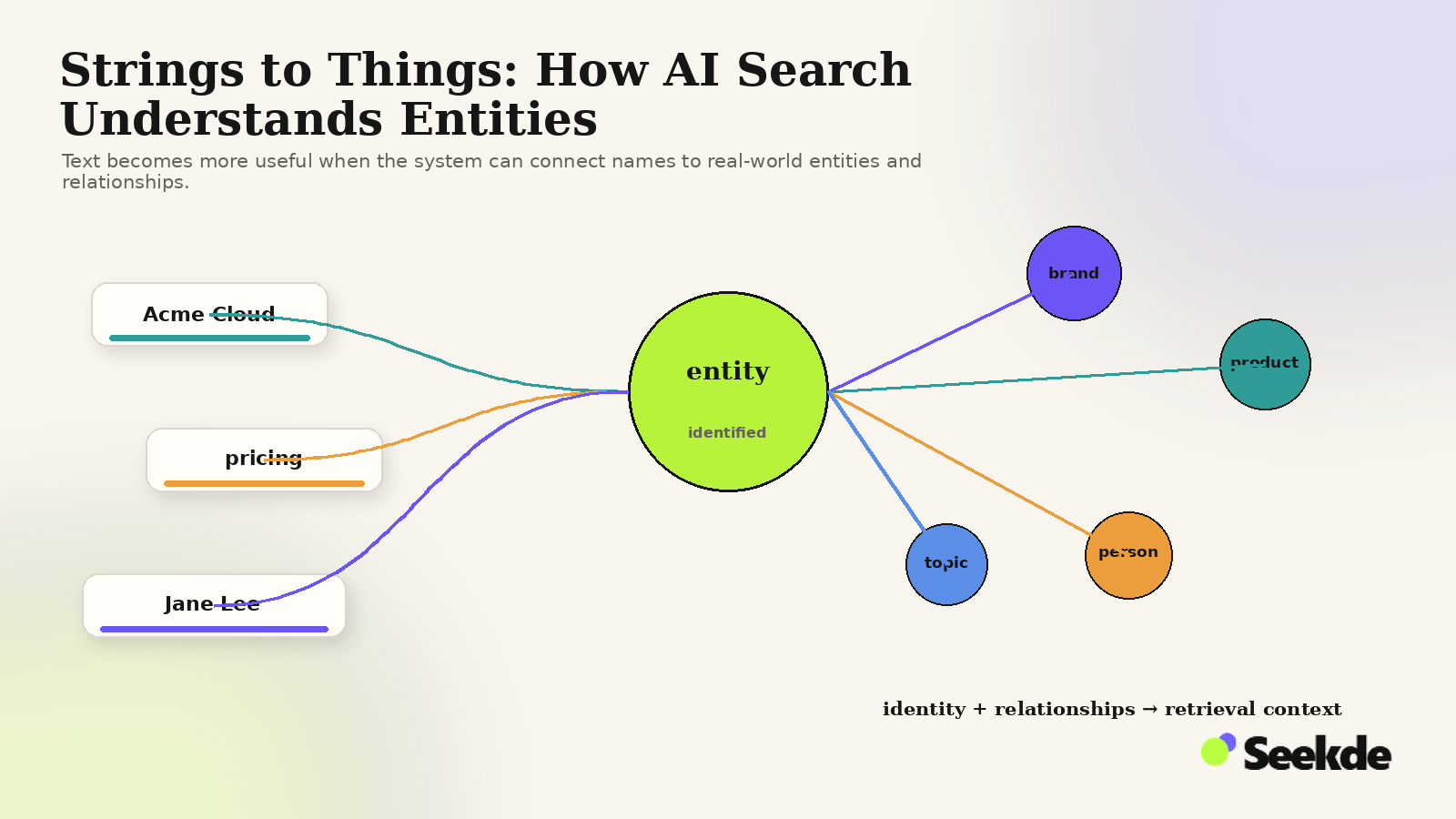
The conceptual shift from keyword matching to entity understanding is often described by Google as moving from "strings to things". In a modern AI search pipeline, entities serve as the foundational scaffolding for retrieval and answer synthesis:
- Entity Extraction and Named Entity Recognition (NER): Natural language processing models parse user prompts and web text to identify proper nouns, products, and technical concepts.
- Disambiguation: If a brand shares a name with a geographic location, a biological organism, or an unrelated business, the model analyzes contextual co-occurrences to determine the correct entity ID.
- Knowledge Graph Traversal: The engine queries authoritative knowledge bases (such as Google Knowledge Graph, Wikidata, DBpedia, and Crunchbase) to verify the entity’s attributes (founder, headquarters, parent company, industry category).
- Entity-Salience Scoring: Rather than counting keyword frequency, algorithms measure how central an entity is to the core proposition of a web document. A page where an entity appears as the primary subject scores higher than a page where the entity is mentioned as an incidental footnote.
When answer engines generate comparison cards or authoritative definitions, they ground their answers in entity attributes verified across multiple external knowledge graphs.
(Note: Generative search engines do not rely on a single, shared knowledge graph. Major platforms maintain distinct proprietary entity databases—such as Google’s Knowledge Graph or Bing’s entity repository—alongside third-party reference ontologies like Wikidata. The entity alignment techniques described below reflect Seekde’s recommended methodology for maximizing cross-platform consistency rather than an official standard mandated by all vendors.)
The Seekde Entity Consistency & Disambiguation Framework
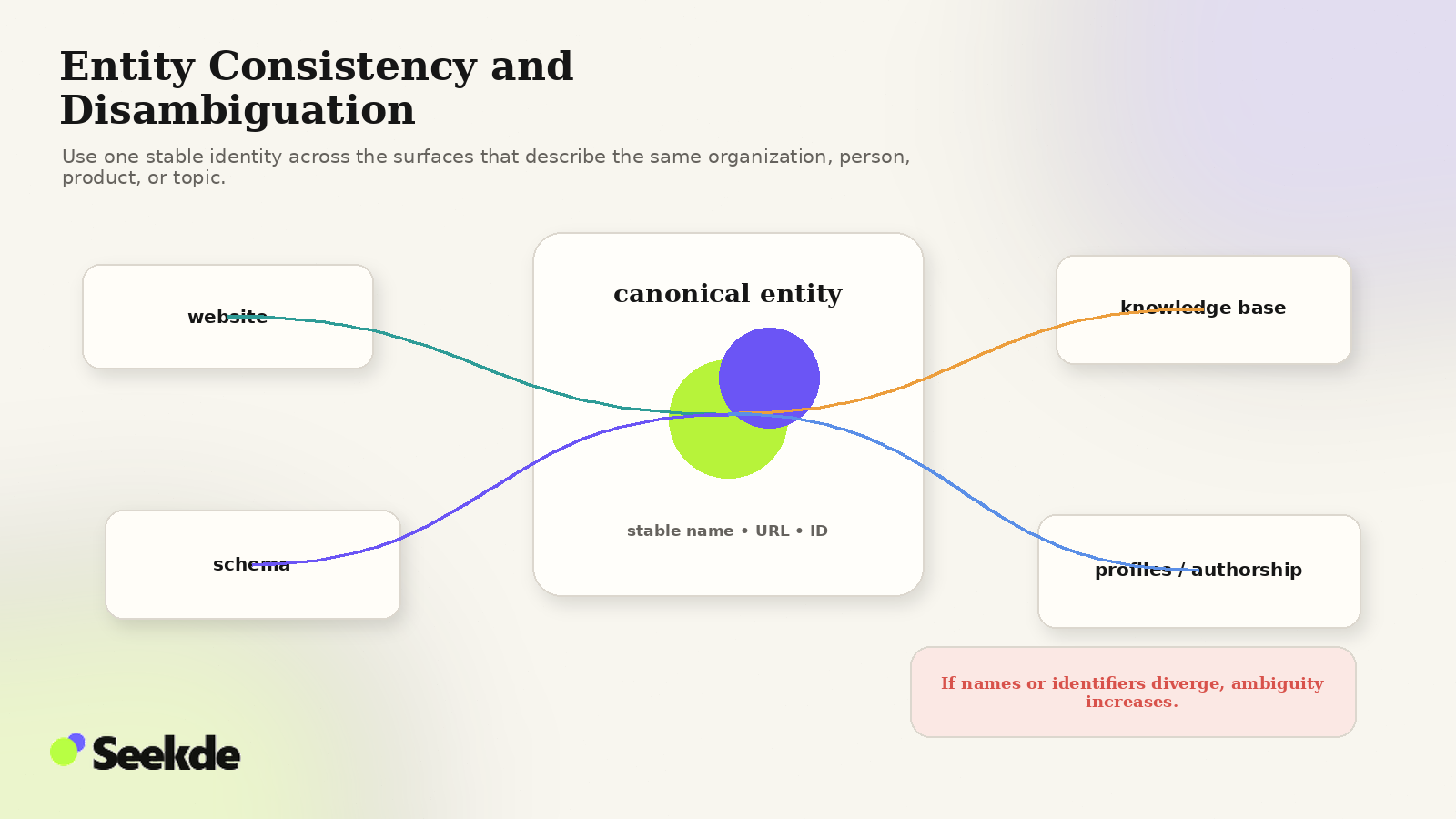
To establish and defend an entity profile across generative search engines, Seekde utilizes a four-pillar framework designed to eliminate ambiguity across machine indexes:
| Framework Pillar | Core Objective | Primary Implementation Surfaces |
|---|---|---|
| 1. Canonical Definition | Establish a single, unambiguous description of the entity across all digital touchpoints. | Homepage lead, About Us page, press boilerplate, Wikipedia/Wikidata summaries. |
| 2. Machine-Readable Identity | Deploy explicit semantic structured data linking the brand to external authoritative databases. | JSON-LD Schema.org (Organization, SoftwareApplication, Person, sameAs). |
| 3. Knowledge Graph Seeding | Reconcile and claim entity profiles across authoritative third-party public registries. | Google Business Profile, Wikidata, Crunchbase, LinkedIn, industry directories. |
| 4. Entity Salience Clustering | Build topical clusters that reinforce the entity’s association with specific technical competencies. | Internal linking architectures, co-citation PR, expert author profiles with credentials. |
Step-by-Step Implementation: Building Your Entity Footprint
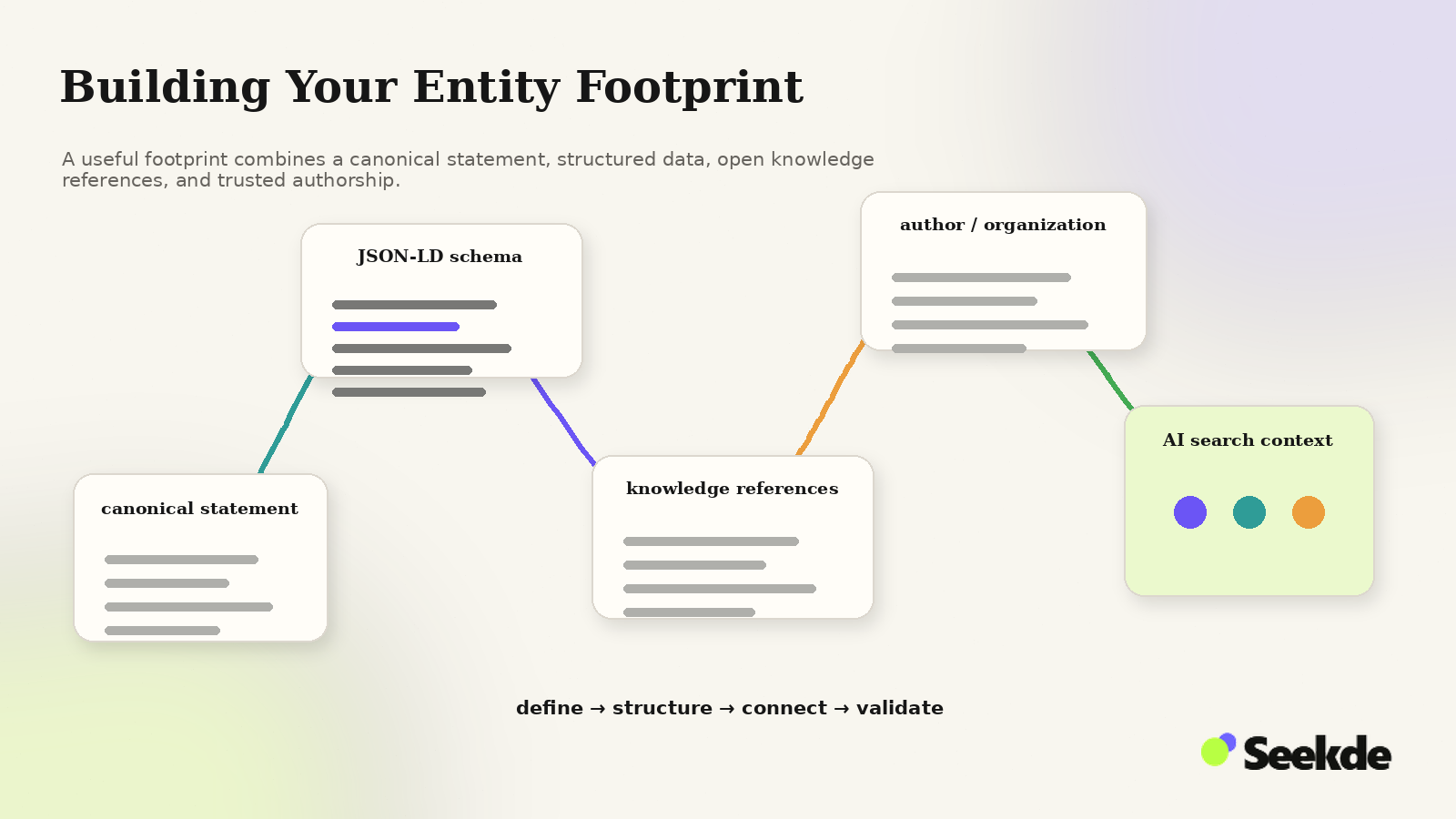
Step 1: Craft the Canonical Entity Statement
Inconsistency across web properties causes entity fragmentation. If your website calls your company an "AI search platform", your LinkedIn profile calls it a "digital marketing agency", and your Crunchbase listing calls it a "SaaS software provider", language models struggle to assign a high-confidence category embedding.
Draft an unambiguous 50-word Canonical Entity Statement:
"Seekde is an AI search visibility and answer engine intelligence platform founded in 2026. The company provides prompt monitoring, citation tracking, and crawl log analytics to help enterprise brands and publishers measure their presence across generative search engines."
Use this exact entity statement across:
- The website homepage and
/about/page - Social media profiles (X, LinkedIn, YouTube)
- Press release boilerplates
- Corporate registry profiles (Crunchbase, PitchBook, G2)
Step 2: Implement Complete JSON-LD Schema with sameAs Links
Structured schema markup is the most direct method for declaring entity identity to search spiders. Use the Organization or Brand schema type, incorporating the sameAs property to link your domain to verified external knowledge nodes:
{
  "@context": "https://schema.org",
  "@type": "Organization",
  "@id": "https://seekde.io/#organization",
  "name": "Seekde",
  "url": "https://seekde.io",
  "logo": "https://seekde.io/assets/images/seekde-logo.png",
  "description": "AI search visibility and answer engine intelligence platform providing prompt monitoring and citation analytics.",
  "foundingDate": "2026",
  "sameAs": [
    "https://www.wikidata.org/wiki/Q12345678",
    "https://www.crunchbase.com/organization/seekde",
    "https://www.linkedin.com/company/seekde",
    "https://twitter.com/seekde"
  ],
  "knowsAbout": [
    "Generative Engine Optimization",
    "Answer Engine Optimization",
    "AI Search Visibility",
    "Web Crawlers"
  ]
}
The sameAs array acts as an explicit identity bridge. It instructs search engine crawlers that the entity discussed on seekde.io is identical to the entity cataloged in Wikidata and Crunchbase, merging disparate web signals into a single, unified knowledge graph node.
Step 3: Establish Presence in Open Knowledge Repositories (Wikidata & Beyond)
While securing a dedicated Wikipedia article is constrained by strict community notability guidelines, Wikidata operates under a broader inclusion policy based on verifiability.
- Create a Wikidata Item: Register an item for your organization or notable software product on Wikidata.
- Populate Core Properties: Add explicit factual claims:
instance of(P31): software company (Q1058914) or website (Q35127)official website(P856):https://seekde.ioinception(P571): 2026headquarters location(P159)topic's main category(P910)
- Link Secondary Databases: Cross-reference Crunchbase IDs, GitHub repositories, and official social identifiers.
Major generative engines (including Google and OpenAI) query Wikidata directly during pre-training and real-time grounding to populate entity knowledge graphs.
Step 4: Optimize Author Entities for E-E-A-T Credibility
In technical and procedural content, search engines evaluate the authority of individual authors alongside the publishing domain. Anonymous articles or posts attributed to generic "Editorial Team" accounts perform poorly in conversational extraction.
- Assign every article to a verified individual author.
- Create an indexable author bio page detailing industry experience, professional credentials, and relevant publications.
- Implement
Personschema markup on author profile pages, linking to their personal LinkedIn profile, academic profiles (ORCID, Google Scholar), and external publications viasameAs.
This author-level entity reconciliation establishes high Experience, Expertise, Authoritativeness, and Trustworthiness (E-E-A-T), signaling to neural rerankers that the content originates from a qualified human subject-matter expert.
Entity Salience: Engineering On-Page Topical Alignment
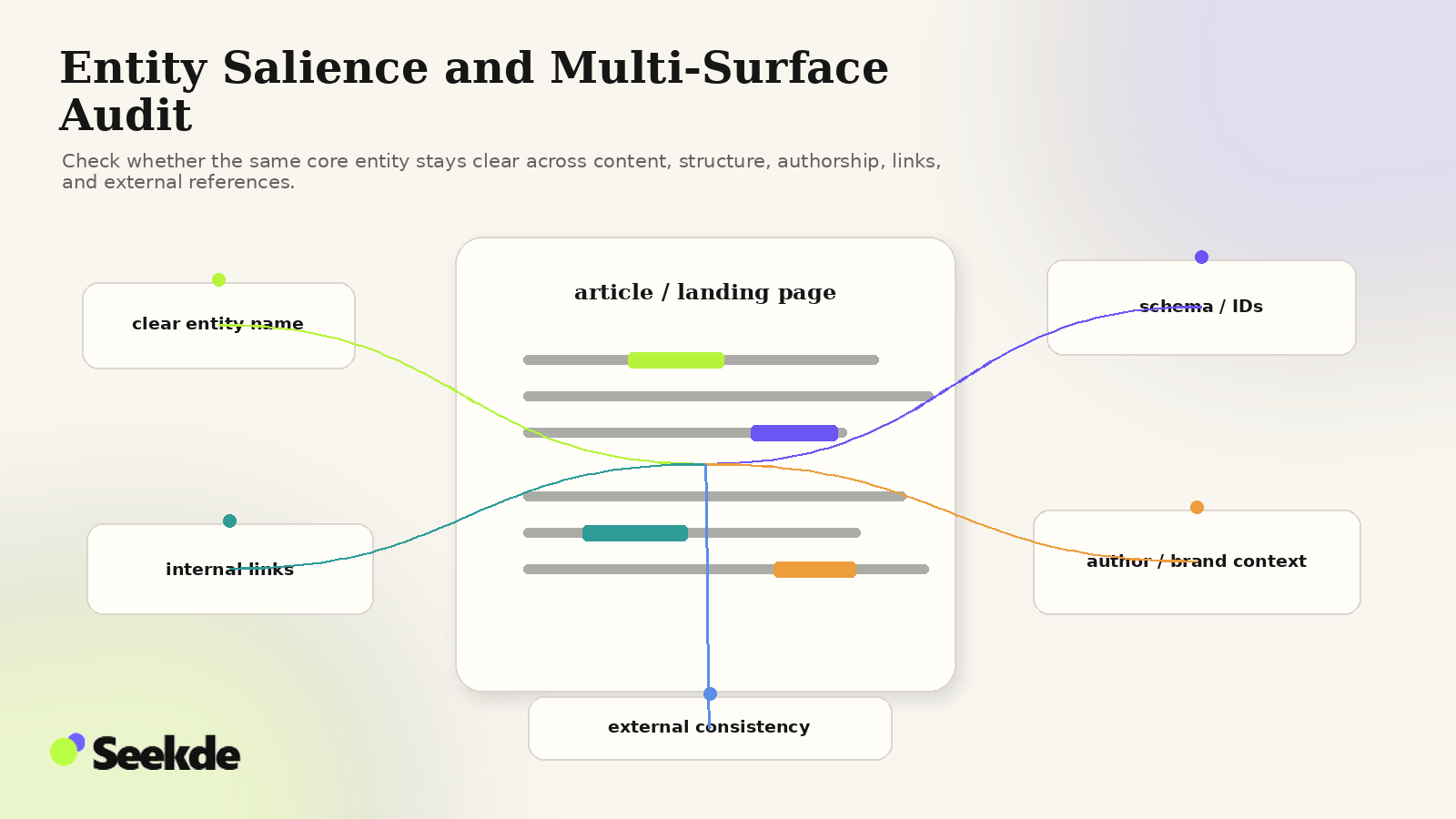
Having an established entity profile is only half the battle; your content must also demonstrate Entity Salience—the measure of how centrally an entity is positioned within the semantic structure of a document.
Search engines compute entity salience using Natural Language Processing algorithms (such as dependency parsing and semantic graph distance):
| Salience Factor | High Salience Practice | Low Salience Anti-Pattern |
|---|---|---|
| Syntactic Position | Position the entity as the subject of the sentence (Seekde monitors prompt variations across...). |
Burying the entity in prepositional phrases or passive constructions (Prompts are monitored by various platforms, including Seekde...). |
| Introductory Presence | Introduce the core entity in the first paragraph and the primary <h1>. |
Introducing the entity on page two after 800 words of generic background history. |
| Co-occurrence Density | Surround the entity with semantically related topic terms (e.g., pairing "Seekde" with "RAG", "crawlers", "citations"). | Surrounding the entity with generic, unrelated marketing buzzwords ("synergy", "game-changing"). |
| Referential Anchor Text | Internal links use the exact entity name as anchor text ([Seekde Research Methodology](/methodology/)). |
Internal links use non-descriptive anchors ([click here](...) or [read more](...)). |
By aligning on-page syntax with entity salience principles, you ensure that automated text parsers classify your entity as the primary authority on the topic rather than an incidental participant.
The Multi-Surface Entity Audit Checklist
Use this 8-point checklist to audit your organization’s entity presence:
- [ ] 1. Canonical Statement Alignment: Is your core 50-word entity statement identical across your website, social profiles, and directory listings?
- [ ] 2. Organization Schema Active: Does the root homepage output valid JSON-LD
Organizationmarkup with completeurl,name, anddescription? - [ ] 3. Identity Bridging (
sameAs): Does your schema link directly to verified Wikidata, Crunchbase, LinkedIn, and social profiles? - [ ] 4. Wikidata Item Published: Is your organization cataloged in Wikidata with accurate
instance of,official website, andinceptionclaims? - [ ] 5. Author Profile Disambiguation: Are article authors linked to dedicated profile pages with
Personschema and verified professional links? - [ ] 6. Knowledge Graph API Verification: Can your brand be retrieved via the Google Knowledge Graph Search API or third-party entity exploration tools?
- [ ] 7. Wikipedia / Secondary Citations: Is your brand mentioned and cited in reputable industry publications, news outlets, and trade directories?
- [ ] 8. Co-occurrence Cleanliness: Are brand mentions across the web consistently associated with your primary topical cluster rather than irrelevant or outdated offerings?
Summary: From Keywords to Semantic Identity
In generative AI search, keywords are temporary; entities are permanent. As language models increasingly replace traditional search result lists with synthesized answers, an organization’s visibility depends entirely on how accurately algorithms can locate, understand, and trust its underlying entity.
By formulating an unambiguous canonical identity, linking semantic profiles through structured schema markup, and establishing strong entity salience across your publication, you transform your brand from an invisible string of characters into an authoritative, indispensable node in the global knowledge graph.
Related Guides and Technical Resources
- Schema Markup for AI Search: What Actually Matters
- How to Create Content AI Search Engines Can Cite
- How Digital PR Influences AI Search Visibility
- What Makes a Web Page Citation-Worthy?
- AI Citations vs Brand Mentions: What’s the Difference?
- What Is AI Search Visibility?
- How AI Search Engines Find, Retrieve and Cite Web Content