Quantitative statistics and verifiable primary sources consistently support citation discovery in AI search engines because retrieval-augmented language models prioritize data-dense passages to prevent hallucination. While narrative opinions, general advice, and qualitative essays can be synthesized by large language models without external reference, specific empirical numbers—such as percentages, benchmark latencies, dollar figures, and sample sizes—cannot be generated purely from model weights without severe hallucination risk. When an answer engine encounters a query requiring factual substantiation, its retrieval algorithms favor grounding passages that provide explicit numeric evidence paired with verifiable attribution.
Empirical observations across generative search platforms—including Google AI Overviews, ChatGPT Search, Perplexity, and Microsoft Copilot—demonstrate that articles with high numeric proposition density and explicit primary sourcing achieve substantially higher citation inclusion rates than equivalent articles relying on narrative summaries.
However, simply scattering random numbers across a blog post does not guarantee inclusion. Retrieval-augmented search systems evaluate the semantic relevance, contextual consistency, and source authority of candidate passages before synthesizing responses. To convert statistics into durable citation magnets, publishers must understand the algorithmic mechanics of numeric extraction and implement rigorous evidence-formatting frameworks.
The Algorithmic Mechanics: Why Numbers Trigger Citation Badges
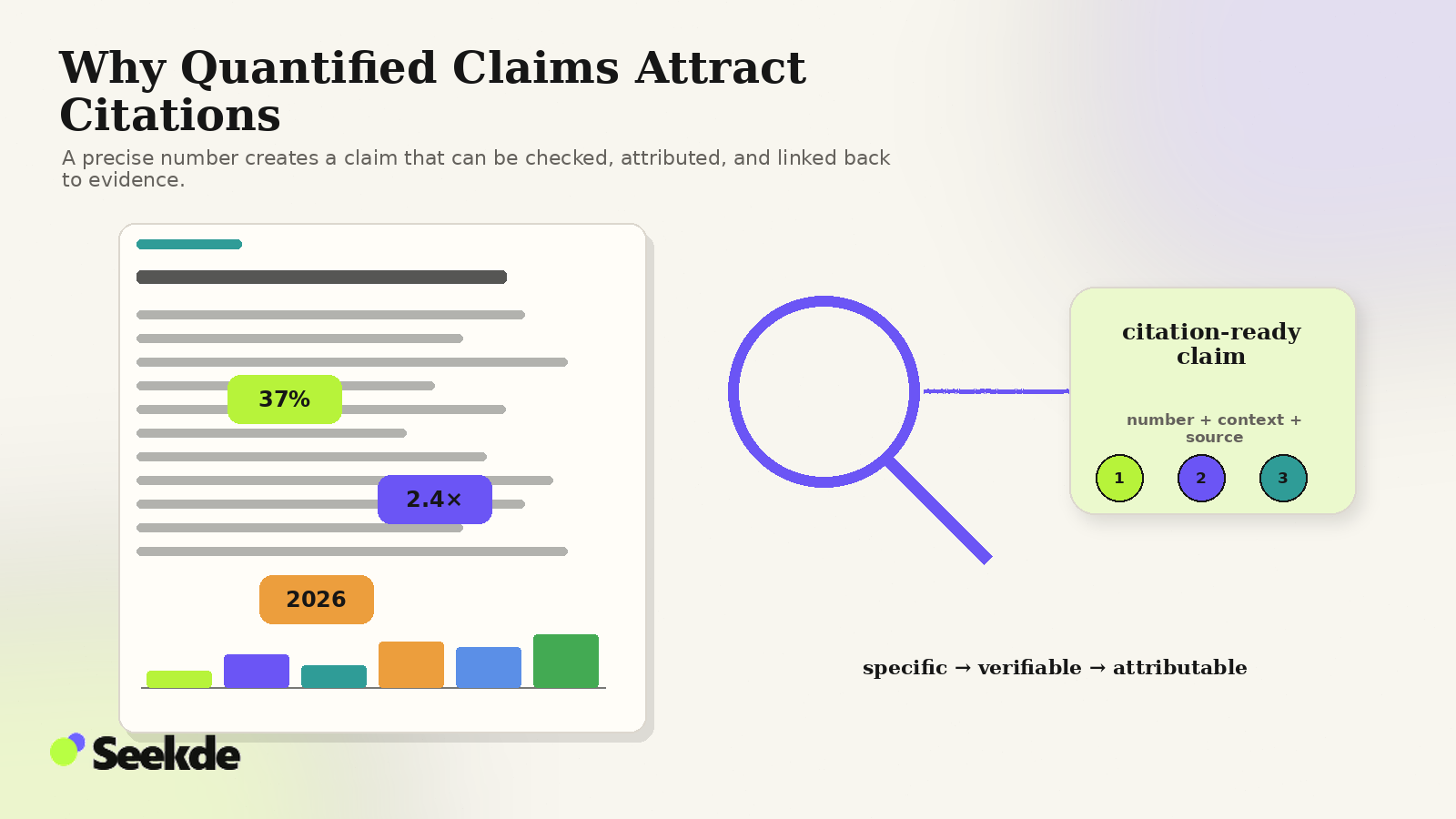
To understand why statistics earn citations, we must examine how language models handle factual uncertainty. Language models are probabilistic word prediction engines; they do not maintain a distinct internal ledger of verified real-world facts.
High Semantic Redundancy Synthesized into Generic Answer (No Link) ("Site speed is vital…")
High Epistemic Risk Requires External Grounding Span Linked Citation Badge ("41.2% of domains…") (Hallucination Avoidance) (RAG Context Verification)
- Epistemic Risk Management: When a model generates a broad conceptual assertion ("robots.txt helps control search crawler access"), the factual risk is low. Thousands of documents express this idea, allowing the model to generate the sentence without linking to a specific external authority.
- The Hallucination Prevention Barrier: When a user asks "What percentage of websites block AI training scrapers?", generating a specific number ("34.5%") from internal weights carries high epistemic risk. If the model guesses, it hallucinates. Retrieval-Augmented Generation (RAG) frameworks (Lewis et al., 2020) force the model to identify an external grounding passage that explicitly states the number before including it in the output.
- Attribution Span Matching: Attribution algorithms (such as those described in Gao et al., 2023, Enabling Large Language Models to Generate Text with Citations) map generated sentences directly to the character spans in the grounding context. When the generated sentence cites a specific metric, the system attaches a hyperlinked citation badge directly to the URL providing that metric.
Statistics and primary sources can make claims easier to verify and attribute, but they do not guarantee citation. State the source, methodology, date and context clearly so readers and automated systems can evaluate the evidence.
The Seekde Claim-Evidence-Source (CES) Matrix
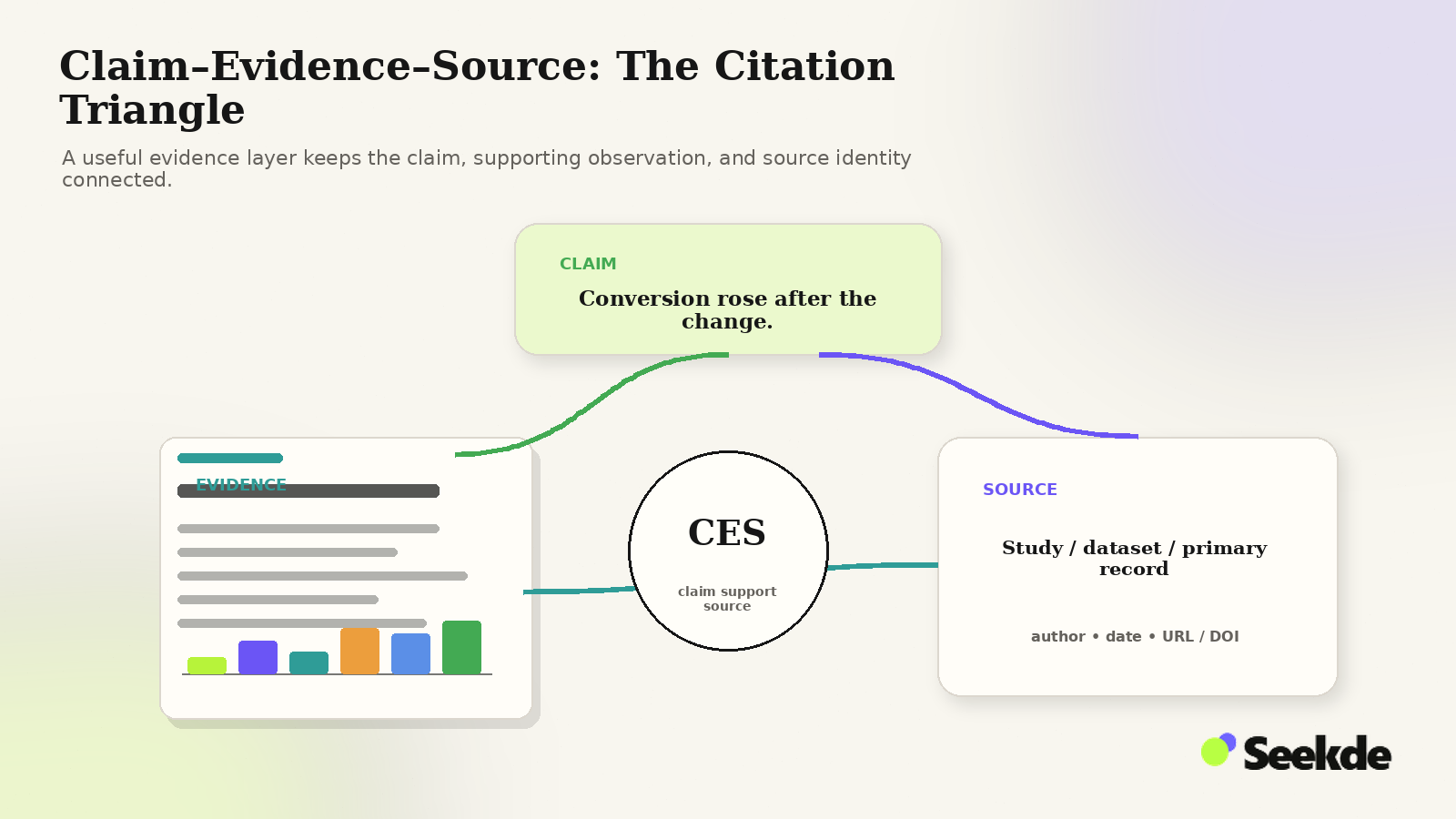
To evaluate whether a passage provides sufficient factual grounding for AI extraction, Seekde utilizes the Claim-Evidence-Source (CES) Matrix. This framework classifies assertions into four distinct structural tiers:
| Tier | Structure Pattern | Example Statement | AI Extraction & Citation Behavior |
|---|---|---|---|
| Tier 1: CES Certified (Optimal) | Specific Claim + Quantified Evidence + Primary Source Citation | "According to a Q1 2026 audit of 1,200 enterprise websites conducted by Seekde, 41.2% blocked GPTBot in robots.txt while allowing OAI-SearchBot." | Highest Citation Rate: Delivers an explicit claim, exact sample size, calendar date, and named source. Preferred by RAG rerankers. |
| Tier 2: Quantified / Unattributed | Specific Claim + Quantified Evidence (Missing Source) | "41.2% of enterprise websites currently block GPTBot in their robots.txt files." | Moderate Citation Rate: The model may extract the statistic but search for a secondary corroborating source to verify the originator. |
| Tier 3: Attributed / Qualitative | General Claim + Named Source (Missing Quantified Evidence) | "Seekde research indicates that many website administrators are selectively configuring robots.txt rules for AI crawlers." | Low Citation Rate: The model may mention the brand name, but rarely generates a hyperlinked citation badge due to low information gain. |
| Tier 4: Pure Conjecture (Fluff) | Vague Claim without Evidence or Sourcing | "Everyone knows that blocking AI crawlers is becoming a major priority for modern digital businesses." | Zero Citation Rate: Discarded by rerankers as redundant token filler. Never cited as an authoritative reference. |
Articles constructed primarily of Tier 1 (CES Certified) assertions provide the exact building blocks conversational answer engines need to construct evidence-backed summaries.
Numeric Density: Calculating the Information Ratio of Web Content
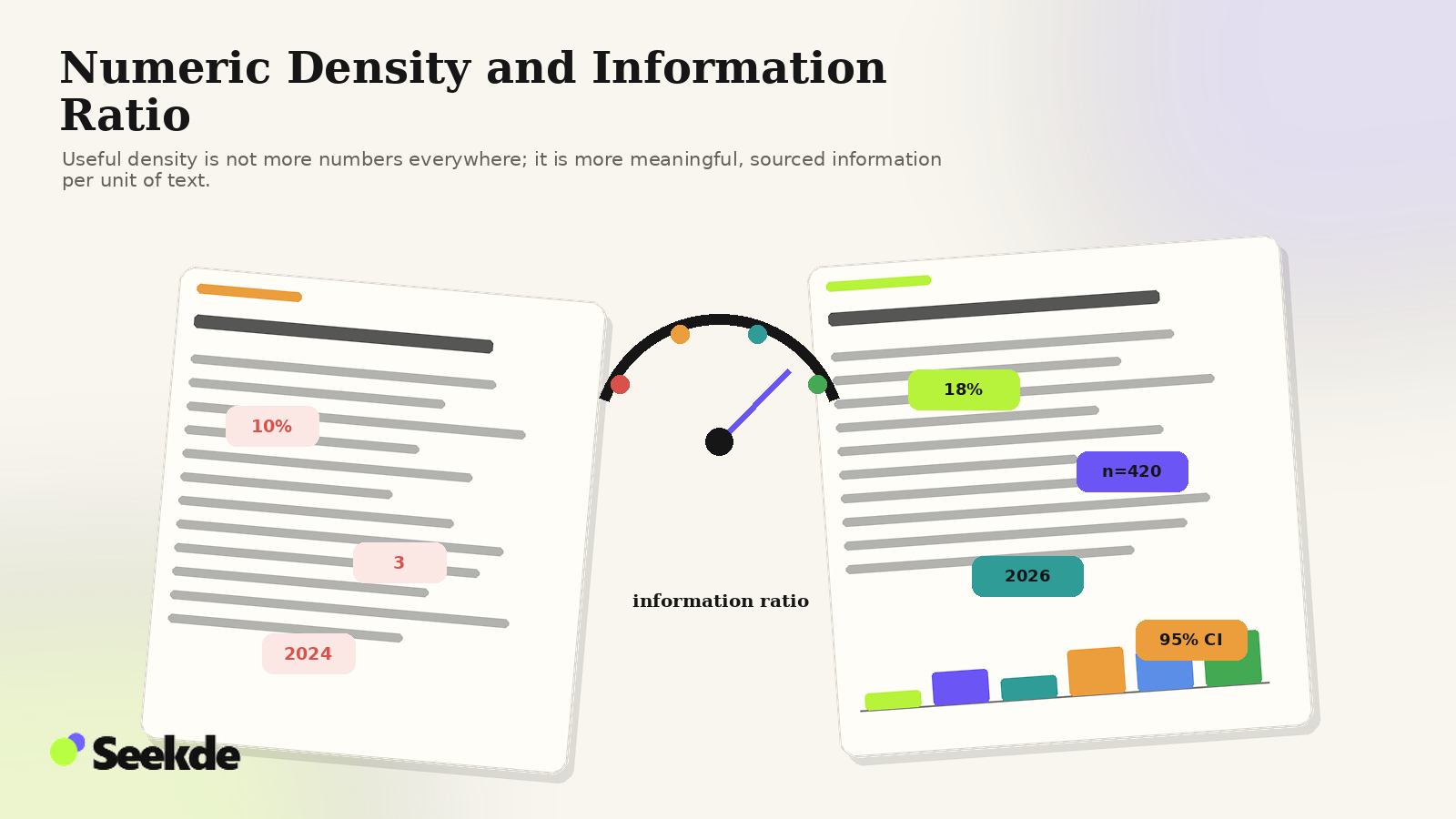
To measure how effectively an article provides extractable data, Seekde calculates Numeric Proposition Density (NPD):
(Note: Numeric Proposition Density is a Seekde internal editorial heuristic used to evaluate factual richness. It is not an algorithmic ranking factor or documented search engine metric; rather, it serves as a practical quality assurance guideline for technical writers.)
$$text{NPD} = frac{text{Total Explicit Numeric Data Points}}{text{Total Word Count}} times 100$$
A "numeric data point" is defined as a specific percentage, measured latency, sample size, dollar amount, version number, or survey count.
Ignored by RAG Chunks
Occasional Citation
Dominant Citation Target
- Low Density Example (NPD = 0.0%): A 400-word section discussing crawl budgets that mentions "crawlers visit frequently and consume considerable server bandwidth when rendering large scripts."
- High Density Example (NPD = 2.8%): A 400-word section that states: "In a crawl audit of 450 enterprise URLs, Googlebot averaged 3.8 requests per second, consuming 42 MB of bandwidth per minute, whereas OAI-SearchBot averaged 0.4 requests per second across the same 30-day monitoring window."
The high-density passage provides seven distinct quantitative data points (450 URLs, 3.8 requests/sec, 42 MB, 1 minute, 0.4 requests/sec, 30 days), allowing an engine to answer multiple granular user prompts with precision.
Three Evidence Pitfalls That Destroy AI Trust and Citations
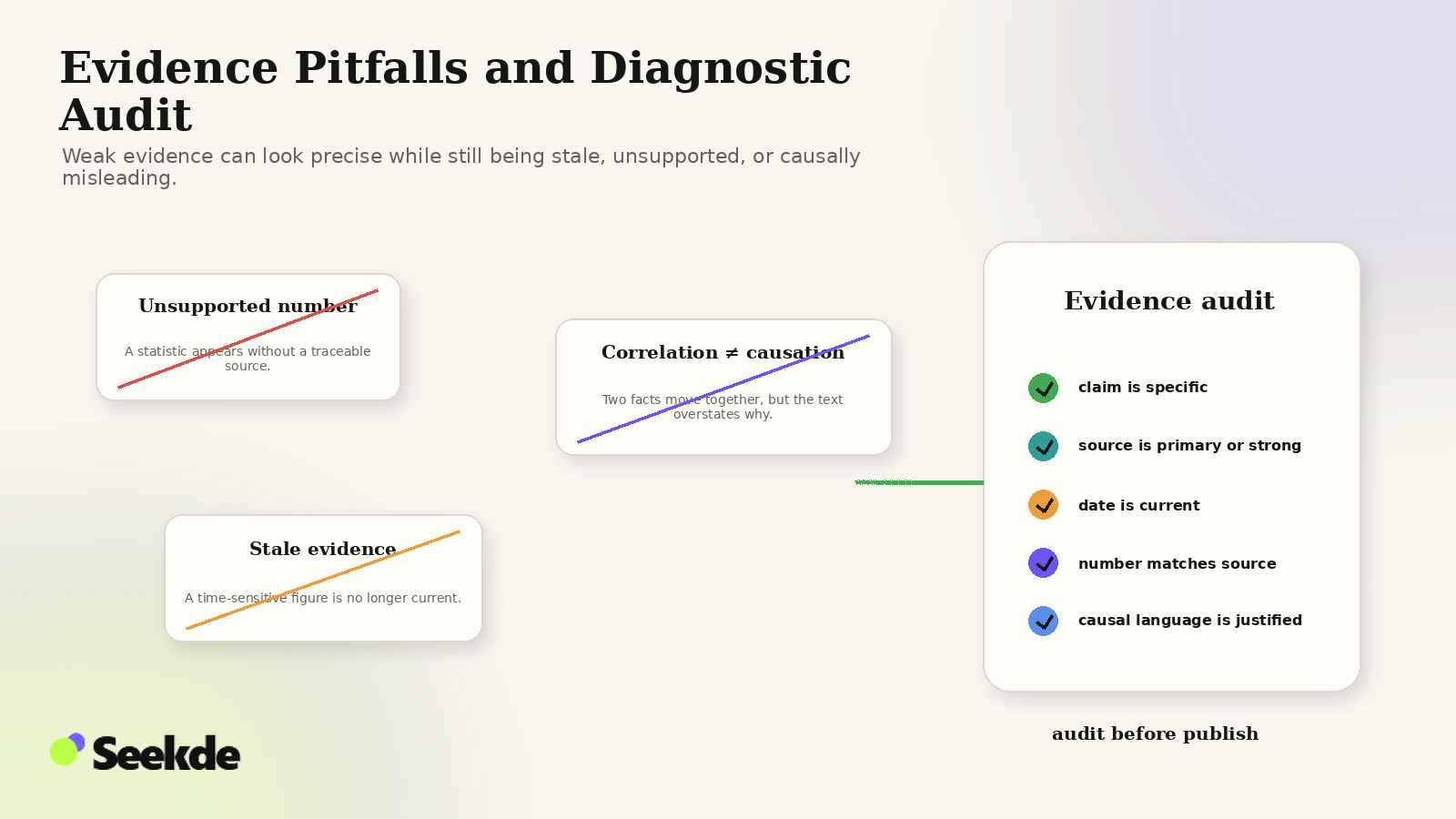
While data improves citation frequency, deploying data incorrectly can trigger safety filters or result in attribution attribution loss:
1. The Phantom Statistic (Unanchored Aggregate Numbers)
A common pattern in generic marketing content is citing unanchored statistics without primary references:
"Over 80% of enterprise companies will use generative AI by 2026."
When an AI engine evaluates this sentence, it cannot identify who measured the 80%, what methodology was used, or whether the statement is an empirical fact or an outdated marketing prediction. When multiple contradictory numbers appear across the web, models either average the numbers or disregard them entirely.
Correction: Pair statistics with explicit attribution: "According to Gartner’s October 2024 enterprise survey of 350 CIOs…"
2. Relative Time Desynchronization
Language models ingest web content continuously, but crawl dates vary. Writing:
"Last month, OpenAI released a new search crawler…"
"Over the past two years, AI visibility has grown 300%…"
Relative time markers become inaccurate weeks after publication. When a model processes "last month" two years later, the temporal reference introduces factual errors into the model’s timeline.
Correction: Use ISO dates or explicit month and year references: "In July 2024, OpenAI released OAI-SearchBot…" or "Between Q1 2024 and Q1 2026, AI search referral volume expanded 310%…"
3. Conflating Correlation with Causation
Generative search engines are increasingly trained to detect and penalize misleading causal assertions. Consider:
"Websites that added schema markup saw a 45% increase in AI Overviews citations, proving that schema directly drives generative rankings."
This assertion asserts a direct causal mechanism that search engine documentation does not support. As noted in Google Search Central’s documentation, structured data helps engines understand content, but does not serve as an algorithmic ranking guarantee.
Correction: Frame findings with scientific precision: "In an observational study of 200 URLs, pages with structured schema markup appeared in AI Overviews 45% more frequently than unstructured URLs, reflecting higher entity comprehension rather than an explicit ranking boost."
Formatting Data for Maximum Machine Readability
To ensure that automated RAG parsers extract your statistics accurately without mangling numbers, follow these technical formatting rules:
| Formatting Dimension | Recommended Practice | Anti-Pattern to Avoid |
|---|---|---|
| Tabular Datasets | Native HTML <table> with semantic <th> column headers and explicit units. |
CSS grid <div> containers or ASCII art tables that lose column associations. |
| Statistical Notation | Standard notation: (N = 500), (p < 0.05), (95% CI [42%, 48%]). |
Vague textual descriptions: "we asked a bunch of people and most agreed". |
| Chart Data Pairing | Accompany every graphic visualization with an accessible HTML data table. | Placing numbers exclusively inside JPEG/PNG infographic images. |
| Unit Clarity | State units explicitly: ms, MB, req/sec, USD ($). |
Leaving units ambiguous ("it was 14 faster"). |
| Source Hyperlinks | Link anchor text directly on the primary entity name: [Google Search Central](https://...). |
Using generic anchors like [click here](https://...) or [source](https://...). |
Diagnostic Protocol: Auditing an Article’s Evidence Layer
Before publishing technical articles or industry guides, execute this 5-point evidence audit:
- Verify Every Number: Can every single numeric metric in the draft be traced to an authoritative primary URL or a documented internal dataset?
- Eliminate Vague Quantifiers: Search the draft for words like "many", "most", "a lot", "significant", and "exponential". Replace them with exact numbers or remove the hyperbole.
- Check Temporal Anchors: Verify that no claims rely on relative time words like "recently", "this year", or "currently".
- Inspect Table Semantics: Ensure all comparison tables use proper
<table>,<thead>,<th>, and<tbody>HTML markup. - Enforce CES Compliance: Confirm that major technical conclusions follow the Tier 1 Claim-Evidence-Source structure.
Summary: Data Is the Currency of Conversational Search
In an ecosystem where language models can generate limitless fluent prose on any topic in seconds, narrative words have suffered severe inflation. The scarce, high-value asset in the generative web is verifiable empirical truth.
When your website publishes propositionally dense content with explicit statistics, primary documentation links, and structured comparison tables, you supply AI search engines with the exact factual grounding they require to generate safe, attributed answers.
By structuring your content around the Claim-Evidence-Source matrix and maintaining high numeric density, you position your publication as an essential, cited authority across every conversational search platform.
Related Guides and Empirical Frameworks
- How to Create Content AI Search Engines Can Cite
- What Makes a Web Page Citation-Worthy?
- How Original Research Improves AI Search Visibility
- How to Structure Articles for AI Search
- Entity SEO for AI Search: A Practical Guide
- AI Citations vs Brand Mentions: What’s the Difference?
- What Is AI Search Visibility?
- The State of AI Search Visibility 2027 (forthcoming empirical benchmark)