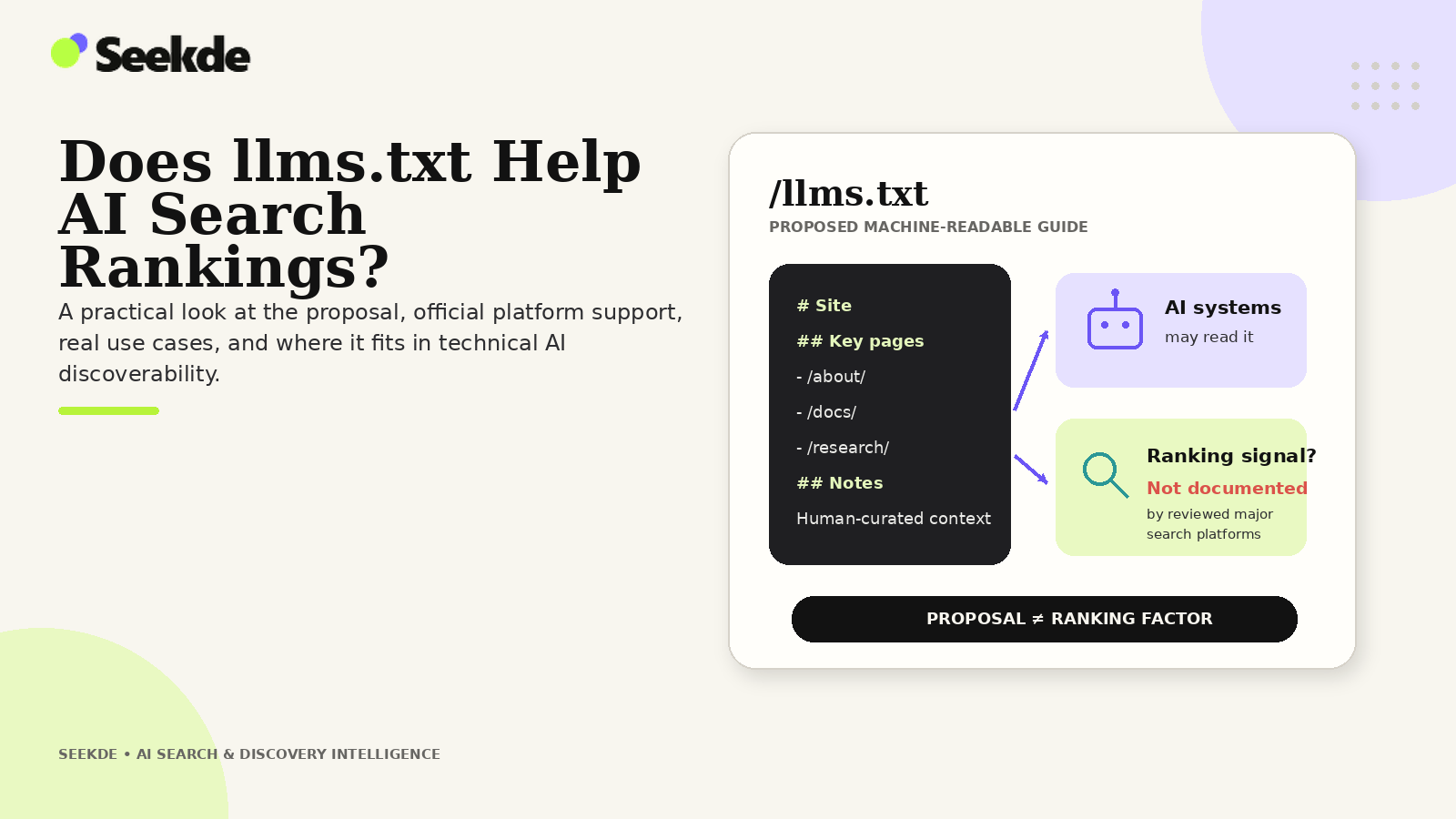
There is currently no documented or empirical evidence that publishing an llms.txt file improves search rankings, citation frequency, or indexation speed in any major generative search engine. As of September 2026, the major search engines reviewed by Seekde (Google for AI Overviews and AI Mode, OpenAI for ChatGPT Search, Microsoft for Copilot, and Perplexity AI) do not document llms.txt as an indexing protocol, ranking signal, or discovery requirement.
However, establishing that llms.txt provides no search ranking benefit is fundamentally different from claiming the proposal is useless. The specification solves a genuine engineering challenge: providing plain-text, token-efficient documentation to developer tools, code editors, and autonomous programming agents. Conflating developer tooling utility with algorithmic search visibility is a pervasive industry myth. This guide provides an evidence-based technical evaluation of the llms.txt proposal, details official platform documentation realities, and outlines where publishers should—and should not—invest technical resources.
What Is the llms.txt Proposal?
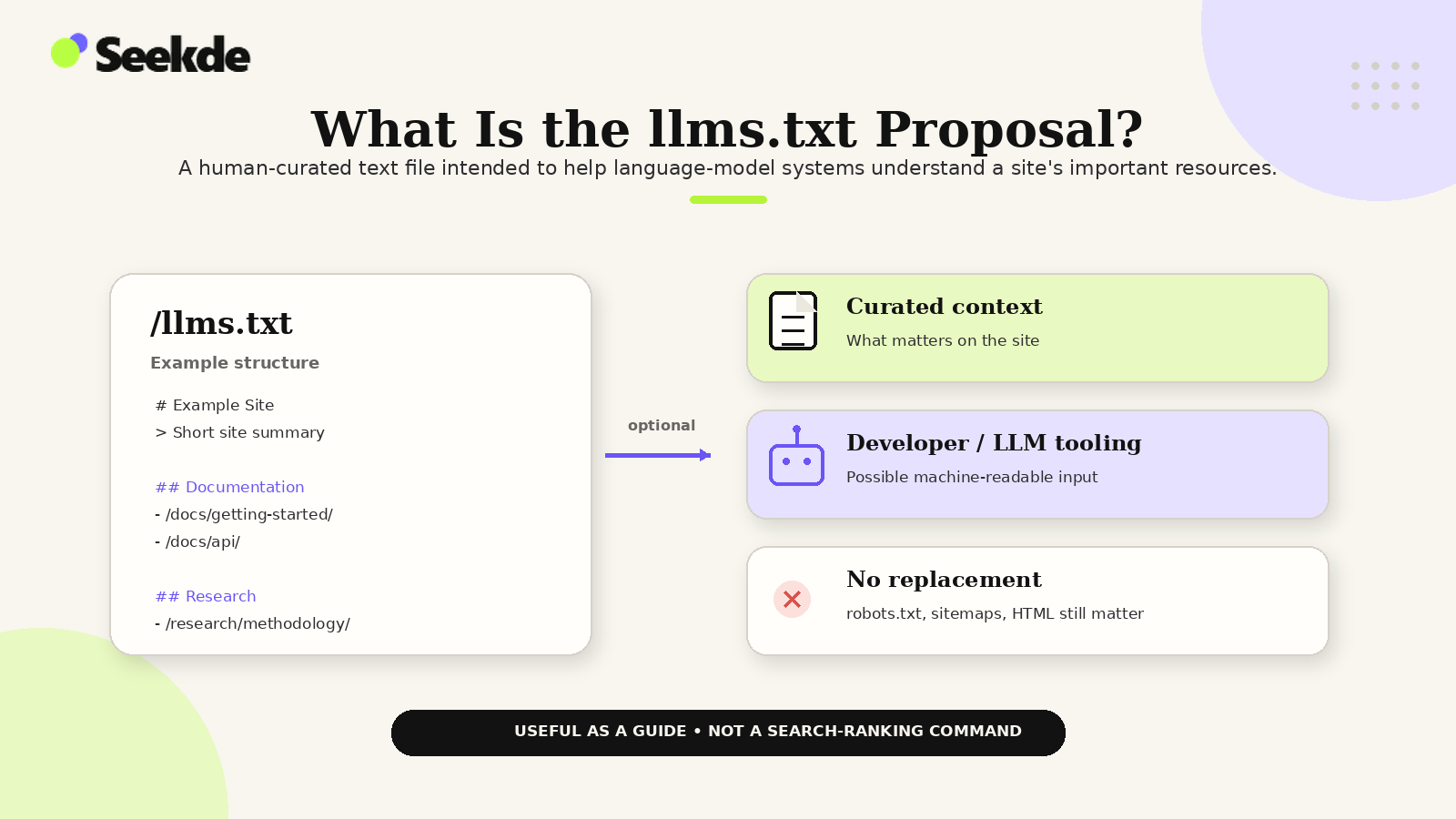
The llms.txt concept was proposed in September 2024 by Jeremy Howard (founder of Answer.AI and fast.ai) as an open, community-driven convention, maintained and documented at the official llms.txt specification site. The proposal suggests placing a standardized Markdown file at the root of a domain (/llms.txt), accompanied optionally by an aggregated document at /llms-full.txt. Through 2026 revisions, the specification remains focused on providing structured, plain-text documentation manifests for AI agents.
/llms.txt
Markdown index file positioned at website root domain.
- Concise project summary and technical overview
- Clean list of key links and documentation resources
- Token-efficient structure for fast model ingestion
/llms-full.txt
Aggregated documentation file for extensive technical reference.
- Full text of essential documentation in a single file
- Single-request context payload for LLM assistants
- Ideal for IDE agent context windows
The Problem It Was Designed to Solve
Modern web architecture is heavily optimized for human visual consumption. Standard HTML documents are wrapped in navigation headers, footer links, cookie consent dialogues, tracking scripts, CSS frameworks, and dynamic DOM elements. When a software developer prompts an AI assistant or coding agent to inspect an online API runbook, feeding raw HTML into an LLM context window consumes excessive tokens and introduces visual noise that degrades reasoning accuracy.
The llms.txt file addresses this friction by providing a curated, plain-text manifest formatted in clean Markdown. It delivers:
- A concise overview of the organization, library, or API;
- Direct links to markdown-formatted documentation pages;
- Optional links to secondary resources, tutorials, or code examples;
- Elimination of CSS, JavaScript payloads, and advertising boilerplate.
Anatomy of a Compliant llms.txt File
The proposal outlines a simple, human-readable structure:
# Seekde Technical Documentation
> Seekde is an AI search analytics and intent exploration platform providing visibility measurement for generative search engines.

## Core Documentation
- [Crawler Specifications](/docs/crawlers.md): Master user-agent tokens, IP ranges, and reverse DNS verification.
- [Robots.txt Protocols](/docs/robots-txt.md): RFC 9309 compliance guides for search and training agents.
- [API Reference](/docs/api-reference.md): Endpoints for programmatic retrieval monitoring.

## Optional Resources
- [Audit Playbook](/docs/audit-checklist.md): 10-step crawlability audit framework.
- [Changelog](/docs/changelog.md): History of platform updates and schema releases.
The optional /llms-full.txt companion file concatenates the entire contents of the linked Markdown files into a single document, allowing an AI agent to ingest the complete technical context in a single HTTP request.
Official Platform Verification: What Search Engines Actually Support
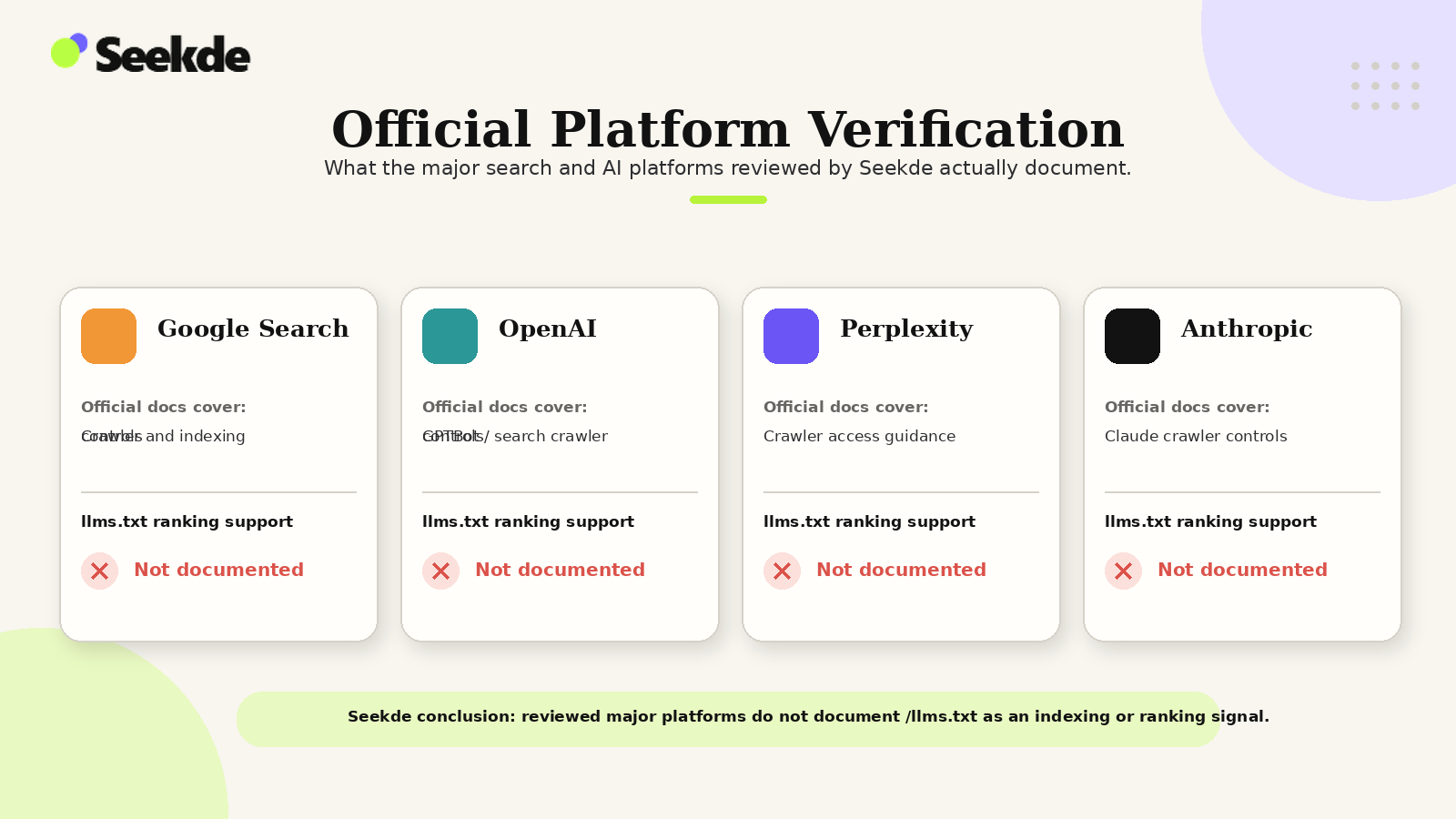
To assess whether llms.txt influences search rankings or discovery, technical teams must examine the primary documentation published by major search and AI providers:
| Platform / Engine | Primary Search Crawlers | Official Support for llms.txt? |
Documented Discovery & Indexing Mechanism |
|---|---|---|---|
| Google Search (AI Overviews & AI Mode) | Googlebot |
No (Explicitly undocumented / unparsed) | Standard HTML crawling, XML sitemaps, RFC 9309 robots.txt, Schema.org |
| OpenAI (ChatGPT Search) | OAI-SearchBot |
No (Undocumented for search indexing) | Standard web crawling of public HTML, XML sitemaps, robots.txt |
| Microsoft Bing (Copilot Grounding) | Bingbot |
No (Undocumented) | Bing web index, XML sitemaps, IndexNow protocol |
| Perplexity AI (Answer Synthesis) | PerplexityBot |
No (Undocumented) | Direct HTML web crawling, real-time partner search indexes |
| Anthropic (Claude Search & Retrieval) | Claude-SearchBot, Claude-User |
No (Undocumented) | Search indexing and on-demand user fetching |
1. Google Search Central Evidence
Google’s webmaster documentation, including Google Search Central’s Get Started Guide, defines exactly how Googlebot discovers and indexes content. Google relies on:
- Internal and external HTML hyperlinks;
- Standard XML sitemaps declared in Google Search Console or robots.txt;
- Semantic HTML tags and structured data markup.
Google representatives have addressed custom discovery files repeatedly, noting that Google Search does not invent support for arbitrary root-level text files. Googlebot processes web pages according to web standards; it does not parse /llms.txt to find pages to crawl, nor does it factor the presence of /llms.txt into page rank, topical authority, or inclusion in Google AI Overviews.
2. OpenAI and ChatGPT Search Evidence
OpenAI documents its search crawler architecture in its official Publisher FAQ. As detailed in our analysis of OAI-SearchBot vs GPTBot, OpenAI specifies that OAI-SearchBot crawls public web content to populate the ChatGPT Search index.
OpenAI’s documentation instructs publishers to:
- Allow
OAI-SearchBotin robots.txt; - Ensure web pages return standard HTTP 200 responses;
- Provide accessible HTML and valid XML sitemaps.
OpenAI does not document any crawler behavior where OAI-SearchBot fetches /llms.txt to discover new URLs or prioritize search results. Claims that publishing /llms.txt guarantees inclusion or preferential ranking in ChatGPT Search directly contradict OpenAI’s official technical documentation. The fact that numerous developer documentation platforms host an /llms.txt file demonstrates its value for developer tooling and IDE context ingestion, but does not indicate any algorithmic ranking benefit in ChatGPT Search.
3. Perplexity AI and Bingbot Evidence
Neither Microsoft nor Perplexity mentions llms.txt in their webmaster guidelines. Perplexity relies on standard web indexes and live retrieval of HTML content. If a page cannot be discovered through ordinary link architecture or XML sitemaps, placing it in an /llms.txt file will not cause Perplexity to index it.
The Three Myths of llms.txt in AI Search
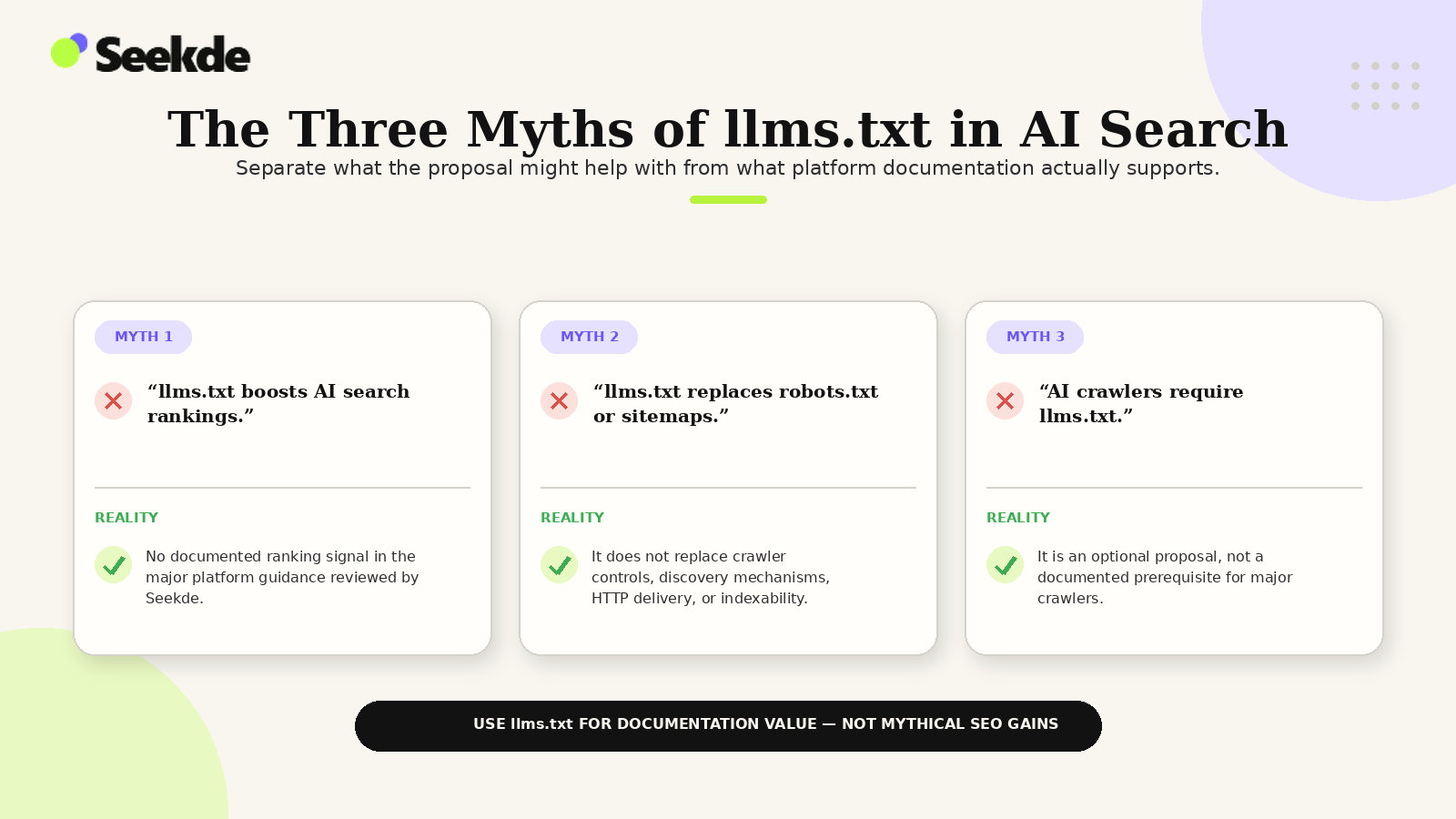
Understanding why llms.txt has gained traction involves separating marketing hype from technical reality:
Myth: "AI Sitemap"
- Claim: AI search bots
- crawl llms.txt first
- to find your pages.
- Fact: Bots ignore it
- and use XML sitemaps.
Myth: "Ranking Boost"
- Claim: Having llms.txt
- improves citation share
- in AI Overviews.
- Fact: Zero documented
- ranking correlation.
Reality: "Developer Tool"
- Fact: Coding assistants,
- CLI agents, and Cursor
- ingest llms.txt cleanly.
- Utility: High for DX;
- Zero for search SEO.
Myth 1: "llms.txt Is an AI Sitemap That Replaces XML Sitemaps"
Advocates sometimes refer to llms.txt as a "modern sitemap for LLMs." This characterization is dangerously misleading for web operations teams. Search engine crawlers operate high-throughput XML parsing pipelines designed to ingest hundreds of thousands of URLs with metadata (<lastmod>, <changefreq>).
Replacing an XML sitemap with /llms.txt, or neglecting XML sitemaps under the assumption that AI search engines prefer Markdown, will directly cripple a site’s discoverability. XML sitemaps remain the universal, documented standard for search discovery across all platforms.
Myth 2: "llms.txt Directly Boosts AI Citations and Share of Model"
Some SEO agencies claim that publishing llms.txt provides a "direct signal of AI readiness" that increases a website’s citation rate in answer engines.
In reality, answer engines select citations based on:
- Index availability (the page was crawled and indexed via conventional web infrastructure);
- Semantic relevance to the user prompt;
- Factual density and passage conciseness;
- Domain authority and corroboration across independent web sources.
An engine evaluating retrieved passages during real-time synthesis does not check whether the parent domain hosts a file at /llms.txt. The citation selection mechanism operates on retrieved passages, as explained in our guide on How AI Search Engines Find and Cite Content.
Myth 3: "llms.txt Informs Models of Real-Time Facts"
A static text file on a web server does not update the parametric weights of large foundation models. Offline models like GPT-4 or Claude 3.5 Sonnet cannot "read" an llms.txt file unless an automated agent or user explicitly fetches that URL during a live session.
Where llms.txt Actually Delivers Value: Developer Experience (DX)
While llms.txt does not impact search engine rankings, it provides substantial value in specific, highly technical developer environments:
1. Cursor, Windsurf, and AI Code Editors
Modern AI code editors allow developers to add external documentation URLs as reference context (e.g., Cursor’s @Docs feature). When a developer points Cursor to a domain that supports /llms.txt, the editor’s ingestion agent can read the curated Markdown manifest and selectively fetch specific documentation files without choking on navigation HTML or client-side JavaScript.
2. Command-Line LLM Tools and Autonomous Coding Agents
Tools such as Claude Code, Aider, and custom Python agent frameworks frequently interact with external APIs. If an API provider hosts an /llms-full.txt file, an autonomous agent can fetch the entire API schema in a single HTTP GET request:
# An agent can pull complete, clean API docs in a single request
curl -s https://api.example.com/llms-full.txt | llm -p "Generate a Python SDK client for this API"
This drastically reduces token consumption, eliminates parsing errors, and improves code generation quality.
3. Internal Enterprise Knowledge Repositories
Within private enterprise environments, hosting /llms.txt files on internal wikis or microservice documentation hubs provides an efficient ingestion layer for internal RAG chatbots.
How to Audit Server Logs for llms.txt Requests
If you currently host an llms.txt file or are evaluating whether to create one, you can inspect your web server access logs to measure actual client demand.
Parsing Access Logs for llms.txt Hits
Run the following terminal commands on your web server to analyze incoming requests for /llms.txt:
Count Total Requests for llms.txt
grep "GET /llms.txt" /var/log/nginx/access.log | wc -lIdentify User-Agents Fetching llms.txt
grep "GET /llms.txt" /var/log/nginx/access.log | awk -F'"' '{print $6}' | sort | uniq -c | sort -nrExpected Log Findings
When examining real production access logs across commercial websites, server administrators consistently observe:
- Search Crawlers (
Googlebot,Bingbot,OAI-SearchBot): Rarely or never request/llms.txtas part of their scheduled crawl sweeps, unless an external webpage explicitly links to it via an<a href>tag. - Developer Tools & Scripts: The vast majority of requests originate from Python scripts (
python-requests),curl, AI coding extensions, or security scanners. - HTTP Status Codes: If the file does not exist, requests return a standard 404 Not Found. This 404 does not harm a site’s search rankings or crawl budget.
Strategic Decision Matrix: Should Your Website Implement llms.txt?
Technical leaders should decide whether to implement llms.txt based on their site’s primary audience and content type:
SaaS / API / Developer Documentation
Audience: Developers. Use Case: Code Assistants. Value: High for DX. Recommendation: [IMPLEMENT]. Deploy /llms.txt and /llms-full.txt to help coding agents ingest docs.
Media / Editorial Publication
Audience: General Readers. Use Case: News & Analysis. Value: Negligible. Recommendation: [OPTIONAL]. Focus on XML sitemaps, Schema.org, and clean semantic HTML articles.
eCommerce / Local Business
Audience: Consumers. Use Case: Transactions. Value: None. Recommendation: [DO NOT DEPLOY]. Prioritize Schema.org, fast HTML rendering, and core web vitals.
Profile 1: Developer Documentation, Open Source, and SaaS APIs
- Verdict: Recommended.
- Action: Create a well-structured
/llms.txtfile listing essential API endpoints, installation guides, and SDK documentation in Markdown. Provide/llms-full.txtif the documentation is under 50,000 tokens. - Objective: Improve the developer experience for engineers using Claude Code, Cursor, and AI agents.
Profile 2: Technical Editorial and Research Publications
- Verdict: Optional / Low Priority.
- Action: You may provide an
/llms.txtsummarizing core research pillars, but do not expect any measurable change in search citations or organic traffic. - Objective: Experimental developer support.
Profile 3: Consumer eCommerce, B2B Services, and Local Business
- Verdict: Do Not Invest Resources.
- Action: Do not deploy
llms.txt. Prioritize proven discoverability foundations: fast server response times, mobile rendering, clean robots.txt rules (How to Configure Robots.txt for AI Search Crawlers), and valid structured data (Schema Markup for AI Search).
The Proven Technical Hierarchy for AI Discoverability
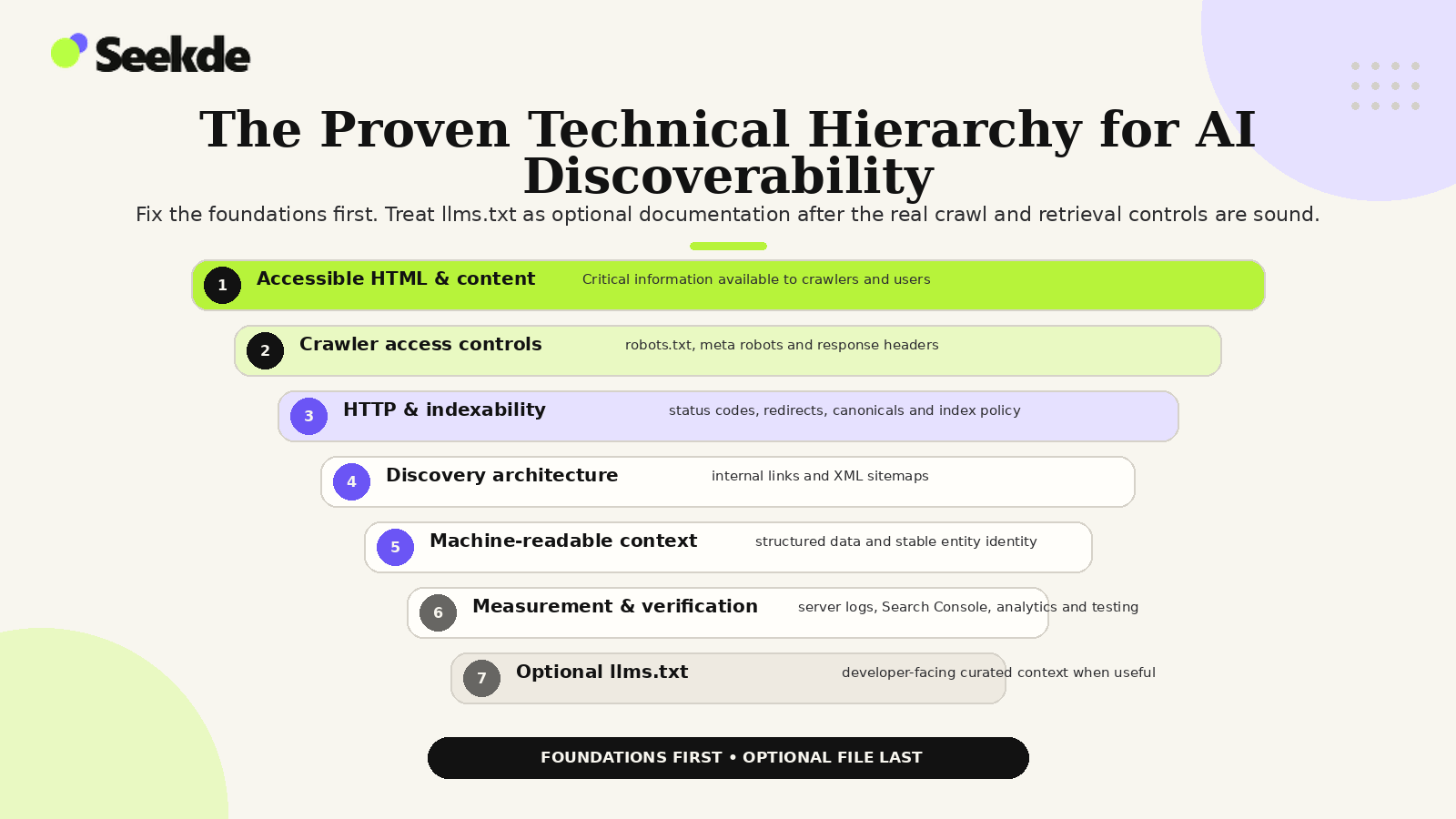
If llms.txt does not drive AI search visibility, what does? Technical teams should allocate resources according to this verified hierarchy of impact:
- Edge & Robots.txt Accessibility (Foundational): Legitimate search discovery bots (
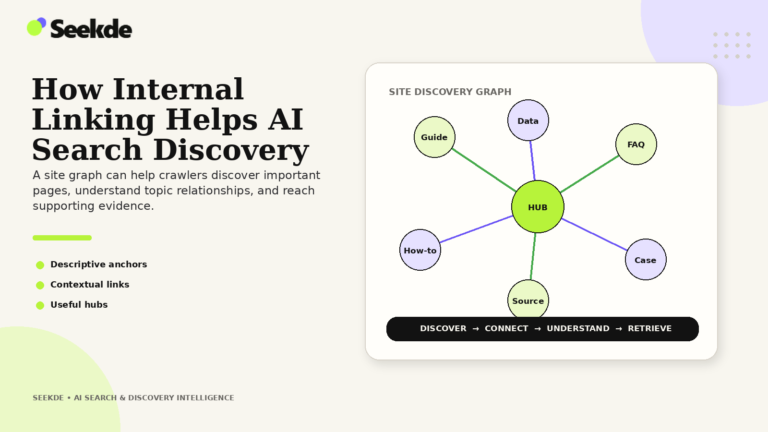
Googlebot,OAI-SearchBot,Bingbot,PerplexityBot) must be allowed in robots.txt and must not be challenged by CDN firewalls. - Discovery Infrastructure: Maintain complete XML sitemaps declared in robots.txt, and build an intentional internal linking graph that eliminates orphan pages. Review How Internal Linking Helps AI Search Discovery.
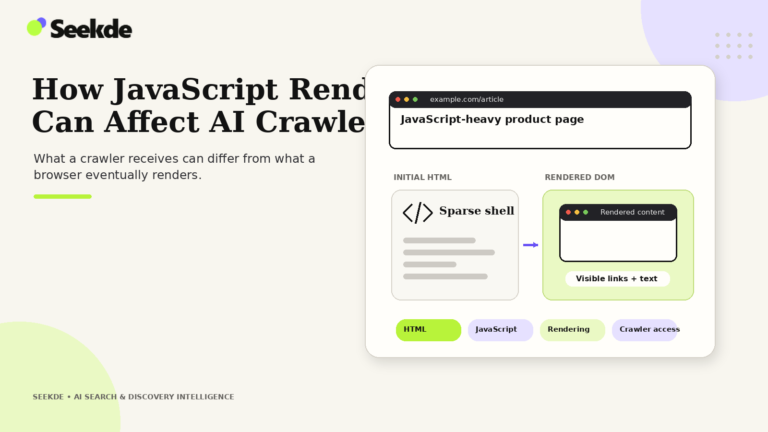
- Raw HTML Availability: Ensure critical titles, copy, and data are delivered in the initial server response rather than trapped behind client-side JavaScript. See How JavaScript Rendering Can Affect AI Crawlers.
- Semantic Structured Data: Deploy valid JSON-LD schema (
Article,Organization,BreadcrumbList) to provide machine-readable entity clarity. - Quality and Factual Precision: Structure content with answer-first summaries, clear data tables, and verifiable citations to satisfy generative retrieval algorithms.
Summary: Key Takeaways for Technical Leaders
- No Documented Search Signal: As of September 2026, the major search engines reviewed by Seekde do not document
/llms.txtas an indexing or ranking signal, crawling priority mechanism, or AI citation requirement. - Useful Developer Tool:
llms.txtis effective for feeding clean context to coding assistants (Cursor, Claude Code) and CLI scripts. - Not an XML Sitemap Replacement: Never substitute
llms.txtfor standard XML sitemaps or semantic HTML links. - No 404 Penalty: If your site does not have an
llms.txtfile, returning a 404 error causes no harm to search rankings or crawler performance. - Prioritize Proven Foundations: Direct technical efforts toward RFC 9309 robots.txt compliance, server-side rendering, and Schema.org markup before exploring experimental conventions.
Related technical guides
- AI Crawlers Explained: Googlebot, OAI-SearchBot, GPTBot and More
- How to Configure Robots.txt for AI Search Crawlers
- Schema Markup for AI Search: What Actually Matters
- How Internal Linking Helps AI Search Discovery
- How JavaScript Rendering Can Affect AI Crawlers
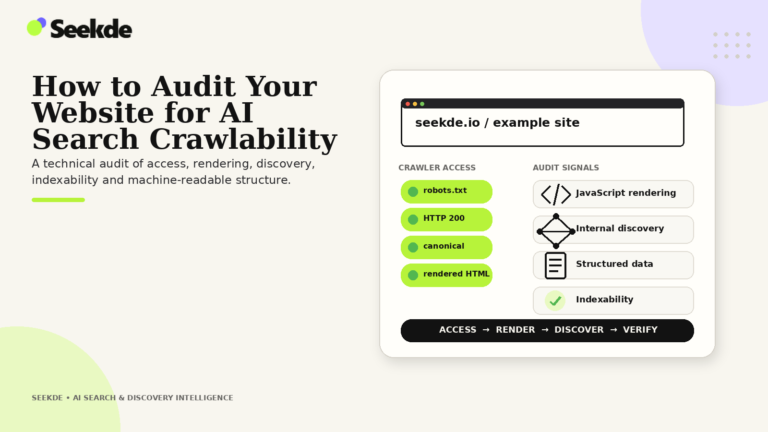
- How to Audit Your Website for AI Search Crawlability
- What Is Generative Engine Optimization?