Structuring articles for AI search requires architecting documents around discrete, self-contained semantic passages that automated retrieval engines can chunk, rerank, and synthesize without losing contextual meaning. Traditional SEO structure was optimized for human readers scanning pages and search engine spiders evaluating overall keyword density across an entire URL. Generative answer engines—such as Google AI Overviews, Perplexity, ChatGPT Search, and Microsoft Copilot—evaluate documents through passage-based chunking and neural embeddings.
When an AI retrieval pipeline processes an article, it breaks the document into semantic fragments (typically 200 to 500 tokens). If an article relies on sprawling narrative paragraphs, vague transitional subheadings, or answers separated by several hundred words of background filler, the chunker severs the connective tissue between questions and answers. As a result, neural cross-encoders assign low relevance scores to the isolated passages, and the page fails to earn attributed citations.
By implementing an AI-Optimized Article Wireframe, publishers ensure that every heading introduces an autonomous informational node, every summary block provides a machine-extractable answer, and every structured table delivers unambiguous entity relationships.
How Retrieval Chunkers Ingest Document Outlines
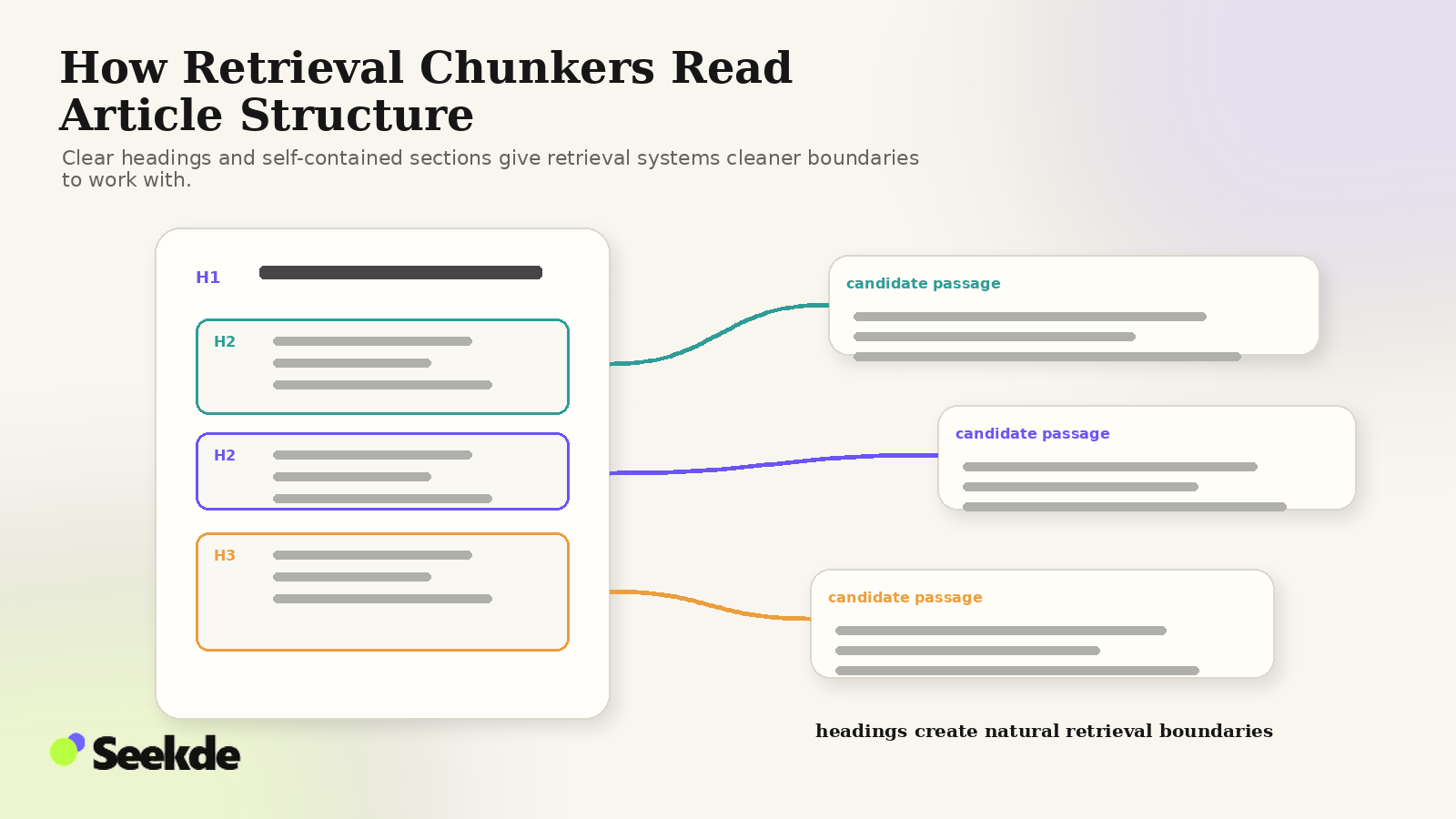
To design an effective document layout, technical authors must understand how automated chunkers segment HTML documents:
DOM Parsing Heading Boundary Splitting Passage Chunking Vector Embedding
H2 H3) (200-500 Tokens) (Cosine Scoring)
- Heading-Based Boundary Detection: Modern RAG ingestion frameworks (including LangChain, LlamaIndex, and proprietary search engine chunkers) prioritize semantic HTML heading tags (
<h1>,<h2>,<h3>) as primary section boundaries. - Context Window Slicing: Content beneath each heading is sliced into token windows. If an
<h2>section contains 1,500 words without subheadings, the chunker arbitrarily divides the section across sentence boundaries, often separating premises from conclusions. - Hierarchical Metadata Attachment: Advanced chunkers attach the document title and current
<h2>text as metadata headers to every chunk generated within that section. If your subheadings are generic ("Overview", "Key Insights", "Next Steps"), the attached metadata provides zero semantic context to the vector embedding.
According to research in passage retrieval architectures (Karpukhin et al., Dense Passage Retrieval for Open-Domain Question Answering), dense embeddings achieve the highest retrieval accuracy when passages are compact, topically homogeneous, and semantically self-contained.
The AI-Optimized Article Structural Wireframe
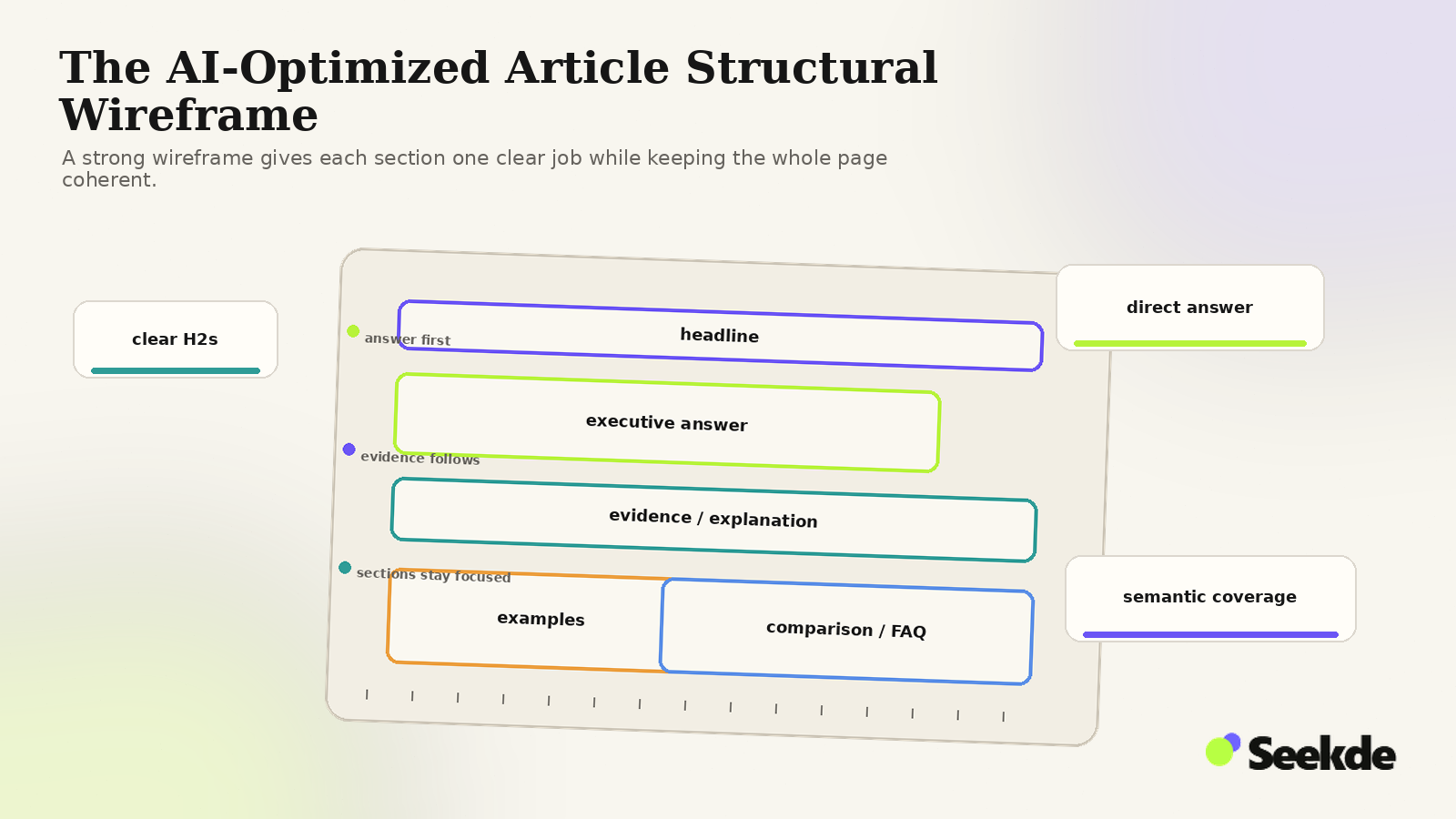
Seekde has codified the AI-Optimized Structural Wireframe—a document layout template engineered specifically to optimize passage extraction rates while maintaining an engaging reading experience for human users.
(Note: The AI-Optimized Structural Wireframe represents Seekde’s proprietary editorial methodology and practitioner recommendation for maximizing informational clarity. Generative search engines do not mandate specific heading counts, paragraph lengths, or formal page formats; rather, this structure aligns with documented passage retrieval and chunking behaviors.)
Exact Target Topic or Question
- Single H1 tag: Explicit target topic or question for retrieval indexing
Executive Answer Block
- Direct Answer Summary Paragraph (Bold, 40-60 words)
- Contextual Qualification Paragraph (Entity Context, 60-80 words)
Core Conceptual Node (H2)
- Autonomous Definition Paragraph (Self-contained, explicit nouns)
- Semantic HTML Comparison Table (Entities vs. Attributes)
Procedural Implementation (H2)
- Ordered Procedural List (<ol> with Step Titles)
- Code / Configuration Snippets (<pre><code> with syntax labels)
Quantitative Benchmarks (H2)
- Metric Highlight Box / Bulleted Parameter Definitions
- Explicit Sample Sizes, Dates, and Primary Source Citations
Diagnostic Checklist / QA (H2)
- Actionable Markdown Checkbox List
- Troubleshooting Comparison Table (Problem | Cause | Fix)
Related Authority Pathways (H2)
- Related Guides and Reference Specifications
- Semantic Internal Links to Cluster Hubs and Prerequisite Maps
Wireframe Component Breakdown
1. The Single Theme <h1> Hierarchy
A common structural error is deploying multiple <h1> elements across an article or placing an <h1> inside the article body content. Modern WordPress themes (including Seekde’s single.php) automatically render the post title as the single authoritative <h1> at the document root.
- Rule: The article body must contain zero
<h1>tags. - Heading Cascading: The body begins with an introductory answer block, followed by major topical divisions marked with
<h2>. Granular subtopics within an<h2>section must use<h3>. Never skip heading levels (e.g., jumping from<h2>directly to<h4>), as this disrupts the document outline tree constructed by web accessibility parsers and RAG chunkers.
2. The Executive Answer Block (The TL;DR Anchor)
Immediately following the page title, place a 40- to 60-word bolded paragraph that provides the direct, definitive answer to the query implied by the title.
<p><strong>A web page becomes citation-worthy in AI search when it provides
verified primary evidence, unique informational gain, and autonomous factual
propositions that retrieval-augmented models can safely synthesize without
hallucinating.</strong></p>
This paragraph serves as the primary extraction anchor for single-turn informational queries. When Google AI Overviews or ChatGPT Search attempts to provide a concise 2-sentence summary card, this block has the highest probability of being selected because its semantic similarity to the primary intent is maximized.
3. Descriptive, Question-Answering <h2> Heading Syntax
Generic subheadings destroy chunk metadata. Every <h2> should either explicitly name the entity and action or mirror a common search intent sub-query.
| Weak Heading (Low Semantic Value) | AI-Optimized Heading (High Semantic Value) | Why It Improves Retrieval |
|---|---|---|
## Overview |
## What Is AI Share of Voice? Core Definition and Scope |
Reranker metadata identifies the passage as an authoritative definition. |
## Technical Details |
## How JavaScript Rendering Affects Crawler Indexation Pipelines |
Attaches the specific operational mechanism (JS Rendering → Crawler Pipelines) to chunk embeddings. |
## Comparison |
## OAI-SearchBot vs. GPTBot: Permission Matrix and User-Agent Roles |
Explicitly indexes both entities and their functional comparison for fan-out queries. |
## Steps |
## 5-Step Protocol for Auditing robots.txt Rulesets |
Informs the model that the passage contains an ordered procedural sequence. |
4. Semantic Comparison Tables Over Narrative Lists
When an article compares features, permissions, or metrics across multiple entities, presenting the information as narrative text forces language models to parse complex linguistic syntax to extract associations.
Structuring the data in a native HTML <table> provides immediate, unambiguous cell-to-header relationships:
<table>
  <thead>
    <tr>
      <th>Feature Dimension</th>
      <th>Google AI Overviews</th>
      <th>ChatGPT Search</th>
      <th>Perplexity Sonar</th>
    </tr>
  </thead>
  <tbody>
    <tr>
      <td>Primary Crawler</td>
      <td>Googlebot</td>
      <td>OAI-SearchBot</td>
      <td>PerplexityBot</td>
    </tr>
    <tr>
      <td>Index Latency</td>
      <td>Hours to Days</td>
      <td>Real-time Bing API + Crawl</td>
      <td>Minutes to Hours</td>
    </tr>
  </tbody>
</table>
RAG parsers convert HTML tables into structured markdown or JSON representations during extraction, allowing answer models to output comparative tables directly into AI Overview response cards.
5. Code and Configuration Snippets with Syntax Delimiters
Technical configurations—such as robots.txt rules, JSON-LD schema markup, or terminal commands—must be housed inside standard <pre><code class="language-*"> blocks.
Do not wrap code in generic italicized prose or blockquotes. Syntax-delimited code blocks allow language models to recognize the text as an executable or declarative ruleset, preserving indentation, capitalization, and special characters (e.g., *, $, /) without corrupting the syntax.
Passage Segmentation: The 150-to-250 Word Chunking Rule
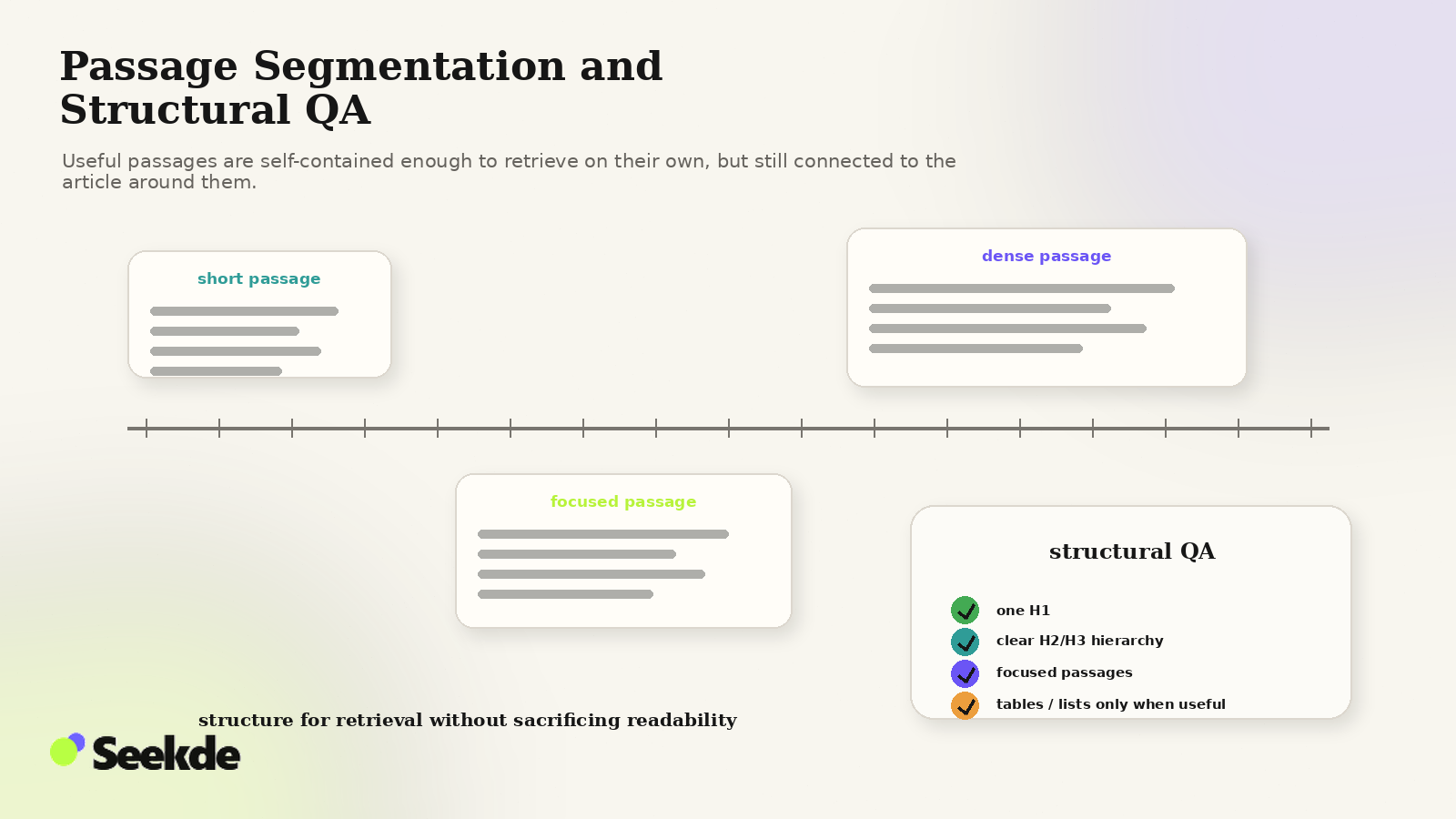
Because vector retrieval engines evaluate passages in chunks, the length and cohesion of your paragraphs directly govern retrieval success.
- Paragraph Length: Target 3 to 5 sentences (approximately 50 to 80 words) per paragraph. Avoid 200-word unbroken text blocks.
- Subsection Length: Keep total text under any individual
<h2>or<h3>between 150 and 300 words. If an explanation exceeds 350 words, divide it into logically nested<h3>subsections. - Topic Homogeneity: Each paragraph should express one central idea. Mixing three disparate topics into a single paragraph forces the vector embedding to represent a noisy average of multiple intents, lowering its cosine similarity score against specific sub-queries.
Architectural Comparison: Legacy SEO vs. AI Search Wireframe
| Structural Element | Legacy Organic SEO Pattern | AI Search Wireframe Pattern |
|---|---|---|
| Introductory Strategy | Long narrative lead, hook, personal anecdote, delayed answer to maximize dwell time. | Immediate bold answer block within first 50 words; background context follows. |
| Heading Structure | Vague, stylistic headings ("The Elephant in the Room", "Looking Ahead"). | Entity-rich, intent-answering headings ("How Token Limits Constrain Passage Retrieval"). |
| Data Presentation | Embedded infographics, unlabelled bullet lists, narrative paragraphs. | Machine-readable HTML tables with explicit column headers and units of measurement. |
| Pronoun Usage | Frequent relative pronouns (it, they, this framework) linking back to previous sections. |
Explicit noun repetition at paragraph boundaries to ensure standalone chunk autonomy. |
| Code & Config | Inline italicized text or screenshots of terminal windows. | Semantic <pre><code class="language-..."> code blocks with exact syntax. |
| Summary / Outro | Fluffy generic conclusions ("Wrapping Up: Why AI Matters"). | Actionable audit checklist, structured troubleshooting matrix, and technical resource links. |
Article Structural Quality Assurance Checklist
Prior to publishing or staging an article in the CMS, run this structural checklist:
- [ ] 1. Single Theme H1: The document contains zero
<h1>tags in the Markdown body. - [ ] 2. Immediate Direct Answer: The first 100 words contain a standalone, bolded direct answer to the title question.
- [ ] 3. Heading Hierarchy: All sections use
<h2>, subsections use<h3>, and no heading levels are skipped. - [ ] 4. Entity-Dense Subheadings: Every
<h2>and<h3>explicitly names the subject, process, or comparative entities. - [ ] 5. Chunk Autonomy: Opening sentences of subsections avoid vague pronoun chains (
This,It,These things). - [ ] 6. Tabular Formatting: Multi-attribute comparisons are structured in native HTML
<table>elements with<th>headers. - [ ] 7. Code Delimitation: All configurations, scripts, and commands are enclosed in language-tagged
<pre><code>blocks. - [ ] 8. Balanced Section Length: Subsections remain between 150 and 300 words, preventing oversized or undersized chunks.
- [ ] 9. Actionable Closure: The guide concludes with a concrete procedural checklist, diagnostic rubric, or troubleshooting table.
- [ ] 10. Crawlable Markup: All content is rendered in clean, server-side semantic HTML without requiring JavaScript execution to display text.
Summary: Designing for Machine Extraction and Human Utility
Structuring content for generative search is not about writing for robots at the expense of humans. Clean document architecture, immediate direct answers, informative subheadings, and structured comparison tables substantially improve the user experience for human professionals who need rapid, authoritative answers.
By structuring web articles around clear passage boundaries and entity-rich hierarchies, publishers ensure that their content serves human readers immediately while providing AI search engines with the exact structural clarity required for high-confidence citation extraction.
Related Guides and Technical Wireframes
- How to Create Content AI Search Engines Can Cite
- What Makes a Web Page Citation-Worthy?
- How to Refresh Existing Content for AI Search
- Do Statistics and Sources Improve AI Citations?
- Schema Markup for AI Search: What Actually Matters
- How JavaScript Rendering Can Affect AI Crawlers
- How AI Search Engines Find, Retrieve and Cite Web Content