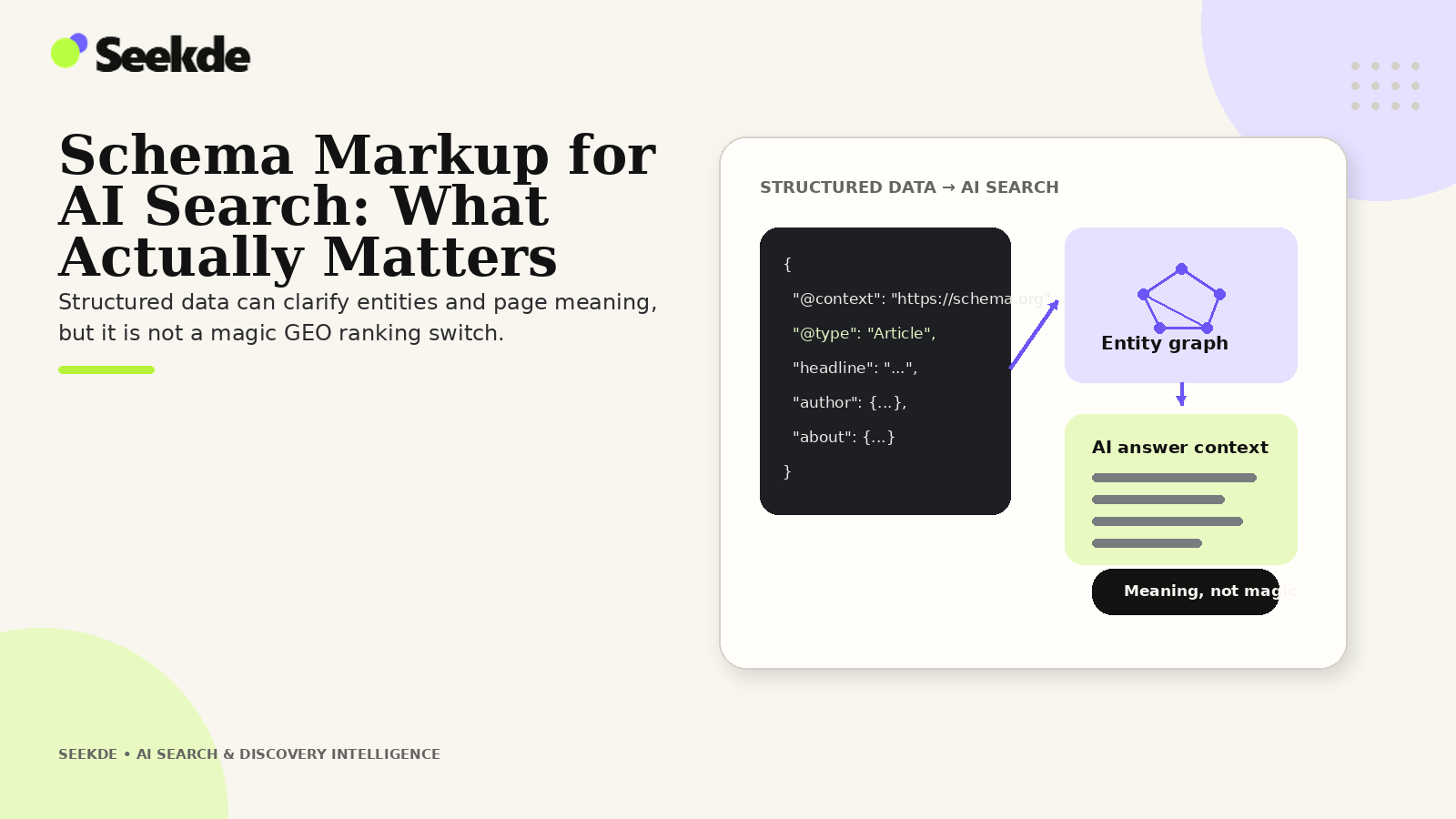
Structured data helps generative AI search engines by providing explicit, machine-readable disambiguation of entities, attributes, and content relationships, but it is not a proprietary "AI schema" that directly forces answer citations. Neither Google, OpenAI, Microsoft, nor Perplexity operates a proprietary schema format for artificial intelligence. In fact, Google explicitly states in its Search Central documentation that AI Overviews and AI Mode do not require any unique or specialized structured data beyond standard web search eligibility.
However, dismissing structured data as irrelevant to AI search represents an equal and opposite misconception. Large language models and Retrieval-Augmented Generation (RAG) pipelines extract knowledge from web pages through both unstructured text parsing and structured entity graphs. Clean, standards-compliant JSON-LD markup removes ambiguity, connects brands to verified knowledge bases via sameAs entity links, clarifies authorship credentials, and structures key facts into deterministic attribute-value pairs. This guide provides a practical, evidence-grounded framework for deploying Schema.org structured data to maximize discoverability across AI search engines.
The Myth of the "GEO Schema" vs. Technical Reality
As interest in Generative Engine Optimization (GEO) has grown, some marketing agencies have begun advertising proprietary "GEO schemas," "ChatGPT schemas," or "LLM-optimized microdata."
Technical teams must evaluate these claims against platform reality:
The "GEO Schema" Myth
- "Proprietary AI schema tags"
- "Guarantees AI citations"
- "Directly forces LLM inclusion"
- "Bypasses standard search quality"
The Technical Reality
- Uses standard Schema.org vocabulary
- Resolves named entity disambiguation
- Supplies clean attribute-value pairs
- Qualifies pages for rich SERP features
1. Zero Proprietary AI Formats
All major search systems—including Google AI Overviews, Microsoft Copilot, ChatGPT Search, and Perplexity—rely on the open-source Schema.org vocabulary encoded as JSON-LD (JavaScript Object Notation for Linked Data). There is no recognized AIArticle, GEORatings, or PromptOptimization schema type. Attempting to inject invented properties into JSON-LD scripts simply triggers validation warnings in testing tools without producing any algorithmic benefit.
2. What Platform Documentation Actually States
Google Search Central’s structured data guidelines confirm that structured data is used to understand page content and enable rich search results. Regarding generative features, Google clarifies that eligibility is tied to overall index eligibility, web search quality, and relevance. Structured data makes content comprehension more efficient for crawlers, but it is an enablement layer rather than an autonomous citation guarantee.
To understand how retrieval systems evaluate content beyond markup, see our analysis of How AI Search Engines Find and Cite Content.
How Generative Engines Use Structured Data in RAG Pipelines
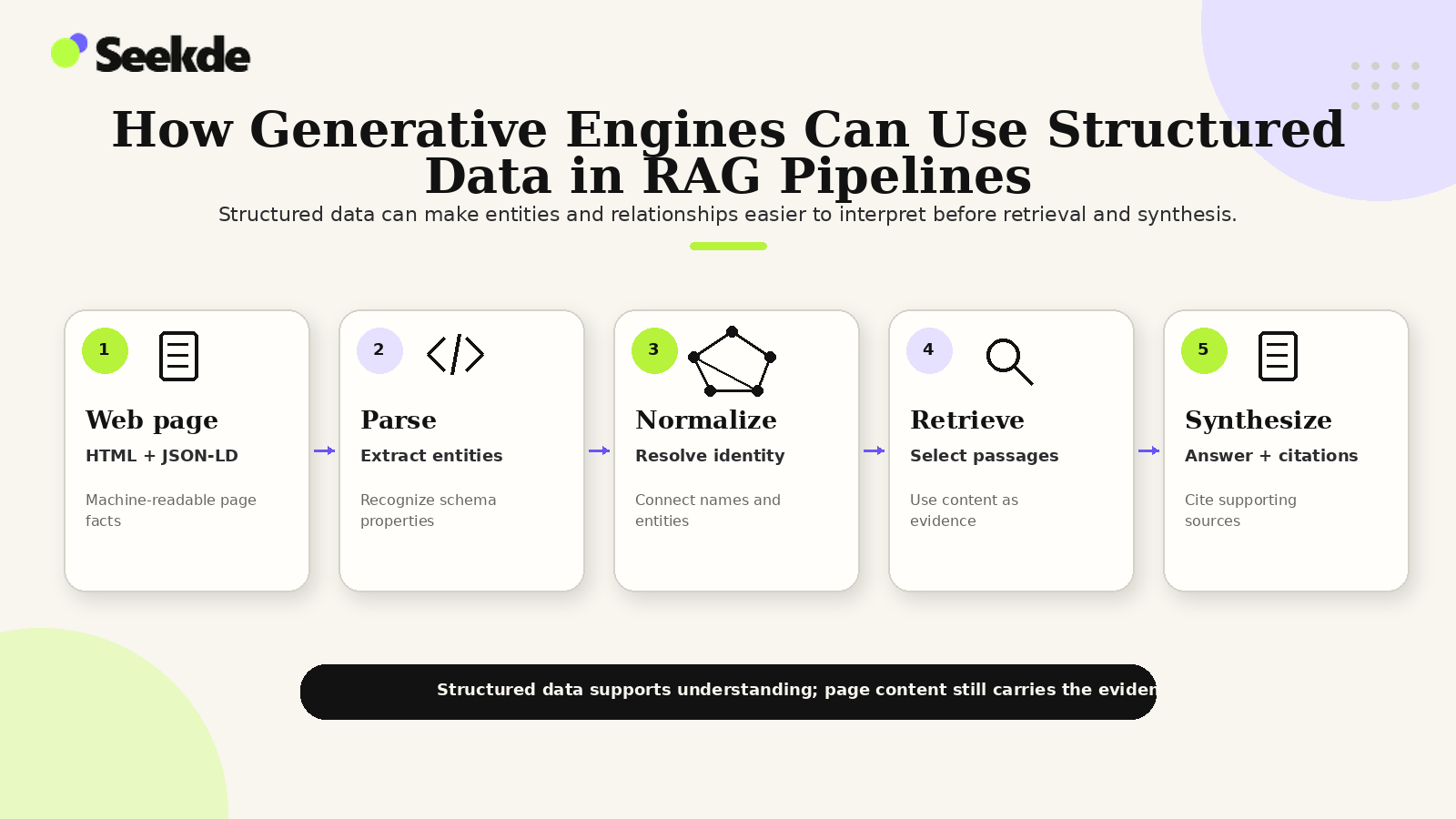
When an answer engine processes a user query, its retrieval engine executes multi-query fan-out across the web index to gather candidate passages. During this process, structured data assists neural systems at three distinct architectural stages:
1. Entity Disambiguation Connects brand, author, and topics to authoritative Knowledge Graph entities via Schema.org sameAs identifiers. 2. Attribute Extraction
publication dates, modified dates, software specs, pricing, and step-by-step procedures. 3. Contextual Verification Validates factual consistency between visible page copy and machine-readable JSON-LD entity definitions.
Stage 1: Entity Disambiguation and Knowledge Graph Grounding
Language models operate on probabilistic associations. When a model encounters a term like "Seekde," it must determine whether the word refers to an analytics platform, an acronym, a geographic location, or an unrelated entity.
By defining an explicit Organization or Product entity with sameAs properties linking to Wikipedia, Wikidata, official GitHub repositories, or verified social profiles, structured data allows search algorithms to ground the entity deterministically within their knowledge graphs.
Stage 2: Deterministic Attribute Extraction
Unstructured prose often contains conversational phrasing that can be misinterpreted by text scrapers. JSON-LD explicitly maps key facts into unambiguous key-value pairs:
- When was the document published? (
datePublished) - When was it substantively updated? (
dateModified) - Who authored the research, and what are their verified credentials? (
authorasPerson) - What organization publishes the material? (
publisherasOrganization)
When an answer engine summarizes recent industry events, clear dateModified markup helps the retrieval model verify freshness without relying on heuristic date scrapers.
Stage 3: Verification of Factual Consistency
Search engines run consistency checks between structured JSON-LD payloads and rendered HTML text. If the structured data claims a software product costs $49/month while the visible page states $79/month, the contradiction introduces a factual defect that harms retrieval trust. Aligned markup reinforces factual reliability.
Ranked Priority: The Schema Types That Actually Matter for AI Search
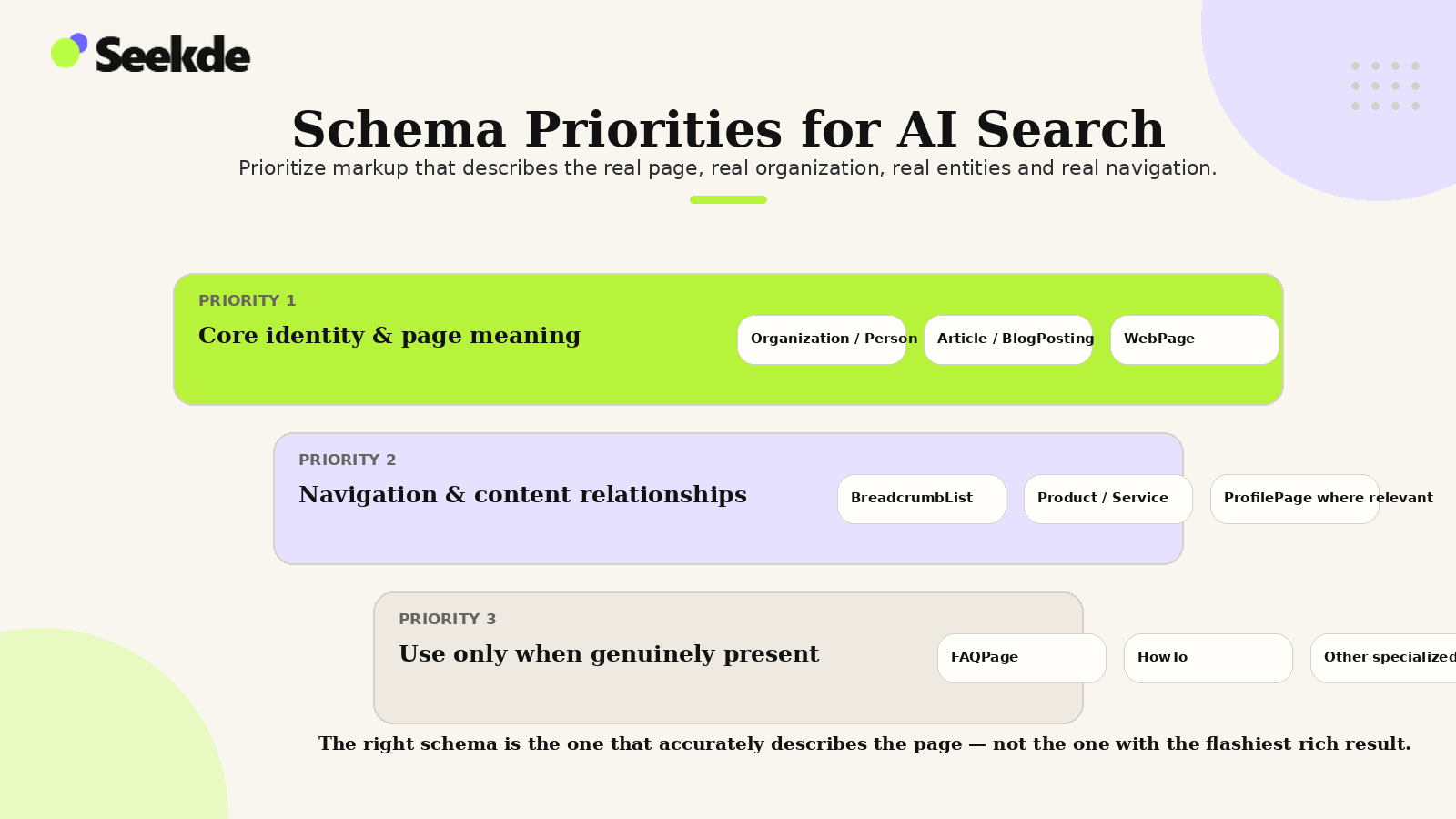
Rather than cluttering pages with dozens of obscure microdata types, technical teams should focus on implementing a clean, interconnected entity graph using these high-impact types:
| Priority Rank | Schema.org Type | Deployment Location | Documented Benefit & AI Retrieval Role |
|---|---|---|---|
| P1 (Core) | Organization |
Homepage, About page | Disambiguates brand identity, official logos, parent organizations, and sameAs entity links |
| P1 (Core) | WebSite |
Homepage | Establishes site-level identity, official name, and internal search capabilities |
| P1 (Core) | Article / BlogPosting |
All editorial and guide pages | Defines headline, visible author, publisher, exact publication dates, and primary image |
| P2 (Structure) | BreadcrumbList |
All spoke and category pages | Communicates hierarchical site taxonomy and parent-child topic relationships |
| P2 (Specialized) | TechArticle / HowTo |
Technical guides, runbooks | Formats procedural, step-by-step workflows for direct step-extraction in generated answers |
| P3 (Entity) | SoftwareApplication / Product |
Dedicated product pages | Provides technical specifications, application categories, and verified pricing |
| Caution | FAQPage |
Informational articles | Restricted / Deprecated for SERP rich results by Google; use visible HTML FAQs instead |
1. Organization Schema
The Organization entity represents the bedrock of brand authority. It tells search engines who is speaking and links the domain to established real-world profiles:
{
  "@context": "https://schema.org",
  "@type": "Organization",
  "@id": "https://seekde.io/#organization",
  "name": "Seekde",
  "url": "https://seekde.io",
  "logo": {
    "@type": "ImageObject",
    "@id": "https://seekde.io/#logo",
    "url": "https://seekde.io/assets/images/seekde-logo.png",
    "caption": "Seekde AI Search Analytics"
  },
  "sameAs": [
    "https://twitter.com/seekde_io",
    "https://www.linkedin.com/company/seekde",
    "https://github.com/seekde"
  ],
  "description": "Seekde provides enterprise analytics, visibility measurement, and intent exploration for generative AI search engines."
}
2. Article / BlogPosting Schema
For technical publications, news sites, and blogs, Article or BlogPosting markup anchors editorial credibility. Crucially, the markup should link directly to the Organization schema via an @id reference rather than nesting duplicate, unverified publisher objects:
{
  "@context": "https://schema.org",
  "@type": "BlogPosting",
  "@id": "https://seekde.io/ai-crawlers-explained/#article",
  "isPartOf": {
    "@type": "WebPage",
    "@id": "https://seekde.io/ai-crawlers-explained/"
  },
  "headline": "AI Crawlers Explained: Googlebot, OAI-SearchBot, GPTBot and More",
  "description": "A comprehensive technical guide to AI search crawlers, model training scrapers, robots.txt directives, and verification methodologies.",
  "inLanguage": "en-US",
  "mainEntityOfPage": "https://seekde.io/ai-crawlers-explained/",
  "datePublished": "2026-09-06T08:00:00+00:00",
  "dateModified": "2026-09-06T18:45:00+00:00",
  "author": {
    "@type": "Person",
    "name": "Seekde Editorial Team",
    "url": "https://seekde.io/methodology/"
  },
  "publisher": {
    "@type": "Organization",
    "@id": "https://seekde.io/#organization"
  }
}
3. BreadcrumbList Schema
Breadcrumb markup maps the logical position of a document within a broader topical cluster. This reinforces topic clustering and helps retrieval algorithms understand context:
{
  "@context": "https://schema.org",
  "@type": "BreadcrumbList",
  "itemListElement": [
    {
      "@type": "ListItem",
      "position": 1,
      "name": "Home",
      "item": "https://seekde.io"
    },
    {
      "@type": "ListItem",
      "position": 2,
      "name": "Crawlers & Tech",
      "item": "https://seekde.io/blog/"
    },
    {
      "@type": "ListItem",
      "position": 3,
      "name": "AI Crawlers Explained",
      "item": "https://seekde.io/ai-crawlers-explained/"
    }
  ]
}
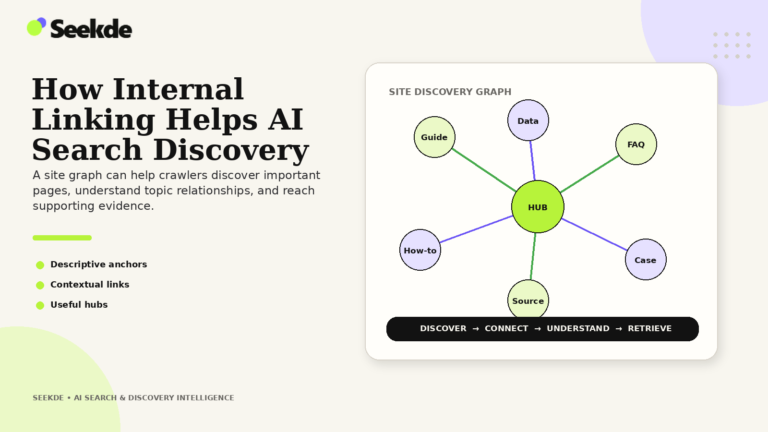
To understand how breadcrumbs and internal link hierarchies guide AI crawlers, read How Internal Linking Helps AI Search Discovery.
What Happened to FAQPage Schema?
Many legacy SEO checklists instruct webmasters to place FAQPage schema on every article. In the modern AI search environment, this practice is outdated and potentially counterproductive:
- Google’s Deprecation of FAQ Rich Results: In August 2023, Google severely restricted FAQ rich results in SERPs, limiting them primarily to authoritative government and health resources, and subsequently phasing them out for general commercial websites.
- Spam Flagging Risk: Injecting extensive
FAQPageschema that duplicates or fabricates questions not visibly presented in the main article body violates Google’s structured data quality guidelines and can trigger manual action penalties. - The Correct AI Approach: Maintain clean, visible FAQ sections in the body text formatted with standard semantic HTML (
<h2>Frequently Asked Questions</h2>,<h3>Question</h3>,<p>Answer</p>). RAG chunking algorithms extract question-and-answer pairs directly from clean DOM text without needing deprecated schema tags.
Architectural Principles for AI-Ready Structured Data
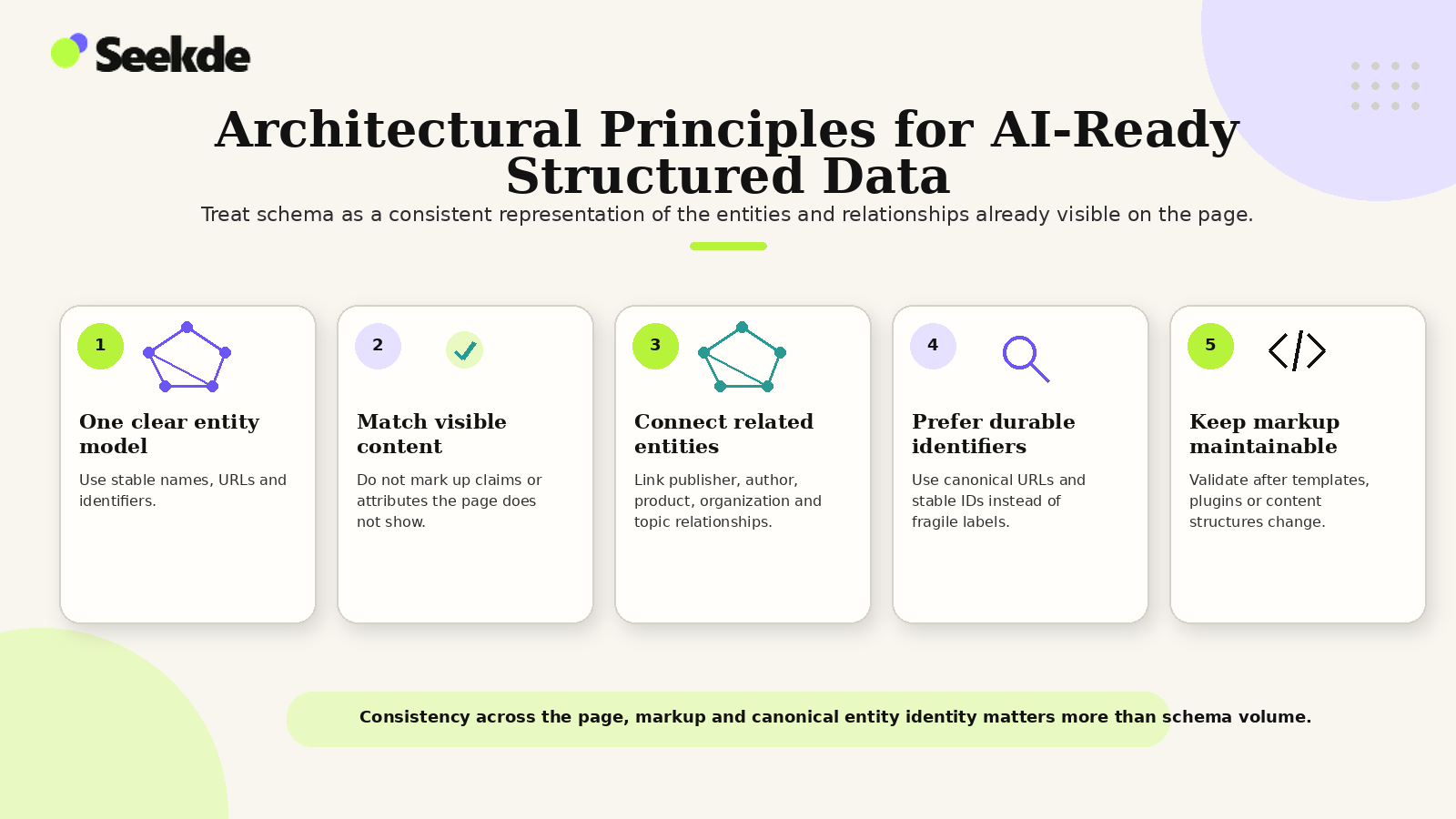
To ensure your structured data acts as an asset rather than a liability, adhere to these four core engineering principles:
1. Visible Parity
- Markup must exactly
- match rendered HTML.
- No hidden promotional
- metadata.
2. Entity Graph Linking
- Use @id references to
- connect Article, Author
- and Organization into a
- unified linked graph.
3. Honest Timestamps
- dateModified must
- , reflect real editorial
- updates, not automated
- timestamp scripts.
1. The Visible Content Parity Rule
Google’s Structured Data General Policies mandate that JSON-LD markup must represent content that is readily visible to a human user visiting the page.
Never include:
- Promotional claims or keyword stuffing inside schema
descriptionorabstractfields that do not exist in the visible copy; - Fabricated author profiles or fake user review scores;
- Pricing or availability details that conflict with visible page text.
Search engines penalize sites that serve misleading metadata to bots while displaying different facts to users.
2. Entity Graph Linking via @id References
A frequent error in WordPress and headless CMS environments is generating fragmented, unlinked schema objects. An SEO plugin might output an isolated Article object, while the theme outputs an isolated Organization object, and a header widget outputs an unlinked BreadcrumbList.
In an interconnected JSON-LD graph, entities reference each other using unique URI identifiers (@id):
- The
Articledefines its publisher as{"@id": "https://example.com/#organization"}; - The
BreadcrumbListis marked asisPartOfthe canonical page URL; - The author points to a recognized
Personentity profile.
This unified graph enables knowledge engines to traverse relationships seamlessly.
3. Maintain Honest Timestamp Discipline
In generative search optimization, content freshness is an important retrieval signal. However, configuring CMS automation to artificially bump dateModified on a daily schedule without making substantive content revisions is actively detected and flagged by search engines.
- Set
datePublishedto the exact UTC timestamp of original release. - Update
dateModifiedonly when substantive editorial updates, factual revisions, or new primary data have been added to the article.
4. Eliminate Duplicate Conflicting Schema in WordPress
In WordPress sites running plugins like Yoast, Rank Math, or custom theme templates, multiple plugins frequently output competing schema graphs simultaneously. If one plugin marks the author as "Jane Doe" while the theme marks the author as "Admin", the conflicting signals degrade search engine confidence. Audit rendered source code to ensure that only a single, authoritative JSON-LD graph is emitted.
Testing, Validation, and Diagnostic Protocol
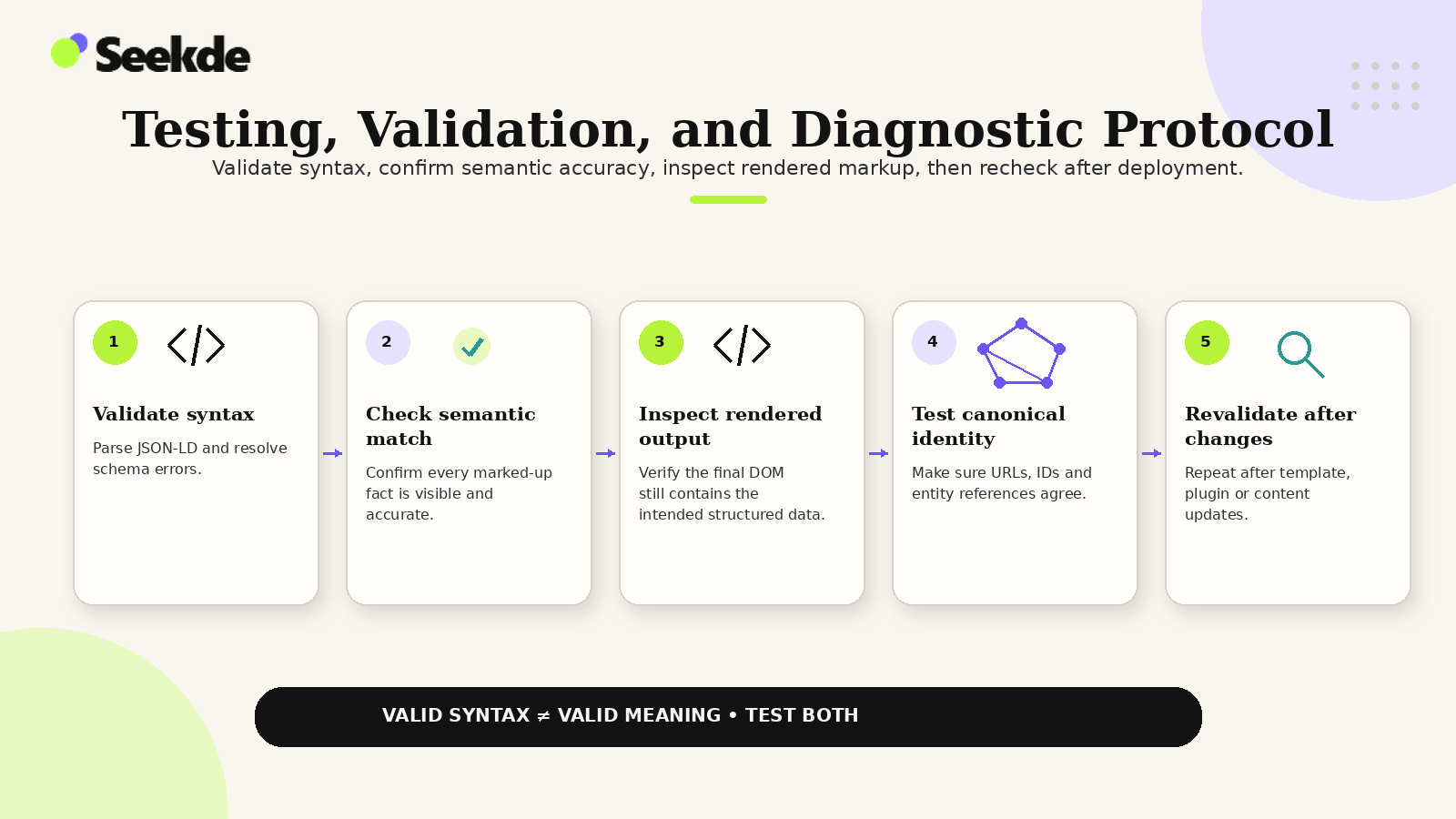
Before deploying structured data to production, technical teams must validate syntax and semantic accuracy across multiple diagnostic layers:
Step 1: Validate Schema Syntax via CLI
You can test that your JSON-LD script is syntactically valid JSON using standard terminal tools:
# Extract JSON-LD script from rendered page and validate syntax
curl -sL https://seekde.io/ai-crawlers-explained/ |
grep -o '<script type="application/ld+json">.*</script>' |
sed -e 's/<script type="application/ld+json">//g' -e 's/</script>//g' |
jq . > /dev/null && echo "JSON-LD Syntax: VALID" || echo "JSON-LD Syntax: INVALID"
Step 2: Use Official Schema.org Validator
Submit the target URL or code snippet to the Schema Markup Validator. This tool evaluates compliance against the full Schema.org technical vocabulary and reports syntax errors, missing brackets, or invalid property types.
Step 3: Run Google Rich Results Test
Submit the URL to Google’s Rich Results Test. This test confirms whether Google recognizes the markup and whether the page qualifies for specific search enhancements.
Step 4: Verify in Google Search Console
Monitor the Enhancements section in Google Search Console. Any unparsable structured data, missing required fields (such as missing image or datePublished on Article), or semantic violations will be flagged with specific line numbers.
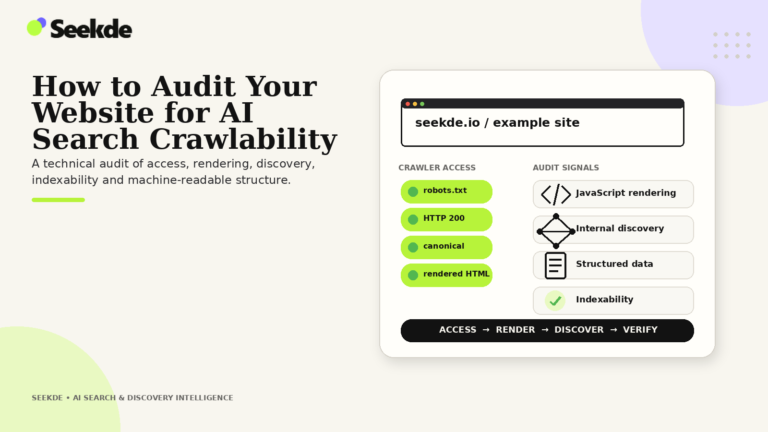
For an end-to-end audit methodology covering status codes, JavaScript execution, and crawler accessibility, see our complete guide on How to Audit Your Website for AI Search Crawlability.
Summary: Key Takeaways for Web Engineers
- No Magic AI Schema: Standard Schema.org JSON-LD is the universal specification; do not waste resources on fictional "GEO" or "ChatGPT" schemas.
- Prioritize Core Types: Build a coherent, interconnected graph using
Organization,WebSite,Article, andBreadcrumbList. - Use Explicit @id References: Connect child and parent objects explicitly using persistent, absolute URI identifiers.
- Link to External Entities: Disambiguate key topics and organizations via
sameAslinks to Wikidata, Wikipedia, and official profiles. - Phase Out FAQ Schema: Rely on semantic HTML for FAQs rather than deprecated
FAQPagerich result markup.