A generative answer engine is a multi-stage information retrieval and synthesis system designed to translate a user query into a coherent, cited natural-language response. Rather than relying on a single neural network or querying a static database, modern answer engines coordinate an orchestrated pipeline: query interpretation and decomposition, candidate retrieval, reranking, context assembly, language-model generation, source attribution, and factual grounding.
Crucially, implementations vary across platforms. Systems such as Google AI Overviews, OpenAI’s search features, Perplexity, and Microsoft Copilot resolve retrieval-augmented generation under distinct engineering constraints, latency budgets, and index ownership models. However, they share a common architectural pattern: connecting foundation models to external retrieval indexes so natural-language answers are grounded in verifiable, current web evidence.
1. What Is a Generative Answer Engine?
A generative answer engine bridges two established computing paradigms: conventional ranked-link search engines and standalone foundation language models.
Conventional search engines operate on inverted document indexes. Algorithms score documents using lexical formulas (such as BM25) and link-based authority signals, returning a ranked list of links with snippets. The user bears the burden of reading, cross-referencing, and synthesizing information across multiple pages.
Standalone foundation models operate on parametric knowledge stored within static neural weights. They generate fluent prose immediately, but their knowledge is frozen at a training cutoff date. Standalone models cannot inspect live primary sources to verify assertions, leading to confident hallucinations when queried on facts outside their training distribution.
User Query → Inverted Index Scoring → Ranked Links (User synthesizes answer) User Prompt → Static Neural Weights → Parametric Text (No live sources; cutoff risk)
User Query → Dynamic Index Retrieval → Context Assembly → Grounded Model Synthesis → Cited Answer
Generative answer engines combine external retrieval with the semantic reasoning of foundation models. By fetching relevant documents and injecting them into the model’s working context window, the system transforms the language model from an imperfect knowledge storehouse into a synthesis engine grounded in external evidence.
In practice, commercial search platforms rarely treat these paradigms as mutually exclusive. Modern engines operate hybrid interfaces: generating conversational answers for complex informational queries while serving traditional link lists for navigational searches, or displaying an overview flanked by source cards and shopping modules.
2. Query Understanding, Rewriting, and Decomposition
The retrieval pipeline begins with query interpretation. Raw user prompts are frequently conversational, incomplete, or multifaceted. Passing raw conversational text directly to an index often yields poor retrieval precision due to query dilution.
Answer engines process inputs through three primary stages:
- Intent Classification: Determining whether the prompt requires live web retrieval, calculation, transactional routing, or can be answered reliably from parametric memory.
- Query Normalization and Rewriting: Stripping conversational filler, resolving pronouns from prior chat turns, and expanding shorthand into clean search queries.
- Query Decomposition (Fan-Out): Complex questions often encompass distinct sub-topics that cannot be satisfied by any single search query.
When a query contains multiple interdependent dimensions, the engine decomposes the prompt into parallel sub-queries. For instance, comparing vector databases against relational databases for semantic search may require separate targeted lookups for indexing speed, memory consumption, and hybrid query latency.
Dispatching these decomposed sub-queries simultaneously allows the engine to retrieve focused candidate documents across all facets of the prompt. To explore how sub-query dispatch operates in commercial environments, see What Is Query Fan-Out in AI Search?.
3. Retrieval and Candidate-Source Discovery
Once sub-queries are generated, the engine queries an underlying index to retrieve an initial candidate document pool. In retrieval literature and production RAG designs, this pool typically ranges from dozens to hundreds of candidate documents, balancing recall against downstream processing latency. Candidate discovery generally relies on three core retrieval paradigms:
Lexical Retrieval (Sparse)
Lexical retrieval searches inverted indexes using term-matching algorithms such as BM25. It represents queries and documents as sparse vectors where dimensions correspond to vocabulary terms.
- Strengths: High precision for exact keywords, technical acronyms, model numbers, and proper nouns. It executes in single-digit milliseconds with low computational overhead.
- Limitations: Susceptible to vocabulary mismatch. If a query uses "latency" while an authoritative document discusses "response delay," lexical matching may fail despite identical concepts.
Semantic Retrieval (Dense)
Semantic retrieval maps queries and documents into continuous vector spaces using neural bi-encoders (such as Dense Passage Retrieval). Proximity in this space—measured via cosine similarity or inner product—reflects conceptual relatedness rather than exact word overlap.
- Strengths: Resolves vocabulary mismatch by recognizing topical intent and semantic equivalents.
- Limitations: Higher computational cost for vector index maintenance and approximate nearest-neighbor search (such as HNSW). It can also struggle to distinguish specific serial numbers or rare tokens absent from the embedding model’s training data.
Hybrid Retrieval
Modern answer engines frequently combine sparse and dense retrieval using algorithms such as Reciprocal Rank Fusion (RRF). By combining candidate lists from both approaches, the system captures both precise keyword matches and broader thematic concepts.
Candidate retrieval is bounded by crawler discovery and indexing policies. While platforms with existing web search engines (such as Google) query proprietary web indexes, standalone answer engines often query commercial search APIs (such as the Bing Search API) supplemented by custom real-time fetching bots. The mechanics of index discovery and extraction are examined in How AI Search Engines Find, Retrieve and Cite Web Content, while the user-agents and fetch behaviors governing discovery are analyzed in AI Crawlers Explained.
4. Ranking and Reranking: Selecting Evidence
Retrieving candidate documents is not the same as selecting evidence for synthesis. First-stage retrieval prioritizes recall, returning dozens or hundreds of URLs. Feeding entire candidate pages into a language model would exceed practical context window limits, increase inference latency, and introduce irrelevant text.
To distill candidate documents into authoritative evidence, answer engines frequently utilize a two-stage retrieval architecture:
Raw crawled index of web pages across the search engine corpus.
First-Stage Retrieval: Dozens to hundreds of candidate documents selected via sparse/dense matching.
Document Chunking: Discrete semantic chunks extracted around heading boundaries.
Second-Stage Neural Reranker: Top high-confidence subset selected for generative model context.
Passage Segmentation
Answer engines do not evaluate multi-thousand-word web pages as single blocks. Ingestion pipelines segment documents into discrete passages or token windows (often 100 to 300 words in common chunking heuristics), discarding non-informational boilerplate like navigation bars and footers. This allows the retrieval system to evaluate focused paragraphs independently rather than scoring an entire multi-topic document.
Neural Reranking
In two-stage retrieval architectures, candidate passages can be rescored by a neural reranker, such as a cross-encoder model. Unlike bi-encoders that encode queries and documents independently into vectors, a cross-encoder processes the query and candidate passage simultaneously through transformer cross-attention layers. This allows the model to capture fine-grained token-level interactions that single-vector representations miss, scoring direct answer relevance with higher precision.
Rerankers prioritize passages that directly resolve the sub-query, penalizing vague or repetitive text. Because cross-attention scales quadratically with input sequence length, running cross-encoders across an entire multi-billion-page index is computationally prohibitive; applying them only to a filtered candidate pool represents a common engineering compromise between latency and precision.
5. Context Assembly and Working Memory Management
Once top-ranked passages are selected (typically a curated subset of high-confidence evidence), the engine constructs the prompt context for the foundation model:
- Context Window Economics: Even as modern foundation models expand support for long context windows (often exceeding 100,000 tokens), production answer engines face strict operational trade-offs. Expanding context length increases latency and computational costs, while introducing extraneous noise. In practice, system architects often constrain working retrieval context to a curated subset of high-confidence evidence rather than flooding the model with raw candidate text.
- Mitigating Attention Degradation: Research on transformer attention dynamics—notably the "Lost in the Middle" phenomenon documented by Liu et al. (2023)—demonstrates that language models retrieve information most reliably when key evidence is positioned near the beginning or end of the input context, while facts buried in the middle suffer from degraded recall. In retrieval-augmented system design, context construction algorithms often consider passage ordering heuristics to ensure critical evidence is not obscured within long input prompts.
- Deduplication and Diversity: When multiple sources repeat identical statements, the engine collapses redundant passages to conserve tokens. When sources report conflicting numbers or interpretations, the assembler includes diverse passages so the model can acknowledge the discrepancy.
6. Answer Generation and Neural Synthesis
In the generation stage, the foundation model synthesizes an answer from a structured prompt containing system instructions, assembled context passages, and user query history.
System instructions enforce grounding, requiring the model to rely strictly on provided passages and acknowledge missing information. The model’s task is synthesis: summarizing multiple viewpoints, extracting key figures, and constructing a coherent narrative.
The primary engineering challenge is preventing hallucination, which occurs through two main mechanisms:
- Parametric Leakage: The model’s pre-trained weights override retrieved evidence, introducing outdated or conflicting information.
- Ungrounded Extrapolation: The model generates unsupported logical leaps or invents details absent from both the context and facts.
Engineers constrain these errors through low generation temperatures, structured decoding parameters, and preference-tuning techniques designed to penalize ungrounded statements.
7. Citation and Source Attribution
A crucial architectural reality is that retrieval does not guarantee citation. An answer engine may crawl a URL, retrieve its passages, and inject them into the context window—yet never display a link to that page in the user interface.
Initial broad retrieval pool filtered from search index.
Reranking & Passage Filtering: Highest scoring semantic passages passed into prompt context.
Generative Synthesis: Supporting sources actively referenced by the LLM during answer synthesis.
Attribution Verification Layer: Verified factual citations rendered as clickable cards or footnotes.
Note: The numbers above represent a conceptual illustration of sequential filtration; actual candidate volumes and visible citation counts vary widely based on interface design, query intent, and platform policies.
In natural language processing and RAG research, citation attribution is typically approached through two primary paradigms:
Token-Level Inline Citation
The synthesis model emits citation tokens (such as [1] or anchor tags) directly during text generation, referencing numbered passages in the context. While computationally efficient, this method can occasionally suffer from token drift, where a reference is attached to the wrong clause.
Post-Generation Attribution Alignment
An independent verification model—often an entailment classifier—evaluates each generated sentence against the retrieved passages. If a passage logically entails the assertion in the sentence, the system links that source. If no passage supports the claim, the citation is omitted or the sentence is edited.
While commercial engines may deploy proprietary hybrids or custom heuristic pipelines, these two paradigms illustrate how systems solve the mapping between generated claims and source documents.
For an examination of how unlinked brand presence differs from clickable citations, see AI Citations vs Brand Mentions: What’s the Difference?. Practical criteria for passage quotability are detailed in What Makes a Web Page Citation-Worthy?.
8. Grounding, Validation, and Answer Quality Verification
Before delivering an answer, robust engines pass the text through verification guardrails:
- Natural Language Inference (NLI): Automated verification models decompose the generated response into discrete claims, checking whether each is entailed, contradicted, or unsupported by the retrieved passages. If ungrounded claims exceed a safety threshold, the system triggers re-prompting or falls back to traditional search results.
- Handling Conflicting Evidence: When reputable sources disagree (such as differing financial estimates), sophisticated engines convey this uncertainty (e.g., "Estimates range from X according to Source A to Y according to Source B") rather than hallucinating an arbitrary compromise.
- Limits of Grounding: Grounding ensures the model aligns with retrieved documents; it does not ensure that external documents are objectively accurate. If top-ranked search results contain errors or outdated facts, the answer engine will faithfully reflect those inaccuracies.
9. A Simplified Reference Architecture
While commercial implementations diverge in proprietary details, the conceptual architecture of a generative answer engine can be modeled as an eight-stage pipeline:
The table below outlines the primary purpose, typical inputs, and expected outputs across each stage:
| Stage | Main Purpose | Typical Input | Typical Output |
|---|---|---|---|
| 1. Query Understanding | Interpret intent, normalize phrasing, and decompose complex prompts. | User prompt and conversational context. | Normalized search strings and sub-queries (fan-out). |
| 2. Candidate Retrieval | Maximize recall across indexed web documents at low latency. | Sub-query strings. | Candidate document pool (e.g., dozens to hundreds of candidate URLs; varies by system). |
| 3. Passage Chunking | Segment long documents into discrete semantic units, removing boilerplate. | Document HTML and raw text. | Candidate passages (discrete semantic chunks or sliding token windows). |
| 4. Neural Reranking | Score answer relevance and evidence quality via cross-attention. | Candidate passages and query. | Top-ranked evidence passages (curated high-confidence subset). |
| 5. Context Assembly | Structure prompt working memory, placing key evidence at boundaries. | Top-ranked passages and metadata. | Formatted context block with strategic passage ordering. |
| 6. Answer Generation | Synthesize information across passages into a cohesive response. | Context block and system instructions. | Draft natural-language response. |
| 7. Source Attribution | Map specific assertions to supporting passages and URLs. | Draft response and source metadata. | Attributed text with validated citation links. |
| 8. Grounding Validation | Check factual entailment, detect hallucinations, and enforce safety. | Generated answer and source evidence. | Verified answer delivered to interface. |
Note: The stages, candidate volumes, and chunk sizes above represent a conceptual reference model based on common retrieval-augmented generation patterns. Proprietary commercial platforms customize, combine, or reorder these stages to meet specific product requirements.
10. Why Architectures Differ Between Platforms
Commercial answer engines vary considerably based on several operational trade-offs:
- Index Ownership: A platform’s search foundation shapes its retrieval pipeline. Search engines with extensive crawl infrastructures (such as Google) integrate answer generation directly with their existing web index, Knowledge Graph, and core ranking systems. Other conversational platforms leverage partnerships with established search index APIs (such as Microsoft Bing) while deploying custom real-time retrieval bots (such as OpenAI’s OAI-SearchBot or PerplexityBot) to fetch and parse fresh target pages.
- Latency Budgets: A standalone conversational assistant can take several seconds to stream an answer. In contrast, an answer module embedded on a mainstream search results page must adhere to strict millisecond latency budgets to preserve Core Web Vitals, relying heavily on pre-computation and aggressive caching.
- Retrieval Depth (Single-Shot vs. Multi-Hop): Simple systems execute single-shot retrieval: decomposing a query, retrieving documents, and generating an answer in one pass. Advanced systems employ iterative agents that evaluate initial findings, identify gaps, and dispatch secondary searches before generating an answer.
- Interface and Citation Strategy: Some platforms prioritize detailed research, embedding explicit footnote citations for nearly every sentence. Others emphasize quick answers, displaying general source pills or favicon carousels to keep the interface streamlined.
11. What This Architecture Means for Understanding AI Search
Understanding generative answer engines from an architectural perspective shifts how publishers and technical teams evaluate search visibility.
In traditional search, visibility was largely defined by winning a high ranking on a static results page. In a generative answer engine, earning an attributed citation requires surviving multiple sequential algorithmic filters:
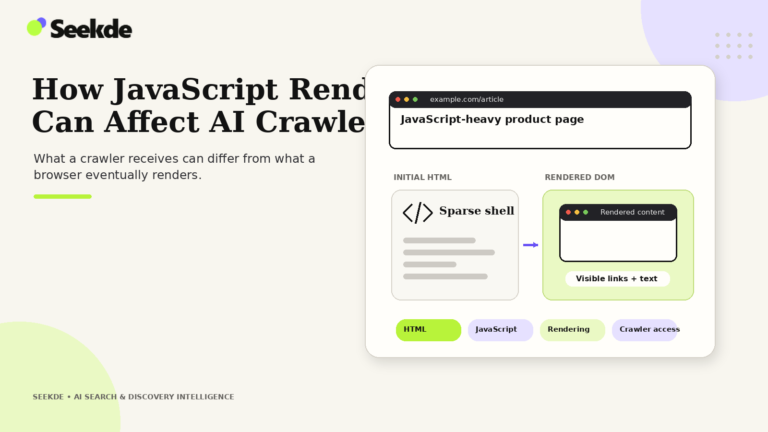
- Accessibility: Crawlers must be able to fetch, render, and index your content without encountering edge firewall blocks or JavaScript rendering hurdles.
- Sub-Query Relevance: Content must align with the specific sub-queries generated during query fan-out.
- Passage Extraction: Content must be organized into discrete, information-dense passages that retain standalone meaning when chunked.
- Reranking Survival: Passages must score highly on cross-encoder models evaluating direct answer relevance and factual substance.
- Context Inclusion: Content must survive context window token budgets and deduplication filtering.
- Synthesis and Entailment: Passages must contain clear, verifiable factual claims that the model incorporates into its synthesized answer and validates through attribution checks.
Conventional search ranking remains an important upstream factor: higher-ranking pages are more likely to enter the initial candidate retrieval pool. However, ranking alone is no longer sufficient. A page can rank among the top organic results for a primary keyword, yet fail to appear in an AI overview if its text is vague, poorly structured, or lacking extractable evidence.
By viewing generative answer engines as end-to-end multi-stage systems—from query decomposition and hybrid retrieval to neural reranking, context assembly, and entailment verification—publishers can build content that is technically accessible, structurally cohesive, and optimized for automated retrieval and synthesis.