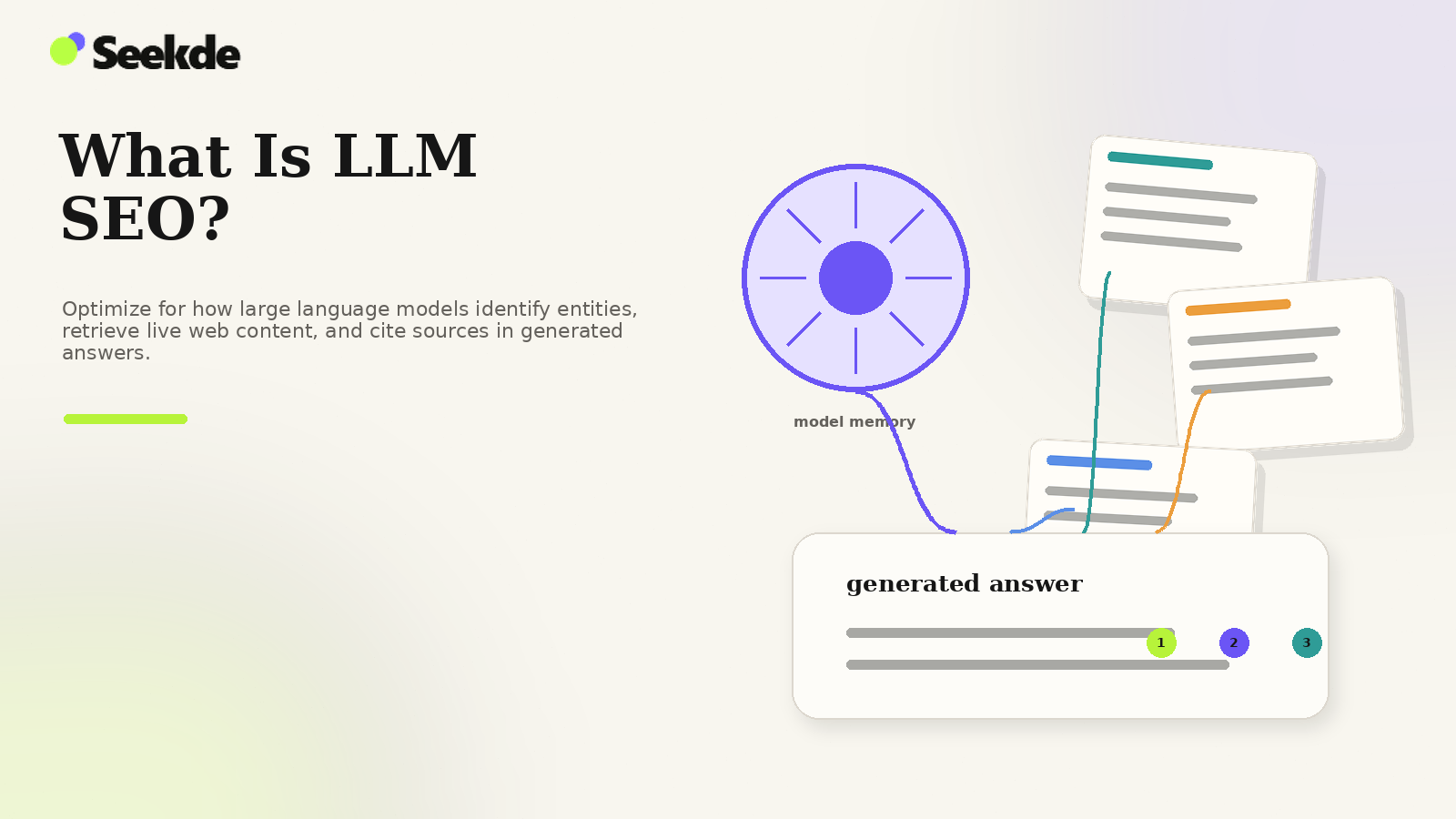
LLM SEO is the practice of making web content easier for large language models and retrieval systems to identify, retrieve, interpret, and cite. This guide explains the dual-memory model behind modern LLM experiences, how entities and semantic co-occurrence affect retrieval, which publisher-controlled actions improve live-RAG discoverability, and where llms.txt fits into the current 2026 documentation landscape.
Unlike traditional SEO, which focuses primarily on ranking web pages for keyword queries on search engine result pages, LLM SEO addresses how generative language models store, retrieve, contextualize, and verbalize information about organizations.
The phrase is often used casually as a synonym for Generative Engine Optimization (GEO), but technically, LLM SEO explores an essential architectural distinction: the boundary between parametric model knowledge and retrieved non-parametric context.
When an AI search assistant answers a question about your industry, its response is governed by two fundamentally different components: the model’s learned parameters (parametric memory), supplemented in retrieval-augmented architectures by external passages retrieved at inference time (non-parametric external context).
The Dual-Memory Model: Parametric vs. Non-Parametric Retrieval
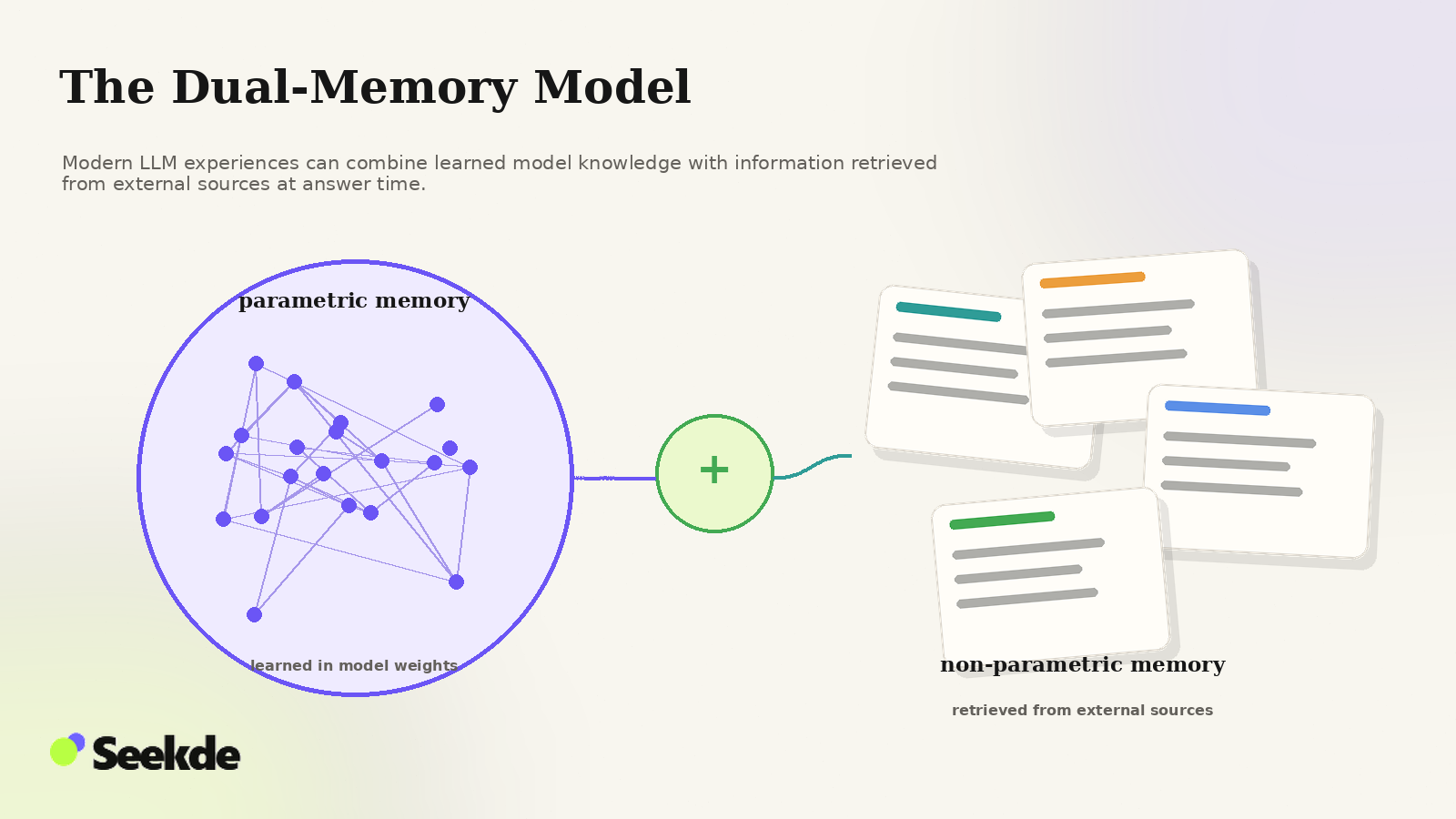
In computer science literature, retrieval-augmented generation (RAG) architectures model information access through this dual-memory paradigm, as articulated by Lewis et al. (NeurIPS 2020).
Seekde structures LLM SEO around this foundational architectural division:
- Mechanism
- Mathematical weights learned across massive offline training corpora (web scrapes, books, public datasets)
- Update Dynamics
- Fixed during inference unless model weights are subsequently updated through additional training or fine-tuning; alignment procedures can also modify model behavior
- Publisher Controllability
- Indirect and non-deterministic; data selection and filtering are proprietary model-builder operations
- Mechanism
- Search index and retrieval systems gathering relevant passages injected into the model context window
- Update Dynamics
- Dynamic; reflects search engine crawl schedules, site update frequency, and discovery indexing
- Publisher Controllability
- More directly influenceable via crawlability, technical markup, modular content, and verifiable facts
1. Parametric Memory (Model Weights)
Parametric memory consists of the billions of mathematical parameters adjusted during a language model’s pre-training phase. When a base foundation model (such as GPT-4, Claude, or Gemini) is trained on internet-scale text corpora, it learns statistical associations between words, concepts, and entities.
- Pre-Training vs. Alignment: Initial pre-training establishes broad world knowledge. Subsequent supervised fine-tuning adapts the model to specific tasks or conversational formats, while Reinforcement Learning from Human Feedback (RLHF) aligns the model’s tone, safety, and instruction-following behavior. Crucially, RLHF and fine-tuning are alignment and behavioral mechanisms, not standard operational pathways for publishers to inject updated corporate facts.
- Publisher Invariance: Publishers cannot reliably "optimize" their way into parametric weights. Pre-training data curation, deduplication pipelines (such as MinHash), quality filtering, and licensing decisions are proprietary operations executed by AI model builders. Publishers generally cannot observe whether particular content entered a proprietary pre-training corpus or quantify its influence on learned parameters, making base training data an opaque, non-operational marketing surface.
2. Non-Parametric Memory (Retrieval-Augmented Generation)
Because parametric memory suffers from knowledge cutoffs and cannot reliably track rapidly changing information (such as software pricing, leadership changes, or new product features), many AI search experiences augment language models with external retrieval.
- When a user submits a prompt, the engine queries an external search index, retrieves relevant passages, and injects them into the model’s active context window.
- The language model then synthesizes a coherent answer grounded in the retrieved external context.
For digital publishers and SEO professionals, non-parametric retrieval is the primary controllable surface. Rather than attempting to influence proprietary training runs, teams should optimize content so that search and retrieval systems can discover, parse, and extract it.
Entity Representation: Beyond Simple Latent Space Positions
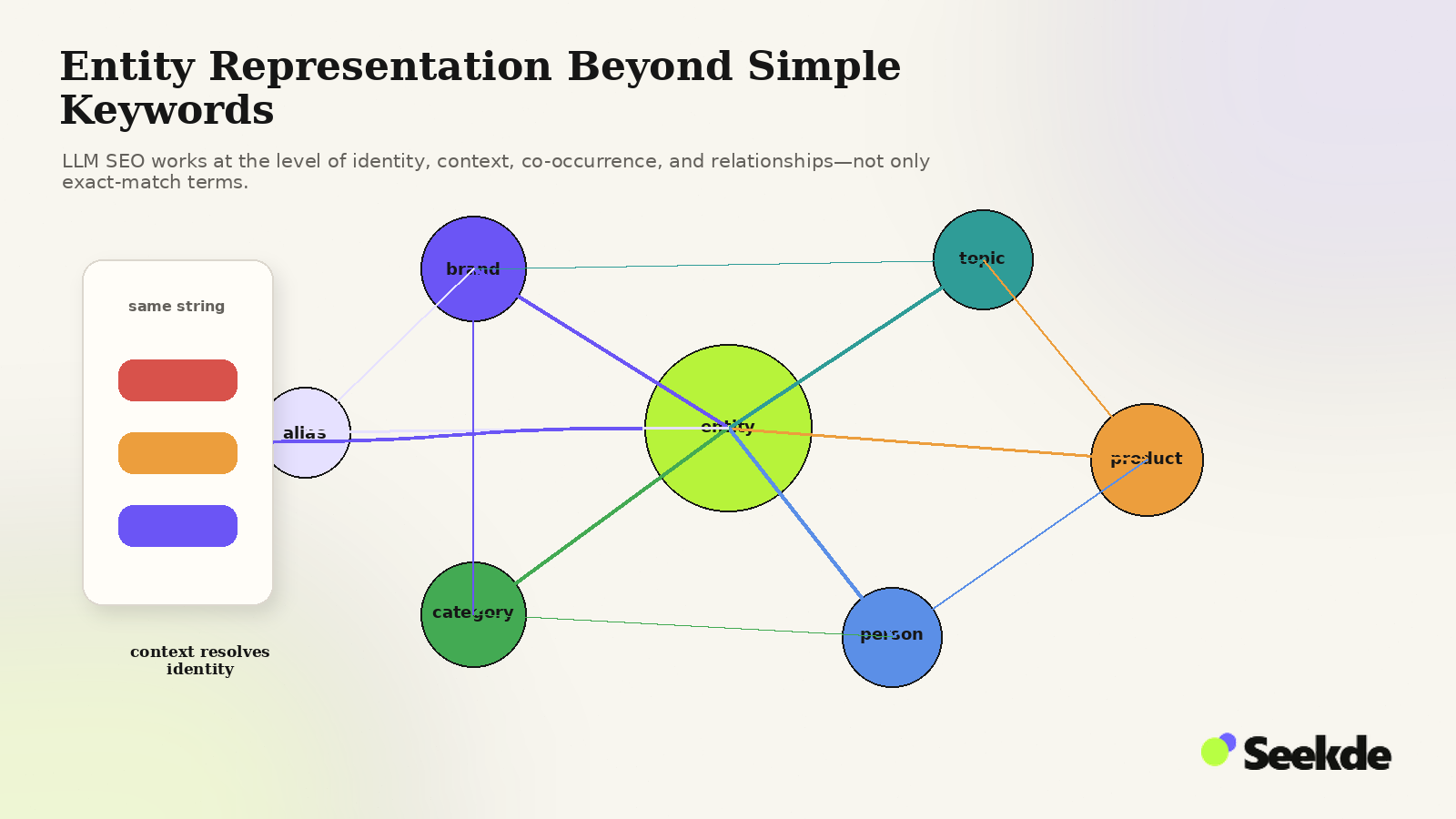
A common oversimplification in search marketing is treating a brand’s presence in an LLM as a single static coordinate or vector in latent space. Modern transformer models do not assign a single scalar position to an organization.
Contextualized Token Representations
In transformer architectures, words and entity names are converted into tokens whose mathematical representations change dynamically across layers based on surrounding context (self-attention mechanisms):
- A brand mentioned in an article about "enterprise database performance" activates different attention patterns than the same brand mentioned in an article about "customer billing disputes".
- If such material is included in model training, repeated contextual associations may contribute to learned statistical relationships, but the effect is opaque and not directly controllable by publishers.
Semantic Clustering and Co-Occurrence
When language models generate text without external retrieval, they predict tokens based on statistical probabilities learned during pre-training. If relevant material is present and influential in a model’s training data, the model may learn statistical associations between an entity and those concepts. Publishers generally cannot observe or predict that effect.
Controllable Actions: Optimizing for the Live RAG Pipeline
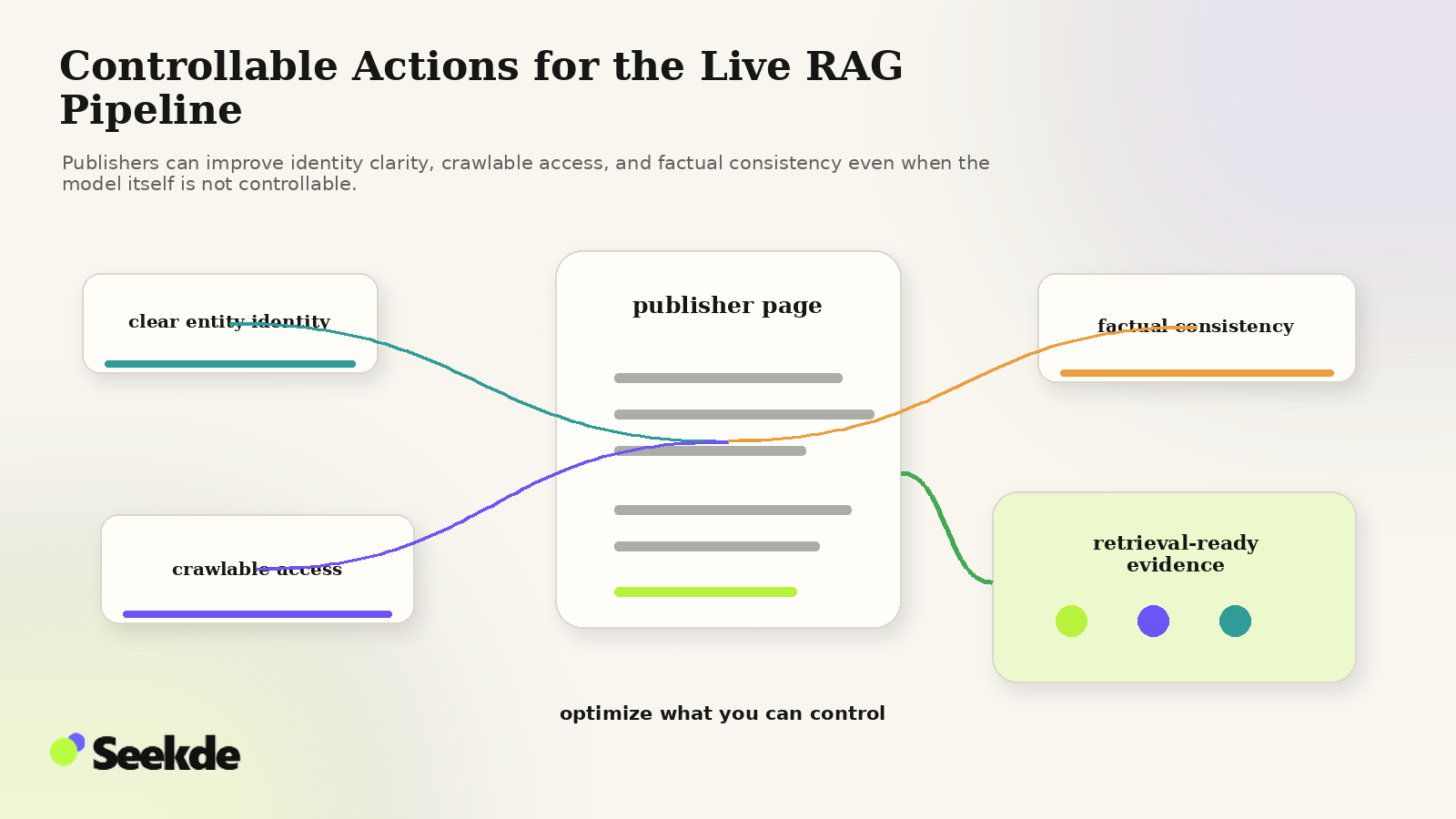
For AI search experiences that use web retrieval, publishers should focus their technical resources on controllable RAG optimization factors:
1. Clear Machine-Readable Entity Identity
To prevent automated systems from confusing your organization with similarly named entities:
- Maintain consistent organization naming and structured product descriptions across all digital properties.
- Implement comprehensive
OrganizationJSON-LD schema. While schema is not a dedicated AI ranking switch, accurate structured data (such as verifiedsameAsreferences to official public registries) provides machine-readable identity links and cues across knowledge graphs. - Provide transparent, indexable product taxonomies that explain what your software or service accomplishes in concrete technical terms.
2. Crawler Access and RAG Ingestion
A page cannot inform non-parametric retrieval if AI search crawlers are blocked or fail to render the content:
- Audit
robots.txtconfigurations to distinguish between crawlers used for search discovery (such as OpenAI’sOAI-SearchBotorPerplexityBot) and crawlers used for model training (GPTBot), configuring permissions to match your organizational data policies. - Structure articles with concise topic headings and self-contained factual statements, as detailed in our guide on how AI search engines retrieve and cite content.
- Inspect the mathematical retrieval fundamentals documented in our technical monograph on the Architecture of Generative Answer Engines.
3. Factual Accuracy and Disambiguation Pages
Generative models synthesize information from external retrieval pools. Publishing clear, authoritative documentation can reduce ambiguity and provide stronger reference material, but cannot prevent model errors:
- Maintain an indexable, regularly updated product specification and comparison hub that articulates exact platform capabilities, limitations, and pricing parameters.
- Verify all factual assertions against Seekde’s institutional Source and Citation Policy.
The llms.txt Proposal: Current 2026 Documentation
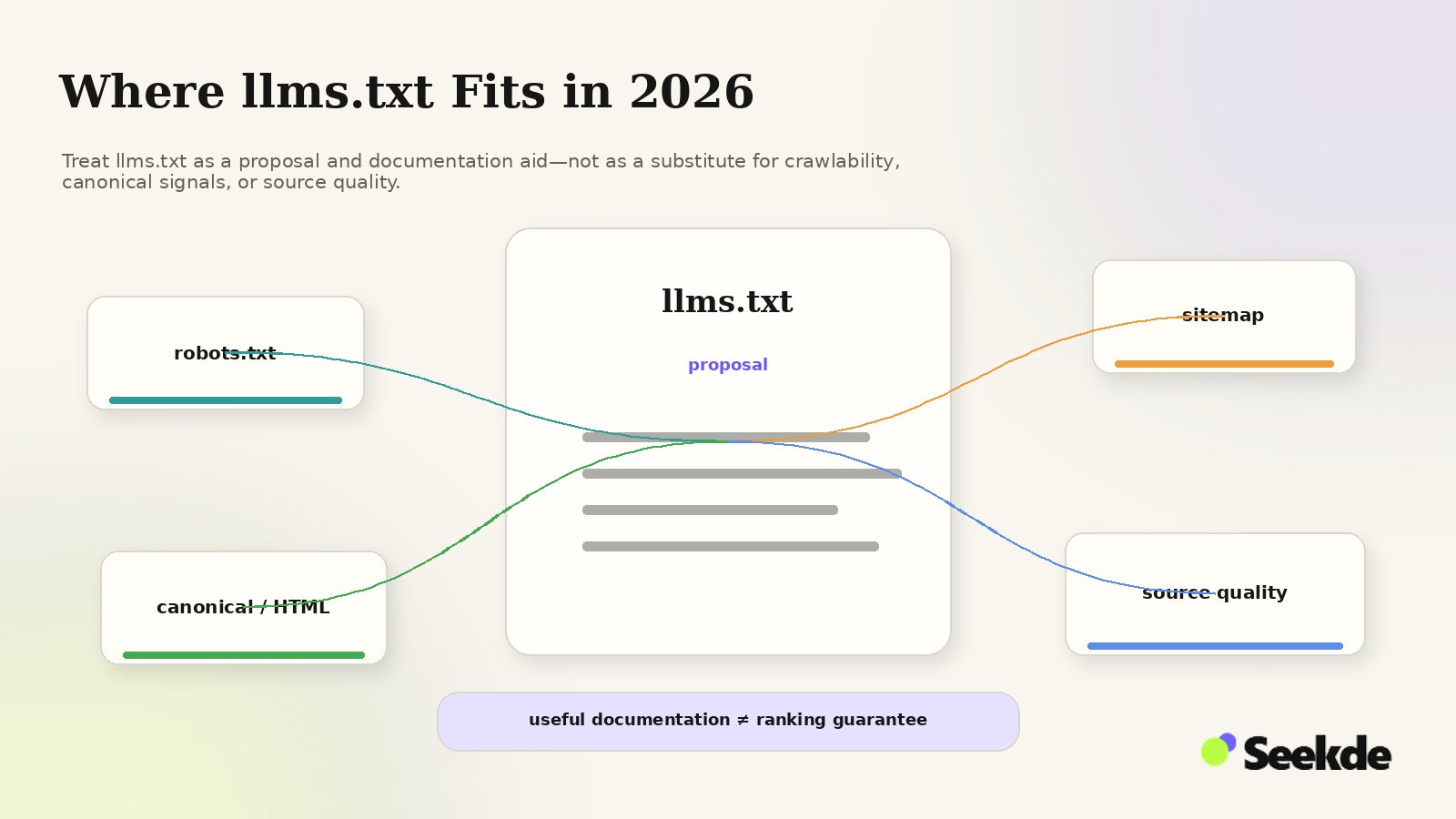
The proposed llms.txt convention has generated considerable interest across developer communities. Originally published by Jeremy Howard on September 3, 2024, llms.txt is an informal community proposal suggesting that websites place a standardized markdown file in their root directory to provide a curated summary of site documentation for autonomous AI agents.
However, search professionals must distinguish between developer proposals and official search engine protocols:
- Google Search Documentation: Current official Google Search documentation explicitly states that Google Search does not use
llms.txt. For Google Search, maintaining anllms.txtfile neither improves nor harms site visibility or rankings in search features, including AI Overviews. Google relies on standard web standards, includingrobots.txt, HTML elements, and supported structured data. - Search Indexing Status: No adoption for search indexing should be claimed for a platform unless current primary platform documentation verifies it. As of 2026, major web search engines have not adopted
llms.txtas a requirement for core search indexation or citation eligibility.
Publishers may choose to deploy llms.txt as a voluntary, convenient roadmap for specialized developer tools or autonomous coding agents, but it should not be treated as a substitute for standard technical SEO, mobile rendering, or semantic web architecture.
Conclusion: Engineering Entity Authority
LLM SEO is not about discovering prompt injections or attempting to manipulate proprietary model training weights. It is the disciplined engineering of your organization’s digital authority across the retrieval lifecycle:
- Topical Authority: Establishing consistent, credible entity associations across the broader web so that models and knowledge bases represent your capabilities accurately.
- Retrieval Readiness: Maintaining technically accessible, modular, and verifiable content that retrieval-based systems can more readily discover and use.
By treating your website as an authoritative, machine-readable knowledge base, you establish resilient visibility across parametric and retrieval-augmented systems.