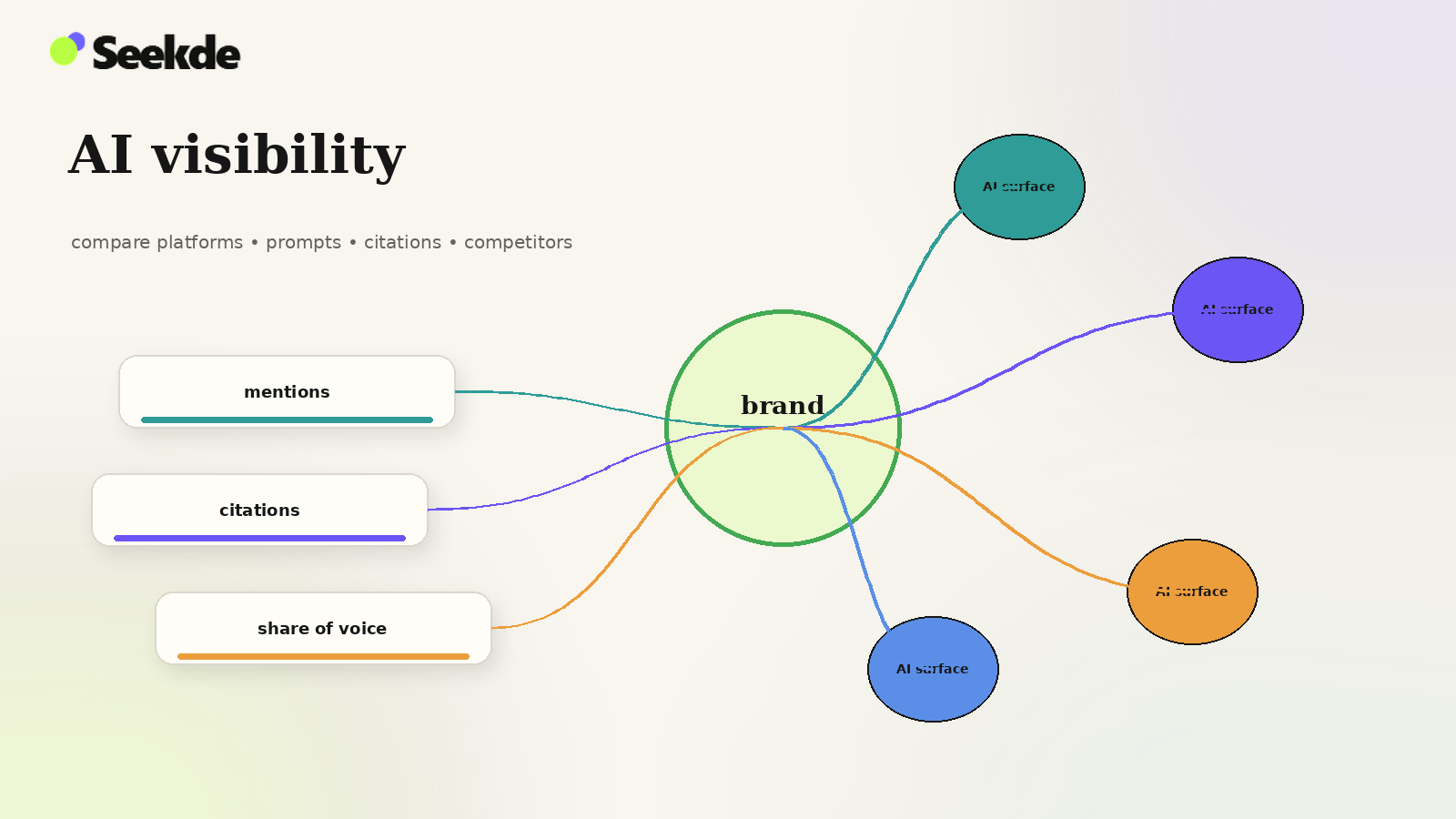
AI search visibility tools are specialized monitoring platforms designed to track, measure, and analyze how brands, domains, and products appear across conversational artificial intelligence answer engines. Unlike conventional SEO rank trackers that monitor static position rankings for ten blue links on search engine results pages (SERPs), AI visibility platforms evaluate non-deterministic generative interfaces—including Google AI Overviews, ChatGPT Search, Perplexity, Microsoft Copilot, and Claude.
As search behavior shifts from link browsing to conversational synthesis, marketing teams, agencies, and enterprise brands face a critical measurement gap. Traditional web analytics platforms (such as Google Analytics 4) capture referral sessions only when a user clicks a hyperlinked citation, leaving unlinked brand mentions, synthesized recommendations, and prompt-level Share of Voice completely invisible.
To bridge this divide, a new category of software has emerged. This guide provides an objective, multi-dimensional evaluation of the leading commercial AI search visibility platforms available as of September 7, 2026. We examine engine coverage, prompt sampling methodologies, citation tracking capabilities, pricing tiers, and architectural trade-offs to help search practitioners select the right platform for their operating model.
Testing Disclosure: Seekde evaluated this software guide using official vendor product documentation, published technical specifications, verified public pricing schedules, and developer API references available as of September 7, 2026. Because we did not have authenticated hands-on access to every product discussed, we do not score interface usability, implementation experience, or measurement accuracy unless independently verified. All comparisons reflect documented capabilities, supported AI engines, and verified commercial terms.
The AI Visibility Evaluation Framework: Five Core Dimensions
To compare platforms objectively, Seekde assesses AI search monitoring software across five functional dimensions:
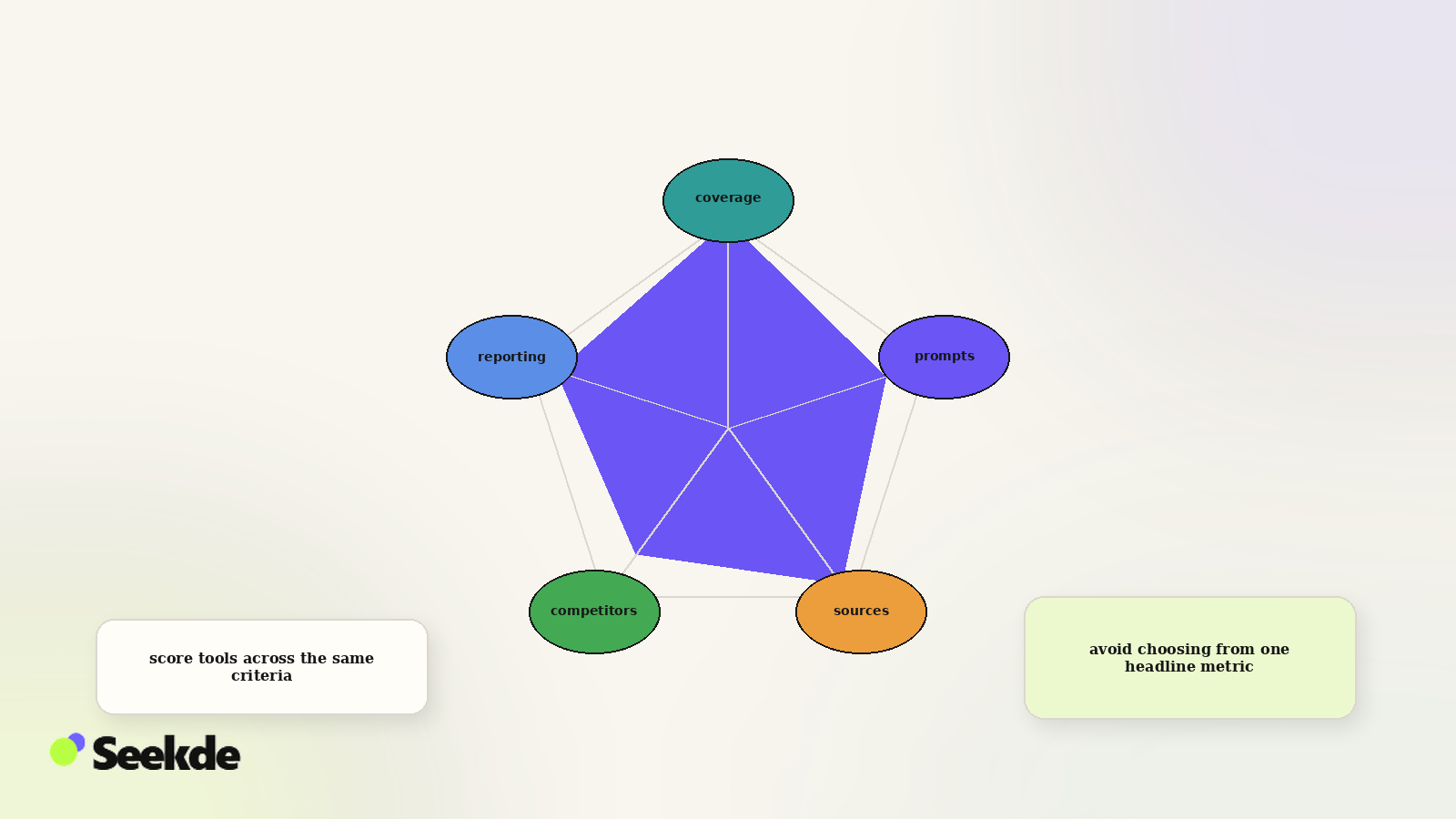
Engine Coverage
- (Multi-Platfor
Prompt Sampling
- m) Methodology
Attribution &
- Citation Aud
Competitive Share
- it of Voice (
API & Data
- SoV) Exportability
| Evaluation Dimension | What We Measure | Why It Matters for Practitioners |
|---|---|---|
| 1. Engine Coverage | Breadth of supported models (Google AI Overviews, ChatGPT Search, Perplexity, Copilot, Claude, Gemini). | Single-platform tools create blind spots; buyer journeys span multiple conversational interfaces. |
| 2. Sampling Methodology | Prompt execution cadence, geographic targeting, temperature settings, and repetition. | Non-deterministic engines call for repeated runs to establish statistically valid visibility scores. |
| 3. Attribution & Citations | Tracking hyperlinked citation cards vs. unlinked textual entity mentions. | Distinguishes between referral traffic drivers and conversational brand reputation. |
| 4. Competitive Share of Voice | Calculating brand mention share against direct competitor sets across prompt families. | Delivers executive-level comparative benchmarks rather than isolated vanity rankings. |
| 5. Data Export & Integrations | API access, CSV exports, Google Looker Studio connectors, and GA4 integration. | Enterprise agencies often seek raw data pipelines for client reporting and custom data warehouses. |
Comprehensive Platform Overview: The Leading Tools Compared
The following comparative matrix synthesizes verified vendor specifications, supported conversational engines, and documented pricing models as of September 2026:
| Platform | Primary Target Audience | Supported AI Engines | Prompt Sampling Cadence | Starting Price (Public / Verified) | Key Differentiating Capability |
|---|---|---|---|---|---|
| Profound | Enterprise Brands & Large Agencies | Google AIO, ChatGPT, Perplexity, Copilot | Daily / Automated Rolling Batches | Custom Enterprise (Starts ~$1,500–$3,500/mo annual) | Deep conversational prompt tree exploration and prompt volume estimation models. |
| Peec AI | Mid-Market Brands & In-house Teams | ChatGPT, Perplexity, Claude, Gemini | Daily / Weekly Configurable | ~$80–$95 / month (Starter Tier) | Multi-model sentiment polarity scoring (Pos/Neut/Neg) and prompt ranking distribution. |
| Otterly AI | SMBs, Startups & Specialized Agencies | Google AIO, ChatGPT, Perplexity | Daily Scheduled Monitoring | ~$29–$49 / month (Lite / Starter) | Accessible self-serve onboarding, AI Overview visual screenshot captures, and competitor alerts. |
| Semrush AI Toolkit | Existing Semrush Subscribers & SEO Teams | Google AI Overviews, Selected LLMs | Daily SERP Crawls | Core Semrush ($139.95–$499.95/mo) + Toolkit | Direct integration with traditional keyword databases, domain authority metrics, and organic rank tracking. |
| AthenaHQ / Scrunch | Enterprise Intelligence & PR Teams | ChatGPT, Perplexity, Copilot, Claude, Grok | On-Demand & Scheduled | $250–$295 / mo (Entry) to Custom Enterprise | Advanced entity co-occurrence mapping, crawler analytics (ClaudeBot/GPTBot), and hallucination detection. |
| Seekde | SEO Practitioners & Technical Publications | Multi-Engine Intent Engine | Real-Time Intent Exploration | Free Preview / Tiered Beta | Transparent RAG retrieval breakdown, crawler log intelligence, and strict empirical methodology standards. |
In-Depth Tool Teardowns
1. Profound (Profound Strategy)
Overview: Profound is an enterprise-grade AI search intelligence platform engineered specifically to help Fortune 500 brands and enterprise marketing agencies track their presence across conversational search systems.
- Supported Engines: Google AI Overviews, ChatGPT Search, Perplexity Sonar, Microsoft Copilot.
- Key Capabilities: Profound excels at prompt volume modeling. The platform constructs multi-branch prompt trees that simulate how users ask follow-up questions during complex buyer journeys. It measures citation share, sentiment, and competitive displacement across prompt families.
- Pricing & Packaging: Enterprise subscription model. Pricing is custom-quoted based on prompt set volume, engine coverage, and seat count, typically beginning in the $1,500 to $3,500 per month range (billed annually).
- Strengths: Comprehensive enterprise governance, prompt volume estimation, and executive-ready Share of Voice reporting.
- Documented Limitations: High barrier to entry for small businesses; typically involves dedicated account onboarding; custom enterprise contract cycles.
2. Peec AI
Overview: Peec AI is a focused AI brand intelligence platform designed for digital marketing teams and mid-market companies seeking streamlined tracking across emerging conversational assistants.
- Supported Engines: ChatGPT, Perplexity, Claude, Google Gemini.
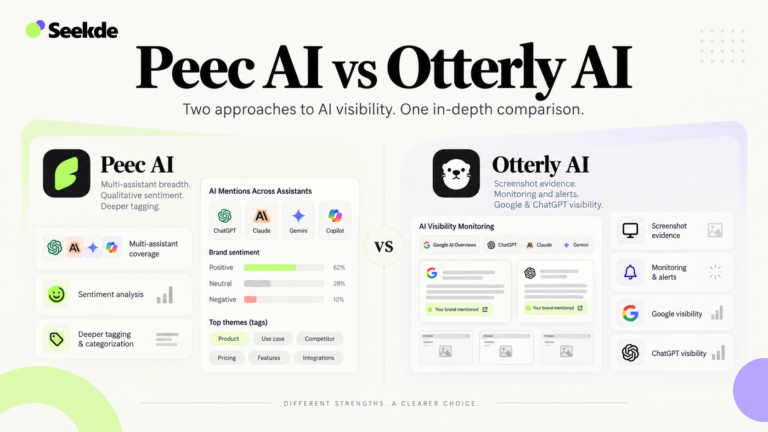
- Key Capabilities: Peec AI tracks how often a brand is mentioned or cited when users ask category, comparison, and alternative prompts. The platform provides a composite Visibility Score, sentiment tracking (positive, neutral, negative), and automated alerts when competitive displacement occurs.
- Pricing & Packaging: Self-serve subscription tiers. Public pricing starts at approximately €89 to €99 per month for entry-level monitoring (tracking up to 50–100 prompts across select engines), scaling to agency tiers for multi-seat access.
- Strengths: Documented self-serve onboarding, structured dashboard visualization, strong coverage of Anthropic’s Claude models.
- Documented Limitations: Historical SERP integration is limited compared to legacy SEO suites; prompt volume estimates rely primarily on secondary search proxies.
3. Otterly AI
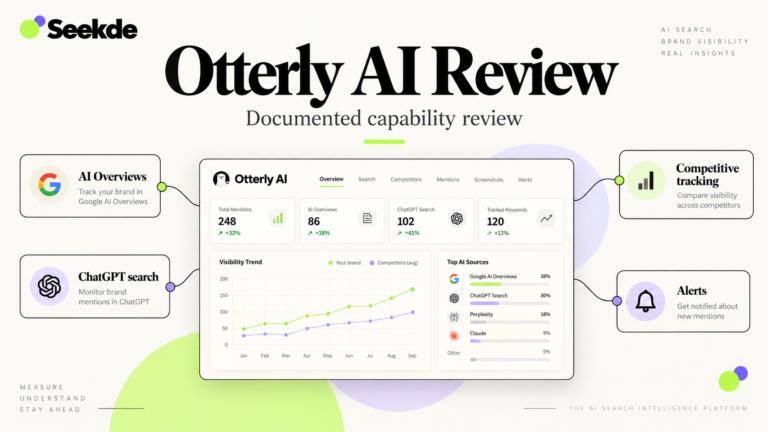
Overview: Otterly AI provides an accessible, rapid-deployment monitoring suite for digital agencies, consultants, and growing businesses focused on monitoring Google AI Overviews and ChatGPT Search.
- Supported Engines: Google AI Overviews, ChatGPT Search, Perplexity.
- Key Capabilities: Otterly AI automates daily prompt execution and captures full-page visual screenshots of rendered AI answers. It logs whether a brand appeared as a bolded recommendation, an unlinked mention, or a hyperlinked source card.
- Pricing & Packaging: Transparent tiered pricing. Starter plans begin around $49 per month for small prompt sets, with professional and agency tiers scaling to $149–$299 per month based on prompt frequency and workspace limits.
- Strengths: Highly affordable entry tier, visual screenshot archives for client proof-of-performance, streamlined setup.
- Documented Limitations: Limited API exportability on starter tiers; does not model complex conversational prompt trees as deeply as enterprise platforms.
4. Semrush AI Visibility Toolkit
Overview: Semrush, an incumbent leader in search marketing software, has integrated AI search tracking features into its existing platform ecosystem, allowing SEO practitioners to evaluate AI Overviews alongside traditional organic rankings.
- Supported Engines: Google AI Overviews (with expanding LLM tracking features via App Center integrations).
- Key Capabilities: Semrush identifies which keywords in a tracked campaign trigger Google AI Overviews, whether your domain appears in the grounding carousel, and how AI Overviews impact traditional organic click-through rates.
- Pricing & Packaging: Available as a modular feature add-on or integrated into Semrush Pro/Guru/Business subscriptions ($139.95 to $499.95 per month base plans plus applicable toolkit fees).
- Strengths: Unified tracking of traditional SEO metrics (search volume, keyword difficulty, backlinks) with AI Overview tracking; zero workflow disruption for existing Semrush users.
- Documented Limitations: Focused predominantly on Google AI Overviews and AI Mode; does not provide native deep prompt simulation for standalone ChatGPT or Claude conversational threads.
Architectural Considerations: How Tools Collect AI Search Data
When choosing a software vendor, technical teams must evaluate the underlying data collection architecture:
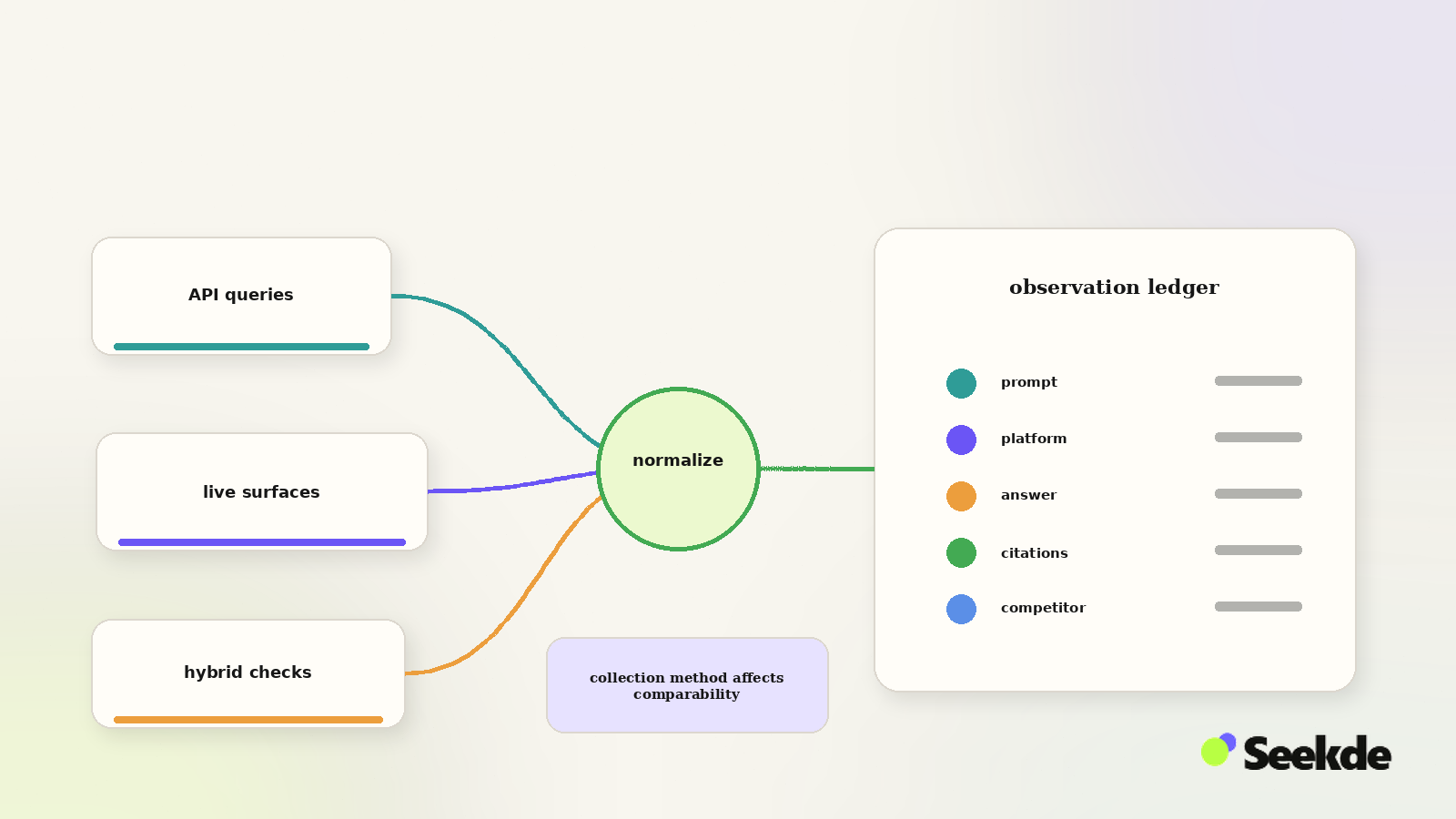
Direct Commercial API Queries
Official vendor APIs (OpenAI API, Perplexity API, Anthropic API)
- Pros: Stable latency, zero IP blocking, consistent JSON structured outputs
- Cons: API outputs do not always match the consumer web/app interface or citation cards
Headless Browser UI Scraping
Simulates real logged-in or guest users browsing consumer web apps
- Pros: Captures actual rendered UI, citation source cards, and visual layout
- Cons: Frequent DOM changes, IP rate limits, and higher computational execution cost
Enterprise platforms typically blend both approaches: utilizing headless browser clusters for Google AI Overviews and consumer ChatGPT Search interfaces to ensure parity with real human searchers, while leveraging direct APIs for high-volume benchmark sampling.
Selection Guide: Which Platform Fits Your Needs?
| Operating Scenario | Recommended Tool Selection | Primary Strategic Rationale |
|---|---|---|
| Enterprise Brand with Dedicated Budget | Profound or Athena | Requires executive Share of Voice modeling, prompt volume forecasting, and SOC 2 enterprise data compliance. |
| Mid-Sized Agency Managing 10+ Clients | Peec AI or Otterly AI (Agency Tier) | Needs multi-workspace client segmentation, white-label client PDF exports, and cost-effective prompt scaling. |
| In-House SEO Team Already on Semrush | Semrush AI Toolkit | Consolidates legacy organic rank tracking with AI Overview detection in a single existing interface. |
| Bootstrapped Startup / Individual Consultant | Otterly AI (Starter) or Manual Workflows | Minimizes fixed monthly software overhead while tracking core brand queries (see our guide to free AI visibility monitoring). |
Summary: Selecting the Right Measurement Infrastructure
The market for AI search visibility software is evolving rapidly. As major search engines continue to refine their generative user interfaces and crawl policies, tracking brand presence across conversational answers has shifted from an experimental curiosity to a core marketing requirement.
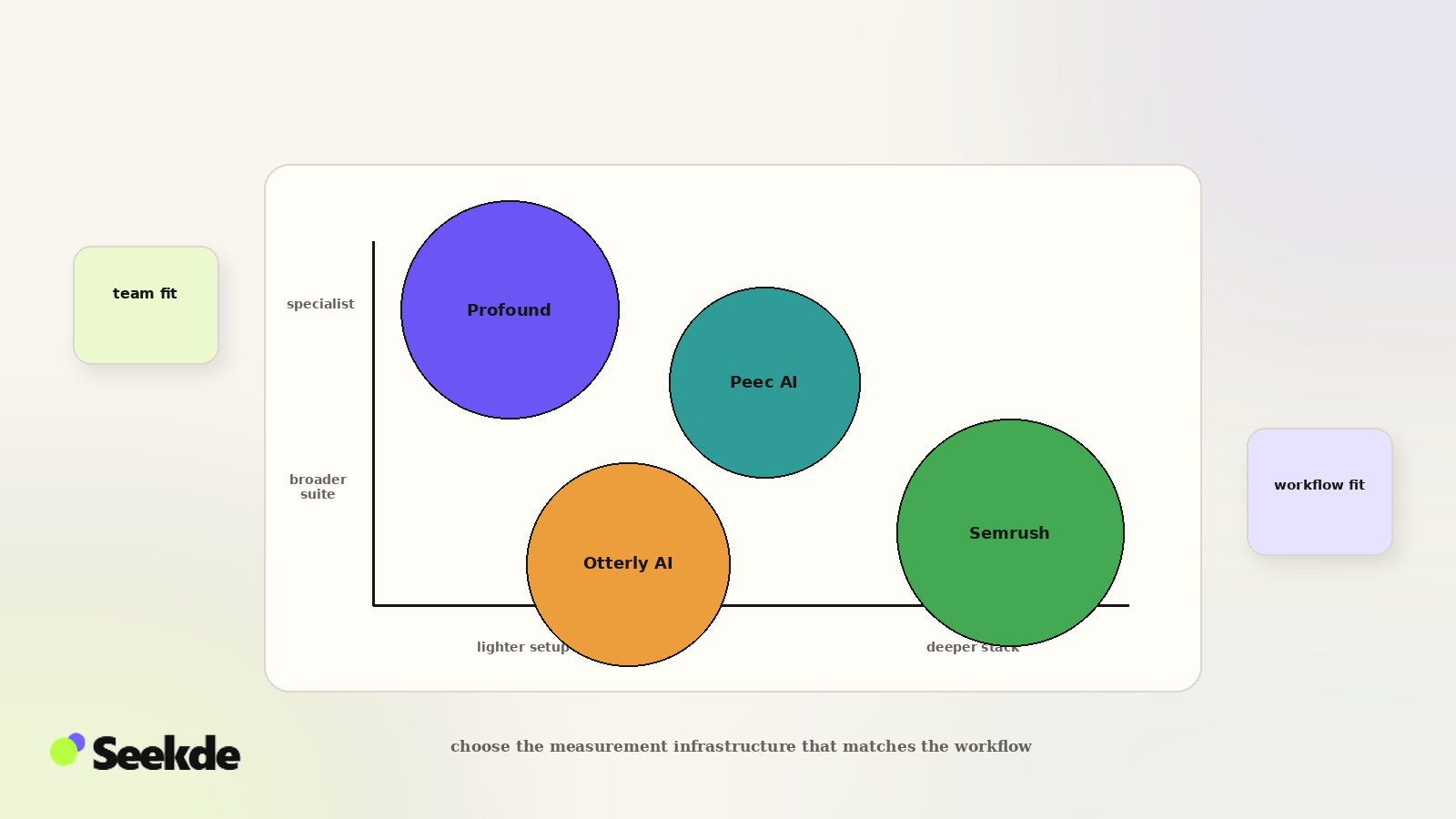
When evaluating vendors:
- Insist on transparent explanations of their prompt sampling methodology and temperature controls.
- Verify whether the platform tracks hyperlinked citations, unlinked entity mentions, or both.
- Choose a tool whose data collection architecture aligns with the specific conversational engines your prospective buyers utilize.
By deploying the right measurement tooling, organizations replace speculative guesswork with empirical data, allowing them to optimize their content and digital PR strategies for maximum generative search impact.
Related guides and reviews
- Best GEO Tools for SEO Teams
- Best AI Visibility Tools for Agencies
- Profound vs Peec AI: Platform Comparison
- Peec AI vs Otterly AI: Platform Comparison
- Otterly AI Review
- Semrush AI Visibility Toolkit Review
- Free Ways to Monitor AI Search Visibility
- How to Measure Your Brand’s Visibility in AI Search
- What Is AI Search Visibility?