"Query fan-out" is Google’s documented terminology for the multi-step query decomposition process where a complex prompt is analyzed and expanded into multiple sub-queries to retrieve diverse supporting information. Across the wider AI search ecosystem, systems like ChatGPT Search and Perplexity perform related query rewriting, multi-step search planning, and decomposition to gather context across distinct facets before synthesizing an answer.
This multi-query approach represents an important evolution from single keyword lookups. While Google specifically documents "query fan-out" in its AI Overviews architecture, related query-expansion and decomposition mechanisms are common across conversational search systems resolving multi-layered questions.
For digital publishers and SEO professionals, query fan-out fundamentally alters content discovery. To win citations, a website no longer competes solely for the exact keyword string submitted by the user; it must provide authoritative answers for the background sub-queries generated during the fan-out process.
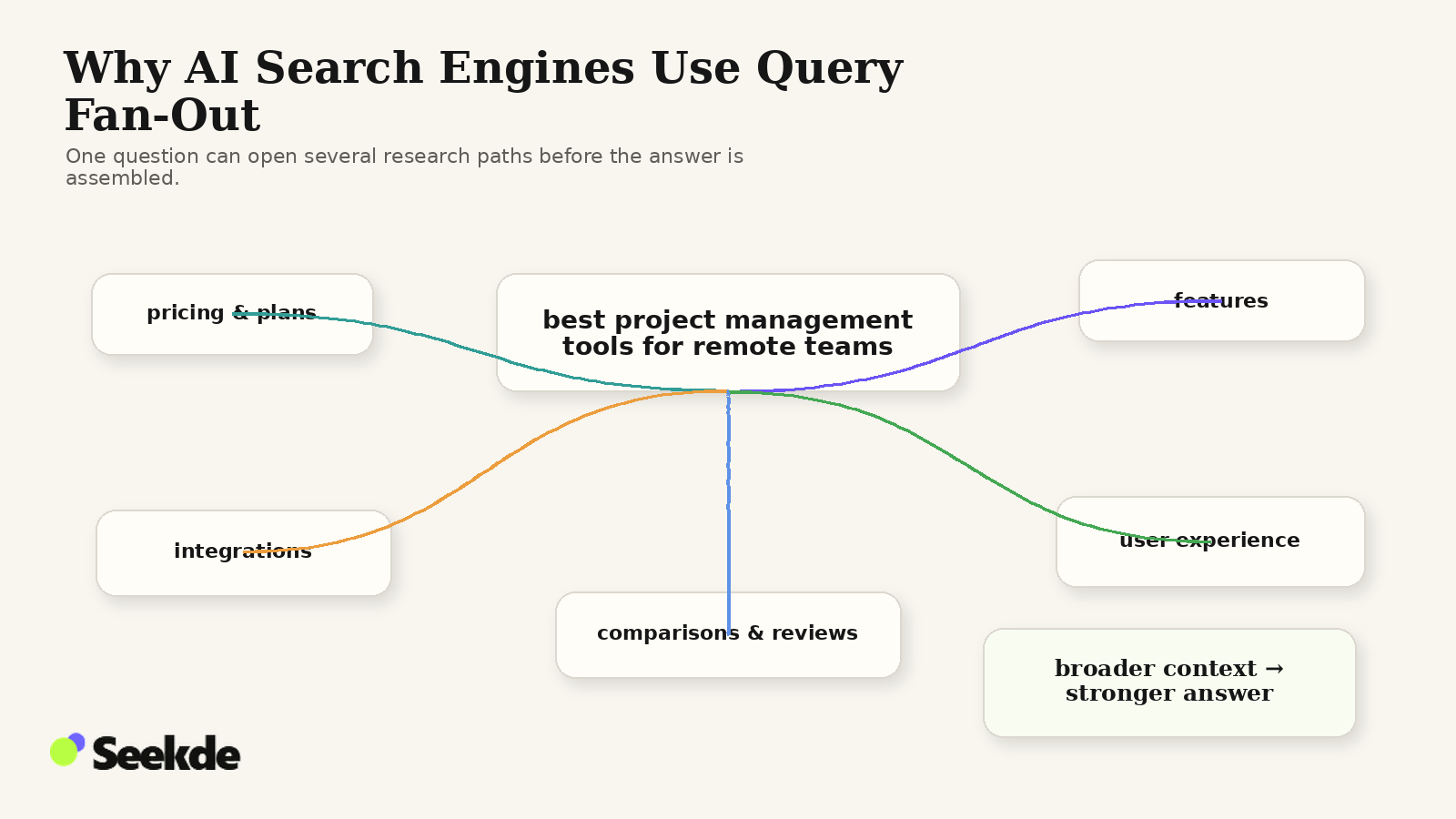
Why AI Search Engines Use Query Fan-Out
In traditional search, user queries were typically short, ambiguous, and disjointed (e.g., "hybrid cloud security architecture"). A single index query returning ten links was sufficient because the human user bore the cognitive burden of clicking through multiple sites to piece together a complete answer.
In generative search, user prompts are conversational, context-rich, and multi-faceted. Consider a realistic research prompt:
"What are the cost differences between building an in-house vector search pipeline using pgvector versus deploying a managed Pinecone instance for a corpus of 50 million embeddings, factoring in maintenance overhead and engineering salaries?"
A single page may not contain the exact pre-computed answer to a highly specific multi-constraint scenario. If an engine executed only one search for that full string, lexical and semantic match scores would fail due to query dilution.
To resolve the prompt accurately, the system may decompose the question into its foundational sub-problems:
"Compare pgvector self-hosted vs Pinecone managed at 50M embeddings…" (LLM Query Planner)
1. "pgvector RAM requirements compute cost 50 million vectors" 2. "Pinecone enterprise pricing 50M embeddings storage tier" 3. "engineering maintenance hours self-hosted vector database" 4. "pgvector vs Pinecone latency benchmark comparisons" (Parallel Web Retrieval)
PostgreSQL performance benchmarks blog
Pinecone official pricing & calculator documentation
DevOps engineering salary & maintenance survey report (Neural Reranking & Synthesis) SYNTHESIZED ANSWER WITH MULTI-SOURCE CITATIONS
As demonstrated in the architecture above, query fan-out operates as an initial retrieval stage within the broader retrieval-augmented generation (RAG) lifecycle. By executing parallel searches, the engine gathers specialized evidence from multiple domains before the generative model performs final synthesis.
Platform Implementations: OpenAI and Perplexity
Different answer engines implement query decomposition through specialized, proprietary agentic architectures:
OpenAI ChatGPT Search
According to official OpenAI Help Center documentation for ChatGPT Search, the platform dynamically determines when search is required. When a prompt requires web information, it rewrites the user’s request into one or more targeted search queries, and can execute additional, more-specific searches after examining initial results before synthesizing an answer with source citations.
Perplexity AI: Search as Code and Agent API Transition (2026)
Perplexity exposes multi-step query generation transparently, displaying real-time "Searching the web for…" progress indicators.
- Search as Code: As detailed in Perplexity’s technical publication Rethinking Search as Code Generation, the platform uses automated code generation to orchestrate complex multi-step retrieval and computation.
- Agent API and Sonar Transition (Current as of September 4, 2026): In its August 13, 2026 announcement, Perplexity declared its transition to the Agent API as its primary future surface. While legacy Sonar endpoints remain available today, they are scheduled to retire on September 27, 2026, at which date the Agent API becomes the primary programmatic search interface. (TIME_SENSITIVE — revalidate after 2026-09-27)
The Publisher Opportunity: Winning Citations Across the Fan-Out Cluster
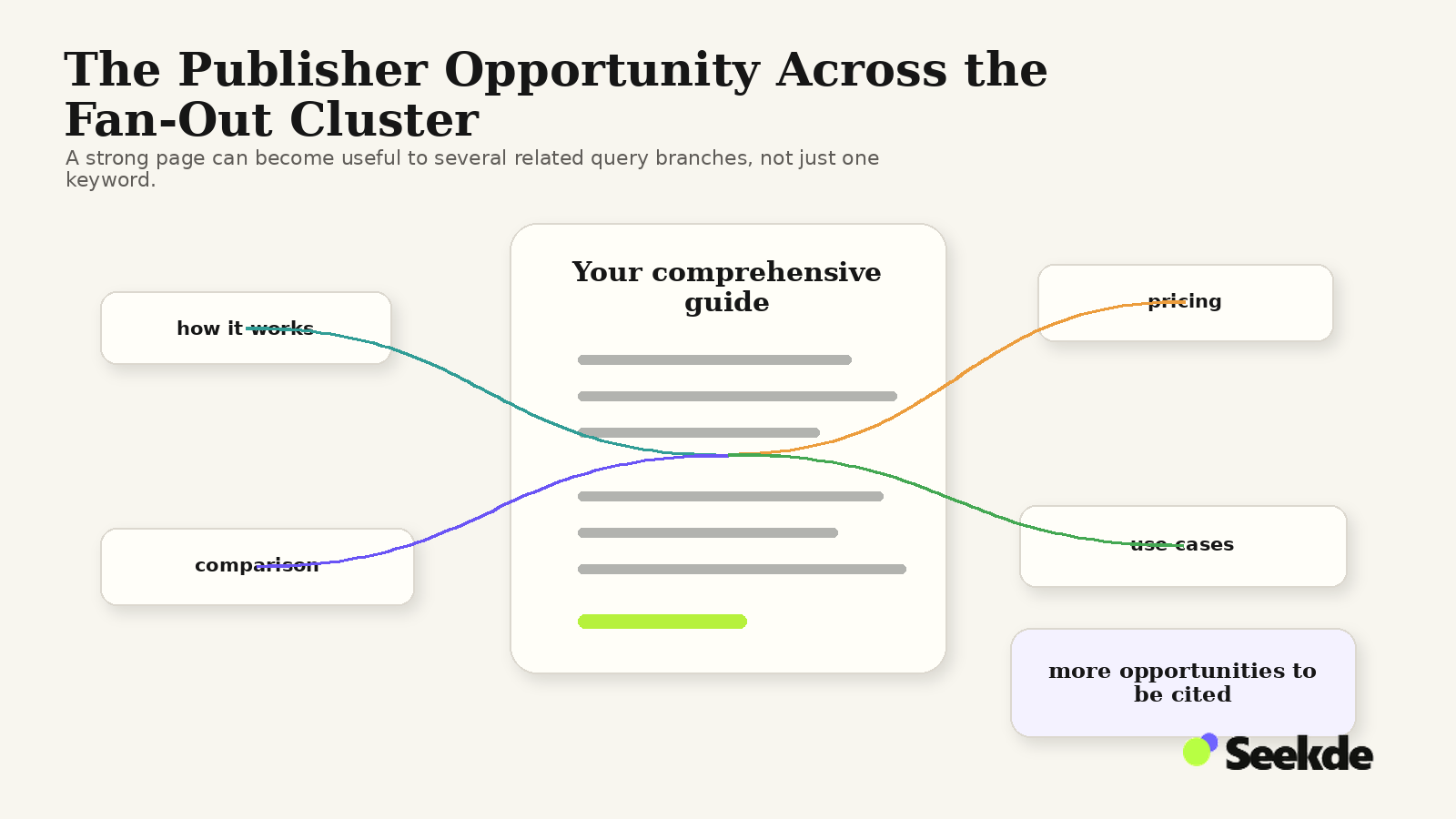
The existence of query fan-out fundamentally alters content strategy. In legacy SEO, conventional practice centered on optimizing for the primary head term. In AI search, a page may be cited for a related generated sub-query even when it is not prominent for the original query wording.
The Seekde Multi-Intent Coverage Model
To capture citations across fan-out clusters, content creators should implement the Multi-Intent Coverage Model:
"Enterprise Vector Database Evaluation Guide"
Memory & Compute Sizing (Wins sub-query: RAM/hardware)
Transparent Cost Models (Wins sub-query: pricing tiers)
Operational Maintenance (Wins sub-query: labor overhead)
Performance Trade-offs (Wins sub-query: latency benchmarks
By organizing an article with modular, deeply specified sections, a single authoritative URL can satisfy multiple sub-queries simultaneously. When an AI search engine dispatches parallel searches, this modular structure creates more opportunities for relevant sections to match distinct sub-queries; citation is not guaranteed.
Editorial Guidelines for Fan-Out Optimization
To optimize your digital assets for query decomposition systems, apply the structured principles of Generative Engine Optimization (GEO):
- Anticipate Background Sub-Queries: Before drafting an article, map out the prerequisite technical questions a reader must resolve to answer the primary topic. Structure your
<h2>and<h3>headings to mirror those explicit sub-problems. - Provide Self-Contained Units of Information: Ensure each section provides a standalone, sufficiently specific answer to its heading. If a sub-query fetches Section 3 of your page, that section must be intelligible without requiring the reader to have consumed Sections 1 and 2.
- Include Specific Benchmark Data: Generic assertions (e.g., "Self-hosting requires substantial engineering time") provide weak signals for neural rerankers. Specific, well-supported factual assertions give retrieval systems more precise material to match against factual sub-queries.
- Avoid Superficial FAQ Accordions (Seekde Editorial Recommendation): Generating dozens of disconnected FAQ accordions with brief, repetitive answers provides low contextual signal. Seekde recommends developing substantive, self-contained sections that explain both the direct answer and the operational context behind it.
- Study Retrieval Fundamentals: Review our formal monograph on Generative Answer Engine Architecture to understand how vector embeddings and sparse indexes process parallel retrieval.
Measuring Query Fan-Out Visibility
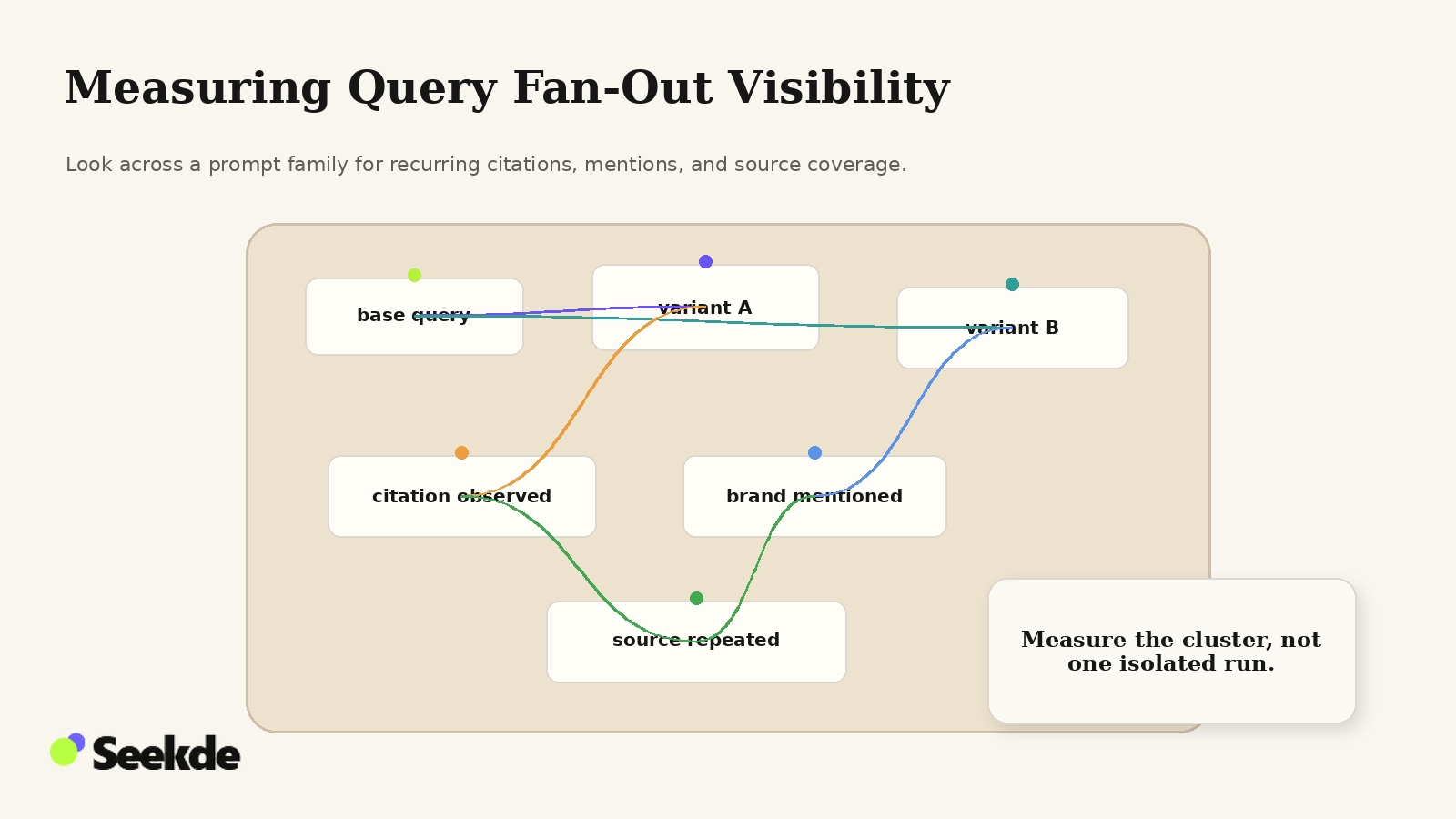
Because background sub-queries are generated dynamically by language models, tracking fan-out visibility calls for structured prompt-testing protocols.
Using the Seekde prompt sampling methodology, search researchers can submit multi-layered evaluation queries across multiple engine instances, record which sub-queries are triggered, and observe which domains are selected to answer each component.
Understanding query decomposition transforms how organizations approach search: by moving from static keyword matching to comprehensive, multi-layered intent resolution, publishers improve their readiness to be discovered when AI engines break down complex informational inquiries.