Modern conversational search engines find, retrieve, and cite web content through architectures broadly characterized as retrieval-augmented answer systems. While specific commercial implementations vary and remain proprietary, systems frequently follow a common reference pattern: connecting language models to an external retrieval index, searching for candidate documents, scoring candidate passages, and supplying retrieved context for synthesis and citation.
In generative search features—such as Google AI Overviews, which specifically references Retrieval-Augmented Generation (RAG) in its search documentation—this pipeline bridges pre-trained models with live web information. However, commercial search vendor implementations differ substantially and remain proprietary. Google AI Overviews, OpenAI ChatGPT Search, Microsoft Copilot, and Perplexity each employ specialized indexing pipelines, custom scoring models, and distinct citation interfaces.
To help web publishers and technical marketers understand how content moves through these architectures, Seekde maintains the following conceptual reference model:
| Conceptual Stage | Retrieval & Ranking Mechanics | Scope & Implementation Detail |
|---|---|---|
| Stage 1: Candidate Retrieval | Web index search (Sparse lexical search + Dense vector embeddings) | Broad candidate document retrieval from core web indexes |
| Stage 2: Neural Reranking | Passage scoring via neural rerankers or late-interaction models | Top-k passage filtering (e.g., Azure AI Search top-50 reranking example) |
| Stage 3: Synthesis & Citation | Generative synthesis with source attribution and link card rendering | Vendor-specific attribution mapping and interactive UI links |
Stage 1: Candidate Retrieval (Finding the Content)
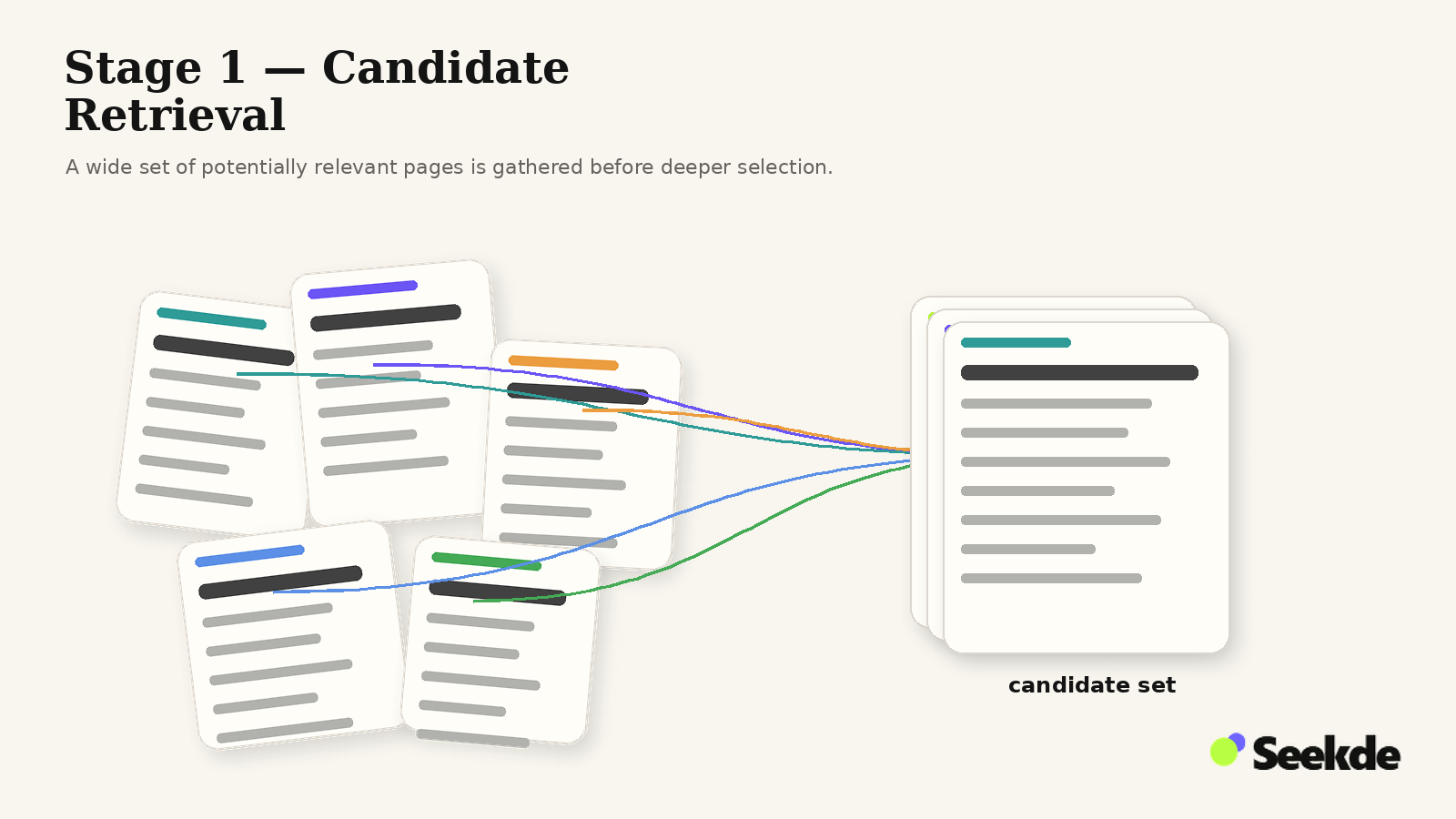
When a user submits an inquiry, the search system initiates a retrieval pass against its web index. Executing an autoregressive language model over billions of raw web pages in real time is computationally impossible; the system must first identify a focused candidate pool.
Hybrid Retrieval: Lexical and Dense Semantic Search
A common retrieval architecture can evaluate candidate content using complementary retrieval methods:
- Sparse Lexical Retrieval (e.g., BM25): Matches exact terms, proper nouns, technical acronyms, and product identifiers across indexed documents. This preserves high precision for specific factual queries.
- Dense Semantic Retrieval (Vector Embeddings): Converts the query into mathematical embeddings and identifies passages with conceptual similarity, capturing intent even when the user uses colloquial or alternative phrasing.
Hybrid retrieval systems can combine these mechanisms into hybrid retrieval pipelines, balancing exact keyword precision with semantic breadth.
Multi-Query Expansion
If a user prompt is complex or multi-layered, the search system may not rely on a single lookup. Depending on the system architecture, the engine may decompose the prompt into multiple targeted searches—a process explored in query fan-out decomposition—to gather context across distinct facets before synthesis.
Stage 2: Neural Reranking (Selecting the Best Passages)
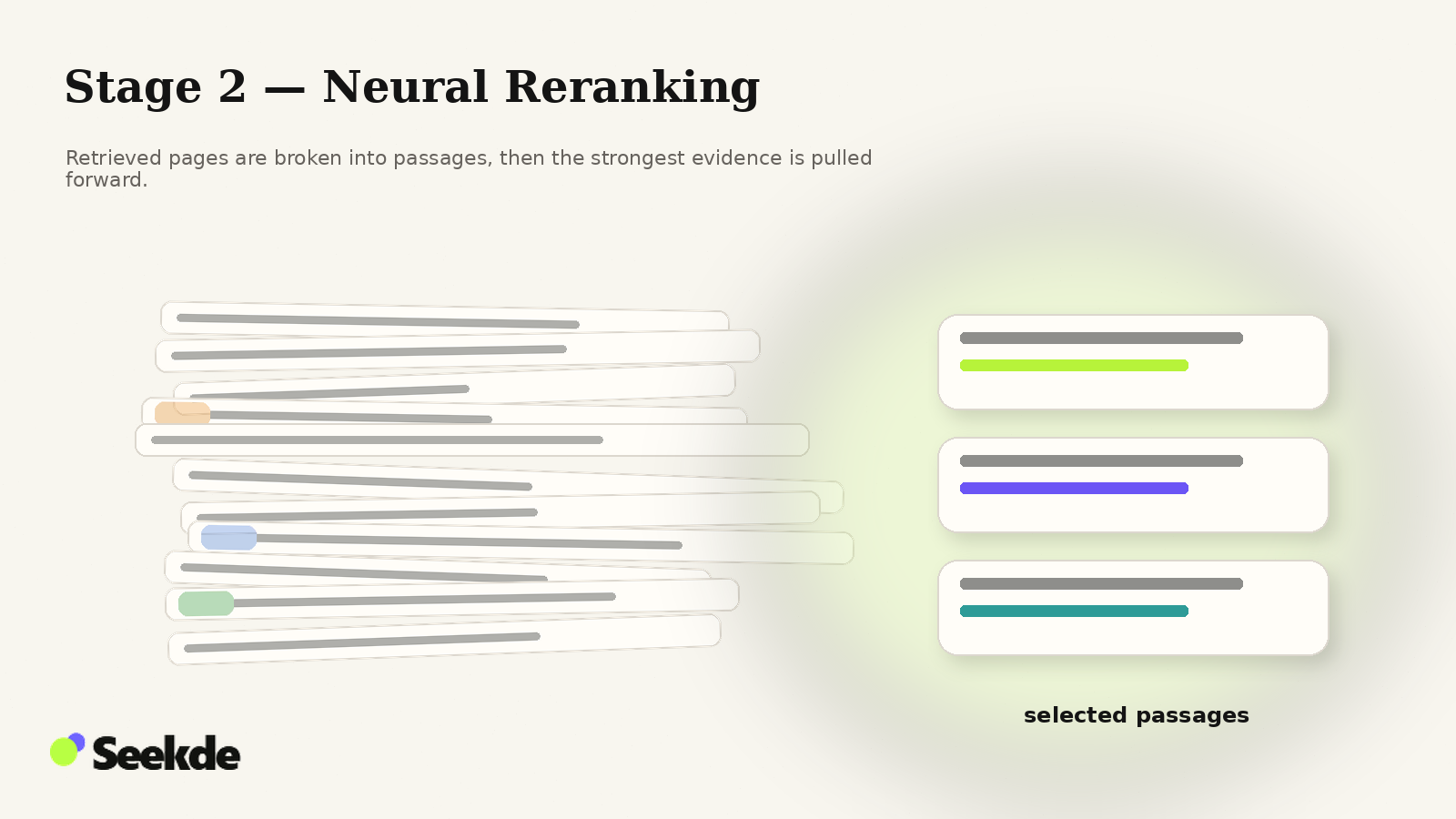
The initial retrieval pass yields an unstructured candidate pool that must be filtered and prioritized before context can be presented to a generative model.
Candidate documents retrieved from primary search engine web index.
Chunk sizing is implementation-dependent based on DOM headings and token windows.
Cross-encoders or late interaction models like ColBERT scoring passage relevance.
Top-k candidate passages selected for generative answer engine context.
Passage Segmentation and Chunk Sizing
To evaluate relevance accurately, retrieval systems may segment or index long content at passage/chunk granularity. Chunk sizing is implementation-dependent: it must be evaluated based on the specific corpus, embedding model, retrieval architecture, and downstream task. Systems may evaluate small passages for granular factual extraction or larger sections for broad conceptual reasoning. For publishers, maintaining modular, cohesive sections with clear subheadings helps preserve semantic context across passage boundaries.
Reranking Architectures: Cross-Encoders vs. Late Interaction
Initial lexical and vector searches prioritize speed over computational depth. To determine true contextual relevance, systems pass top candidates to neural rerankers:
- Cross-Encoders: Full cross-encoder models process the query and candidate passage simultaneously through transformer attention layers. While computationally intensive, they yield deep semantic relevance scores.
- Late-Interaction Architectures (ColBERT): Developed by Khattab & Zaharia (SIGIR 2020), ColBERT introduces late interaction—preserving token-level vector representations for both query and document, then computing similarity via a fast MaxSim operator. Crucially, late interaction is distinct from full cross-encoder attention, offering a balance between computational efficiency and fine-grained token-level matching.
- Vendor-Specific Implementations: Specific enterprise platforms document their exact reranking thresholds. For example, Microsoft Azure AI Search semantic ranking documentation documents that only the top 50 results progress to Azure AI Search semantic ranking, illustrating how a commercial retrieval pipeline bounds computational cost.
Stage 3: Synthesis and Source Attribution (Generating Citations)
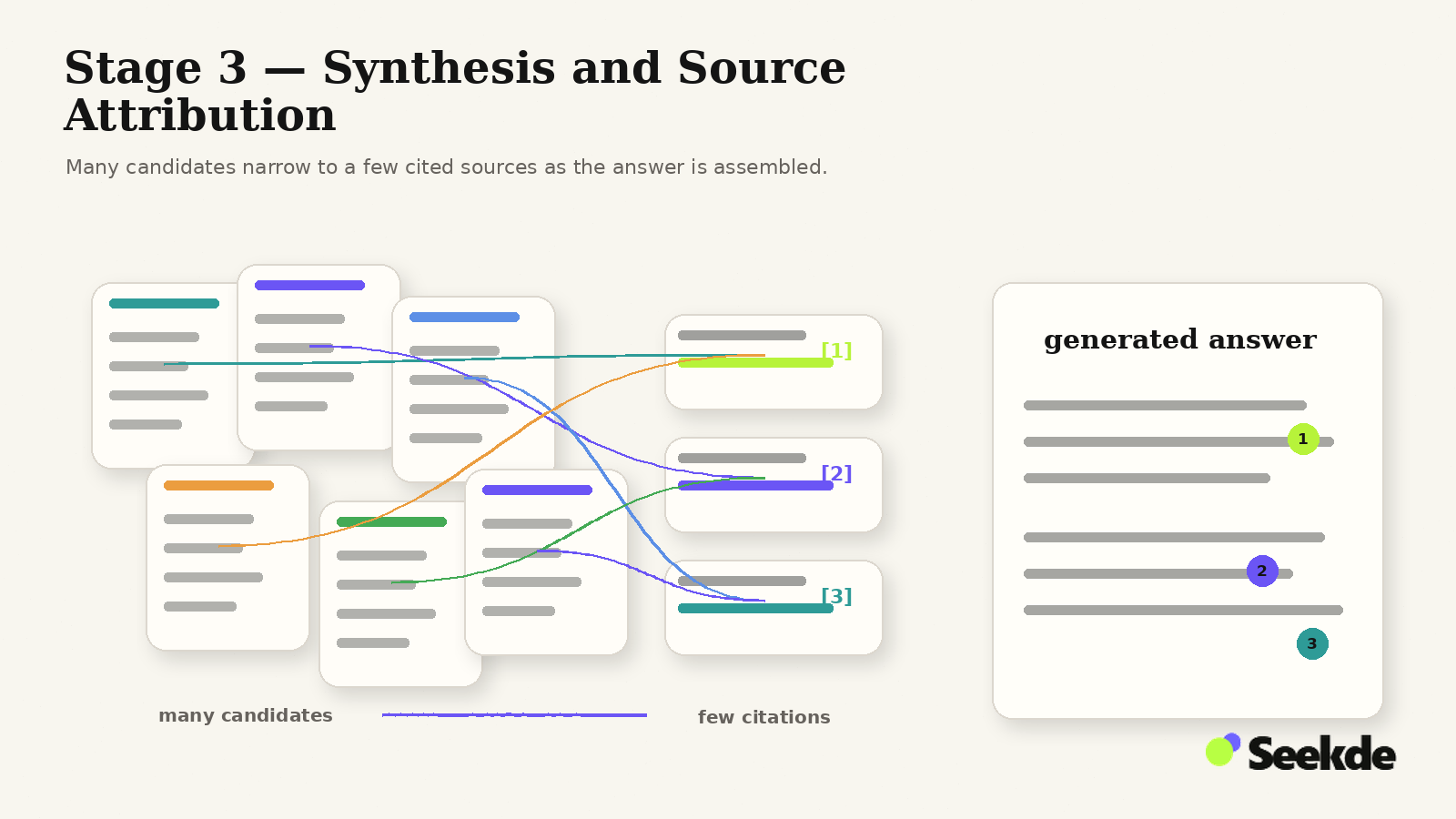
Once candidate passages are reranked and selected, they are provided to the generative model alongside the user prompt.
Proprietary Citation Mechanics
Commercial citation and attribution implementations vary and are often not publicly disclosed. In research literature and production engineering, answer engines explore diverse potential attribution patterns:
- Prompt-level attribution instructions, where the generative model is prompted to insert citation markers corresponding to retrieved context.
- Post-hoc verification pipelines, where secondary validation models align generated assertions against retrieved source passages after drafting.
- Search-result mapping, where interface link cards are populated based on retrieval rank and passage overlap.
Commercial search platforms do not publicly disclose the complete internals of their citation-binding pipelines, and techniques remain an active area of proprietary engineering across major vendors.
Interactive Interface Rendering
Common citation interfaces can present sources through accessible UI elements:
- Inline Citation Chips: Interactive numbers or source names placed alongside claims.
- Sidebar Link Cards: Visual cards displaying document titles, site favicons, and URLs.
- Source Carousels: Expandable trays allowing searchers to explore primary source material.
For an exhaustive mathematical and architectural analysis of vector embeddings and attention mechanisms, consult our technical monograph on the Architecture of Generative Answer Engines.
The Attribution Drop-Off: A Conceptual Model
A common source of confusion for marketing teams is why pages that rank well in organic search may not always receive citations in AI answers. To visualize this filtering process, Seekde provides the following conceptual model:
Search engine indexes page in primary web index
Neural rerankers filter for high contextual relevance
Context limits select top-k candidate chunks
Generative model selects supporting facts to cite
Final attributed citations presented to user
In this conceptual reference model, content may fail to advance across stages for several reasons:
- Retrieval Stage: Crawl barriers, unindexed content, or weak entity associations may reduce retrieval relevance, preventing a document from entering the initial candidate pool.
- Reranking Stage: Even if indexed, passages with dispersed data or unclear structure may be harder for retrieval systems to evaluate favorably compared to cohesive, tightly focused passages.
- Synthesis Stage: Candidate text enters the model’s context, but alternative sources may provide clearer or more direct factual assertions that the model incorporates into the synthesized response.
Practical Editorial Guidelines for AI Retrieval
To improve the likelihood that your content is retrieved and credited across RAG-driven platforms, follow the principles of Generative Engine Optimization (GEO):
- Maintain Modular Structural Coherence: Organize articles with clear
<h2>and<h3>headings that reflect explicit sub-topics. Rather than aiming for arbitrary word counts, ensure each section completely addresses its stated concept. - Lead with Core Propositions: Place the primary definition, conclusion, or finding in the opening sentences of each section. Clear, prominent assertions can make a passage easier for readers and retrieval systems to interpret; they do not guarantee reranking or citation.
- Publish Verifiable Facts and Data: Ground analysis in inspectable primary data, transparent methodologies, and authoritative external references.
- Study Ingestion Protocols: Review the Seekde research methodology and our institutional Source Policy to understand how automated observation pipelines evaluate multi-model search results.
By aligning editorial architecture with the operational dynamics of hybrid retrieval, neural reranking, and generative synthesis, publishers improve the retrieval readiness and attribution opportunities of their assets across conversational search environments.