The Semrush AI Visibility Toolkit is an integrated feature suite within the broader Semrush software ecosystem designed to track, analyze, and benchmark how websites perform across Google AI Overviews alongside traditional organic search rankings. As an incumbent leader in search engine marketing technology, Semrush has approached the generative search revolution not by launching a separate standalone startup, but by retrofitting its massive keyword index and Position Tracking infrastructure to monitor generative SERP features.
For existing enterprise subscribers and agency teams already utilizing Semrush for daily keyword research, backlink audits, and competitor rank tracking, this integrated approach offers immediate workflow continuity. Search practitioners can monitor AI Overview appearances for their existing tracked keyword campaigns without onboarding a separate vendor or managing disparate billing accounts.
However, Semrush’s architectural foundation is inextricably tied to Google’s traditional search index. While standalone conversational platforms like Profound, Peec AI, and Otterly AI track multiple emerging conversational engines (including ChatGPT Search, Perplexity, and Claude), Semrush’s primary AI capabilities remain centered on Google.
This review provides an objective, technical evaluation of Semrush’s AI search visibility features as of September 7, 2026, examining feature mechanics, workflow integration, pricing models, core advantages, and documented limitations.
Review Methodology & Testing Disclosure: This review provides a documentation-based product evaluation of Semrush’s AI search visibility capabilities rather than a hands-on usability test. All feature mechanics, workflow descriptions, and pricing figures are verified from official Semrush product documentation, knowledge base manuals, and public pricing schedules as of September 7, 2026. Because Seekde did not have active authenticated access to the specialized enterprise toolkit during this review cycle, we do not score interface latency, ease-of-use, or empirical data freshness.
Executive Assessment: Documented Capability Matrix
| Evaluation Dimension | Documented Capability Status | Analytical Assessment |
|---|---|---|
| Google AI Overviews Depth | Documented Core Feature | Native integration with Position Tracking, keyword databases, and organic SERP displacement metrics. |
| Standalone Conversational Breadth | Limited / App Center Only | Native features focus on Google; standalone conversational models (ChatGPT, Claude) require third-party App Center add-ons. |
| Workflow & Stack Continuity | Documented High Synergy | Direct integration for teams already using Semrush Position Tracking, Looker Studio, and Agency Growth Kit. |
| Competitive Benchmarking | Documented Native Feature | Side-by-side domain inclusion comparisons across keywords triggering AI Overviews. |
| Pricing Economics | Verified Core Inclusions | Cost-effective for existing Semrush subscribers ($0 incremental software spend); uneconomical if purchased solely for AI search monitoring. |
Core Feature Architecture: How Semrush Tracks Generative Search
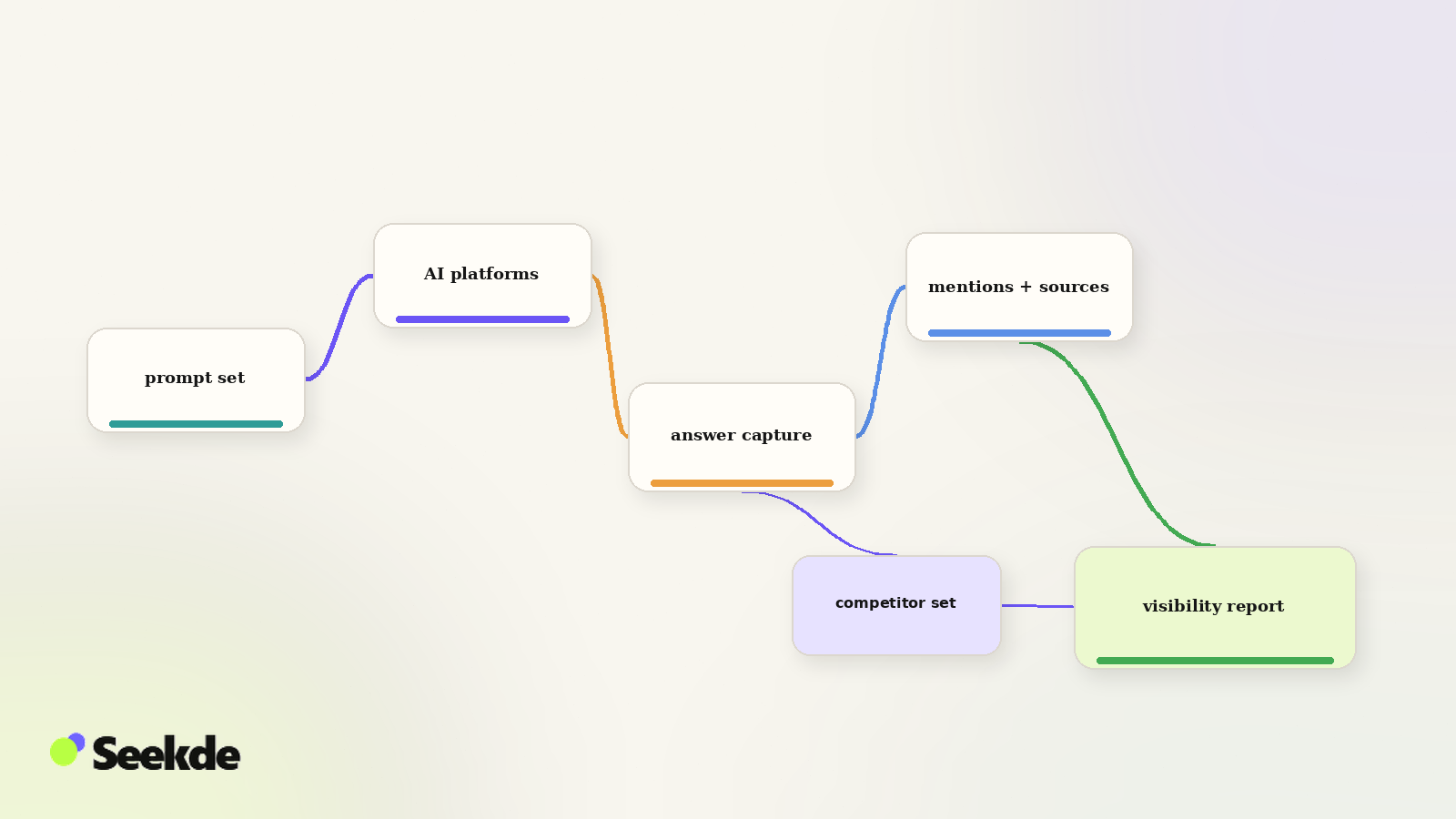
Semrush monitors generative search by treating Google AI Overviews as an advanced SERP feature within its established Position Tracking and Organic Research toolsets:
1. AI Overview SERP Feature Filtering
Within the Position Tracking campaign view, Semrush includes a dedicated filter for AI Overviews:
- AIO Presence: Filters keywords where Google renders an AI Overview.
- Domain Inclusion: Isolates keywords where your domain appears as a cited source card in the AI Overview carousel.
- Competitor Inclusion: Shows which competitor domains were cited in the carousel when your domain was excluded.
2. Organic Cannibalization & Displacement Analysis
One of Semrush’s most valuable analytical features is evaluating how AI Overviews impact traditional organic click-through rates.
- When an AI Overview appears above a client’s #1 organic ranking, it pushes traditional organic results below the fold.
- Semrush visualizes this displacement, allowing SEO managers to demonstrate why organic CTR declined even though their organic keyword rank remained at position #1.
3. Share of Voice Integration
Semrush incorporates AI Overview carousel inclusions into its proprietary Share of Voice (SoV) calculations. Domains that capture citations in the AI Overview receive an adjusted visibility weighting, reflecting their prominence above traditional organic listings.
4. App Center & Modular LLM Extensions
Through the Semrush App Center, users can integrate specialized third-party applications and experimental add-ons (such as AI Search Tracker apps) that expand monitoring to ChatGPT and Perplexity, though these remain distinct modular purchases rather than core native features.
The User Experience: Workflow Walkthrough for SEO Teams
For search teams already familiar with Semrush, the learning curve for tracking AI search visibility is effectively zero:
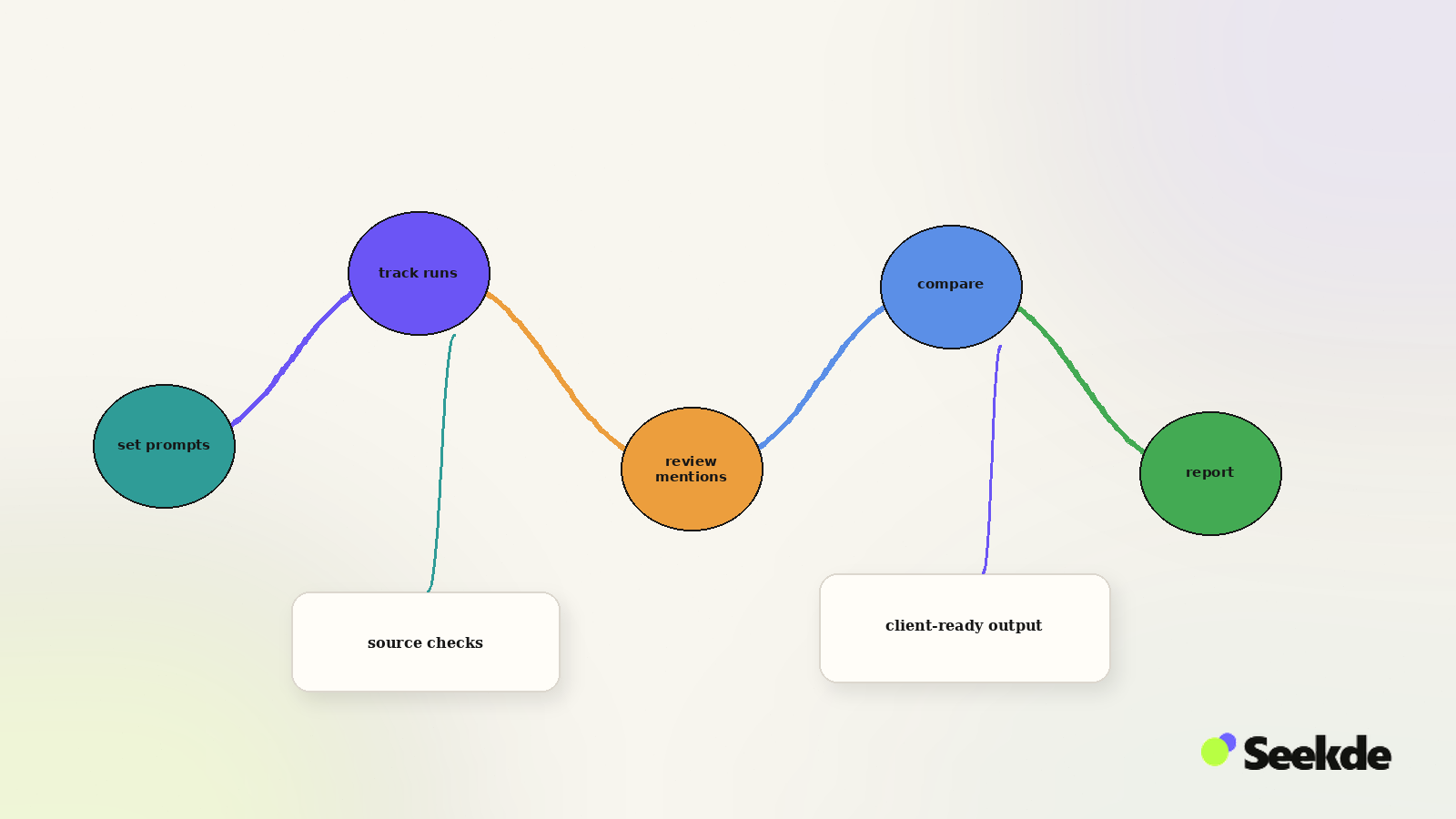
- Activate Position Tracking: In any existing Semrush Project, navigate to the Position Tracking tool.
- Apply SERP Feature Filters: Click the SERP Features dropdown menu and select AI Overview. You can toggle between "Domain in AI Overview" (your citations) and "AI Overview on SERP" (all queries triggering the feature).
- Analyze Cited URLs: Expand individual keyword rows to inspect the exact landing page cited by Google, alongside the competitor domains featured in the grounding carousel.
- Export to Looker Studio: Using Semrush’s native Google Looker Studio connector, agencies can pipe daily AI Overview metrics directly into automated client dashboards.
The direct blending of traditional rank tracking with AI Overview intelligence makes it the least disruptive solution for enterprise SEO departments.
Pricing, Packaging, and Subscription Economics (September 2026)
Unlike standalone AI visibility tools with independent pricing, Semrush’s AI capabilities are packaged within its core subscription tiers:
| Semrush Subscription Tier | Monthly Cost (Monthly / Annual) | Tracked Keyword Limit | AI Overview Features Included |
|---|---|---|---|
| Semrush Pro | $139.95 / mo ($117.33 billed annually) | 500 Keywords | Core Position Tracking with AI Overview SERP feature filters. |
| Semrush Guru | $249.95 / mo ($208.33 billed annually) | 1,500 Keywords | Historical data, multi-targeting, and expanded AI Overview trend lines. |
| Semrush Business | $499.95 / mo ($416.66 billed annually) | 5,000 Keywords | API access, Share of Voice metrics, and enterprise Looker Studio exports. |
| Agency Growth Kit (Add-On) | +$150 / mo | Unlimited Client Portals | White-label client reporting including AI Overview inclusion widgets. |
Economic Evaluation: Semrush currently includes AI-search performance tracking within its SEO offering, while broader AI-visibility and prompt-tracking capabilities vary by plan. Teams should compare current plan limits and pricing before estimating the incremental cost of AI-search monitoring.
Key Strengths and Advantages
- Zero Stack Fragmentation: Eliminates the need to procure, onboard, and train team members on another standalone software tool.
- Historical Keyword Context: Links AI Overview presence to ten years of historical search volume, keyword seasonality, and domain backlink profiles.
- Documented SERP Displacement Metrics: Directly quantifies how AI Overviews depress traditional organic click-through rates on specific high-value commercial terms.
- Enterprise Agency Reporting: Direct integration with Semrush’s Agency Growth Kit and Looker Studio enables automated, white-label client reporting.
Documented Technical Limitations and Trade-offs
- Google-Centric Architecture: Semrush’s native tracking is almost entirely restricted to Google AI Overviews. It does not natively monitor real-time conversational search sessions in ChatGPT Search, Anthropic’s Claude, or Microsoft Copilot.
- No Conversational Prompt Trees: Semrush tracks static keyword queries (e.g., "enterprise crm software"). It does not model how conversational users ask complex, multi-turn follow-up prompts ("Which enterprise CRM has the best API for Python?").
- No Sentiment Polarity Scoring: Unlike Peec AI, Semrush does not analyze whether a brand was recommended favorably or criticized within the synthesized text; it simply records presence or absence in the source carousel.
- High Financial Commitment for Non-Users: If your organization does not need traditional SEO features (backlink audits, technical site crawling, keyword research), paying $140–$500/month just for AI Overview tracking is uneconomical.
Comparison: Semrush AI Toolkit vs. Dedicated Tools
| Evaluation Dimension | Semrush AI Toolkit | Otterly AI | Peec AI | Profound |
|---|---|---|---|---|
| Primary Specialty | Integrated Traditional + Google AIO | Visual Screenshot Proof (AIO + ChatGPT) | Multi-Model Brand & Sentiment Tracking | Enterprise Prompt Volume & SoV Modeling |
| Google AI Overviews Depth | Exceptional | High | Moderate | Exceptional |
| ChatGPT Search Support | App Center Add-on | Yes (Native) | Yes (Native) | Yes (Native) |
| Anthropic Claude Support | No | No | Yes (Native) | Limited / API |
| Traditional SEO Metrics | Massive Database | None | None | None |
| Starting Cost | $139.95 / mo (Base Plan) | $29 – $49 / mo | $80 – $95 / mo | $1,500+ / mo |
Final Assessment: Documented Workflow Alignment
Seekde Assessment: Recommended for Existing Semrush Subscribers
If your marketing department or agency is already invested in the Semrush software ecosystem, the Semrush AI Visibility Toolkit represents the most logical and operationally efficient way to monitor Google AI Overviews on paper. It provides workflow continuity, documented SERP displacement data, and direct correlation with organic rankings without adding another software vendor to your balance sheet.
However, if your strategic mandate requires tracking buyer recommendations across ChatGPT Search, Claude, and Perplexity, Semrush cannot stand alone. Teams requiring multi-model conversational intelligence should pair Semrush with a dedicated conversational tracker like Peec AI or Otterly AI.
Related Guides and Platform Reviews
- Best AI Search Visibility Tools: Complete Pillar Review
- Best GEO Tools for SEO Teams
- Best AI Visibility Tools for Agencies
- Otterly AI Review
- Profound vs Peec AI: Platform Comparison
- Peec AI vs Otterly AI: Platform Comparison
- Free Ways to Monitor AI Search Visibility
- How to Track AI Search Visibility in Google Search Console